


Every enterprise, when it makes a move as a startup, faces the difficulty at early stages in building systems that can keep up with its ambition and long-term goals. Especially when they move from ideation to execution, they often realize that the generic tools they use can’t keep up with the current technological trends. This is where custom software development for startups becomes necessary, helping them build technology that perfectly aligns with how the business operates and evolves.
In this informative blog, we can explore how custom software empowers startups to build scalable products and establish a secure foundation for long-term success.
What is Custom Software Development?
Custom software development is nothing but designing, building, and developing software solutions which have been customized to your unique business needs. Unlike the pre-packaged software that only offers limited features, custom software solutions are created specifically to align with the specific workflows and operational requirements. This will give startups, mid-range businesses, and enterprises greater control over software scalability and functionality.
When it comes to startups, custom software has many advantages, turning ideas into a purpose-built digital products that support innovation and growth. This approach allows teams to build what exactly they need and adapt quickly as the business evolves, without being limited by rigid platforms and legacy systems.
Why Custom Software Development for Startups is Ideal?
Even though a business is about to establish itself in the future, it should operate in a fast-moving environment, where flexibility and focus matter more than anything. In the meantime, custom software supports this by aligning with the current technology directly with business goals.
Tailored for Startup Needs
- Custom application development is designed specifically for your product’s vision and workflows.
- Removes unnecessary features that drag the team behind.
- Flexible enough to evolve with your business ideas.
Faster Iteration & Market Response
- Offers quick updates based on real user feedback.
- Custom software development for startups supports MVP software development and rapid feature testing.
- Minimizes dependency on third-party platform limitations.
Cost Efficiency Over Time
- Restricts recurring fees from multiple tools.
- Reduces costly future rework caused by technical compromises.
- High sales without forcing expensive platform changes.
Strong Foundation for Growth
- Built specifically with performance and scalability in mind.
- Integrates flawlessly with advanced tools and systems.
- Supports long-term product growth and business expansion.
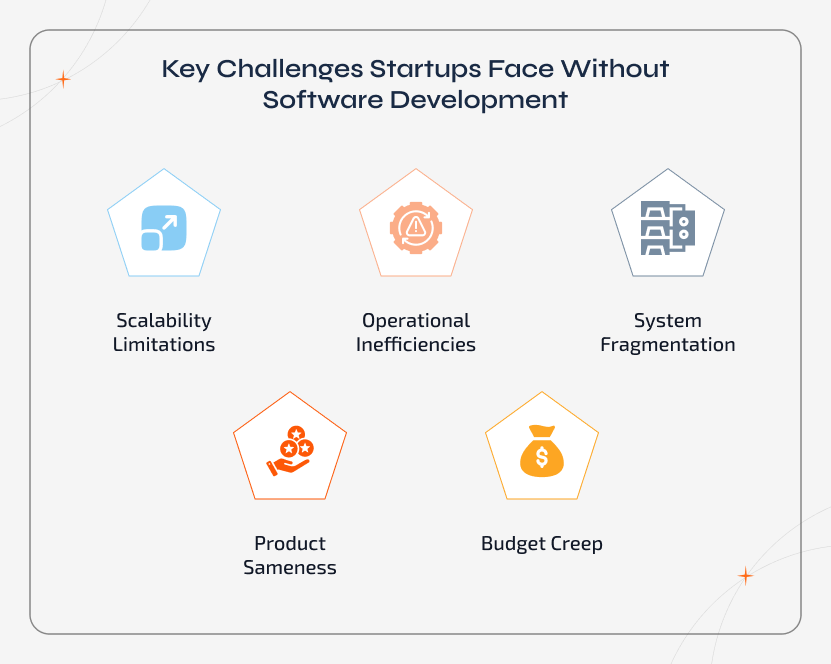
Key Challenges Startups Face Without Software Development
In the absence of the right software foundation, startups often encounter operational hurdles. Understanding these technical challenges will highlight why purpose-built solutions become essential as the business scales.
Scalability Limitations
Most of the startups outgrow legacy tools faster than we expect. As the data, users, and operations expand, these outdated tools struggle to keep up with the current trend. This will cause performance issues and restrict growth potential.
Operational Inefficiencies
Without custom software development for startups, they were forced to rely on manual processes or disconnected platforms. This will slow down the daily operation, increase manual errors, and divert the focus away from core business activities.
System Fragmentation
Most of the standard tools fail to integrate seamlessly with each other, resulting in fragmented data, poor visibility across diverse systems, and leading to challenges in making informed business decisions.
Product Sameness
By using off-the-shelf solutions, businesses find it difficult to build unique features or experiences. As a result, startups risk blending up with their competitors instead of standing out with an innovative and tailored functionality.
Budget Creep
Even though the generic software seems cost-effective at the initial stage, recurring subscriptions, add-ons, and workaround expenses will add up over time. Due to this, startups face higher custom software development costs without gaining true value.
Custom Software Development Process for Startups
Having a structured custom software development process in hand, startups can transform ideas into scalable and user-focused products. Following a clear roadmap ensures efficiency, quality, and long-term growth when it comes to custom software development for startups.
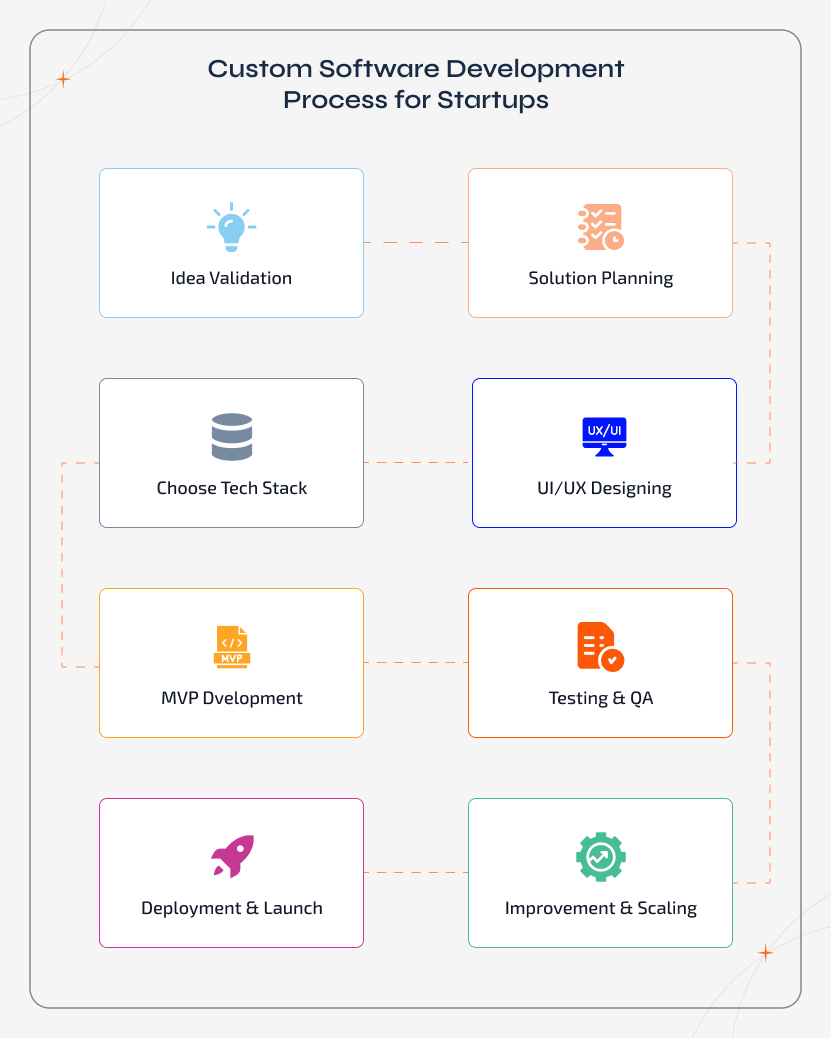
Step 1: Idea Validation
Start the custom software development process by understanding the business objectives, the startup’s idea, and most importantly target audience. A detailed discussion helps in validating the concept and defining functional and operational requirements.
Step 2: Solution Planning
Scalable and secure custom software architecture is designed based on the current needs and future growth plans. This is the step that ensures the foundation can support performance, integrations, and expansion.
Step 3: Choose Tech Stack
Further, startup tech stack selection ensures the software’s performance, scalability, and long-term maintenance. Startups must evaluate the framework, programming languages, and cloud platforms for their future growth.
Step 4: UI/UX Designing
Interactive prototypes and user-centric designs are created to map the user’s journey. This allows startup companies to visualize the product, refine usability, and align the design with user expectations early.
Step 5: MVP Dvelopment
At this stage, the development begins with only the core features to build a Minimum Viable Product (MVP). This enables a quicker time to market, real-world testing and early user feedback without over-investing in resources.
Step 6: Testing & QA
The software has further gone through rigorous testing for performance, security, and compatibility. Pinpointing and fixing these issues at this stage ensures a stable and reliable product launch.
Step 7: Deployment & Launch
Once the testing is done, the software is deployed into a live environment. This includes data setup, final configurations, and ensuring that the product is ready for real users.
Step 8: Improvement & Scaling
Upon launching, the software is continuously monitored and enhanced accordingly based on user feedback and business needs. Additional features and scaling efforts will support long-term startup growth.
MVP Development: The First Milestone for Startups
An MVP (Minimum Viable Product) is the simplest version that benefits a wide range of companies and delivers value to its users, specifically, when it comes to custom software development for startups. It mainly focuses on core features, allowing small startups to test their concept in the market without investing in a full-fledged product. When starting with a Minimum Viable Product along with MVP development services, startups can easily identify user needs, validate assumptions, and understand which functionalities are actually essential.
Once the MVP is live, startups can easily collect real-time user feedback and do analyze how the product is about to perform in real-world conditions. This kind of approach ensures faster improvements, smart feature additions, and minimized development risks. Overall, MVP development has become the first milestone that guides startup companies towards building strong, scalable, and user-focused software solutions.
Common Mistakes Startups Make in Software Development
At the initial stages, startups often face critical slip-ups in software development that will affect the growth and the product quality. Here are some of the common mistakes that a startup company make while developing a software.
Skipping Requirement Analysis
Most of the startups in recent times rush into software development without thoroughly understanding the business goals or user needs. This will lead to features that actually don’t solve real-time problems and resources.
Remedy: Ensure to conduct rigorous requirement analysis and gather feedback from stakeholders and potential users before you start the software development process.
Choosing the Wrong Tech Stack
Picking up the technology without even considering the scalability, performance, and long-term maintenance will create limitations. With a wrong pick, startups will often face costly rewrites and integration issues.
Remedy: Make sure to pick up the correct tech stack based on your current needs, future scalability, and long-term support.
Overloading With Features
When you try to include too many features right in the first version will overwhelm users and can slow down the development process.
Remedy: With custom software development for startups, focus more on core functionalities with an MVP and iterate based on user feedback.
Neglecting Testing & QA
Skipping through testing will lead to bugs, crashes, and security vulnerabilities. Startups that actually neglect QA will risk losing users and might damage their brand reputation.
Remedy: Ensure you implement consistent testing and quality assurance across every device and platform.
Ignoring Scalability
Building custom software without a plan for future scaling will cause performance issues as the user base grows.
Remedy: Design a modular and scalable architecture that can easily adapt to future growth and requirements.
When Should a Startup Choose Custom Software Development?
A startup must consider implementing custom software development when off-the-shelf tools no longer align with the unique workflow, business model, and growth plans. When the operation becomes more and more complex, tailor-made software helps in eliminating limitations, boosting efficiency, and supporting specific requirements that most of the generic solutions cannot address.
On the other hand, custom software development for startups is also ideal when you look for scalability, data security, and seamless integration. In the meantime, startups that actually aim to build a distinct product, gain a competitive edge, or prepare for rapid growth will benefit from investing in custom software that has a long-term vision.
How to Choose the Right Custom Software Development Partner for Startups?
For mid-sized businesses and enterprises, especially for startups, choosing the right development partner plays a critical role in the product’s success and growth. Evaluating the key factors will ensure a long-term business collaboration and technical reliability in custom software development for startups.
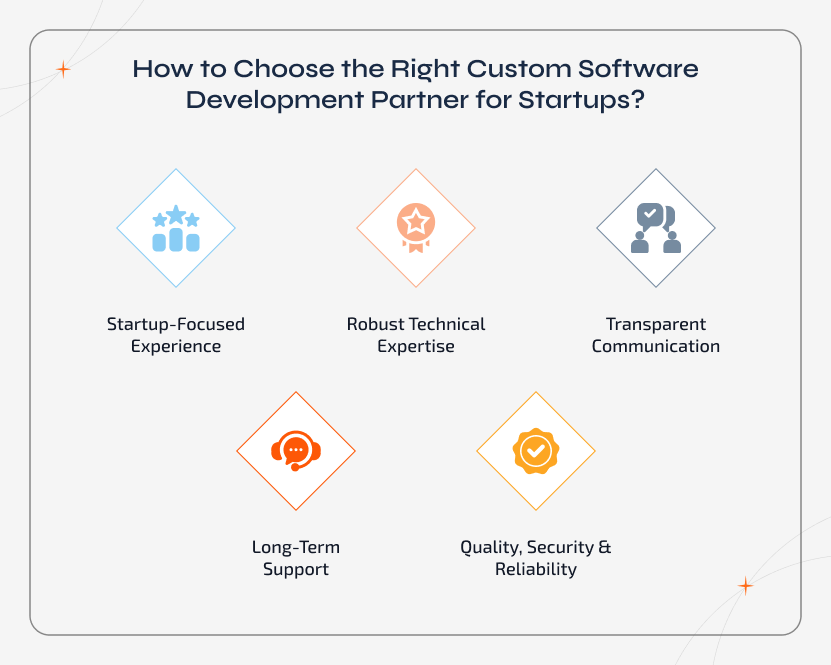
Startup-Focused Experience
Look for a reliable partner with previous experience working with startups and early-stage software development businesses. Also, remember that they must understand limited budgets, quick timelines, and the need to build scalable software that drives true value.
Robust Technical Expertise
A reliable development partner must have expertise across modern technologies, advanced frameworks, and platforms. This ensures that the partner can recommend the right tech stack and build custom software that supports performance and real-time growth.
Transparent Communication
Clear communication and a well-defined development process are essential for a smooth collaboration. The right development partner will keep your startup business informed at every stage.
Long-Term Support
Choose a reliable partner who builds software with the future in mind. They are the ones who scale the product, introduce new features, and provide long-term support as your startup company evolves.
Quality, Security & Reliability
The custom software solutions for startups should follow best practices for testing, security, and code quality. This reduces potential risk, ensures stability, and helps in protecting your product and user data.
Real-World Startup Use Cases Showcasing the Impact of Custom Software Development
Only the real-world use cases showcase how startups apply custom software development in solving practical business challenges. These examples highlight the scalability, flexibility, and impact of tailored software solutions across diverse industries.
Healthcare & Telemedicine
Custom software solutions enable healthcare startups to create digital healthcare platforms that support various aspects, including appointment scheduling and virtual consultations. These solutions are built in a way to meet privacy standards.
Example: With custom software development for startups, a telemedicine company can offer video consultations, digital prescriptions, and encrypted patient records through a single platform.
FinTech
Startups that are in the fintech field can leverage custom software to develop a secure and high-performance payment system. These platforms are specifically designed to handle real-time transactions and smooth user experience.
Example: With a reliable custom development partner, a fintech startup can develop UPI-enabled mobile applications with built-in fraud detection.
E-commerce
E-commerce startup companies mostly rely on tailored software to manage inventory, personalize shopping experience, and integrate multiple payment and logistics services.
Example: A D2C skincare brand can utilize a custom platform for real-time stock updates, order tracking, and personalized product recommendations.
SaaS
SaaS-based startups use custom development solutions to build scalable platforms with subscription management, analytics, and role-based access.
Example: With custom software, SaaS development for startups can launch a subscription-based CRM tool designed specifically for small sales teams.
On-Demand Platforms
On-demand startups will use software to manage real-time service requests, location tracking, and provider coordination. These systems ensure quick response times and seamless experiences for both service providers and users.
Example: A home service startup can connect users with electricians and plumbers nearby through instant booking and live tracking.
Why Choose Sparkout for Custom Software Development?
As said before, choosing the right development partner plays a vital role in how your product performs and scales over time. Here are the major aspects that set Sparkout apart from other custom software development companies when it comes to building custom software for startups.
Startup-Centric Approach
Sparkout truly understands the specific challenges that startups face, from tight timelines to evolving environments. The custom software development for startups is designed in a way to match your business goals and adapt as your business grows.
End-to-End Expertise
From initial ideation and MVP development to ongoing support, Sparkout delivers complete custom software development services, ensuring consistency, rigid quality, and faster time-to-market.
Dedicated Teams
Sparkout offers flexible engagement models and a dedicated development team that aligns with your startup’s pace and budget. Hiring custom software developers from Sparkout allows startups to scale resources, adjust priorities, and stay agile as their product evolves.
Future-Ready Solutions
We actually build custom software, having scalability in mind. This ensures your product can evolve without the performance and architectural limitations, helping startups stay prepared for long-term growth.
Winding Up!
To conclude, custom software development empowers startup companies in turning raw ideas into purpose-defined solutions, which can actually solve real-time problems. Stop forcing your vision to fit into off-the-shelf tools and get full control over the features and performance, making the custom software easier to adapt as your product and users grow.
For startups that are aiming to stand out in this rapidly evolving market, custom software solutions become one of the long-term assets. When startups build the software with the right strategy and a dedicated team, it can lead to faster innovation and smooth scaling that helps to evolve and succeed in the long run.