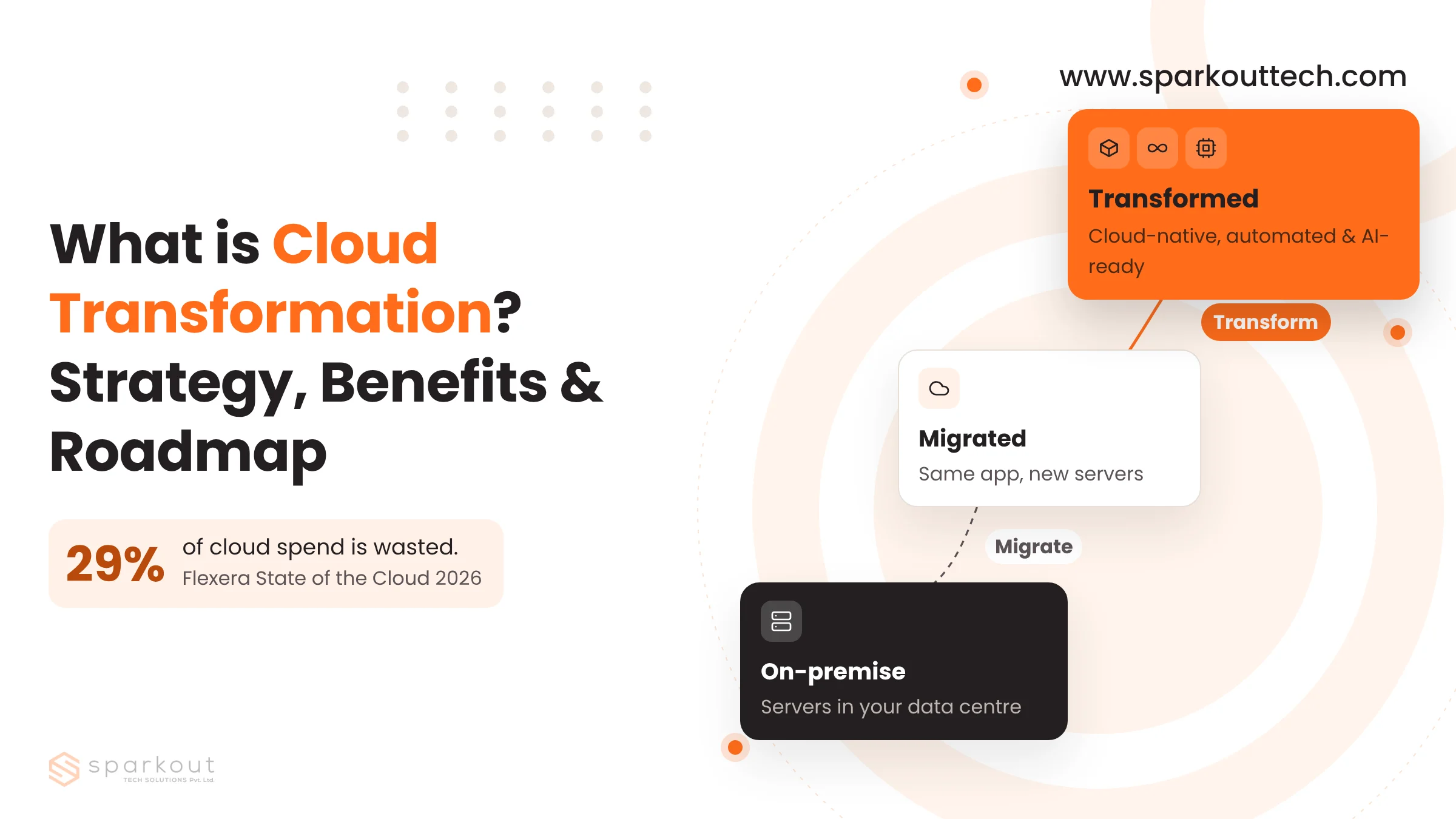



Most companies are already using the cloud. But simply moving workloads to the cloud does not always deliver the business results they are expecting.
According to Flexera's 2026 State of the Cloud Report, organizations waste approximately 29% of their cloud spend, while 85% say managing that cloud spend remains a top challenge.
The gap between "we moved to the cloud" and "the cloud changed how we work" is exactly where cloud transformation comes in. That is where cloud transformation comes in.
Cloud transformation goes beyond moving servers from a data centre to the cloud. It involves modernizing apps, improving data infrastructure, automating operations, and changing how teams build and deliver software.
Here in this guide, we'll explain:
- What cloud transformation means
- How it differs from cloud migration and digital transformation
- The key benefits for modern businesses
- The strategies and technologies involved
- A practical cloud transformation roadmap
- Common challenges and how to avoid them
- How to choose the right cloud transformation partner
What is Cloud Transformation?
Cloud transformation is the process of re-architecting an organization’s applications, data, infrastructure, and operating model to run on cloud platforms so the business can scale, innovate, and ship software faster.
But it is more than moving servers from a data center to the cloud. It can also mean adopting cloud-native applications, containers, automation, DevOps, platform engineering, and FinOps, while changing how technology is managed and paid for.
A transformation can change how systems are built, how teams work, and how technology costs are managed. For example, organizations may adopt cloud-native architectures, containers, automation, DevOps, platform engineering, and FinOps. They also move from traditional capital-heavy infrastructure spending toward a more flexible, consumption-based model.
The NIST definition of cloud computing highlights five core characteristics of cloud computing:
- On-demand self-service
- Broad network access
- Resource pooling
- Rapid elasticity
- Measured service
A true cloud transformation takes advantage of these capabilities rather than treating the cloud as just another place to host virtual machines.
The 4 Layers of Cloud Transformation
Cloud transformation typically spans four connected areas:
| Layer | What it involves |
|---|---|
| Infrastructure | Moving from traditional data centers to public, private, hybrid, or multi-cloud environments. |
| Applications | Modernizing applications through rehosting, replatforming, refactoring into cloud-native architectures, or replacing systems with SaaS. |
| Data | Moving toward managed cloud data platforms, warehouses, and lakehouses that support analytics and AI. |
| People & process | Adopting DevOps, CI/CD, infrastructure as code, security by design, and ongoing cost governance. |
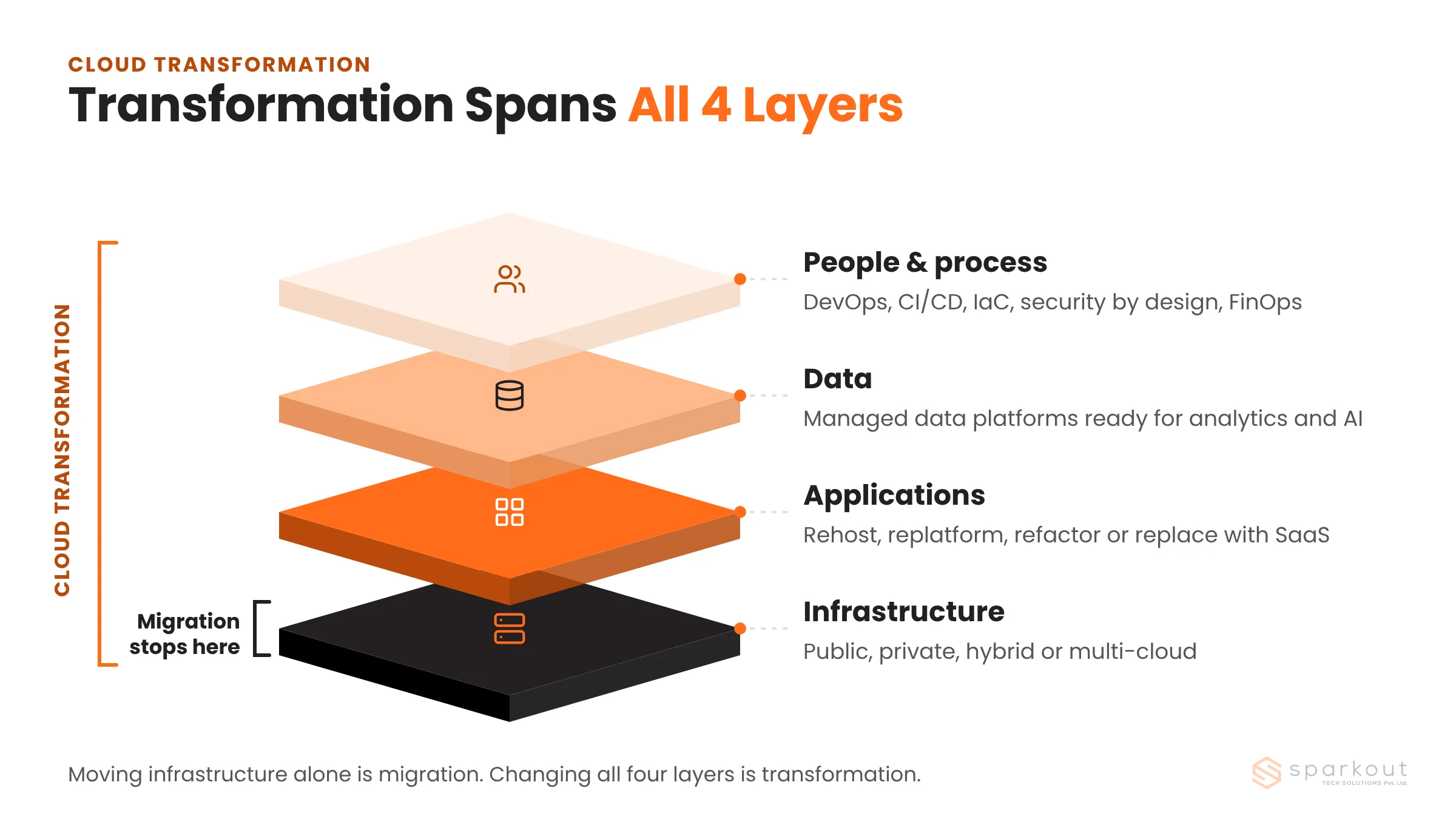
These layers work together. Moving infrastructure to the cloud alone is not enough. Businesses also need to modernize their applications and the way their teams work to achieve real transformation.
From our projects: The teams that see results fastest treat cloud transformation as a business program with clear owners and KPIs, not just an infrastructure project. When we scope engagements, we involve finance and product leaders early rather than limiting the conversation to IT.
Cloud Transformation vs Cloud Migration vs Digital Transformation
These three terms are often used as if they mean the same thing, but they don't.
A simple way to remember the difference is:
- Cloud migration is a step that moves workloads.
- Cloud transformation is the program that changes how those workloads and teams work.
- Digital transformation changes how the business uses technology to compete and serve customers.
| Cloud Migration | Cloud Transformation | Digital Transformation | |
|---|---|---|---|
| Scope | Moving workloads to the cloud | Modernizing applications, data, infrastructure, and operations | Changing products, processes, and customer experiences with technology |
| Typical approach | Rehost or replatform | Refactor, cloud-native development, DevOps, FinOps | Cloud + AI + data + process redesign |
| Timeline | Weeks to months | Usually delivered in phases | Ongoing |
| Success looks like | More workloads in the cloud or a data center exit | Faster releases, better scalability, lower cost per transaction, and stronger resilience | New products, better customer experiences, revenue growth, and stronger retention |
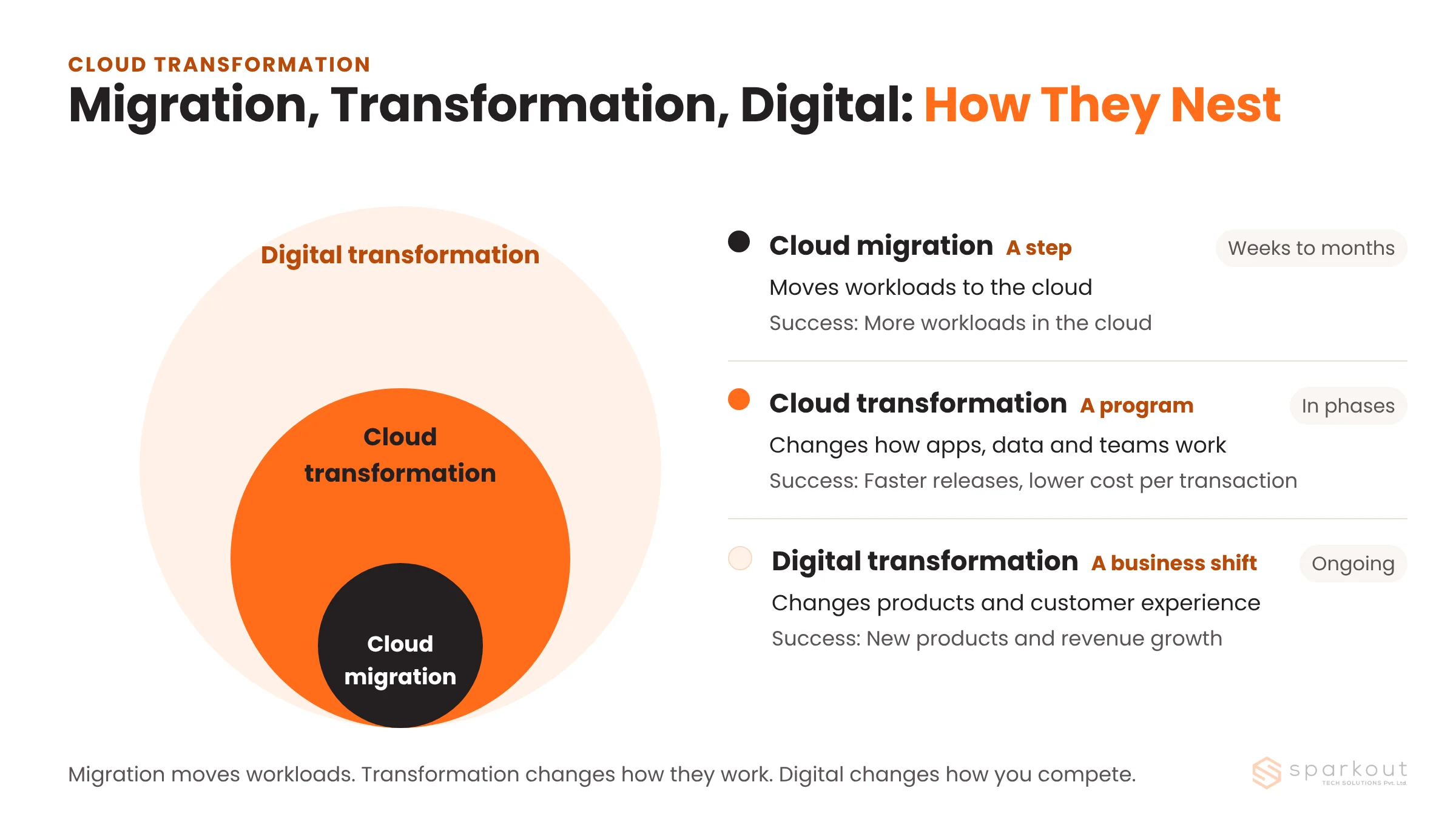
The main difference between cloud migration and cloud transformation is how much changes.
- A "lift-and-shift" migration moves the same application to cloud servers with little or no change to the way it works.
- Cloud transformation goes further. The application may be redesigned to scale automatically, support more frequent releases, and reduce the cost of running each transaction or user workload.
So, moving an application to the cloud is migration. Changing the application and the way it is built and operated to get more value from the cloud is transformation.
How Cloud Enables Digital Transformation
Cloud often provides the technology foundation for broader digital transformation. It gives teams on-demand infrastructure to test new ideas, access managed data and AI services, and reach users around the world without having to build new hardware.
Gartner expects end-user public cloud spending in India to reach $17.5 billion in 2026, up 28.1%. A major driver is the growing need for AI-ready infrastructure. This is why many businesses now plan cloud and digital transformation together, rather than treating them as separate projects.
In simple terms: Cloud gives businesses the infrastructure and services they need to experiment, build, scale, and deliver digital products faster.
7 Benefits of Cloud Transformation
Cloud transformation can improve speed, cost, scalability, security, and resilience across the business. However, the value goes beyond simply moving workloads to the cloud.
McKinsey estimates that cloud could unlock up to $3 trillion in EBITDA value by 2030. But the biggest opportunities are for businesses that use the cloud to change how they operate, not just where they host their systems.
1. Faster Time to Market
CI/CD pipelines and managed cloud services help teams build, test, and release features faster. In other words, what once took months can often be delivered in days.
2. Easier Scalability
Cloud capacity can increase or decrease as per demand. This means businesses can effortlessly handle seasonal spikes without buying enough hardware to support their busiest day of the year.
3. Lower and Clearer Costs
Pay-as-you-go pricing helps reduce the need for large upfront infrastructure investments. By following FinOps practices, teams can also track and manage cloud costs by product, workload, or customer.
4. Better Resilience and Uptime
Multi-zone architectures, automated backups, and infrastructure as code help keep systems more reliable. Disaster recovery can also become a regular process that teams test instead of something they handle only during an emergency.
5. Stronger Security
A well-designed cloud environment can bring identity management, encryption, and continuous compliance monitoring into one place. Security can also be built into the development process instead of being added later.
6. Better Data and AI Readiness
Cloud platforms make it easier to bring data together and use managed services for analytics and AI. Thus ensuring a stronger foundation for generative AI and other data-driven applications.
Flexera reports that 81% of organizations now use generative AI services. This shows cloud data and infrastructure are becoming increasingly important for businesses adopting AI.
7. Higher Developer Productivity
Platform teams can give developers self-service environments and automated tools. This helps reduce the time engineers spend waiting for infrastructure or handling manual tickets, leaving more time for product development.
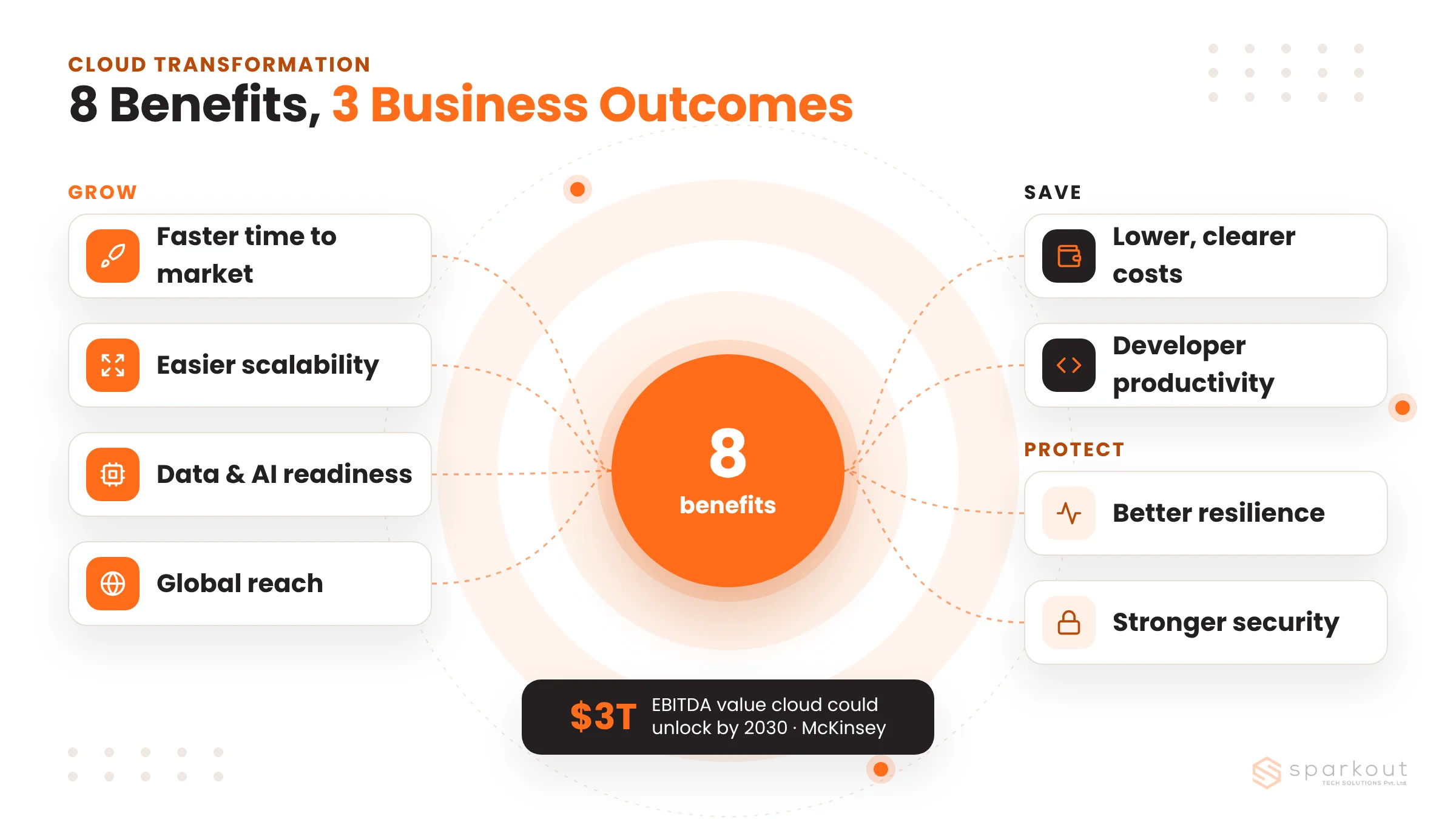
The Bigger Benefit: These benefits can build on each other. Faster releases create more useful data; that data can support AI, and successful AI features can create new revenue that helps fund further modernization.
How to Build a Cloud Transformation Strategy
A cloud transformation strategy helps you decide what should change, how it should change, and what order to tackle it in.
One common framework is the 7 Rs, documented in AWS Prescriptive Guidance on migration strategies.
The 8 Rs of Cloud Transformation
| # | Strategy | What it means | Best for |
|---|---|---|---|
| 1 | Retire | Remove applications the business no longer needs. | Duplicate or unused systems |
| 2 | Retain | Keep an application where it is for now. | Systems with compliance, latency, or other constraints |
| 3 | Rehost | Move an application to cloud VMs with little or no change. | Fast data center exits |
| 4 | Relocate | Move a virtualized platform to the cloud largely as it is, such as a VMware environment. | Large VM estates with tight deadlines |
| 5 | Repurchase | Replace an existing system with a SaaS product. | Common CRM, HR, or ERP functions |
| 6 | Replatform | Make small changes to use managed cloud services, such as a managed database. | Lower-risk modernization and quick wins |
| 7 | Refactor | Redesign an application to use a more cloud-native architecture, such as microservices. | Core and revenue-generating applications |
| 8 | Reimagine | Redesign the product or business process around cloud, data, and AI rather than simply changing the code. | New digital products and AI-led services |
AWS officially documents seven migration strategies. Many cloud transformation programs add an eighth — Reimagine — because transformation is all about more than moving or updating existing software. It can also mean rethinking the product or business process itself.
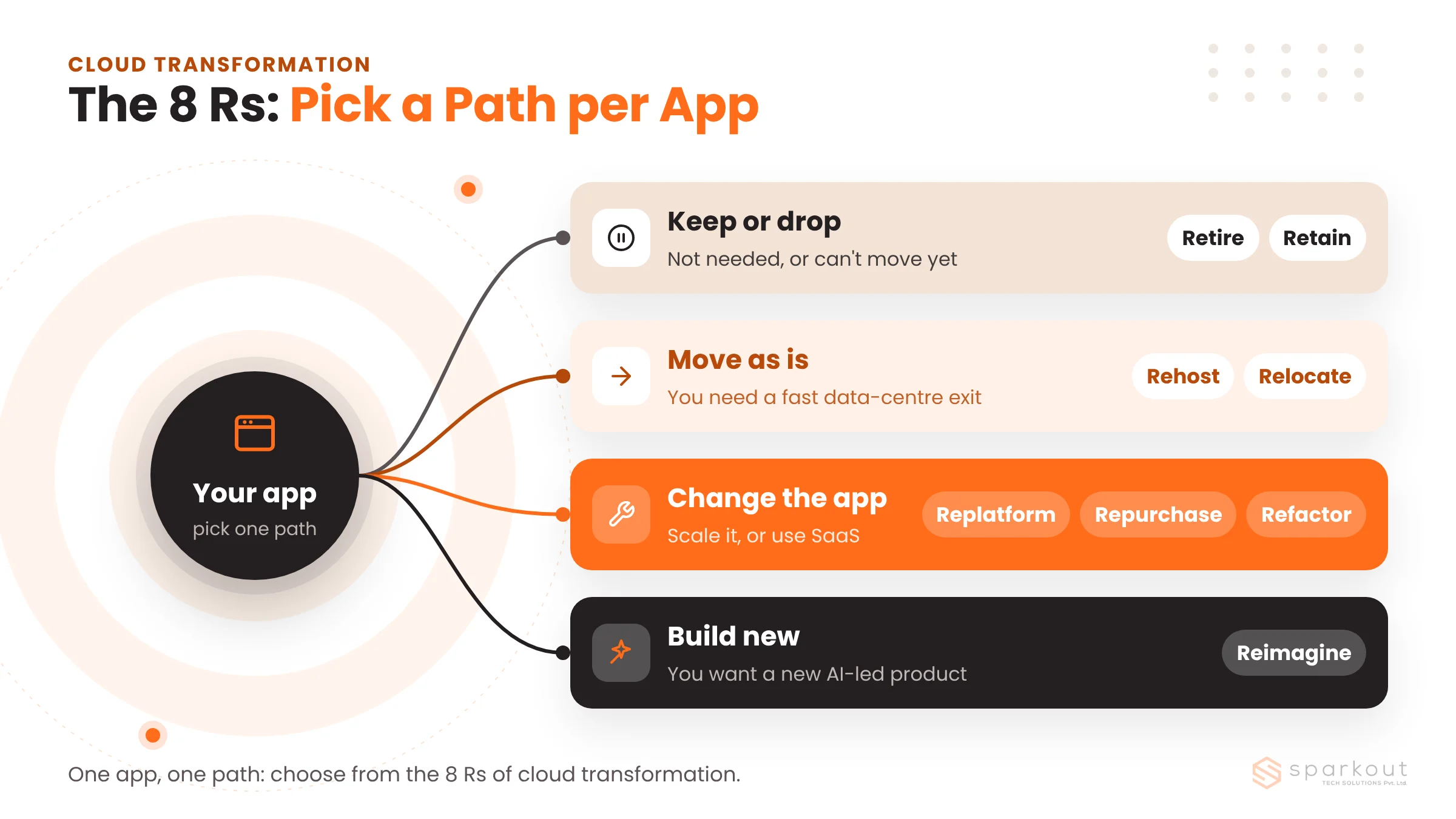
It is to note that not every application needs the same approach. You might rehost one workload, while another may benefit more from refactoring or reimagining.
For example, rehosting can help a business move away from its data centre quickly. Refactoring can bring more long-term benefits by changing how a core application works. Whereas reimagining goes a step further by asking whether the product or process itself should be redesigned.
A 6-Step Cloud Transformation Roadmap
A good cloud transformation roadmap gives your team a clear roadmap from planning to ongoing optimization. The exact path will vary by business, but these six steps provide a practical starting point.
1. Assess Your Current Environment and Set Goals
Start by reviewing your applications, dependencies, licenses, infrastructure, and current costs. Then connect the transformation to two or three clear business goals, such as faster releases, better uptime, or lower cost per transaction.
2. Choose the Right Cloud Model
Decide whether a single-cloud, multi-cloud, or hybrid cloud approach works for your business. Consider your regulatory requirements, existing skills, workload needs, and vendor risk before making the decision.
3. Build a Secure Landing Zone
Set up the core cloud environment before moving workloads. This includes accounts, networking, identity and access controls, security guardrails, and logging. Use infrastructure as code to make the setup easier to manage and repeat.
4. Migrate and Modernize in Waves
Start with lower-risk applications and use them to test your approach. Once the process works, move on to more critical workloads. Use cloud app deployment pipelines to make each migration and deployment more consistent and repeatable.
5. Adopt DevOps and Automation
Use CI/CD, containers, automated testing, and other automation to help teams deliver software faster and more reliably.
Our DevOps implementation services team typically works on this alongside the first migration waves. So, there is no need to wait until the entire migration is complete.
6. Optimize Continuously
Cloud transformation does not end when the workloads are moved.
It is vital to keep checking your cloud costs, performance, security, and reliability. Use FinOps (see the FinOps Foundation), rightsizing, monitoring, and regular security checks to keep things running smoothly. The FinOps Foundation has useful guidance on managing cloud costs.
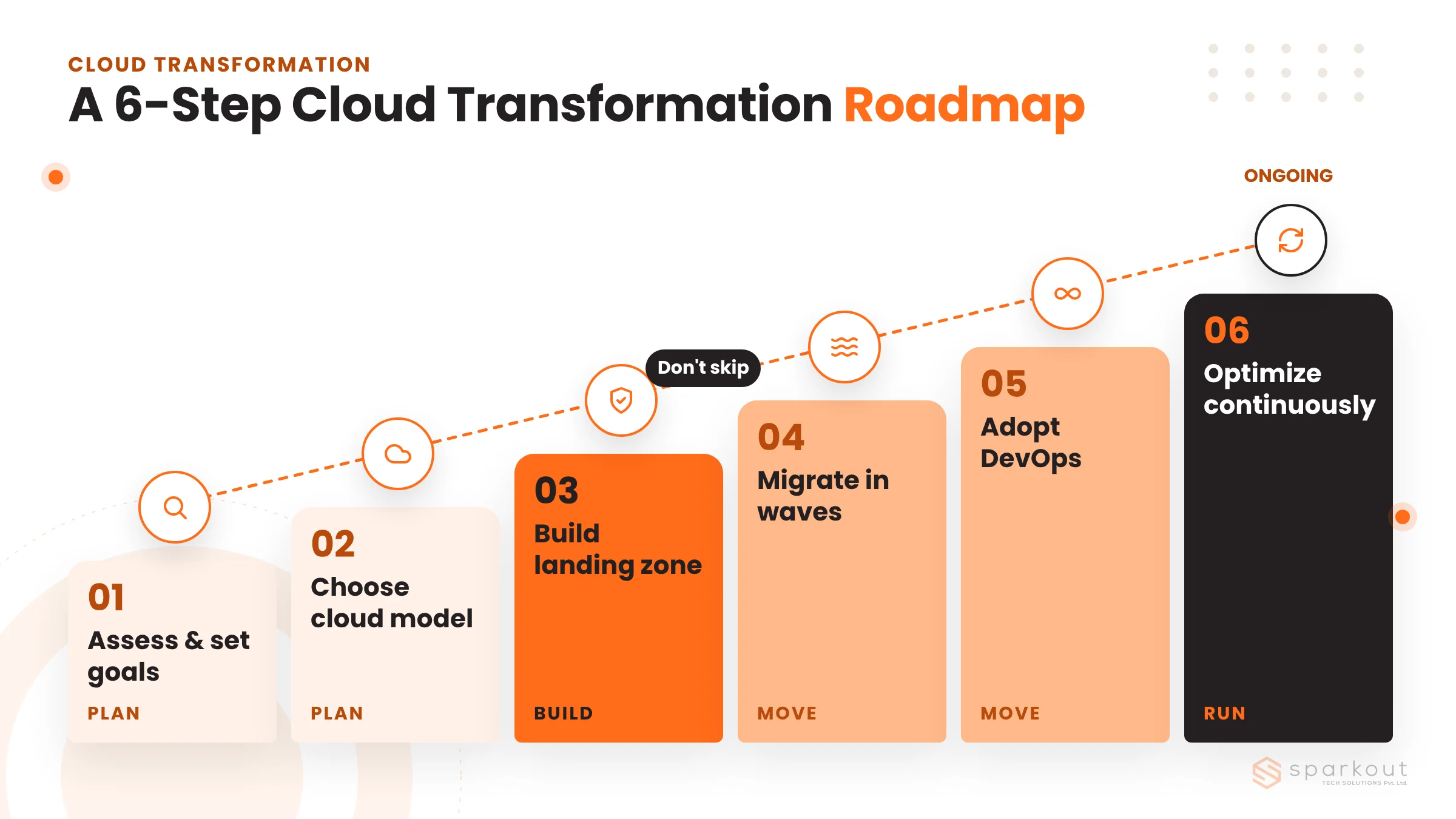
From Our Projects: Skipping the landing zone can create more work later. Setting it up properly makes the rest of the cloud transformation easier and smoother.
Cloud Transformation Challenges and Why Programs Fail
Cloud transformation does not usually fail because of the technology alone. Problems often come from unclear goals, skill gaps, rising costs, security issues, or legacy systems that are hard to change.
Here are some of the common challenges and what you can do about them:
| Challenge | What can go wrong | How to avoid it |
|---|---|---|
| Runaway cost | Idle resources & too much capacity can increase cloud costs. Flexera estimates that 29% of cloud spend is wasted. | Use tagging, budgets, & a FinOps owner from the start. |
| Lift-and-shift only | Moving an old app to the cloud without changes may not deliver the speed or cost benefits you expect. | Refactor your top revenue-generating applications instead of only rehosting them. |
| Skills gap | Teams may not have enough experience with cloud, infrastructure as code, or Kubernetes. | Train your teams & work with an experienced partner during the first few waves. |
| Security and compliance | Misconfigured storage and access controls can create security & compliance risks. Flexera lists security as a top concern in the AI era. | Use security guardrails, least-privilege access, & policy as code. |
| Legacy dependencies | Older applications often depend on other systems. Moving one system without its dependencies can cause problems. | Map dependencies first & move related systems together. |
| No business KPIs | Measuring success by the number of servers moved does not show whether the transformation is helping the business. | Track deployment frequency, uptime, & cost per transaction. |
A simple rule: If you cannot name the business outcome a workload's move will improve, it may not be ready to move. The goal is not simply to move more workloads to the cloud. The goal is to make the business better through that change.
How to Choose Cloud Transformation Services
Choosing the right cloud transformation partner can make the process easier and reduce risk. But not every provider has the same level of experience.
When comparing the cloud transformation consulting firms, look for these five things:
- Certified cloud engineers — Make sure the team has experience with your chosen platform. This covers AWS, Azure, or Google Cloud, rather than relying only on sales partnerships.
- Real case studies — Look for examples with clear results, such as lower cloud costs, faster releases, better performance, or improved uptime.
- Strong DevOps and automation skills — Moving applications to the cloud is only a part of the work. Your partner should also know how to automate deployments, testing, and operations.
- Security and compliance experience — Choose a provider who understands the security and compliance requirements of your industry.
- Ongoing FinOps and support — Cloud costs and performance need attention after migration too. Make sure the provider can help you manage and optimize the environment after go-live.
Start Your Cloud Transformation with Sparkout Tech
Cloud transformation can involve a lot of moving parts, from planning the right architecture to modernizing applications and managing costs after migration.
Sparkout Tech helps start-ups and enterprises manage this cloud transformation journey from end to end. Our services include assessment, landing zone setup, migration, DevOps services, and ongoing cloud optimization.
For businesses preparing for AI-driven modernization, our AI software development team can build on the new cloud and data foundation. You can also hire AI developers to add cloud and AI skills to your existing team.