


In 2026, hiring a mobile app developer is not just a technical decision. Rather, it is a strategic business investment that directly impacts your product's ROI, scalability, and long-term success.
Mobile apps are no longer optional, and they act as a core revenue engine, customer engagement platforms, and operational drivers for modern businesses. Thus, hiring the wrong mobile app developer can cost far more than just development fees. It can lead you to missed launch deadlines, poor user experience, scalability issues, security risks, and lost market opportunities.
In 2026, with rising user expectations and competition, AI-powered features are becoming standard, and businesses need more than just developers. i.e., with strategic technology partners, it is possible to build high-performing mobile applications. This is where a structured hiring approach becomes vital.
Here in this guide, we will break down the process of how to hire mobile app developers the right way. This covers everything from defining requirements and evaluating skills to understanding the costs, conducting interviews, and planning for long-term success. Thus, by the end of this blog, you will have a clear, actionable framework to:
- Avoid costly hiring mistakes
- Identify top-tier developers faster
- Optimize your development budget
- Build a mobile app that scales with your business
Quick Decision Guide - Choose the Right Hiring Model in Minutes
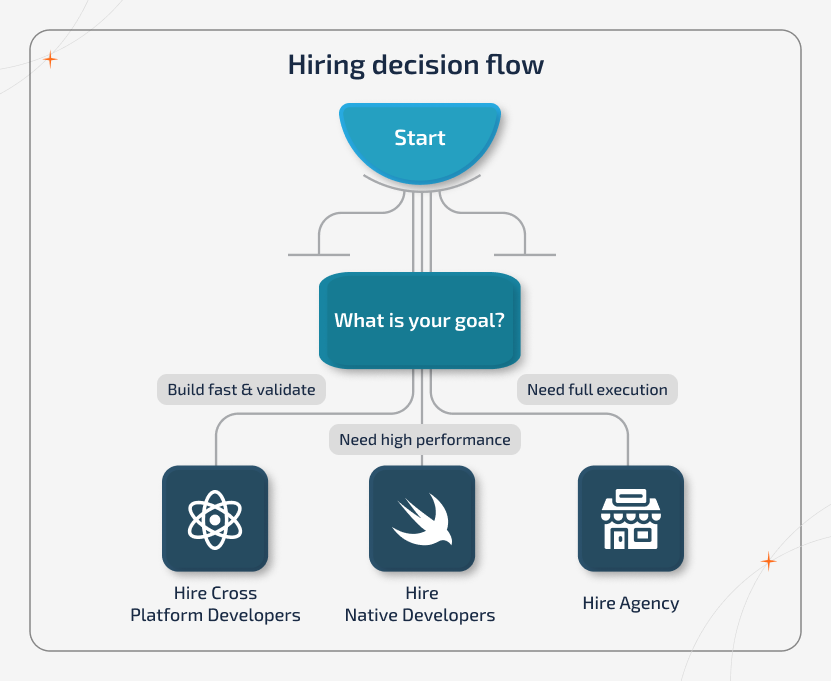
Here is how we recommend hiring the right mobile app developer based on your business goals:
1. Build fast & validate your idea - Choose cross-platform developers (Flutter / React Native) to launch MVPs faster with a single codebase while reducing time and cost.
2. Need high performance & scalability - Hire native developers (Swift / Kotlin) when your app requires high performance or deep device integration. Build performance-driven apps optimized for platform-specific experiences.
3. Want end-to-end execution without risk - Choose a mobile app development company as they handle everything from strategy and design to development, testing, and scaling.

Choosing the wrong hiring model early often leads to rework, higher development costs, and scalability issues later.
Before You Hire a Mobile App Developer - Define These 6 Factors That Decide Your App's Success
Just before you begin the process of hiring a mobile app developer, having better clarity helps build a project without delays, rework, and exceeding budget.
Defining the following six critical factors upfront ensures every decision from hiring to development is better aligned with measurable outcomes. This helps reduce the scope creep, improve cost & timeline accuracy, speed up development cycles, and minimize rework and technical debt.
Clearly define whether you are building the app for revenue generation, user engagement, automation, internal efficiency, or market expansion.
With a clear goal, it is possible to
- Choose the right architecture
- Prioritize the right features
- Align development with measurable outcomes
Without this clarity, teams will end up building features instead of solutions.
Getting a clear understanding of who your users are defines everything from UI/UX to performance expectations.
Thus analyse:
- User behaviour and preference
- Device usage patterns and
- Pain points and expectations
A mismatch will lead to poor adoption even if the app is technically strong.
It is to note that not everything needs to be built at once. So identify:
- The top 5 features required for your MVP
- Features that can be launched in a phased rollout &
- High-impact vs low-value functionalities
This helps prevent feature overload and speed up time-to-market.
Choose if you want to build a mobile app for iOS, Android, or both. This decision will directly impact the costs, timeline, and tech stack.
Choose the platform based on
- Your target audience
- Business strategy &
- Market demand
Planning your budget early helps set realistic expectations for scope, features, and hiring models.
A clear budget helps you:
- Prioritize essential features
- Choose the right development approach &
- Avoid unexpected mobile app development cost escalations
When budgets are not clearly set, then it becomes one of the biggest reasons for the project to exceed timeline and costs.
Decide whether you need a quick MVP to validate your idea or a fully developed product for launch.
This helps find the
- Development phases
- Resource allocation &
- Delivery timelines
Thus, with clear timelines, businesses can balance speed, cost, and quality of the product effectively.
Hiring Models Explained - Freelancer vs Agency vs In-House
Selecting the right hiring model is just as important as choosing the right developer. All three options have their own trade-offs in cost, speed, scalability, and control.
| Model | Best For | Recommended | Advantages | Risks |
|---|---|---|---|---|
| Freelancer | MVPs, small tasks | Short-term, experimental builds | Cost-effective, flexible | Limited scalability, inconsistent quality |
| In-house | Long-term product ownership | Long-term product ownership | Full control, strong team alignment | High hiring cost, slower ramp-up |
| Agency | End-to-end development | Scalable, production-ready applications | Dedicated team, structured delivery | Higher upfront investment |
Where to Find & Hire Mobile App Developers - Top Channels to Source
Finding and hiring the right mobile app developers isn't about availability. But it is all about accessing reliable talent pools with proven expertise and delivery track records. Here are the most effective channels businesses use:
1. Mobile App Development Companies
Hiring mobile app developers from established mobile app development agencies gives you access to a full-stack team with structured processes and proven delivery frameworks.
- This works best for end-to-end app development, scalable and production-ready applications, & businesses that need reliability and faster time-to-market.
2. Developer Directories
Discover vetted development companies from platforms like Clutch and GoodFirms with verified reviews, ratings, and case studies.
- This works for comparing agencies based on credibility, industry experience, and client feedback.
3. Freelance Platforms
Businesses looking to access a global pool of freelance developers can check Upwork and Toptal platforms to find and hire developers based on different experience levels.
- This is ideal for MVPs, short-term projects, and quick feature development.
4. Developer Communities
With platforms like GitHub and Stack Overflow, it is possible to evaluate developers based on real contributions, open-source work, and technical problem-solving skills.
- This is useful for assessing hands-on expertise beyond the resumes.
5. Professional Networks
With platforms like LinkedIn, it is possible to find and hire experienced app developers by analysing career history and validating endorsements.
- It works for hiring full-time developers or for building long-term teams.
6. Tech Events & Referrals
It is possible to hire high-quality, pre-vetted developers from industry events, referrals, and hackathons.
- Thus, strong referrals often help reduce hiring risks and improve reliability.

No matter where you hire app developers from, focus on checking.
- Proven portfolio and live applications
- Relevant domain expertise
- Consistency in delivery and
- Communication and collaboration skills
Step-by-Step Process to Hire Mobile App Developers
Following a structured hiring process helps reduce the risk, improve delivery timelines, and ensure you hire mobile app developers who can build scalable and high-quality applications.
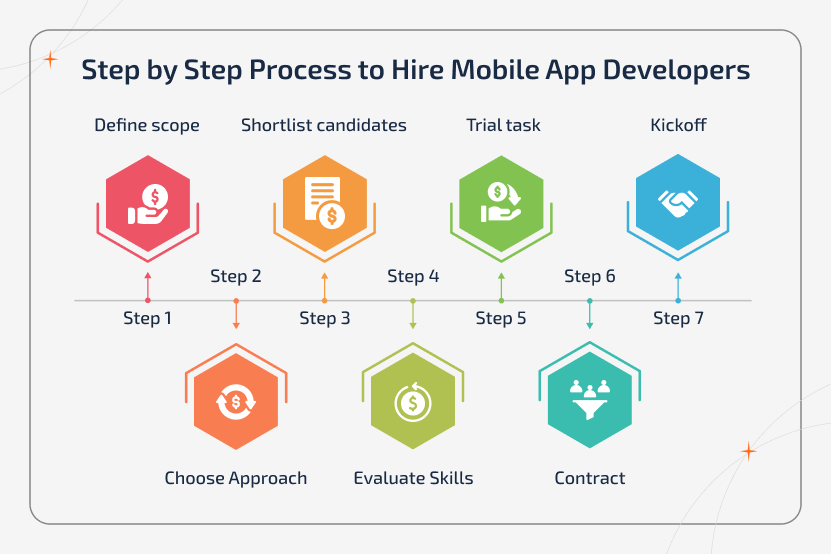
The proven mobile app framework is as follows:
Step 1: Define Project Scope Clearly
The first step is to outline your app's core features, user flows, integrations, and technical needs.
A clearly defined scope minimizes uncertainty, prevents scope creep, and sets clear expectations from the start.
Step 2: Choose the Right Development Approach
Businesses should decide whether to build an app using native, cross-platform, or hybrid technologies.
This decision directly impacts the performance, cost, scalability, and time-to-market.
Step 3: Shortlist Qualified Candidates
You should shortlist candidates based on relevant experience in similar projects, quality of portfolio & live apps, domain expertise, and client reviews and ratings.
This step involves focusing only on developers who have delivered comparable solutions successfully.
Step 4: Evaluate Technical and Problem-Solving Skills
Either you or your technical team shall start assessing candidates through technical interviews, architecture discussions, or real-world problem-solving scenarios.
So, by looking beyond coding, it is possible to evaluate how developers approach scalability, challenges, and performance.
Step 5: Run a Paid Trial Task
Now, you shall assign a small, paid task or prototype to the shortlisted candidates.
This helps evaluate the execution quality, communication, and turnaround time before committing.
Step 6: Finalize Contract and Ownership Terms
Before starting, you should define the scope, deliverables, timelines, milestones, payment structure, and intellectual property ownership.
With clear agreements, it is possible to prevent misunderstandings and legal issues later.
Step 7: Kickoff Development with Structured Execution
After finalizing, start the development with sprint planning, regular progress updates, demo reviews, and feedback loops.
This ensures transparency, alignment, and consistent progress.
Skills Checklist - What a High-Quality Mobile App Developer Must Have
Hiring the right mobile app developer goes beyond coding skills. i.e., the ideal candidate should be able to build scalable, secure, and high-performance applications while following modern development practices.
Use the checklist below to evaluate candidates effectively, not in terms of skills, but to separate average developers from high-impact ones:
A strong foundation in platform-specific or cross-platform technologies is vital. Hence, the developer should have solid expertise in the technologies required for your app. When hiring mobile app developers in 2026, it is better to prioritize teams with AI integration experience.
- iOS - Swift, SwiftUI
- Android - Kotlin, Jetpack
- Cross-platform - Flutter, React Native
Thus, the developer you hire should have hands-on experience building and deploying real applications rather than having just theoretical knowledge.
A mobile app's architecture defines how the code is structured, how components interact, and how easily the app can scale or be updated in the future.
Hence, look for developers who understand:
- Modular architecture
- MVVM or Clean architecture
- Offline-first design approach
Thus, a developer with strong architecture knowledge can build apps that grow with your business.
Modern mobile apps depend heavily on multiple third-party services and backend integrations. This includes payment gateways, notifications, analytics, etc. Thus, a developer must know how to integrate these seamlessly.
Hence look for
- REST or GraphQL APIs to enable smooth communication between the app and backend systems.
- Authentication methods (OAuth, JWT) to secure user login and protect sensitive data.
- Caching strategies and error handling to ensure the app works even in slow network speeds or API failures.
Hire a developer with strong integration skills, as they ensure your app works reliably across different systems and conditions.
Quality assurance is critical for delivering a stable and bug-free application. This ensures your app works as expected across devices and scenarios.
Look for developers who follow:
- Unit testing
- UI testing
- Code reviews and best practices
In most projects, developers handle initial testing, while QA engineers ensure overall app stability before release. Developers who prioritize using mobile app testing tools help reduce long-term maintenance issues.
User experience depends heavily on app speed and responsiveness. Even a small scenario that causes a mobile app launch delay can frustrate users and lead to uninstalls.
So, look for developers who can:
- Optimizing app load time
- Smooth UI rendering
- Efficient offline functionality
Developers you hire are responsible for writing efficient code and optimizing performance. Whereas the QA teams validate performance across devices and conditions. It is to note that poor performance is one of the leading reasons users abandon mobile apps.
Security is a fundamental requirement, especially for apps handling user data. Look for developers who follow:
- Secure data storage
- Encryption standards
- Understanding of mobile security best practices (such as OWASP principles)
Developers implement security at the code level, and security testing or audits may be handled by QA or specialized teams. Strong security-first approach helps protect user data and build trust.
Beyond development, a good mobile app developer should understand how to deliver and maintain applications in production.
Check for developers or teams who can:
- CI/CD pipelines
- App Store and Play Store deployment
- Release and rollback strategies
In many projects, developers handle deployment basics, while DevOps engineers manage automation and release processes at scale. This ensures smoother launches and faster updates.
Hire developers who can handle real-world complexity
- Build scalable and maintainable applications
- Reduce long-term technical debt and operational costs
- Deliver a better user experience
- Ensures strong performance and data security
All of the above skills not just impact your app development, but they also determine how well your app performs in the real world.
Portfolio Audit Checklist - How to Evaluate Mobile App Developers Like an Expert
A developer's portfolio is one of the most reliable ways to assess real-world capability. So, just viewing the screenshots or project lists isn't enough. It is important to evaluate how those apps perform in real-time. The checklist below helps assess portfolios effectively:
Things to Look for in a Developer's Portfolio:
1. Can you download and test the app?
Always try the live app from App Store or Play Store to evaluate the performance, usability, and overall experience.
2. Is the app actively maintained and updated?
Regular updates indicate ongoing support, stability, and long-term reliability.
3. What was the developer's actual contribution?
Get clarified information on whether they built the full app, or worked on specific features, or were part of a larger team.
4. How does the app perform in real-world conditions?
Check for the loading speed, responsiveness, crash behaviour, and offline usability.
5. Are there user reviews and ratings?
App store feedback offers insights about real user satisfaction and common issues.
Evaluating the portfolios helps find developers with real production experiences, avoid those who have only limited or theoretical exposure, understand how their work performs in real user environments, and make more confident and informed hiring decisions.
Red Flags to Avoid When Hiring Mobile App Developers
It is to note that not all developers are capable of delivering the same level of quality. Finding the early warning signs helps avoid costly mistakes, delays, and long-term technical issues.
Common red flags and what they indicate:
| Red Flag | What It Typically Indicates |
|---|---|
| Vague or unclear pricing | Lack of planning, hidden costs, or scope ambiguity |
| No clear QA/testing strategy | Higher risk of bugs, crashes, and unstable releases |
| Unrealistic timelines | Inexperience or underestimation of complexity |
| No access to code repository | Risk of losing ownership and control over your app |
| Weak communication | Misalignment, delays, and poor collaboration |
Thus, when evaluating developers,
- Ask for clear mobile app development cost breakdowns and timelines.
- Check for defined testing and QA process.
- Confirm code ownership and repository access, like GitHub.
- Assess communication through early interactions.
Spotting even one of these red flags will help save significant time, cost, and delay at a later stage.
Interview Questions to Ask Before Hiring Mobile App Developers
Choosing the right mobile app developer often involves more than just reviewing portfolios. Asking the right questions helps you understand how candidates think, solve problems, and handle real-world challenges.
Here are some key questions to ask during the evaluation process:
1. Technical & Architecture
- How do you design a scalable mobile app architecture?
- How do you handle offline functionality in mobile apps?
These types of questions help you find out whether the developer can build applications that are reliable and future-ready.
2. Process & Quality
- How do you ensure code quality and testing throughout development?
- What is your release and deployment process?
Questions like this give insight into how they maintain stability and manage production releases.
3. Performance
- How do you measure and improve app performance?
This helps you understand their approach to delivering fast and responsive applications.
4. Collaboration & Communication
- How do you handle scope changes or evolving requirements?
This shows how well they can adapt to changes and communicate during the development process.
Why These Questions Matter?
When you hire mobile app developers, the goal is not just to find someone who can code, but someone who can build, adapt, and deliver under real-world conditions.
The right questions help:
- Evaluate practical experience
- Identify problem-solving ability
- Ensure alignment with your project goals
Cost to Hire Mobile App Developers in 2026
The cost to hire mobile app developers in 2026 varies based on your app's complexity, features, and the development approach you choose. In 2026, businesses are prioritizing not just cost, but value, scalability, and long-term ROI when building mobile applications.
On average, mobile app development for business teams costs range from $15,000 for basic MVPs to $300,000+ for complex applications. It can even exceed $500,000 for enterprise-grade or AI-powered platforms.
Developer Hiring Cost by Region (2026 Estimates):
Hourly rates vary based on location, expertise, and project complexity:
| Region | Hourly Rate |
|---|---|
| India / Southeast Asia | $15 - $50 |
| Eastern Europe | $30 - $90 |
| USA / Western Europe | $80 - $200+ |
Companies today hire remote development teams or opt for offshore hiring to reduce costs while maintaining quality.
Industry Insights: 2026 Pricing Trends You Should Know
Developer pricing is becoming more flexible and competitive due to:
- AI-assisted development - Offers faster coding and reduced development time.
- Global remote hiring - Provides access to a wider talent pool across regions.
- Increased outsourcing competition - More competitive pricing from agencies and offshore teams.
Thus, businesses now have more flexibility in choosing cost-effective hiring models without compromising on quality.
Developer Hiring Cost by Experience Level:
| Experience Level | Hourly Rate |
|---|---|
| Junior Developer | $20 - $50 |
| Mid-Level Developer | $50 - $100 |
| Senior Developer | $100 - $180+ |
Hiring senior developers costs more upfront, but often reduces long-term costs as they ensure the use of better architecture, fewer bugs, and faster delivery.
Often, your total cost is influenced by multiple factors and not just based on the developer rates.
- Number of platforms - iOS, Android, or both (native doubles effort)
- Feature complexity - Real-time features, AI, and payments increase cost
- UI/UX design quality - Custom design vs templates
- Backend & integrations - APIs, databases, third-party services
- Security requirements - Compliance (fintech, healthcare) adds cost
- Testing scope - More devices, scenarios = higher QA effort
App complexity, platform choice, and tech stack are among the biggest cost drivers in 2026.
Many budgets fail because businesses only consider development and miss out the ongoing expenses.
- App Store / Play Store fees
- Cloud hosting & infrastructure
- Analytics and monitoring tools
- Push notifications & messaging services
- Security audits and compliance
- Ongoing maintenance and updates
Post-launch costs typically add 20-30% annually to your overall budget.
A realistic mobile app budget is distributed across multiple stages:
- UI/UX Design - Wireframes, prototypes, user experience
- Development - Frontend + backend engineering
- Quality Assurance (QA) - Testing, bug fixing, device validation
- Deployment - App store launch and release setup
- Maintenance - Updates, scaling, performance improvements
Development is only one part, whereas maintenance and scaling are ongoing investments.
It's better to start with an MVP to validate your idea before scaling
- Choose cross-platform development to reduce initial cost
- Consider offshore or dedicated developers for better cost efficiency
- Focus on long-term scalability, not just short-term savings
The biggest mistake businesses make is focusing only on the upfront hiring cost. The reality involved with the mobile app developers for hire is that you are investing in:
- Product quality
- User experience
- Scalability
- Future growth
A higher initial investment leads to lower long-term costs and higher ROI.
Pricing Models Explained - How You Pay When Hiring Mobile App Developers
Once you have decided whom to hire, the next step is understanding how you will pay them. There are different pricing models, and each of them offers varying levels of flexibility, cost control, and risk.
| Model | Best For | How It Works | Advantage | Limitation |
|---|---|---|---|---|
| Hourly | Evolving or undefined scope | Pay based on hours worked | Flexible & adaptable | Costs can increase without control |
| Fixed-Price | Clearly defined requirements | Predefined cost for set deliverables | Budget certainty | Limited flexibility for changes |
| Dedicated Team | Long-term development | Monthly cost for a committed team | Full control & scalability | Requires ongoing investment |
| Retainer | Continuous support & updates | Fixed monthly fee | Predictable cost & ongoing support | Not ideal for one-time projects |
How to Choose the Right Model:
- Choose hourly for flexibility
- Choose a fixed price for budget certainty
- Choose a dedicated team for scalability
- Choose a retainer for long-term support
Contracts and Ownership Terms to Define When Hiring Mobile App Developers
If you are looking to hire mobile app developers, then defining contracts and ownership terms in advance is vital to protect your investment, avoid disputes, and maintain full control over your product.
Before the development begins, make sure these key elements are clearly defined:
What Every Mobile App Development Contract Should Include:
- Intellectual Property (IP) ownership
- Milestones & acceptance criteria
- Payment terms
- Scope change process
- Exit and handover plan
What You Should Fully Own After Development
In order to avoid dependency on developers or agencies, it is vital to check and receive complete access and ownership of
- Source code
- Repository access
- Design files
- Technical documentation
- Deployment credentials
A lot of times, businesses overlook contracts and ownership until issues start occurring. So, defining these upfront will help protect your IP, maintain full control over your app, avoid legal and operational risks, and ensure smooth scaling & future development.
Common Hiring Mistakes That Lead to Mobile App Failure & How to Avoid Them
When there is no careful planning, businesses hiring the wrong mobile app developers will end up facing mobile app launch delays, poor performance, security risks, and increased long-term costs. Hence, understanding the risks upfront will help you make better hiring decisions and build a more reliable mobile application.
| Hiring Mistake | How to Avoid It |
|---|---|
| Unclear requirements (scope creep) | Define clear features, priorities, & MVP scope before hiring |
| Ignoring performance expertise | Hire developers who focus on real-device testing & optimization |
| Overlooking security practices | Ensure developers follow secure architecture and industry standards |
| Lack of app store knowledge | Choose developers familiar with App Store & Play Store guidelines |
| No focus on scalability | Hire developers who build with scalable architecture & clean code |
Note that these mistakes don't appear during development, but after launch. This is where fixing them becomes costly and time-consuming. By avoiding these mistakes, you can
- Minimize the mobile app launch delays and budget overruns
- Ensure better app performance and stability
- Avoid app rejection during submission
- Build a scalable, future-ready product
Most mobile app failures happen not because of the development, but because of hiring the wrong developers. Thus, making informed hiring decisions becomes the foundation of building a successful mobile application.
How to Hire Mobile App Developers Based on Your Business Stage
When you hire mobile app developers, it is vital for your approach to align with your business. i.e., hiring too early increases costs, while hiring too late can limit the growth and performance. Thus, a stage-based hiring strategy helps build mobile apps faster while controlling costs and scaling efficiently.
1. Start-up/MVP Stage
- Focus - Speed & validation
- Team - Small team or cross-platform developers
At this stage, the goal is to launch quickly with core features and test your idea in the market.
So, it's better to keep the team lean and avoid overbuilding.
2. Scaling Product Stage
- Focus - Performance & scalability
- Team - Mobile developers + backend developers + QA
When your app grows, you need better performance, stability, and the ability to handle more users.
So, start investing in experienced developers and structured testing.
3. Scaling Product Stage
- Focus - Security & integrations
- Team - Full development team (mobile, backend, QA, DevOps)
Enterprise apps need strong security, system integrations, & reliable performance.
Thus, prioritize stability, compliance, and long-term maintainability.
When you hire mobile app developers, there is no one-size-fits-all approach. Start small, scale your team as your product grows, and choose hiring decisions as required by your business.
Enterprise Integration Capabilities to Look for When Hiring Mobile App Developers
When you hire mobile app developers, they should be capable of connecting your app with your existing business systems to ensure seamless data flow and operations.
| System Type | Example Platforms | Business Value |
|---|---|---|
| ERP Systems | SAP, Oracle | Real-time inventory, finance, & operations sync |
| CRM Systems | Salesforce | Centralized customer data & better engagement |
| Legacy Systems | Custom internal tools | Modernization of outdated systems & workflows |
Thus, developers with strong integration capabilities help ensure your app works as part of a connected ecosystem and not in isolation.
Security & Compliance Essentials to Look for When Hiring Mobile App Developers
When you hire mobile app developers, security should be a core requirement not an option.
Look for developers who can implement:
- Secure authentication - To protect user access (OAuth, MFA)
- Data encryption - To secure data in transit and at rest
- Role-based access control - To limit access based on user roles
- Privacy-first architecture - To minimize data exposure and ensure compliance
For regulated industries, ensure the developer has familiarity with standards like GDPR, HIPAA, or PCI-DSS.
When you hire mobile app developers with strong security practices, you are reducing the risk of data breaches while ensuring compliance and building user trust when your app scales.
What to Look for When Hiring Mobile App Developers in 2026
When you hire app developers in 2026, focus on features that ensure your application is not just functional, but is scalable, efficient, and future-ready.
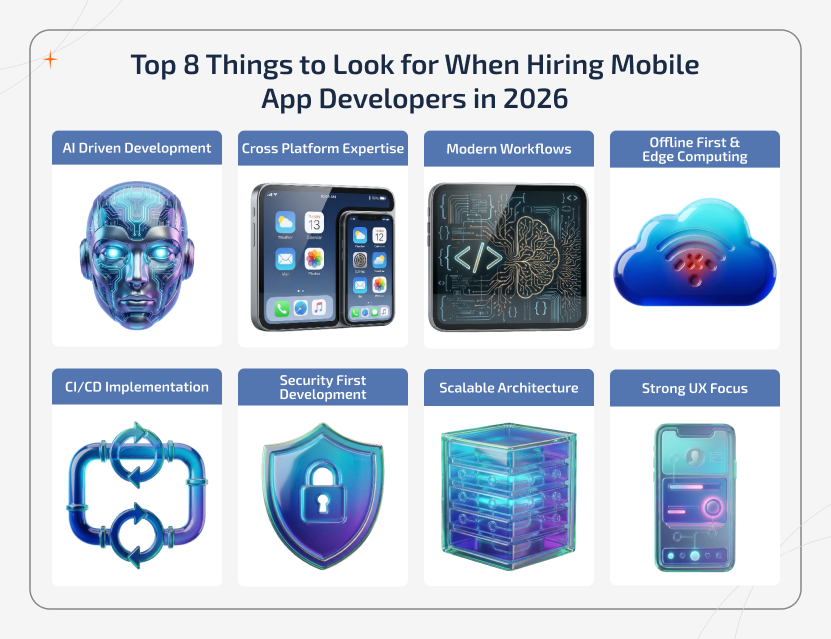
Prioritize developers who offer:
- AI-driven development capabilities - They offer personalization, automation, and smarter user experiences
- Cross-platform expertise - Offers faster delivery with optimized performance across devices
- Modern development workflows - Provides AI-assisted coding, testing, and productivity tools
- Offline-first and edge computing experience - Offers reliable performance even with low connectivity
- CI/CD implementation - Provides faster, consistent releases with minimal downtime
- Security-first development practices - They offer built-in protection for data and users
- Scalable architecture - Provides API-first design and modular systems for long-term growth
- Strong UX focus - They offer an intuitive design that improves engagement and retention.
Thus, hiring mobile app developers in 2026 is all about choosing teams that can build future-ready, scalable applications, and not just deliver current features.
Partner vs Vendor - Who Should You Hire?
When hiring mobile app developers, one of the biggest decisions is choosing between a vendor and a technology partner.
| Vendor | Partner |
|---|---|
| Executes your requirements | Challenges and improve your idea |
| Focuses on delivery | Focuses on outcomes |
| Limited strategic input | Provides product and architecture guidance |
| Short-term engagement | Long-term collaboration |
Hiring a vendor looks faster or cheaper initially. But it often brings in poor scalability decisions, missed optimization opportunities, and higher long-term costs. Whereas hiring a technology partner helps build a better product strategy, avoid technical debt, improve performance and user experience, and scale your application effectively.
When you hire mobile app developers, choose teams that think beyond execution and contribute to your product's success.
Why Businesses Choose Sparkout to Hire Mobile App Developers
After understanding how to hire the right mobile app developers, the next step is choosing a reliable development partner. The right partner will turn your vision into a scalable, secure, and high-performing application.
When you hire mobile app developers from Sparkout, you are choosing a developer or team that:
- Understand your business goals and not just features.
- Build scalable and maintainable applications.
- Follow structured development and communication processes.
- Offers post-launch support.
At Sparkout, we work as a technology partner and thereby help businesses plan, build, and grow mobile applications with a focus on performance, scalability, and long-term success.
Conclusion
Hiring a mobile app developer in 2026 is all about choosing the right technology partner who can translate your business goals into a scalable, high-performing product. The success of your mobile app depends on how well you:
- Define your requirements early
- Choose the right hiring model
- Evaluate technical and strategic capabilities
- Plan for long-term scalability and maintenance
Businesses that follow a structured hiring approach can minimize the development risks, control costs, and speed up time-to-market. Whereas those who rush the hiring process often come across delays, rework, and performance issues.