


When businesses look for the right software development solution, one big question always emerges on everyone’s mind: Should you choose SaaS or invest in custom software development? This is a serious call. Over 70% of businesses rely on SaaS tools for their daily operations, and on the other hand, companies are shifting toward custom solutions to stay competitive.
Even though both offer seamless experiences in their own way, businesses are still in a dilemma choosing between them. So, which one actually works for you? Let’s find out.
This comparative guide breaks down the key differences between SaaS vs custom software development and helps you figure out which is the right choice based on your business goals and long-term vision.
SaaS vs Custom Software - Understand the Basic Differences
Before choosing between custom software and SaaS, you need to understand their basics on how one actually means in real-world use. Even though both solve business problems, their delivery approach and scalability differ. Having a basic understanding helps you pick one without wasting money and time that doesn’t fit with your flow.
What is SaaS (Software as a Service)?
SaaS, also known as Software as a Service, is a ready-made software solution that you access through the internet, usually on a subscription basis. There’s no necessity to install, manage, or maintain anything on your own. Everything will be handled by the provider. Tools like CRMs, project management apps, and accounting platforms are common examples of SaaS.
To make it simple, with SaaS, you’re working with predefined features and ready-made features to serve a wide range of users.
What is Custom Software?
Custom software is nothing but custom-built solutions, which are built specifically for unique business needs. The solutions are designed from the ground up to match with your exact requirements and workflows. Instead of aligning your businesses to the software, the software itself adapts to your business workflow.
By implementing this approach, businesses can gain full control, flexibility, and scalability of the software, and it can even evolve when the business expands.
SaaS Vs Custom Software: A Detailed Comparison
Choosing between SaaS and custom software is mandatory, as it shows how well the solution fits with your business. Each one has its own limitations, strengths, and growth. Understanding these differences clearly will help you make smarter decisions confidently.
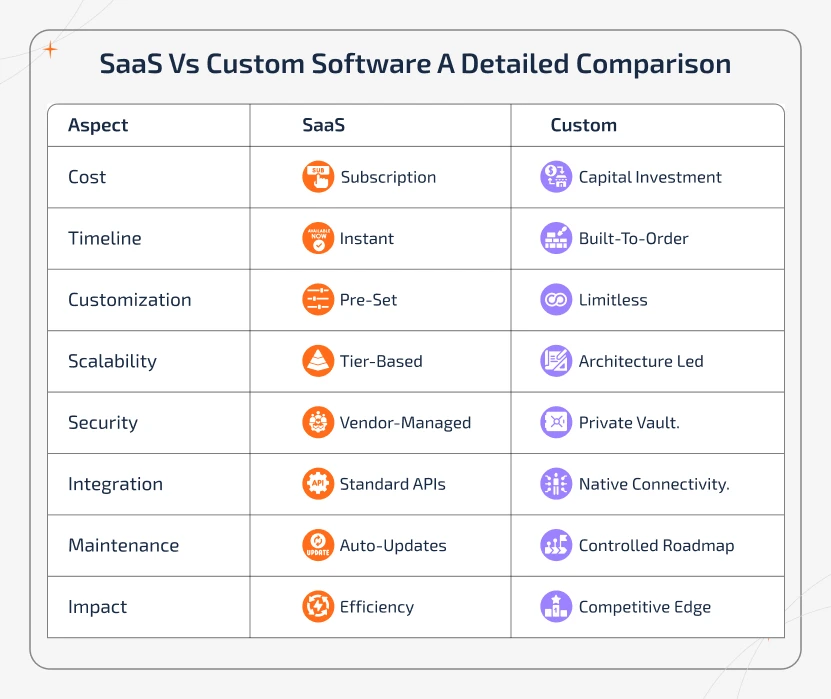
Here’s a quick comparison between SaaS vs custom software, before you dive deep:
| Aspect | SaaS | Custom Software |
|---|---|---|
| Cost Structure | Low upfront cost and recurring subscription fees | High initial cost and low ongoing cost |
| Timeline | The setup is quick and ready to use in days or minutes | It will take weeks to months, depending on the complexity |
| Customization | Limited to customization | Fully customizable based on business needs |
| Scalability | Easy to scale within the platform limits | Highly scalable and flexible as the business grows |
| Security | The entire thing is being controlled by the vendor | You can inspect and control things |
| Integration | Limited to supported integrations | Can be easily integrated into any system or API |
| Maintenance | Handled by the provider | Managed by an in-house team or developers |
| Long-Term Use | Not suitable for long-term use as it limits features | Can add extra features when the business expands |
1. Cost Breakdown
SaaS: SaaS app development doesn’t need a high upfront cost, and it will feel super affordable at the start. You will pay something around $10 to $100 per user per month, which looks harmless at first. But when your team grows, and you start adding additional features, the costs will pile up. Over time, you could be spending thousands every year, and it never stops.
Custom Software: Custom software development needs a high upfront cost. Approximately, you might spend $15k to $100k and even more, depending on what you’re building and how many features it has. Even though it’s a headache at the beginning, you’re free from paying a monthly fee for every single user or feature.
What’s the Best Best Pick? If you go deeper and think about the long-term, then custom software makes more sense. Even if SaaS starts more easily, it can become a nightmare, especially for small businesses and startups.
2. Development Timeline & Deployment
SaaS: This is the area where SaaS shines better than custom software. One can easily sign up anytime and start using it for the next few hours or a couple of days. Here, there’s no heavy setup, just plug-and-play.
Custom Software: Custom software development takes patience. Practically, even a simple product can take 1-2 months, and bigger systems can go up to 3-6 months or even more.
What’s the Best Best Pick? It depends. If speed is your top priority, then SaaS is a good pick. But if you’re building something serious, then custom software is worth the wait.
3. Customization Levels
SaaS: Opting for SaaS means you’re working with limits. You can tweak settings, like adding a plugin or two, but that’s all about it. When time passes, you’ll notice that you’re adjusting your business to fit the tool, and not the other way around.
Custom Software: Unlike SaaS, custom software turns the tables. Here, you must decide how things must work, like the features, workflows, and all others. It’s more like built to work around your business and not vice versa.
What’s the Best Best Pick? If your business has its own way of doing things in this competitive landscape, then custom software is the one you must pick.
4. Scalability & Growth Potential
SaaS: With SaaS, you can scale in the initial stages. Like, you can add users, upgrade plans, and keep things moving without any intervention. However, once your operations get complex, you will start hitting limits with the latest features or automation.
Custom Software: Custom solutions don’t have any limitations, it grows with you. If you need to add a new feature or automate something, you can do it without any restrictions. It evolves as your business evolves.
What’s the Best Best Pick? For long-term growth and success, custom software is the best choice and the safest bet.
5. Security & Data Control
SaaS: Without burdening you, SaaS provides secure handling for you, which can be convenient. But the catch is, your data sits on their servers, and you don’t have thorough control over it. It’s fine for some businesses and might be a risk for a few.
Custom Software: With custom software, you’re in control of all things. You must decide how your data is being stored, secured, and managed. This actually matters the most if you’re handling sensitive or any critical information.
What’s the Best Best Pick? When control and security matter the most, then opting for custom software is the wisest choice.
6. Integration Capabilities
SaaS: Most of the SaaS tools come with proper integrations, which is a great call. On the other hand, if you need something out of the box, then things get tricky. Either you’re forced to run things without that feature, or it leads to higher costs.
Custom Software: Speaking of integration capability, custom software doesn’t even have this issue. You can connect to pretty much everything, whether it’s an existing tool, third-party app, or legacy systems.
What’s the Best Best Pick? The SaaS world is good for simple setups, but for anything that is even slightly complex, custom software gives you way more freedom.
7. Maintenance & Updates
SaaS: Maintenance doesn’t even bother you when you’re using a SaaS product. Updates happen in the background without affecting things. But there’s a downside to it. As you cannot control the updates, things can change without warning, which might affect the usual workflow.
Custom Software: By leveraging software, you’re in charge. The updates happen when and how exactly you need them. Even though you need a dedicated team and support, you’ll never be forced into unwanted changes.
What’s the Best Best Pick? Despite the fact that SaaS is easier, custom software takes the lead when it comes to control and stability. Here, you decide what changes, and not someone else.
8. Long-Term Business Impact
SaaS: You might figure this already. SaaS is great to get started, as it helps you move fast and keep things simple. Over time, it can hold you back, leading to limited features, rising costs, or dependency on the provider.
Custom Software: Custom software becomes a part of your daily routine. It supports you in all possible ways, how you work, helps you stand out, and grows with you. More than just a tool, having custom software gives a competitive advantage.
What’s the Best Best Pick? If you’re thinking beyond the current workflow, then having custom software is the smart long-term move.
Build vs Buy Software Decision: Making the Smarter Business Choice
At some point, every business realizes that not every tool aligns perfectly with the day-to-day workflow. This is exactly where the decision-making becomes serious. You can keep using what’s already available or build something that works exactly the way you want. The answer depends on how your business works and what perks you need.
- Look at how much your team works around the tool: If your team continuously uses spreadsheets and manual steps to make a tool fit with your workflow, then the software isn't built for you.
- Measure how often your needs change: Businesses that evolve quickly (like, for example, on a monthly basis) often outgrow fixed tools. If it keeps changing every month, relying on a ready-made solution will drag you down.
- Check how much of your work is unique: When your workflows are mostly standard, buying a ready-made software is fine. However, if you need to feel unique, then you must not force into a generic one.
- Think about ownership, not just usage: Utilizing a software is easy and reliable, but owning the system gives you full freedom.
- Consider long-term impact: Everything’s not about what you actually pay today, but how well the software supports your growth and future plans.
SaaS Benefits & Drawbacks: A Complete Breakdown
SaaS is more popular because of its tendency to remove a lot of technical heavy lifts. But like any other solution, it comes with its own advantages and limitations, depending upon how the business works.
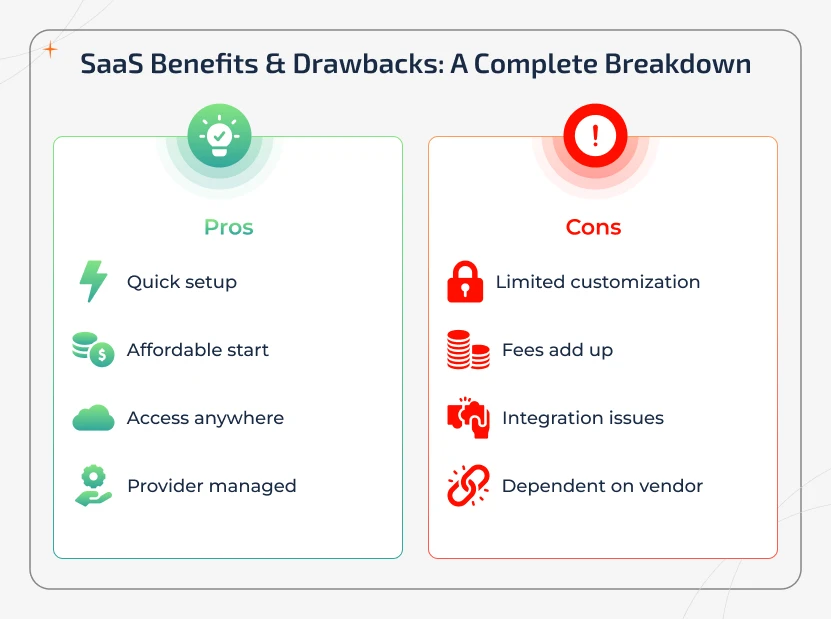
Pros
- SaaS allows businesses to use the software quickly with only a minimal setup.
- The upfront cost of software development is being reduced, offering flexible subscription-based models.
- Enables easy access from any location with an internet connection.
- The maintenance, updates, and security are managed fully by the service provider.
Cons
- The customization is limited and does not fully align with specific business requirements.
- Long-term usage will be costly as user-based and subscription fees accumulate.
- Integration with certain third-party systems will be restricted.
- Businesses must remain dependent on the provider for updates.
Pros & Cons of Custom Software
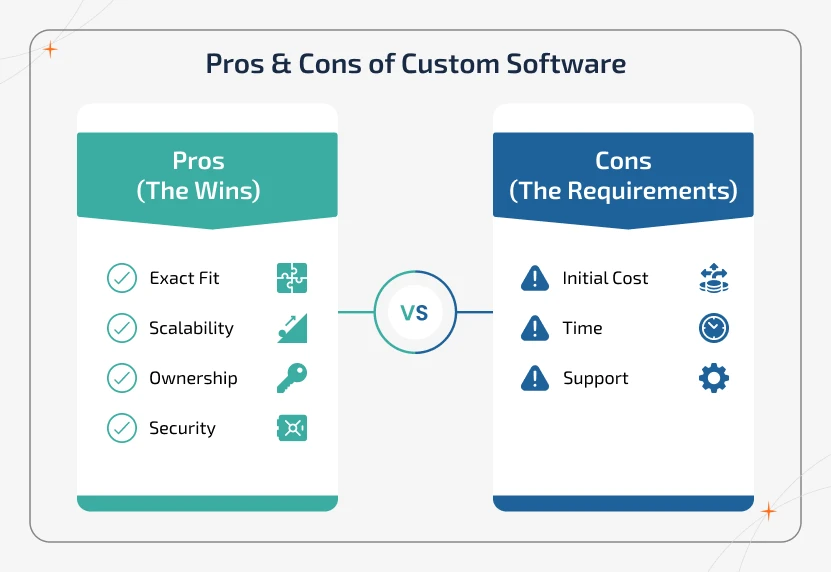
Custom software is built specifically for the business’s unique needs, offering complete control over how the system works. However, it does come with higher responsibility in terms of cost, time, and maintenance. Here are the advantages of custom software as well as the disadvantages.
Pros:
- Custom software is designed specifically to match the exact business requirements.
- Provides complete flexibility to add, modify, or scale features as the business evolves.
- It eliminates the dependency on third-party vendors and recurring licensing fees.
- Businesses can gain full control over security and data management.
Cons:
- Requires higher upfront investment when compared to ready-made SaaS solutions
- The development and deployment might take more time, ranging from weeks to months.
- Ongoing maintenance and updates need dedicated technical support for development teams.
SaaS vs Custom Software in Real Business Scenarios
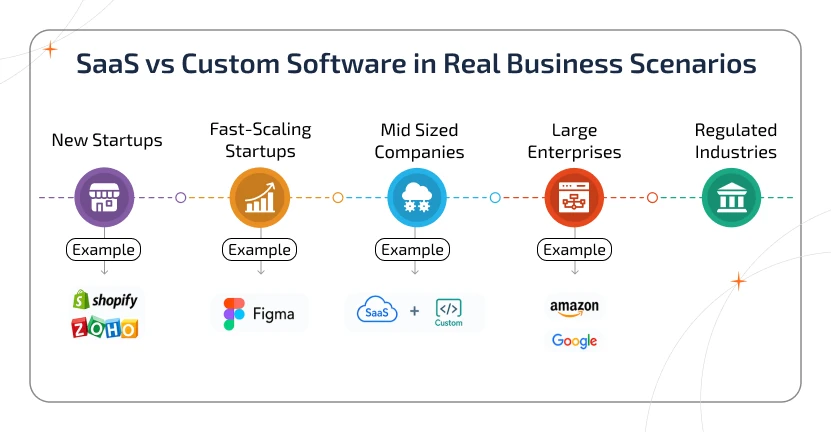
In real scenarios, companies don’t just pick SaaS or custom software randomly. They do based on the growth stage, complexity, and long-term goals.
1. New Startups
A new startup, like small eCommerce brands, always uses SaaS tools like “Zoho” or “Shopify” at the beginning stage. This is because they need to launch the product quickly without spending months on development. With this, they can focus more on validating the business idea than building infrastructure.
2. Fast-Scaling Startups
At the early stage, fast-scaling startups like “Figma” and “Notion” typically start with a mix of SaaS tools for internal operations. As time passes, it gradually moves its core systems to custom-built infrastructure to support performance and product differentiation.
3. Mid-Sized Companies
Usually, mid-sized companies follow a hybrid approach. In this, SaaS is used for generic functions like payroll or CRM. On the other hand, custom software is introduced for internal workflows that gives operational efficiency or a competitive advantage.
4. Large Enterprises
Successful large enterprises like Google and Amazon don’t use SaaS for their core operations. They usually build their own system using custom software for logistics, recommendation engines, and massive data processing. These companies do use SaaS, but for simpler and non-core things like HR tools and communication.
5. Regulated Industries
Businesses in regulated industries like healthcare or banking prefer custom software for their core systems. It’s because they need strict control over security and compliance, which SaaS platforms can’t always provide.
Why Choose Custom Software Development Over SaaS Development
By comparing the aspects, you’ll understand that custom software development is far better than SaaS development, especially when it comes to future growth. Here are the core reasons why you should choose custom software over SaaS.
1. Average Hourly Rates in Canada Regions
The key factors that influence the development costs include project complexity, feature scope, technology stack, team size, expertise level, project timeline & urgency, third-party integrations, compliance & security requirements, and post-launch support & maintenance.
👉 Built Around Your Business
Custom software is designed specifically to work around your daily workflows. Due to this, it fits your exact operational needs.
👉 No Feature Limitations
Unlike SaaS, you’re not restricted by any pre-built functions. This allows one to add exactly what your business needs without wasting your time on vendor updates.
👉 Better Long-Term Scalability
When your business expands, custom software can cope up with you. It allows new features, integrations, and improvements without platform restrictions.
👉 Full Data Ownership
You can maintain complete control over the data and system architectures instead of relying on third-party providers.
👉 No Dependency on Vendors
You’re not tied to any subscription changes, feature removals, or policy updates from the external providers.
Challenges Faced by Businesses in SaaS Adoption
Even though SaaS makes it easy to get started, when the business grows and starts depending on multiple tools, the real challenge begins to show up.
- As different departments use different tools, businesses will face workflow fragmentation, which doesn’t work together smoothly.
- Performance limitations can emerge when SaaS platforms can’t support complex internal processes.
- When usage exceeds, organizations will face difficulties in standardizing processes across teams.
- Businesses sometimes struggle with vendor-driven changes, where the feature removals impact the existing workflows.
How AI is Changing Modern Software Development
AI is reshaping both the SaaS and custom software by improving speed, automation, and decision-making. It’s making both the development process more efficient and more capable in many ways.
Smarter SaaS Tools
SaaS platforms now leverage AI for smart suggestions and faster task execution, reducing the manual effort in day-to-day work.
Faster Custom Development
AI-assisted coding and tools are now helping developers to build custom software much quicker and minimize the overall development time and cost.
Automation Everywhere
Both platforms are using AI to handle repetitive tasks, which include reporting, workflows, and a generic decision process.
Better Data Use
AI helps businesses in understanding the patterns even faster and makes the analytics more useful for real-time decisions.
Blurring the Difference
With AI implementation, SaaS is getting more flexible, and custom software is faster to build, which narrows the gap between the two models.
How Sparkout Supports Your Custom Software Journey
Being one of the leading custom software development agencies, Sparkout helps businesses build tailored solutions that fit their business needs.
- Business-First Approach: Sparkout understands your workflows before suggesting any solution to avoid unnecessary drama.
- End-to-End Development: From initial planning to final deployment, everything is handled under one roof.
- Scalable Solutions: The customized software is built to grow as your business expands.
- Seamless Integration: Sparkout helps in connecting the software with your existing tools and systems.
- Long-Term Focus: The solutions are built to deliver true value.
Final Verdict
Custom software and SaaS both have their own pros and cons, and at the end, the choice is yours to make. While SaaS you move fast and keep things simple and straightforward, custom software fills the unique needs that a ready-made solution fails to deliver.
When your business evolves, the real shift usually happens when the ready-made solution starts feeling limiting the functions rather than being helpful. This is where custom software becomes more relevant. Not just because SaaS stops working, but your business outgrows what it was really designed for.
Need Custom Software Development For Your Business?
Partner up with Sparkout Tech to build your custom software with minimal cost.