



UI/UX mistakes in mobile app development are one of the fastest ways to kill app growth in 2026. Mobile users don't just explore apps anymore; they judge them instantly. In 2026, most app uninstallation decisions take place within the first 10 seconds, even before onboarding even finishes. A single moment of friction, such as a slow load, confusing layout, unclear text, etc., can cost you a user forever.
Poor mobile UI/UX mistakes fail silently. Most often, they start to occur due to lower retention, fewer sessions, bad reviews, rising acquisition costs, and stalled growth. While all these happen, teams will still keep shipping features that will never be reached by the users.
Here in this blog, we will break down the 14 most common mobile UI/UX design mistakes that are actively killing app growth. If your app isn't bringing outcomes as expected, chances are one or more of these mistakes are the reason.
UI vs UX in Mobile Apps - A Quick Practical Difference

1. UI or User Interface - This is what a user sees and touches. Often, the screens, buttons, layouts, typography, colours, and visual feedback.
2. UX or User Experience - It is responsible for how smoothly users get things done. i.e., finding features, completing actions.
Note that a polished UI can't fix a broken UX, while a usable UX won't scale without a clear, consistent UI. In mobile apps, both UI and UX directly shape retention, trust, and conversion.
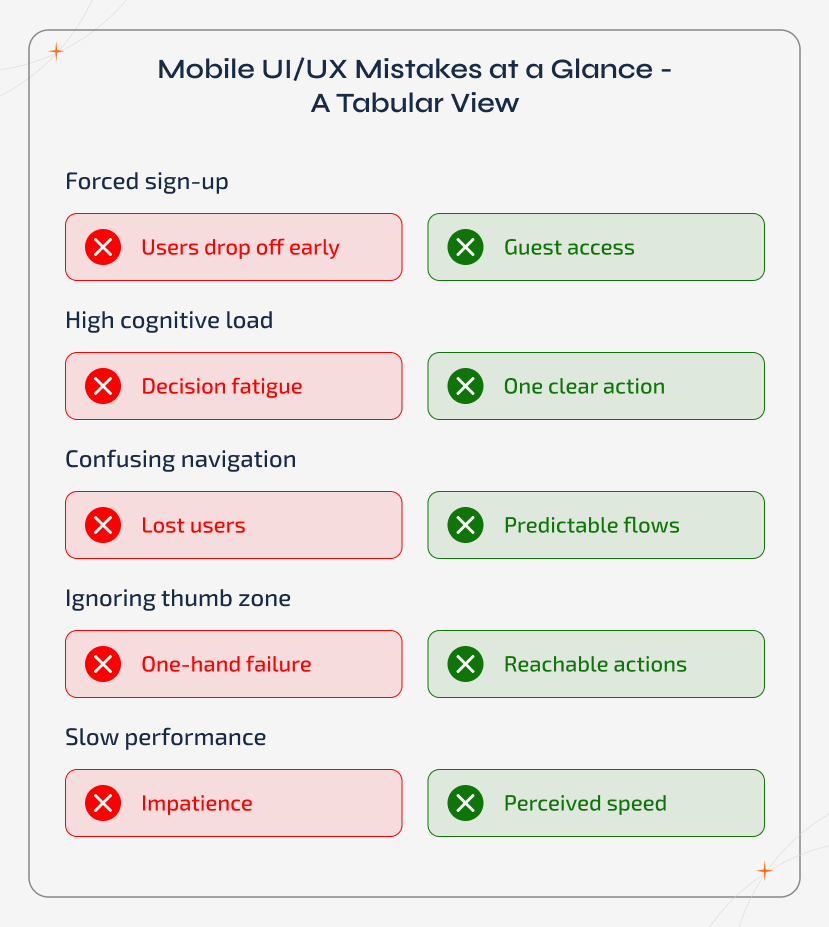
Mobile UI/UX Mistakes at a Glance - A Tabular View
Take a quick view of the most common mobile UI/UX mistakes and why they hurt user behaviour, and the immediate fixes that prevent early drop-offs.
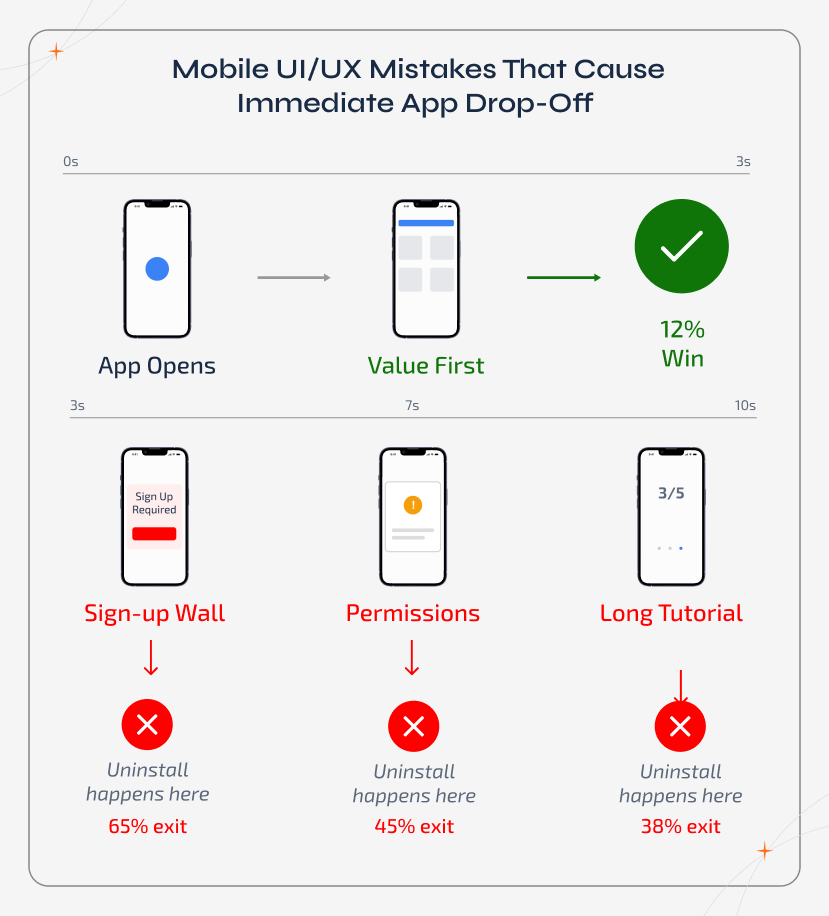
Mobile UI/UX Mistakes That Cause Immediate App Drop-Off
These are issues that push users to uninstall before they understand your app's value. They usually happen within the first few seconds of use.
Mistake #1 - Forced Sign-Up Before Showing Value
Asking the users to sign up even before showing value creates friction. When the first screen is a registration wall, most users exit. In other words, this is a forced sign-up that appears at first launch and eventually pushes users out before they experience anything useful.
Why it hurts:
- Users don't trust unfamiliar apps with personal data.
- Early friction increases bounce rate and uninstall rates.
- The app hasn't earned the ask yet.
How to fix:
- Offer guest access or a clear "skip for now" option.
- Delay sign-up until they make a save, sync, or payment moment.
- It is good to clearly explain why an account improves the experience.
Quick check:
- Can users experience one meaningful outcome before creating an account?
Mistake #2: Complex or Unzippable Onboarding Tutorials
Long walkthroughs send a clear message for the user that this app is going to be hard. It is to note that most users prefer to explore, and not access slides they won’t remember.
Why it hurts:
- Users look for discovery over instruction.
- Cognitive overload often leads to early exits.
- Most onboarding content is forgotten immediately.
How to fix:
- Make onboarding an optional approach and fully skippable.
- Teach features contextually when the user starts to use it.
- Use tooltips, empty states, and progressive hints.
Quick check:
- Can a new user succeed without completing onboarding?
Mistake #3: Asking for Permissions Too Early
Permission prompts without context feel intrusive. When users say "Don’t Allow," then it obvious that trust and functionality both take a hit.
Why it hurts:
- Users don't understand why access is required.
- Early denials break features later.
- Trust is taken off even before value is demonstrated.
How to fix:
- It is better to ask for permissions only when the feature is triggered.
- Explain the benefit before the system prompt appears.
- Avoid stacking multiple permission requests at launch.
Quick check:
- Is every permission request tied to a visible, immediate benefit?
Mistakes That Increase Cognitive Load
These are problems that, in turn, make users think too hard about what to do next. This leads to confusion, fatigue, and abandonment.
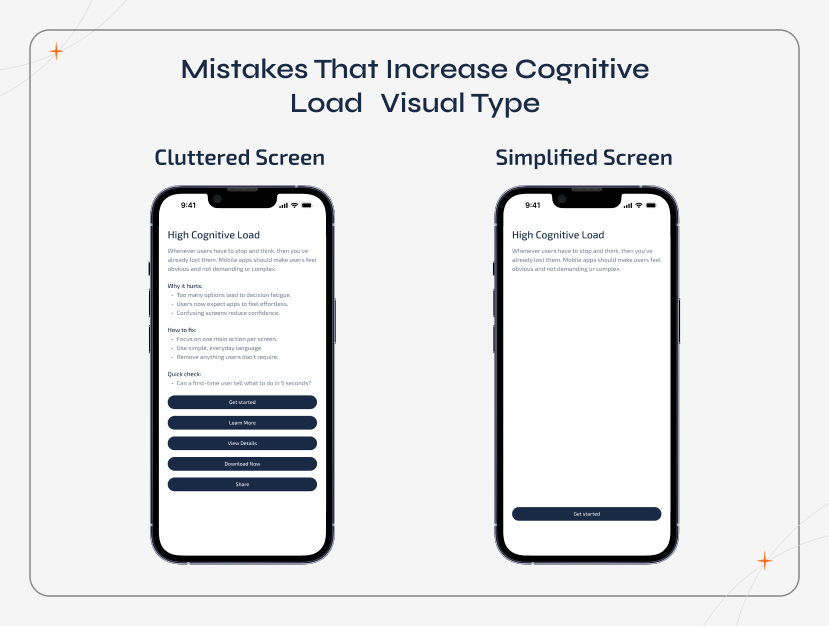
Mistake #4: High Cognitive Load (Too Much Thinking)
Whenever users have to stop and think, then you've already lost them. Mobile apps should make users feel obvious and not demanding or complex.
Why it hurts:
- Too many options lead to decision fatigue.
- Users now expect apps to feel effortless.
- Confusing screens reduce confidence.
How to fix:
- Focus on one main action per screen.
- Use simple, everyday language.
- Remove anything users don’t require.
Quick check:
- Can a first-time user tell what to do in 5 seconds?
Mistake #5: Confusing Navigation & Structure
Users prefer using familiar options. When navigation feels hard and unpredictable, they get lost and leave.
Why it hurts:
- Hidden actions can often slow down users.
- Inconsistent back behaviour frustrates.
- Deep menus increase mistakes.
How to fix:
- Keep key actions easy to find.
- Limit top-level navigation items.
- Ensure back navigation behaves the same everywhere.
Quick check:
- Is the next step obvious on every important screen?
Mistake #6: Ignoring the Thumb Zone
Most people use apps with one hand. If actions are hard to reach, the app feels uncomfortable to use.
Why it hurts:
- Top-heavy layouts will often strain the hand.
- Important buttons are hard to tap.
- One-handed use breaks common tasks.
How to fix:
- It is good to place main actions within easy thumb reach.
- Avoid critical button placement in the top corners.
- Use automated mobile app testing tools on real devices and not on simulators.
Quick check:
- Use a thumb-zone diagram to validate your layouts
Platform, Standards & Accessibility Mistakes
These mistakes break user expectations by excluding platform norms and basic usability standards users rely on.
Mistake #7: Ignoring iOS & Android Design Guidelines
Mobile platforms have established patterns for a reason. When apps ignore following them, then accessing those apps feels unfamiliar and uncomfortable.
Why it hurts:
- Android shouldn't feel like iOS and vice versa.
- Users expect native navigation, controls, and gestures.
- Platform standards evolve, but custom UI often doesn't.
How to fix:
- Follow Apple's and Google's design patterns.
- Respect native back behaviour, navigation, and dialogs.
- Customize only when it improves clarity.
Quick check:
- Does the app feel native on both platforms?
Mistake #8: Treating Accessibility as an Afterthought
Accessibility isn't optional. It directly affects how usable your app is for everyone.
Why it hurts:
- Low contrast fails in sunlight.
- Small tap targets cause frequent errors.
- Motion effects can trigger discomfort.
How to fix:
- Use readable font sizes (16px+).
- Maintain strong text and color contrast.
- Respect text scaling and reduced-motion settings.
Quick check:
- Can the app be used comfortably in bright light and with one hand?
Performance, Feedback & Perceived Speed Mistakes
These issues often make apps feel slow, unresponsive, or broken, even when the backend seems to be working fine.
Mistake #9: Slow Performance & Long Load Times
Faster networks don't always make users more patient. Rather, they made delays more visible. On mobile, even short pauses feel long.
Why it hurts:
- Waiting feels longer on the small screens.
- Blank screens create uncertainty.
- Users assume the app is broken.
How to fix:
- Optimize images, assets, and API calls.
- Load content in stages rather than all at once.
- Prioritize instant UI response, even if data is still loading.
Quick check:
- Does the interface respond immediately, even while content loads?
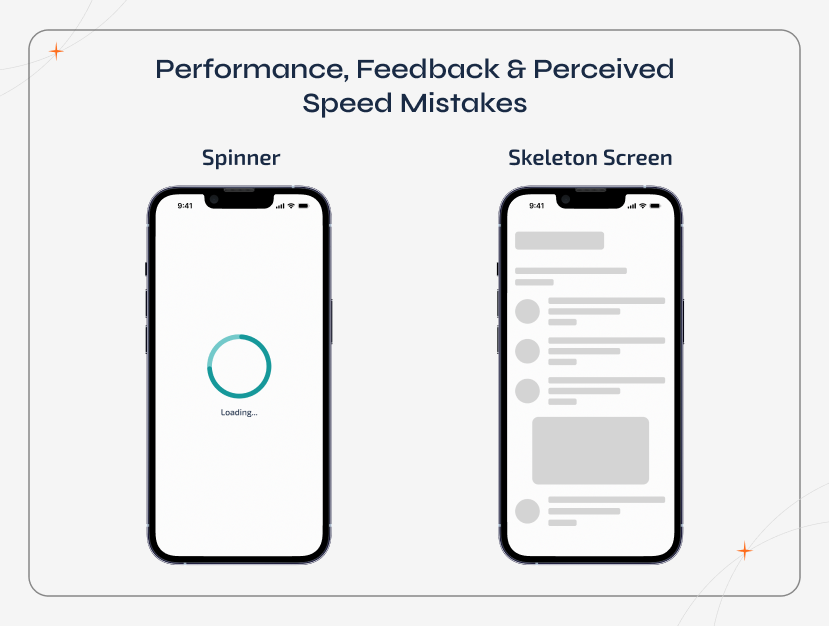
Mistake #10: Using Spinners Instead of Meaningful Feedback
Spinners don't explain what's happening, and silence makes users nervous.
Why it hurts:
- No indication of progress.
- Unclear wait time.
- Reduces trust in the app.
How to fix:
- Replace spinners with skeleton screens.
- Show progress or status messages when possible.
- Always display success, error, and disabled states.
Quick check:
- Does every user action trigger clear, visible feedback?
Scalability, Content & Growth Killers
These mistakes don’t always hurt immediately, but they silently block growth as your app adds users and features.
Mistake #11: No Design System to Support Growth
As apps grow, inconsistency happens. Without a design system, teams slow down ,and users feel the chaos.
Why it hurts:
- UI becomes inconsistent across screens.
- Feature releases take longer.
- Maintenance costs keep increasing.
How to fix:
- Build reusable, modular components.
- Document typography, spacing, buttons, and states.
- Treat the design system as core product infrastructure.
Quick check:
- Can new features ship without redesigning existing screens?
Mistake #12: Ignoring Micro Copy, Tone & Clarity
Sometimes, the smallest words often cause the biggest confusion. Poor micro copy may break trust at critical moments.
Why it hurts:
- Vague labels leave users guessing.
- Harsh error messages frustrate the users.
- AI-driven actions feel unclear without explanation.
How to fix:
- Use clear, action-based labels ("Save,' "Send," "Confirm").
- Write calm, helpful error messages.
- Explain what's actually happening and what to do next.
Quick check:
- Do your words reduce uncertainty or create it?
Advanced UX Mistakes Growing Apps Must Avoid
Listed here are some common UX mistakes that appear as products grow and complexity increases without strong design practices.
Mistake #13: Animation Without Purpose
Motion should help users understand what’s happening—not slow them down or show off.
Why it hurts:
- Adds delays to basic interactions.
- Pulls attention away from content.
- It can cause discomfort or accessibility issues.
How to fix:
- Use motion to show feedback and visual hierarchy.
- Keep animations fast, subtle, and meaningful.
- Respect reduced-motion system settings.
Mistake #14: Designing by Intuition Instead of Data
Gut feelings don’t scale. Sustainable growth comes from observing real user behavior.
Why it hurts:
- Teams are designed for internal opinions, not users.
- Real friction points stay hidden.
- Growth slows without obvious failure signals.
How to fix:
- Review session replays and heatmaps regularly.
- Track drop-offs, hesitation, and rage taps.
- Combine AI insights with human judgment.
Mobile UX Audit Checklist (2026-Ready)
A practical, no-fluff checklist to quickly find UX gaps that hurt retention, usability, and growth in modern mobile apps.
Onboarding & Access
✅ Users can explore without a mandatory sign-up
✅ Onboarding is optional, skippable, and lightweight
✅ Permissions are requested only at the moment of use
Navigation & Layout
✅ Each screen has one clear primary action
✅ Key actions are placed within comfortable thumb reach
✅ Back navigation behaves consistently across the app
Visuals & Accessibility
✅ Body text is readable (16px+ across devices)
✅ Tap targets meet minimum touch size (44×44px)
✅ Adequate contrast and reduced-motion support are enabled
Performance & Feedback
✅ Skeleton screens replace blank or blocking loaders
✅ Errors clearly explain what happened and what to do next
✅ Every user action receives immediate visual feedback
Scalability & Consistency
✅ UI components are modular and reusable
✅ A documented design system guides new features
Why Bad UX Stops Apps From Scaling
When UX in the mobile app is weak, this often affects its growth and creates problems rather than momentum.
1. Feature creep breaks clarity
As new features are included, screens
become overcrowded and may look confusing. Users struggle to find what matters the most.
2. Support costs increase
Confused users end up asking more questions,
reporting more issues, and leaving negative reviews.
3. Release cycles are slow
Without a clear UX structure, every change
takes longer, and it can even break something else.
4. User trust disrupts
When an app feels inconsistent or unreliable,
users will often stop trusting it and even stop using it.
Thus, UI/UX design agencies in the UK, Dubai, etc., believe that good UX is not just the decoration. Rather, it is a system that keeps the product usable as it grows.
What Modern Mobile UX is Moving Towards
In 2026, UI/UX design trends for mobile app development are less about adding features and more about removing friction. The best apps focus on clarity, adaptability, and trust. Thus, helping users reach outcomes faster with fewer decisions.
1. Predictive, context-aware interfaces
The modern mobile app development agency in Austin, Chicago, and other cities
aims to show what users need based on their situation, and not everything at once.
2. Personalization with user control
Apps adapt to users while giving
them clear choices and easy ways to opt out. However, they always let them stay in control.
3. Fewer features, clearer flows
Successful teams remove clutter and
help focus on helping users complete the key tasks faster and without clutter.
4. Accessibility by default
Apps are designed to work well for everyone
across devices, environments, and user abilities.
5. Design systems as infrastructure
Shared
components and patterns create consistency, speed up development, and support long-term scalability.
How AI Helps Prevent UX Mistakes in Mobile App Development
The untold story of AI for UI/UX design is that it not only creates interfaces but also helps teams avoid repeated UI/UX design mistakes in mobile app development.
Instead of guessing, AI tools analyze how users actually use an app. This includes where they pause, tap repeatedly, abandon screens, or drop off entirely. These signals help teams find issues like confusing navigation, high cognitive load, poor feedback, and unclear onboarding much earlier.
AI also helps prevent small UX issues from becoming major issues when apps scale. It flags friction, performance slowdowns, and usability regressions even before users complain or retention drops.
Thus, AI doesn’t replace designers or product teams. It supports in making better decisions by showing what’s really happening. This way teams can fix UX problems before they turn into lost user
Final Takeaway - Fix the First Experience Before Adding Features
Most mobile apps fail not just because they lack features. They fail because the first experience they offer for the user is confusing, slow, or demanding too much too soon.
Small UX fixes, such as clear onboarding, predictable navigation, faster feedback, and accessible design helps deliver bigger results than major redesigns. When users get to know what to do and feel in control, retention improves naturally.
Before adding new features, businesses should audit how their app behaves in its first few moments. Fix what users touch first. That's where growth really starts