


The future of web development is changing rapidly, and many businesses struggle to keep up with emerging technologies, rising user expectations, and the need for faster, more secure web applications. Those companies that rely on outdated web technologies often come across major issues like slow performance, poor scalability, and limited user experience.
Web applications remain the core of the digital ecosystem. From SaaS products and enterprise systems to eCommerce platforms and AI-driven tools, businesses that rely on top web development agencies and modern web applications deliver fast and reliable user experiences.
The latest web development trends in 2026 focus on solving these challenges via faster frameworks, AI-assisted development, edge computing, and stronger security practices.
By understanding these trends, businesses can build scalable, high-performance web applications and stay competitive in the rapidly evolving digital landscape.
Quick Overview of the Latest Web Development Trends in 2026
Take a quick look at the latest web technologies and trends in web development shaping the industry.
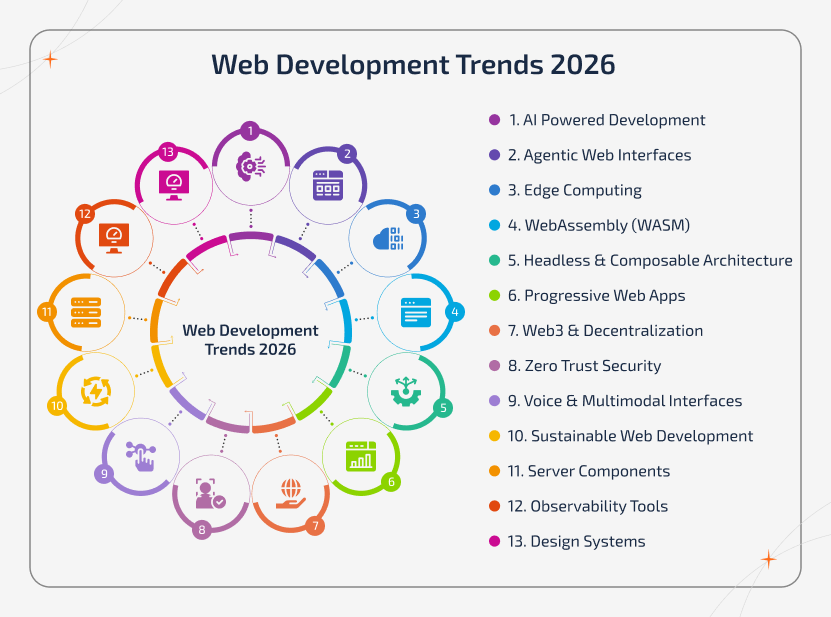
| Web Development Trend | Why It Matters |
|---|---|
| AI-Powered Development | Speeds up coding, testing, & product development |
| Agentic Web Interfaces | AI agents handle tasks inside applications |
| Edge Computing | Reduces latency & improves global performance |
| Edge AI | Enables real-time personalization & AI processing closer to users |
| WebAssembly (WASM) | Supports high-performance browser applications |
| Headless & Composable Architecture | Flexible content delivery across platforms |
| Progressive Web Apps | App-like web experiences without installations |
| Web3 & Decentralization | Secure, transparent digital ecosystems |
| Zero-Trust Security | Advanced authentication & threat detection |
| Voice & Multimodal Interfaces | New ways for users to interact with applications |
| Sustainable Web Development | Energy-efficient & environmentally responsible apps |
| Server Components | Faster applications with less JavaScript |
| Observability Tools | Improved performance monitoring |
| Design Systems (AI-Driven) | Consistent & scalable UI development |
| Developer Experience (DX Evolution) | Shifts development toward AI-assisted & prompt-driven workflows |
| AI-Native Applications | Enables intelligent, personalized, & context-aware applications |
These are modern web technologies that shape how developers build platforms & how businesses deliver digital experiences.
What is Web Development - Understanding the Basics
Web development is the process of building and maintaining websites and web applications that work on the internet. It often involves designing, developing, and managing digital platforms that users can access online through a web browser on any device, including smartphones, tablets, or computers.
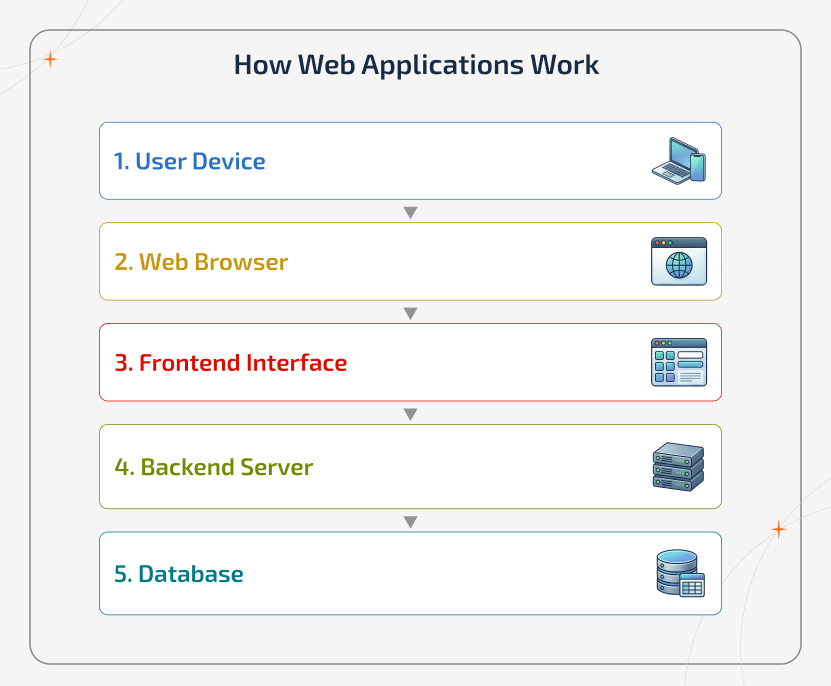
Today, the methodologies followed by web development agencies go far beyond simple informational websites to complex platforms that help businesses efficiently handle operations. Modern web applications support complex digital services and business operations just like traditional software, but work directly in the browser. Some of the common examples of web applications include:
- Customer portals
- SaaS platforms
- eCommerce platforms
- AI-powered web tools &
- Data analytics dashboards
Unlike traditional desktop software, web applications don't require any installation. Users can access them instantly via a browser, making them easier to maintain, update, and scale for businesses that have a user base across multiple devices and locations.
Types of Web Development in Modern Applications
Learning the main types of web development helps understand how modern web applications are built and how different technologies work together to deliver digital experiences.
1. Frontend Web Development
Frontend development approach focuses on the visual interface and user experience of a web application. This covers everything that the users can see and interact with in their browsers. i.e., layouts, navigation menus, forms, and responsive designs.
Frontend developers use modern frameworks and tools to create fast, interactive, and mobile-friendly interfaces. The popular frontend web development technologies include:
- React
- Next.js
- Vue
- Angular
- Tailwind CSS
The above technologies help developers build responsive and engaging user interfaces for modern applications.
2. Backend Web Development
Backend development handles the server-side logic that powers web applications. It helps manage how data is processed, stored, and delivered to the frontend. The backend is responsible for core application functions like:
- Database management
- User authentication and authorization
- Server infrastructure
- APIs and system integrations
- Application business logic
The most common backend technologies include:
- Node.js
- Python
- Java
- Go
- Serverless cloud platforms
3. Full Stack Web Development
Full-stack development is the combination of both frontend and backend development. Thus, the full-stack developers work across the entire web application and handle everything from UI to server-side logic and database management.
By using both frontend and backend technologies, the full-stack developers will build complete web applications. Thus, ensuring all the components work together efficiently.
The most common full-stack technologies include:
- MERN stack (MongoDB, React, Express, Node.js)
- MEAN stack
- Full-stack frameworks like Next.js
Full-stack development is used across modern projects where end-to-end ownership and faster development are important. This includes start-ups, SaaS platforms, and b2b web development.
All these three types of web development put together form the foundation of modern web applications.
Frontend vs Backend vs Full Stack - Quick Comparison
| Type | Focus Area | What It Handles |
|---|---|---|
| Frontend Development | User interface | Layout, design, interactions, responsiveness |
| Backend Development | Server-side logic | Databases, APIs, authentication, business logic |
| Full Stack Development | End-to-end development | Combines frontend and backend to build complete applications |
Web Development Trends in 2026
The latest web development trends in 2026 focus on faster performance, AI-assisted development, scalable architectures, and stronger security. As web applications become more complex, modern technologies are transforming how developers design, build, and manage digital products.
Given below are the most important web development technology trends that are shaping the future of web development and modern web applications.
1. AI-Powered Development Tools
Artificial intelligence (AI) is transforming how developers build and maintain web applications. Modern AI-powered tools assist users with writing code, finding bugs, generating documentation, and automating testing processes.
By using AI-powered coding assistants and intelligent IDE features, development teams can speed up the workflow while maintaining high code quality. These allow developers to focus more on solving complex problems rather than spending time on manual coding tasks.
AI development tools are now evolving towards AI-generated user interfaces and autonomous development workflows. Some modern platforms help developers describe application features in natural language while AI generates UI components, application structure, and initial code.
This helps teams rapidly prototype products and experiment with new ideas without building everything from scratch.
Modern AI development tools can handle:
- Code generation & intelligent code suggestions
- Bug detection & automated debugging
- Automated testing & test case generation
- Documentation generation
- Performance monitoring & optimization
This shift is also transforming developer experience (DX). i.e., Development is moving from traditional coding toward prompt-driven and AI-assisted workflows. Thus, developers guide AI systems to build, test, and optimize applications. This shift is redefining how modern development teams work.
2. Agentic Web Interfaces
The rise of agentic web interfaces is one of the most important emerging web development trends in which AI agents perform tasks inside the applications.
Traditional web applications need users to manually complete the workflows. Whereas agent-driven systems are intelligent agents that assist or automate tasks.
These AI agents operate within web platforms to support users, streamline processes, and optimize productivity. Agentic AI understands the context and user intent to handle repetitive tasks, generate insights, and recommend the best actions.
For example, an AI agent in a financial sector can automatically analyze data, create insights, and recommend the best investment or budget strategies to the user.
The common examples include:
- AI assistants are completing workflows in SaaS platforms
- Automated financial analysis dashboards
- Intelligent customer support systems
- AI-powered productivity tools and task management tools
Agentic interfaces are transforming web applications into intelligent systems that help connect with users, automate complex processes, and improve overall UX.
3. Edge Computing for Faster Web Applications
Edge computing is transforming the way modern web applications handle data processing and delivery. Instead of sending every request to centralized cloud servers, edge computing processes data closer to the user via distributed edge servers located around the world.
This approach reduces the physical distance required for the data to travel. This architecture delivers faster response times and a more reliable user experience.
A lot of modern applications are designed as edge-native systems. i.e., they are built specifically to run on distributed edge infrastructure instead of centralized servers. With Edge-native architectures, applications can process data closer to users, improving real-time performance and supporting globally distributed platforms.
One of the growing trend is the combination of edge computing with AI and is referred to as edge AI. This helps applications to run AI models closer to users, enabling real-time personalization, faster decision-making, and improved user experiences without relying entirely on centralized servers.
Key benefits include:
- Faster page load times and improved website performance
- Reduced latency for users across different geographic locations
- Improved application responsiveness for real-time services
- Better scalability for large user bases
Edge infrastructure is widely used in modern platforms, including streaming services, e-commerce websites, SaaS applications, and real-time collaboration tools that need high-speed content delivery and real-time interactions.
4. WebAssembly (WASM)
WebAssembly is a technology with which developers can run high-performance code directly inside web browsers. Traditionally, web applications were limited by the performance of JavaScript. However, WebAssembly helps overcome this limitation by allowing developers to compile code written in languages like C, C++, or Rust into a compact binary format that runs efficiently in the browser along with JavaScript.
WebAssembly also supports a new category of browser-native AI applications. Thus, developers can run machine learning models directly inside web browsers with the help of technologies like WebAssembly and WebGPU. This allows applications like AI image editors, local AI assistants, and privacy-focused AI tools to work without sending data to external servers.
Thus, it is possible to build complex applications like:
- Browser-based video editing tools
- Advanced 3D graphics applications and gaming experiences
- Interactive data visualization platforms
- High-performance analytics and scientific computing tools
WebAssembly is helping the web evolve into a powerful platform that is capable of running advanced software directly in the browser. This shift offers faster, privacy-focused, and offline-capable AI experiences in modern web applications.
5. Progressive Web Apps (PWAs)
Progressive Web Apps, aka PWAs, have become a standard approach in modern web development. Thus, PWAs are not just a replacement for mobile apps, but they work as a baseline and deliver a fast, reliable, and app-like web experience for users.
PWAs are built using modern web technologies like service workers, web app manifests, and responsive frameworks. In 2026, they have evolved with AI-driven features, edge delivery, and real-time functionalities that make the modern digital platforms more powerful and responsive.
Key capabilities include:
- Offline functionality that lets users access content without an internet connection
- Push notifications to re-engage users and deliver timely updates
- Installation on the home screen for quick access
- Fast loading speeds and better performance across devices
Businesses can rely on PWAs as they are a cost-effective way to deliver mobile app-like experiences without needing to build separate native mobile applications.
6. Headless CMS and Composable Architecture
Modern digital platforms should deliver content seamlessly across multiple channels. This includes mobile applications, smart devices, and emerging digital interfaces. Traditional monolithic CMS platforms often find it hard to support this level of flexibility and scalability.
Headless CMS and composable architecture solve this by splitting the backend system from the frontend interface. This helps developers deliver content through APIs across multiple platforms and build modular digital systems.
Modern development teams also follow an API-first approach in which the APIs are designed before the frontend interface. This helps different systems, applications, and services to integrate easily. This makes the digital platforms more scalable and flexible.
Key benefits include:
- Faster content delivery across multiple platforms
- Improved website performance
- Greater development flexibility
- Scalable digital infrastructure
A lot of enterprises adopt this architecture to build a flexible ecosystem that supports omnichannel experiences and adapts quickly to evolving technology and customer expectations.
7. Server Components and Modern Framework Architecture
Modern web frameworks are moving towards server-driven architectures, where more application processing takes place on the server instead of the user's browser. This approach helps minimize the processing required on the client side while helping improve the overall performance of the web applications.
Server components allow certain parts of an application to be rendered on the server before the content is sent to the user's browser. As a result, web pages load faster and more efficiently.
Modern web applications in 2026 now support real-time features like live updates, collaborative editing, and streaming data. Technologies like WebSockets, streaming APIs, and edge messaging systems allow platforms to update information instantly without requiring users to refresh the page.
This approach improves:
- Page loading speed
- SEO performance
- Overall application performance
- Scalability of large web platforms
By handling more processing on the server, developers can build faster, more scalable web applications that deliver better user experiences.
8. Observability and Performance Monitoring
As web applications become more complex, monitoring their performance is more important. Development teams should have a clear visibility of how applications work in real-world environments.
With the help of observability tools, developers can track system activity and get to know how different parts of an application are performing. These tools offer insights that make it easier to find issues and improve the system's reliability.
Performance optimization is closely related to Core Web Vitals, which are important metrics used to measure real user experience on websites. Metrics like Largest Contentful Paint (LCP), Interaction to Next Paint (INP), and Cumulative Layout Shift (CLS) help developers find out any performance issues and improve page speed.
These tools are used to monitor:
- Performance metrics
- Application errors
- User interactions
- Infrastructure health
Upon finding out the problem early, development teams can fix the issues and maintain stable, reliable web applications.
9. Zero-Trust Web Security
Security has become a critical priority for modern web applications. This is especially true when it comes to handling sensitive data and user accounts. Often, traditional security models rely on perimeter-based protection, which is no longer sufficient for today's distributed systems.
Zero-trust security follows the principle of a "never trust, always verify" approach. So, every user, device, and request must be continuously verified before system or data access is granted.
Common technologies used in zero-trust systems include:
- Passwordless authentication
- Biometric login methods
- Behavioral threat detection
- AI-driven fraud monitoring
By continuously validating access and monitoring system activity, zero-trust security helps protect the web applications from evolving cyber threats and unauthorized access.
10. Web3 and Decentralized Applications
Web3 technologies have brought a new approach to building digital platforms using blockchain infrastructure. Unlike traditional web applications that depend on centralized servers, decentralized applications (dApps) distribute data across blockchain networks.
This model reduces the dependency on a single controlling authority and allows users to have control of digital assets and transactions.
Examples include:
- Decentralized finance (DeFi) platforms
- Blockchain-based identity systems
- NFT marketplaces
- Decentralized governance platforms
Although the ecosystem is still evolving, building Web3 technologies are used for niche use cases like decentralized finance, digital identity, and asset ownership. Many enterprises are also adopting hybrid approaches that use traditional web technologies with blockchain for specific business needs.
11. Voice and Multimodal Web Interfaces
Currently, the user interaction with web applications is expanding beyond traditional text-based interfaces. Also, users are looking for more natural and flexible ways to interact with digital platforms.
Voice technology and multimodal interfaces allow users to interact with applications via voice commands, images, or natural language. Thus, accessing applications is made easy and offers better accessibility for different types of users.
Examples include:
- Voice search features
- Conversational AI assistants
- Voice-enabled task management systems
In the future, we may expect many web platforms to combine voice, visual, and text-based interactions to develop more natural and intuitive UX.
12. Sustainable Web Development
Sustainability is becoming an important factor in modern web development. It is because companies in the current period are trying to reduce the environmental impact of digital infrastructure.
Developers are improving application efficiency to minimize energy consumption, thereby making websites and platforms more resource-efficient.
Common strategies include:
- Reducing unnecessary JavaScript
- Optimizing server resources
- Relying on efficient hosting infrastructure
- Minimizing data transfer and page weight
Sustainable web development practices help not just reduce environmental impact but also improve website performance and efficiency.
13. Design Systems and Accessibility
Design systems help organizations maintain consistent UX across websites, applications, and digital platforms. A design system is all about reusable UI components, design guidelines, and development standards that teams can use across projects.
In 2026, design systems are evolving into AI-driven and adaptive systems. Modern platforms supports generating UI components dynamically based on user behaviour, preferences, and context. This offers personalized UI and faster design-to-development workflows.
The key benefits include:
- Faster development cycles
- Consistent user interfaces
- Better collaboration between design and development teams
- Improved accessibility compliance
Accessibility is one of the major factors that organizations aim to build inclusive digital platforms that work for all users.
14. AI-Native Web Applications
The rise of AI-native web applications is one of the most notable web development trends in 2026. Unlike traditional apps, where AI is added as a feature, AI-native apps are built entirely around artificial intelligence as a core part of the application architecture. These apps use large language models (LLMs), agentic workflows, multimodal AI, and real-time data to deliver intelligent, context-aware experiences.
Key characteristics include:
- Offers personalized user interfaces based on user behaviour and context
- Real-time decision-making and automation
- Conversational and adaptive user experiences
- Deep integration of AI into core application workflows
Thus, AI-native applications are becoming a key part of the best AI web development strategies and are thus helping businesses build intelligent SaaS platforms and advanced digital products.
How Modern Web Development Trends Benefit Businesses
By adopting modern web development technologies and frameworks, businesses can build better digital platforms that work faster, more reliably, and are scalable. Modern b2b web development platforms rely more on scalable architectures, AI-driven automation, and performance optimization to deliver seamless digital experiences. The business benefits include:
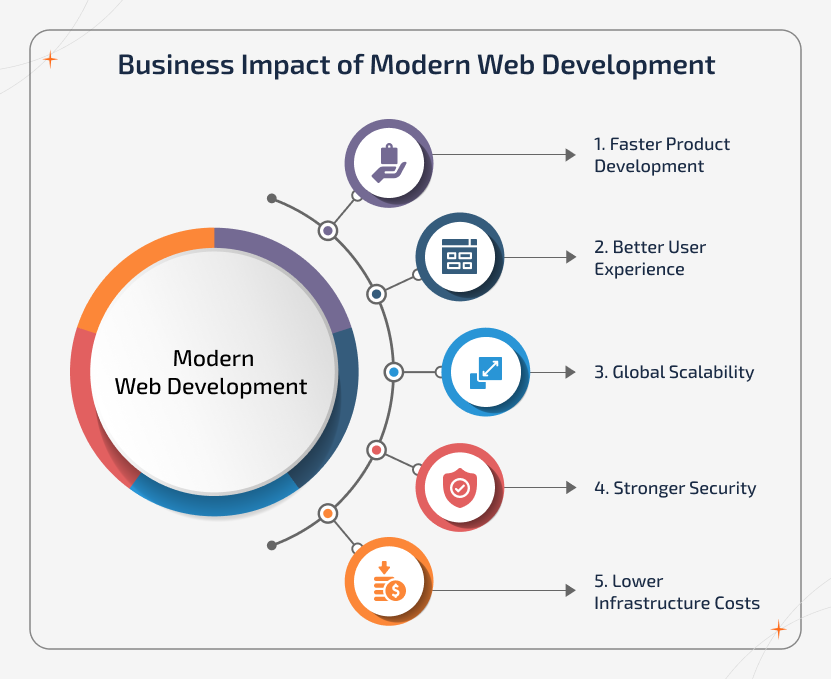
1. Faster Product Development
With the help of modern frameworks and AI tools, it is possible for developers to build applications more quickly and efficiently. Thus, businesses can launch new products and features faster.
2. Better User Experience
Often, new web technologies help improve the website's speed, responsiveness, and usability. This helps businesses deliver results more smoothly with more engaging digital experiences.
3. Global Scalability
With the cloud platforms and edge computing technologies, web applications is made available for users across different regions.
4. Stronger Security
Modern security frameworks like zero-trust architectures and advanced authentication systems help protect web applications from growing cyber threats. With stronger security, sensitive data is safeguarded, and this helps build user trust.
5. Lower Infrastructure Costs
Optimized web architectures and efficient cloud resources help reduce the computing power that are required to run the applications. This helps businesses maintain high-performance platforms while controlling infrastructure and operational costs.
Industry Use Cases of Modern Web Development in 2026
Modern web development trends in 2026 are being adopted based on real business needs. This includes performance, automation, personalization, and scalability. The following use cases reflect how companies are currently using these technologies.
1. eCommerce & Retail Platforms
eCommerce platforms are heavily investing in performance and personalization because even small improvements directly impact revenue. Modern web development technologies like edge computing, AI-driven personalization, and high-performance architectures are widely adopted to improve conversion rates.
What's happening now:
- Real-time product recommendations powered by AI
- Edge-based delivery for faster global performance
- Instant checkout experiences with minimal latency
Real-world impact:
- A 0.1-second improvement in mobile page load time can increase retail conversion rates by up to 8.4%, showing how critical performance optimization is for modern web applications.
- Source: https://www.vennapps.com/blog/35-essential-stats-on-mobile-commerce-in-2025/
Example use cases:
- AI-driven product recommendations
- Dynamic pricing and inventory updates
- High-performance PWAs for mobile commerce
2. SaaS and B2B Platforms
SaaS platforms are highly built as AI-native and composable systems. Businesses that are integrating AI agents, real-time data processing, and scalable architectures can automate workflows and improve decision-making.
What's happening now:
- AI copilots embedded inside dashboards
- Real-time collaboration using streaming and edge infrastructure
- API-first platforms for integrations across tools
Example use cases:
- AI-powered CRM and sales automation platforms
- Workflow automation tools (HR, finance, operations)
- Real-time analytics dashboards
3. Fintech and Financial Applications
Fintech platforms are using AI + edge + zero-trust security to better handle sensitive data and real-time transactions.
What's happening now:
- AI-based fraud detection running in real time
- Edge processing for faster financial transactions
- Strong shift toward passwordless authentication
Example use cases:
- Automated financial insights and reporting tools
- Real-time trading and analytics platforms
- Secure digital payment systems
How Businesses Should Prepare for the Future of Web Development
As web technologies grow, businesses need to adapt their development strategies to stay competitive. Preparing for the future of web development is all about adopting modern tools, scalable architectures, and performance-focused practices. Businesses exploring new web app ideas for business shall focus on scalable architectures, AI integration, and performance-first development strategies.
Key steps businesses should consider:
1. Adopt Modern Frameworks - Teams can use frameworks like React, Next.js, and Vue to build scalable, high-performance web applications.
2. Invest in Scalable Architecture - Using microservices, composable systems, and cloud-native platforms helps applications scale easily when the user demand grows.
3. Use AI-Assisted Development - With the help of AI-powered tools, teams can automate coding, testing, and debugging, and thereby build applications faster.
4. Optimize Performance - Enhances user experience and application efficiency by improving page speed, Core Web Vitals, and using edge infrastructure.
5. Strengthen Security - Businesses can implement zero-trust security, secure authentication, and continuous monitoring to protect modern web platforms.
By adopting these practices, businesses can effortlessly build scalable, secure, and future-ready web applications.
The Architectural Shift Shaping the Future of Web Development
The major change in the future of web development is the shift from traditional web architectures to modern, scalable, and intelligent systems. Rather than building large monolithic applications, developers started designing modular platforms that are faster, more flexible, and easier to scale.
This architectural shift helps businesses deliver better performance, support global users, and integrate advanced technologies like AI and real-time data processing.
| Traditional Web Development | Modern Web Development |
|---|---|
| Monolithic architecture | Composable and modular architecture |
| REST APIs | GraphQL and real-time APIs |
| Centralized servers | Edge computing infrastructure |
| Password-based authentication | Passwordless and biometric authentication |
| Manual coding workflows | AI-assisted development tools |
| Static interfaces | AI-driven and interactive interfaces |
Modern architectures help build high-performance web platforms that can adapt to growing user demand and evolving technologies. These changes highlight how the future of web development is moving toward scalable, automated, and high-performance web applications.
The Future of Web Development
The future of web development will focus more on building faster, smarter, and more scalable web applications. As digital platforms become more advanced, developers will start using new technologies to create better user experiences and more efficient systems.
Technologies like artificial intelligence, edge computing, and modern web frameworks are transforming how web applications are built and delivered.
Businesses that adopt modern web technologies and web development trends early will be better prepared to build scalable, high-performance digital platforms and stay competitive in the evolving digital landscape.