



Digital transformation is no longer optional. It is the foundation of business survival in a digital-first world. While organizations are rapidly investing in modernization, not all the transformation efforts offer results. Studies from leading firms like McKinsey and Gartner report that nearly 70% of digital transformation projects fail, often due to missed goals, low adoption, and lack of measurable business impact.
A digital transformation project failure happens when an initiative does not deliver the expected business results, like better efficiency, improved customer experience, or increased revenue growth, despite the technology being successfully implemented.
These failures are rarely caused by the technology itself. In other words, they often occur due to unclear goals, weak leadership alignment, poor execution, and resistance to change across the teams. When these gaps occur, even well-funded transformation initiatives may stall, exceed budgets, and fail to create real value.
The best part is that digital transformation project failure is preventable with the right strategy, governance, and legacy system modernization. Businesses can turn transformation into a long-term competitive advantage.
In this guide, we break down:
- The top reasons digital transformation projects fail
- Early warning signs to watch
- A proven framework to fix and prevent failure
- Practical steps to ensure success
The Top 3 Reasons Digital Transformation Projects Fail - Quick Answer
1. Lack of clear business goals and KPIs - When there is no clear outcome, teams will not know what success actually looks like.
2. Poor change management and low user adoption - Even the best technology fails when teams are not aligned, trained, or encouraged to use it.
3. Treating transformation as an IT-only project - Transformation usually needs business, process, and culture changes, and not just the technology alone.
What is Digital Transformation & Why It's Non-Negotiable Today
Digital transformation is the process of using modern technology to fundamentally change how a business operates, delivers value, and serves customers. It is not about buying new software, but it is all about how your business works and delivers measurable results.
Key Terms Explained:
- Digitization - Converting analogue or paper-based information into a digital format. Example: Scanning paper records into PDFs.
- Digitalization - Using digital technologies to improve or automate existing business processes. Example: Replacing email approvals with a workflow tool.
- Digital Transformation - Fundamentally reimagining your business models, operations, and customer experiences using digital capabilities as the enabler.
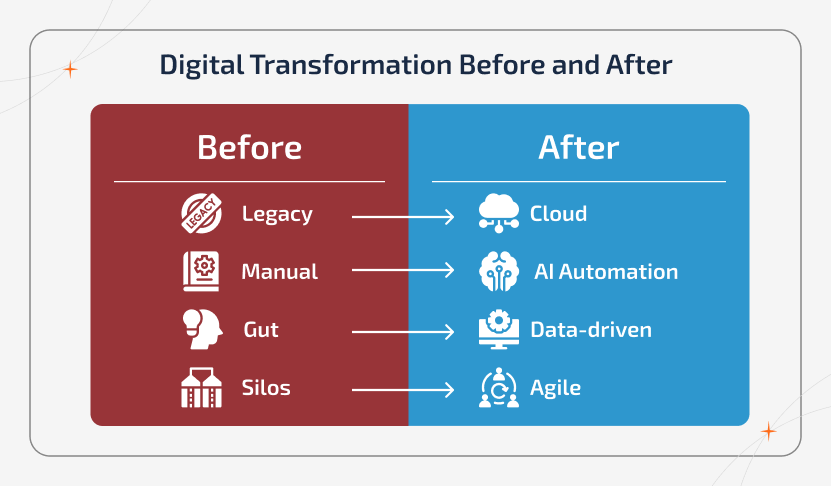
When it comes to today's enterprise, digital transformation touches four interconnected areas at the same time, and they are as follows:
1. Legacy systems → cloud
Moving from outdated, legacy system infrastructure to scalable, cloud-based platforms that offer speed, flexibility, & global collaboration.
2. Manual tasks → AI automation
Replace repetitive processes with intelligent, smart automation so that teams can focus on strategic, high-value tasks.
3. Gut instinct → data-driven decisions
Using integrated systems and real-time analytics to make decisions based on evidence, not on assumptions.
4. Silos & rigid workflows → agile operating models
Restructuring how teams work, collaborate, and make decisions by embedding digital-first thinking across culture, processes, and leadership.
Digital Maturity Assessment - Know Where You Stand Before You Leap
As per McKinsey reports, one of the leading causes of digital transformation project failure is that organizations start without accurately understanding their starting point. Just before investing, check the score for your organization across four dimensions as given below:
Step 1: Assess Your Digital Maturity
Rate your organisation between 1 and 5 across each dimension. You shall average the scores to find your maturity level.
| Score | Level | What It Means |
|---|---|---|
| 1 | Unaware | Mostly manual, no digital strategy |
| 2 | Aware | Isolated tools, no integration |
| 3 | Capable | Defined roadmap, some automation |
| 4 | Scaling | Integrated systems, data-driven ops |
| 5 | Leading | Continuous innovation culture |
Step 2: Evaluate Across 4 Key Dimensions
1. Technology stack - How modern and scalable are your systems? Are they cloud-enabled and integrated across teams?
2. Culture & leadership - Do leaders drive change? Are teams encouraged to experiment and improve how they work?
3. Skills & talent - Do your teams have the skills to use new tools effectively? Are gaps identified and addressed?
4. Processes - Are your processes optimized, or are you digitizing inefficient workflows?
Step 3: What to Do Based on Your Score
Score 1-2: Start small. Focus on one high-impact use case & fix your data foundation first.
Score 3: Strengthen governance, improve system integration, & invest in change management.
Score 4-5: Scale what works. Focus on standardizing platforms, governing transformation efforts, & speed up delivery.
Why Digital Transformation Projects Fail - The 3-Pillar Framework
As per research, about 70-80% of digital transformation initiatives fail to meet their goals. But failure is caused rarely due to a single issue. In other words, it happens across three interconnected areas, such as:
- Strategy
- People
- Technology
Identifying which pillar is weakest in your organization is the first step to preventing failure.
1. Strategic Failures
- Unclear or misaligned business goals
- Treated as a one-time IT initiative
- Poor tool & platform decisions
- No clear way to measure ROI or success
2. Human Failures
- Resistance to change across teams
- Leadership (CXO) knowledge gaps
- Siloed teams & lack of collaboration
- Poor communication & change fatigue
3. Technical Failures
- Legacy system limitations & technical debt
- Weak or inconsistent data governance
- Disconnected automation efforts
- Applying AI to inefficient or broken processes
- Expanding scope without control
Strategic Failures
These failures occur when organizations lack direction, planning, or execution clarity. These issues begin at the leadership level and expand across the organization.
1. No Clear, Measurable Business Goals
The most common reasons digital transformation projects fail involve the lack of clearly defined success metrics. Many organizations initiate transformation with unclear goals like "improve efficiency" or "go digital," even without defining what success actually looks like.
Without measurable KPIs, teams cannot:
- Track progress
- Align priorities
- Demonstrate ROI
- Make informed decisions
This leads to confusion, wasted effort, and eventually, stalled initiatives.
How to fix:
Define outcome-driven KPIs tied to business value. Thus, each initiative should include:
- A clear baseline (current state)
- A measurable target (desired outcome)
- Ownership (who is responsible)
- A defined timeline
Example: Reduce invoice processing time from 10 days to 3 days within 6 months.
2. Choosing the Wrong Technology
This is one of the most common and preventable reasons for digital transformation projects failing. Organizations often choose tools because they are trending, used by competitors, or showcased in strong demos.
But the real question isn't: "Is this technology good?" It's actually "Is this technology right for our processes, people, & data, and does it align with our software development approach?"
What it looks like:
- Integration issues that occur after implementation
- Employees end up creating workarounds outside the system
- Vendor lock-in & limited flexibility
- Unexpected migration & maintenance costs
- Security or compliance gaps that are found later
Why does it happen:
- Tool-first thinking rather than problem-first
- Vendor influence & sales pressure
- Decisions based on best-case demos
- No structured evaluation or comparison process
How to fix this:
Before choosing any software, ask these 5 simple questions:
- Will it work with our current systems?
- Is it secure and compliant?
- What will it really cost over time?
- Can our team actually use it easily?
- Can we rely on the vendor long-term?
In simple words, don't ask: "Is this tool impressive?" Instead, ask "Will this actually work for us?"
3. Treating Transformation as a One-Time IT Project
Digital transformation is not a project that comes with a start and end date. It is an ongoing process of working and improving your business. So, those companies that launch and move on often end up with modern tools but with outdated processes and mindset.
What it looks like:
- Transformation is marked "complete," but there is improvement in business results
- No ongoing updates or improvement cycle
- The transformation team is disbanded after launch
Why does it happen:
- Success is measured by project completion and not based on the outcomes
- Leadership focuses on short-term delivery
- There is no clear ownership after implementation
How to fix this:
Set up a quarterly Digital Transformation Review with leadership and:
- Review the progress against KPIs
- Find out the gaps & improvement areas
- Update the roadmap regularly
- Approve the next phase of work
Treat transformation like a product you continuously improve and not a project you complete.
4. Lack of Executive Alignment & Sponsorship
When there is no strong executive support, digital transformation loses its direction and momentum. However, the bigger issue is that the leaders may support the idea but don't fully understand what it takes. Thus, this gap leads to weak decisions, unclear scope, and loss of focus when challenges occur.
What it looks like:
- Leaders approve budgets but can't clearly explain the goal
- Tool-first thinking (e.g., "we need AI")
- There are no changes in how decisions are made
- Transformation is owned by IT and not driven by leadership
Why does it happen:
- Leaders usually have limited time to go deep
- Transformation discussions look too technical
- Budget approvals were done without a clear understanding of the impact
How to fix this:
Run a focused executive workshop to align leadership:
- Clarify what transformation really requires just beyond tools
- Define clear goals with measurable KPIs
- Set ownership & accountability for each leader
With that, businesses shall create a simple monthly scorecard to:
- Track progress against the key metrics
- Share updates with all C-level leaders
- Keep alignment & visibility consistent
Digital transformation succeeds when the leaders don't just approve it; instead, they actively drive it.
5. Unrealistic Timelines & Budget Models
Digital transformation often takes time. Most successful initiatives require 12-24 months in phases and not a few months.
So, when leaders expect quick results or approve only the technology budget, projects almost always face delays, cost overruns, or incomplete outcomes.
What it looks like:
- The scope gets reduced during budget reviews
- "Phase 2" will never happen
- Teams skip testing or training stages to meet the desired deadlines
Why does it happen:
- Costs are underestimated at the beginning
- Focus is made only on the tools and not on the entire implementation
- Training and change management are cut to save money
How to fix this:
It is better to plan for the full cost and realistic timeline from the start:
- Including all the costs for tools, implementation, integration, training, and change management
- Add a 15-20% buffer to handle unexpected issues
- Allow extra time, up to 25% more than the vendor estimates
Besides, it is vital to prepare a simple backup plan:
- What will you do if timelines slip?
- Who makes decisions in case of delays?
- What is the rollback plan if something fails?
Digital transformation succeeds when plans are realistic, well-defined, and grounded in execution.
Human Failure
Even the best technology fails if people don't understand, trust it, or consistently use it in their everyday work.
6. Resistance to Change and Change Fatigue
Resistance to change is normal. However, people usually don't resist change, while they are capable of resisting uncertainty, overload, and lack of support.
When too many tools are introduced too quickly, or when there is no proper guidance, then teams may feel overwhelmed. As a result, digital transformation adoption drops, and workarounds begin.
What it looks like:
- Employees who intend to use the new tools will have low participation in training sessions
- Employees are going back to the spreadsheets and emails
- Comments like "not another new system."
- Unofficial workarounds and parallel processes
Why does it happen:
- There is no focus on the human side of change
- There are too many initiatives set to follow at the same time
- Often, employees are not involved in decision-making
How to fix this:
- Roll out changes in phases, as it helps avoid multiple major changes at once
- Offering role-based training and not generic sessions
- Identify 2 change champions per team to support adoption
- Recognizing and sharing even small wins to build momentum
The Shadow IT Problem - A Hidden Cost of Poor Change Management
Whenever the official system is hard to use, employees will not just stop working, but they also look for alternatives. In other words, they end up using spreadsheets, personal tools, messaging apps, and other unofficial methods to get things done. This is often referred to as Shadow IT and is one of the most overlooked risks in digital transformation.
Why does it matter:
- Creates data security and compliance risks
- Your metrics show system usage and not how work actually gets done
- Reveals that the system failed the usability test, not the employees
How to fix it:
- Design solutions with users and not just for them
- Focus on ease of use from the first day
- Solve real workflow problems and not just deploy tools
- Involve end users early in the process
Thus, Shadow IT is not a user problem, it is a design and adoption problem.
7. Siloed Teams & Fragmented Communication
Digital transformation often needs teams to work together. However, when departments operate in silos, alignment breaks down.
i.e., each team works with different goals, priorities, and timelines, so the systems will never fully connect.
What it looks like:
- IT builds solutions, and other teams don't actually use them
- Different departments rely on separate or duplicate systems
- Data is inconsistent across teams (e.g., "customer" means different things)
Why does it happen:
- Teams are structured around departments and not based on the outcomes
- No shared ownership across functions
- No clear model for cross-team decision-making
How to fix this:
Create a cross-functional transformation team:
- Include one representative from each key department
- Assign a clear executive sponsor
- Define shared goals & responsibilities
- Meet regularly (e.g., monthly) to make decisions
Transformation succeeds when teams work together and not in isolation.
8. Insufficient Skill Development & Training
It is worth noting that introducing new technology without properly training your team will fail. i.e., people will not use the new tools until they understand. As a result, productivity drops, mistakes increase, and teams prefer to work using their older approaches.
What it looks like:
- People stop using the new system after some time
- Only a few trained employees do all the work
- Teams keep asking for help even for simple tasks
- Many go back to old tools like Excel or email
Why does it happen:
- Training is reduced or skipped to save costs
- Employees get only one-time training, and there will be no follow-up support further
- There is no structured plan to help teams learn over time
How to fix this:
By building a simple, ongoing training plan that:
- Provides role-based training and not one session for everyone
- Creates a safe test environment where teams can practice
- Run monthly support sessions to answer all the real questions
- Train power users in each team to guide others
Overall, technology delivers value only when people know how to use it well.
Technical Failures
Technical failures occur when systems, data, and tools are not aligned properly. This slows the execution and limits the impact of the transformation.
9. Legacy System Debt - The Innovation Tax
Although the legacy systems look like they are functioning, they quietly slow down the business operations, innovation, and increase costs. It may look like a stable system today, but it will slow down progress and affect every new initiative.
What it looks like:
- New systems can't connect with those old databases
- Data is manually moved between the systems
- Simple integrations take months
- Security updates affect the existing functionality
Why does it happen:
- Legacy systems still "work," and so the change is often delayed
- Replacing the legacy system feels risky and complex
- The true cost of maintaining them is not clearly tracked
How to fix this:
To make the impact visible in business terms, it is vital to:
- Calculate annual maintenance costs
- Estimate delays that are caused by integration challenges
- Show the total cost as a business impact
We are losing time, money, and efficiency because we haven’t upgraded our systems.
10. Poor Data Governance and Integration
It becomes hard to make good decisions when the data you own is not reliable and trustworthy. When the data is inconsistent, disconnected, or unclear, every system built on top of it becomes unreliable. This includes reports, dashboards, AI, etc.
What it looks like:
- Different reports show different numbers
- "Customer" or key data is defined differently across systems
- AI or analytics showing incorrect results
- Teams spend a lot of time fixing data rather than using it
Why does it happen:
- Data management is not prioritized
- Data issues are not visible during tool selection or demos
- Teams skip fixing data issues due to time pressure
How to fix this:
Start by building a strong data foundation to:
- Assign a clear owner for each key data area, such as customer, product, etc.
- Define what each data point actually means across all systems
- Clean and validate your most important datasets
- Check if the data is ready before launching new tools
Digital transformation succeeds only when data is clean, connected, and trusted.
11. Siloed Automation vs. Connected Workflows
Often, a lot of companies begin to automate the tasks instead of the full process. This creates "automation islands" where individual steps are fast, but the overall workflow is slow due to the manual handoffs.
What it looks like:
- One step is automated, but the next step is set to be manually handled
- Systems don't connect with each other
- People end up moving data between the tools
- Often, work gets stuck between stages
Why does it happen:
- Teams automate only what they control
- There is no visibility of the full process
- Cross-team coordination is often missing
How to fix this:
It is better to focus on the full workflow instead of just individual tasks:
- Map your key processes from start to end
- Find out where work moves between systems or teams
- Automate the handoffs and not just the steps alone
- Connect systems to create a smooth flow
It is to note that the automation delivers real value only when the entire workflow is connected.
12. Customer Experience Ignored in Transformation
Transformation is not just over soon after improving internal systems. When the customers don't get a better experience, then it means the transformation is incomplete.
From the customer's point of view, nothing has changed unless things are faster, easier, and more relevant.
What it looks like:
- Customers still contact the support team for handling simple tasks
- Onboarding remains slow even after integrating new systems
- Communication feels generic and not personalized
Why does it happen:
- Customer experience is not included in success metrics
- Focus stays on internal systems, not user experience
- Customer pain points are not clearly identified
How to fix this:
Start measuring what customers actually experience:
- Track how easily customers complete the key tasks
- Measure satisfaction like CSAT or NPS at key touchpoints
- Monitor how many requests are handled through self-service
So, the digital transformation is considered successful only when customers feel the change.
Early Warning Signs Your Digital Transformation Project is Going Off Track
Most of the digital transformation project failures don't happen overnight. They often start small and gradually turn into major setbacks. By the time the impact is identified, a significant time, budget, and effort have already been lost.
But the good news is that if you spot the early warning signs within the first 3-6 months, you can fix the issues before they become costly setbacks and the damage becomes irreversible. If you notice the below-mentioned patterns, it is time to step back and reassess your strategy.
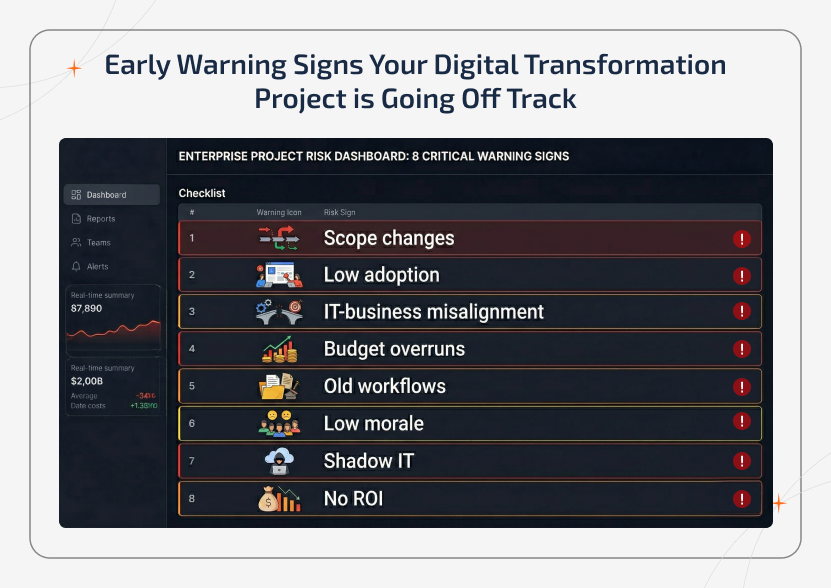
1. Frequent Changes in Project Scope or Goals
Constant shift in goals, requirements, and priorities usually means the strategy wasn't clearly defined. This shift creates confusion and leads to rework, wasted effort, and resources.
2. Low User Adoption at 30/60/90 Days
When the employees don't prefer to use the new systems within the first 90 days, it's a red flag. It often means the tools don't fit their workflow or the team wasn't properly trained.
3. Poor Alignment Between IT and Business Teams
When the tech and business teams are not aligned on requirements, priorities, and outcomes, execution becomes fragmented. This, in turn, leads to delays and solutions that fail to address real business needs.
4. Delayed & Budget Overruns
Minor budget variations are normal. But repeated delays or a single overrun exceeding 20-25% means deeper issues happened in planning, scope control, and execution.
5. Employees Reverting to Old Workflows
Whenever teams keep going back to manual or legacy methods such as spreadsheets, emails, or other manual processes, it shows that new processes are not practical or easy to use.
6. Declining Team Morale Around Digital Initiatives
When teams show signs of burnout, frustration, or disengagement, it often means the project is relying on unsustainable effort and not on structured execution. Thus, low enthusiasm and frustration across departments mean the transformation feels like extra work rather than a shared goal.
7. Rise of Shadow IT
When the employees start to use unofficial tools, it is a clear sign that the current system isn't effective or working for them. Hence, it is vital to fix the real issue instead of blocking them.
8. No Measurable ROI within 6-12 Months
When you don't start seeing a clear ROI within 6-12 months, then your digital transformation strategy likely needs a course correction. Taking up a quick action at this stage can prevent a full-scale failure at any time later.
Thus, early warning signs don't mean failure. Rather, they are opportunities to correct the direction. Those companies that act early can prevent small issues from turning into large-scale digital transformation project failures.
The AI Transformation Trap - Why Most AI-Led Digital Transformation Projects Fail
It is to note that adding AI to a broken app or web development process will not fix the issue. Rather, it worsens the problem further and faster. This is the very reason why a lot of AI-driven transformation efforts fail.
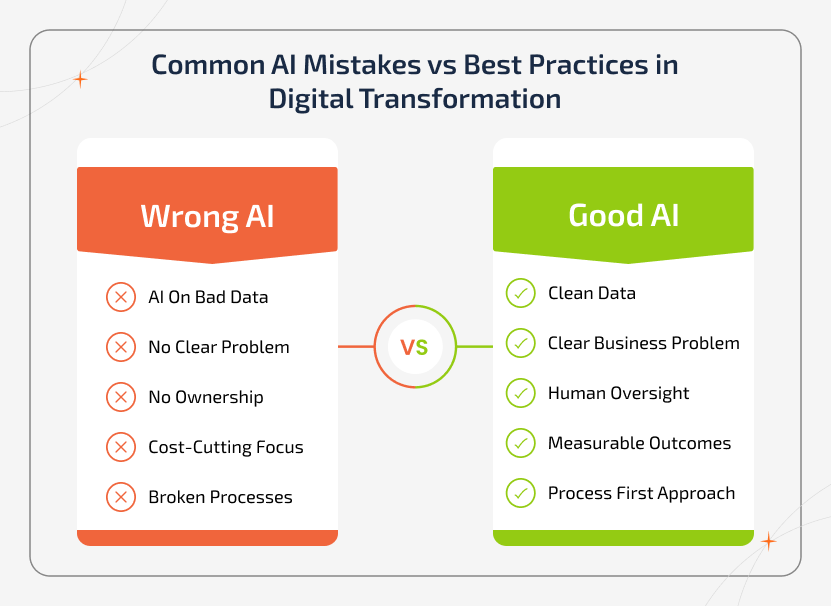
Some of the Common AI Mistakes Include:
- Using AI without fixing the data quality issues
- Choosing AI tools even before defining the actual problems
- There is no clear ownership or accountability for AI outputs
- Starts using AI just to cut down the operational costs and not focusing on improving the user experience
- Expecting AI to fix messy or unclear processes
The Right Approach
- Begin with a clear business problem, and not with the tool
- Ensure to clean and prepare your data before using AI
- Add human review where AI impacts customer or decisions
- Start measuring success based on usage and output quality, and not on deployment
So, AI works best when it improves a well-defined process and not when it tries to fix a broken issue.
How to Plan a Successful Digital Transformation - The 6-Step Fix Framework
Often, successful digital transformation needs a structured approach to balance the speed, clarity, and execution. The following framework helps those organizations starting fresh as well as those recovering from a stalled transformation.
1. Week 1-2: Set Clear Business Goals & KPIs
Begin by defining what success looks like. It's important for every goal to be measurable and owned rather than being vague.
Limit the goals to 3-5, as exceeding this often reduces the clarity and impact. Further, don't proceed until every goal has a number and an owner.
2. Week 2-4: Select 1-2 High-Value Use Cases
Don't try transferring everything at once. It is good to start small with use cases that deliver measurable results. Ensure the use cases have a business owner, manageable technical complexity, and high visibility to build internal momentum. Examples include customer onboarding, invoice processing, etc.
3. Month 1: Build the Right Team & Governance
Transformation will fail without clear ownership. Defining roles early avoids confusion later. The key roles include executive sponsor, product owner, change lead, and data owner. When the roles are unclear or missing, progress will stall during the critical decisions.
4. Month 2-4: Pilot, Test, and Measure Before Scaling
Run a focused pilot rather than a full rollout. You shall start with one team, department, or region. Before launching, define success criteria like adoption rate, task completion rate, and primary KPI improvement. Proceed to expand only when the pilot meets these benchmarks. It is because scaling too early increases risk.
5. Month 3-5: Drive Adoption with Training & Communication
Adoption among the teams doesn't take place automatically; it must be managed actively. It is vital to provide role-based training before the go-live state, clearly state why the change is necessary, recognize early adopters, and share progress updates regularly. Businesses should not assume that teams will figure things out on their own, and this is the very reason most transformations fail.
6. Ongoing: Review, Optimize, & Scale on Quarterly Basis
Since digital transformation is a continuous process, it is vital to review KPIs against targets every quarter, reprioritize based on results, stop initiatives that don't deliver value, and start scaling with what works. All these ensure long-term success, while this step is often ignored.
Hence, successful digital transformation is all about doing the right things in the right order with clear ownership and measurable results.
Key KPIs to Measure Digital Transformation Success at Every Stage
To measure the digital transformation project’s progress effectively, it is important to track the right KPIs at each stage from delivery to adoption to business impact. The key KPIs to measure include:
1. Delivery Metrics:
These metrics help you track execution efficiency and delivery quality during development and pilot stages.
- Sprint Velocity
- Defect Rate
- Pilot Time-to-Value
2. Adoption Metrics
These are the metrics that show if the users are actually adopting and benefiting from the system.
- Monthly Active Users (MAU)
- Task Completion Rate
- Shadow IT Incidence
3. Business Metrics
These metrics help measure whether the transformation is delivering real business value.
- Cost per Transaction
- Customer Satisfaction (NPS / CSAT)
- Revenue per Digital Customer
- Churn Rate
- Process Cycle Time
- Digital Self-Service Rate
4. Data Health Metrics
Data quality is the one that directly impacts decision-making and AI performance. These metrics ensure your data is reliable.
- Data Completeness
- Data Latency
- Data Quality Score
Tracking the right KPIs at the right stage helps ensure your digital transformation stays aligned with business outcomes and not just technical milestones.
Digital Transformation Project Failure Prevention Checklist
Before launching any major digital transformation project initiative, it is vital to ensure that the following checklist. This helps identify the gaps at an early stage and before they turn into costly failures.
✅ 3-5 clear business outcomes are well defined & each has a named owner
✅ Each outcome has a KPI, baseline, & measurable target
✅ End users were involved in defining project requirements
✅ Data owners are assigned to all critical business entities
✅ Role-based training is planned & scheduled before go-live
✅ Budget includes integration, change management, and support costs
✅ A contingency plan exists for delays, risks, and rollback scenarios
✅ The executive sponsor has participated in at least one cross-functional review
✅ Technology selection is done based on a structured evaluation, and not vendor bias
✅ A quarterly review is scheduled for continuous improvement
How to Modernize Legacy Systems - 3 Practical Ways To Prevent Digital Transformation Project Failure
Many digital transformation projects fail as a result of risky, large-scale system replacements. Modernizing legacy systems does not always require replacing everything all at once. The right approach depends on your budget, risk level, and system importance.
1. Wrap & Renew (API-Based Approach)
Build an API layer around your existing system. Let the new digital features sit on top of it while your core system remains as such temporarily. It works best when:
- The system is stable but outdated
- Replacement costs more or is riskier
- You need quick results without major disruption
2. Incremental Replacement (Module-by-Module)
This is all about replacing parts of the system one at a time, starting with the most important areas. The old system continues running until each new module is stable. This works the best when:
- The system can be broken into smaller parts
- Teams choose gradual change
- You can run old and new systems simultaneously
3. Phased Rebuild (Full Replacement)
This is all about building a new system along with the old one and then gradually move users and data before shutting down the legacy system completely. This works best when:
- The system is outdated, risky, or unsupported
- Maintenance costs are too high
- Long-term benefits outweigh short-term risks
Digital Transformation Project Failure Examples - Lessons from Industry Giants
Over time, even well-funded companies with experienced teams fail to handle digital transformation. This reflects the common mistakes seen across industries. By looking at a few examples, we could understand why their digital transformation projects fail and what can be learned from them.
1. GE Predix - Strategy Failure
GE invested heavily in its Predix platform to become a leader in industrial IoT. But the initiative struggles because of unclear goals, an overly broad product vision, and low customer adoption. The technology itself was strong, but the strategy behind it was not the same.
Things that went wrong:
- There was no clear and focused business need
- Tried to serve too many markets at once
- Overestimates how customers would adopt
This clearly shows that this transformation failed due to poor strategy, unclear goals, and lack of focus. Starting with a smaller, well-defined use case could have delivered better results.
Source: https://www.panorama-consulting.com/ge-digital-transformation-failure/
2. Ford Motor Company - When People Factors are Ignored
Ford tried to move from a traditional car manufacturer to a software-driven business. However, they faced strong internal resistance because the company's culture was built around hardware, engineering, and not on software development. Although technology was available, teams found it hard to adapt to the new way of working.
Things that went wrong:
- Resistance to change across teams
- The gap between leadership vision and how teams actually worked
- Employees weren't ready for a digital-first approach
This transformation wasn't a success due to people-related failure. Digital transformation works only when people are ready to adopt it. So, it is not just about new technology, but is all about changing how teams think and work.
Source: https://hbr.org/2007/01/leading-change-why-transformation-efforts-fail
How to Turn a Digital Transformation Project into Success
It is important to understand that a stalled transformation isn't a failure. There is a high chance of fixing what's broken when the right measures are taken at the early stage. Here is a simple 5-step recovery plan that any of the legacy system modernization companies follows:
- Stabilize the situation immediately - Pause new changes, stabilize tools, assign clear owners, and focus on one key KPI.
- Audit the current state - Find out what's working vs. broken. Get an outside view if needed.
- Refocus on goals - Keep only what matters. Make goals measurable and assign ownership.
- Stay flexible - Shift to agile, short cycles. Learn and adjust quickly.
- Fill capability gaps - Bring in the right expertise to regain momentum fast.
Why Enterprises Trust Sparkout for Digital Transformation Project Handling
At Sparkout, we've seen why digital transformation projects fail, and we've built our strategic approach to avoid those mistakes.
We work closely with enterprise and business teams to ensure every initiative is driven by clear goals, strong governance, and real user adoption, and not just based on technology implementation.
What We Do:
Our services cover the complete transformation journey:
- Digital strategy and roadmap aligned with business outcomes
- Legacy system modernization (wrap, replace, or rebuild)
- Cloud and data platform transformation
- AI and automation with proper data readiness
- Application development, web development, and modernization
- Change management, training, and adoption support
As a trusted software modernization services provider, we focus on outcomes and not just implementation. By partnering with Sparkout, every engagement begins with a transformation health check, where we:
- Assess your current maturity
- Find out the key risks
- Define a realistic 90-day quick-win plan
This ensures your transformation starts with clarity and delivers measurable results from the beginning.
Conclusion
Thus, a failing digital transformation is not the end. It is actually the chance to learn what truly needs fixing. With every setback, it is possible to find the gaps in strategy, culture, or technology that actually need improvement. When done right, the transformation ensures that you stay away from the competitive market, serve users, and get long-term outcomes. The companies that will lead are the ones that stay clear on goals, act honestly, execute step-by-step, and learn & improve over time.