


In today's fast-moving digital economy, custom software development for start-ups and small businesses has become a strategic advantage. With the increase in customer expectations and the need for business scalability, those generic, off-the-shelf tools fall short. For better flexibility, integration, and long-term performance, businesses can better rely on custom software development. It helps start-ups and growing businesses to build software solutions customized to their exact workflows, users, and growth goals. The best part is they don't have to pay long-term costs for workarounds, unused features, and vendor lock-in.
This guide breaks down what custom software development is all about, when to build vs buy, what to build, how much it costs, and how start-ups can minimize risk while scaling confidently.
What Does Custom Software Development Mean for Small Businesses
Custom software development is the process of designing, building, and maintaining software around your specific business processes instead of reshaping your business operations to fit generic SaaS tools.
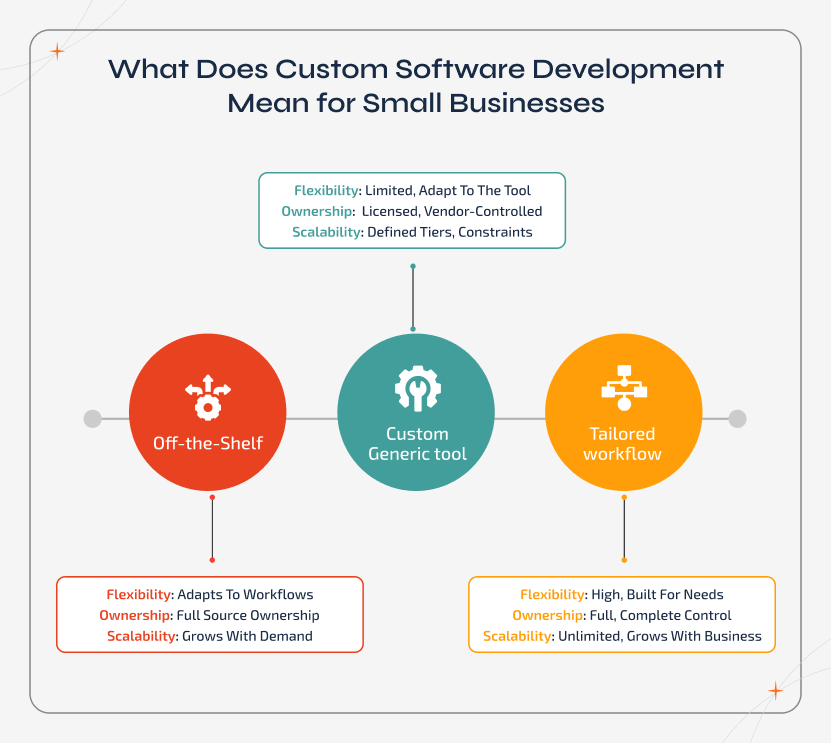
For small businesses and start-ups, custom software becomes important when growth reveals the limit of off-the-shelf tools that don't fit your workflows, customers, or long-term goals. It is especially valuable when:
- Your workflows don't align with standard SaaS products.
- Manual processes are slowing teams and increasing errors.
- Data is scattered across disconnected systems.
- You need ownership over features, product roadmap, and intellectual property.
Unlike off-the-shelf cross-platform software, custom software is built to evolve with your business. It integrates with your existing tools, supports new use cases as your business grow and scales without forcing costly or disruptive platform changes later.
In short, custom software helps small businesses move faster, operate smarter, and stay in control as complexity increases.
Signs Your Start-up or Small Business Should Build Custom Software
Custom software is not always the right first step. But as your business grows, certain signals show that off-the-shelf tools are starting to hold you back.
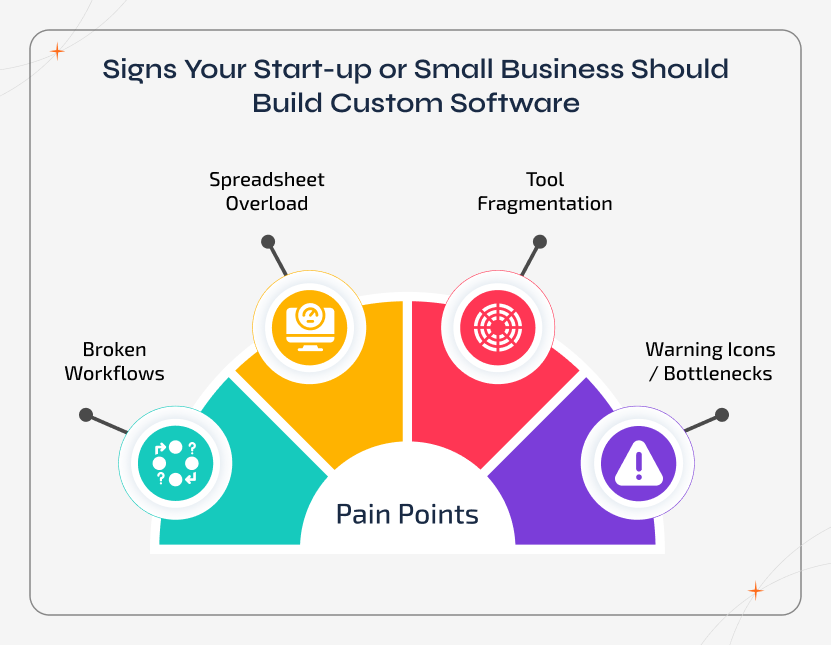
So, it is better to consider custom software development upon noticing any of the following things:
- Rapidly changing workflows that standard tools fail to keep up with.
- Heavy reliance on manual work or spreadsheets, which in turn causes delays and errors.
- Increasing subscription costs without the flexibility to customize features.
- Stronger data security or IP control needs as your product or data grows.
- Multiple tools that don't integrate, leading to data silos.
- Scaling teams, customers, or locations that affect the existing systems.
When two or more of these apply, custom software development for small businesses is the best option, as it often delivers better long-term ROI than stacking more SaaS tools on top of each other.
In short, if your tools are slowing growth instead of supporting it, custom software becomes a strategic upgrade.
Common Custom Software Projects for Start-Ups & Small Businesses
Successful start-ups usually don't build custom software to follow trends. Instead, they build it to solve specific operational problems and drive measurable outcomes.
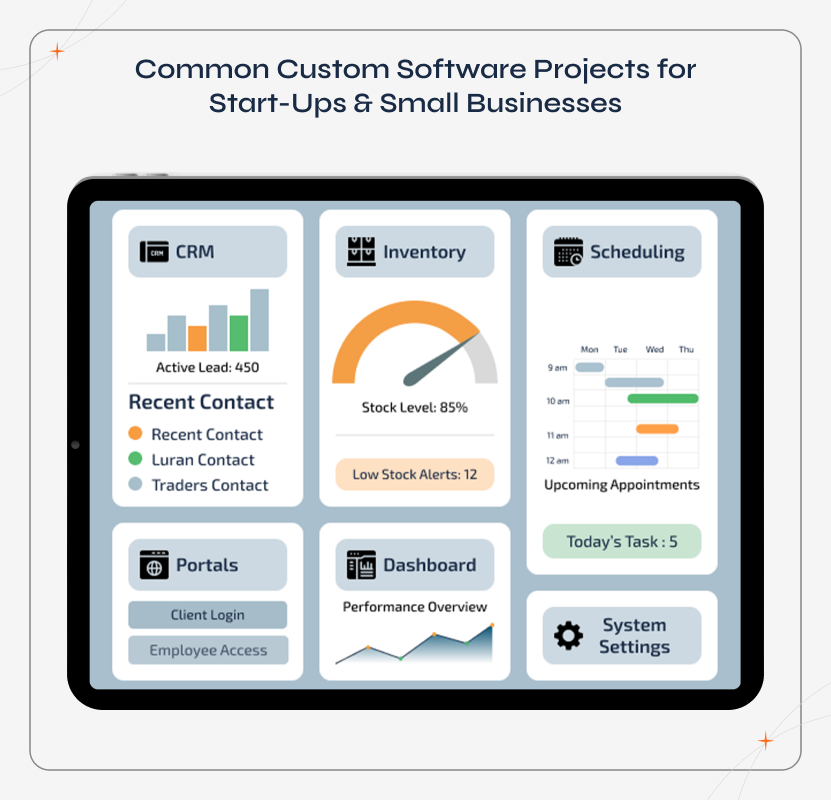
The most common custom software projects for small businesses include:
- Customer portals & onboarding systems to streamline sign-ups and self-service.
- Booking, scheduling, and dispatch tools that help reduce coordination friction.
- Inventory and order management systems for better accuracy and visibility.
- CRM customization and workflow automation that help improve sales and support efficiency.
- Billing, POS, and accounting integrations that remove manual reconciliation.
- Internal dashboards and reporting tools that help with real-time decision-making.
Each of these projects is designed to minimize manual effort, reduce errors, and improve response times, the core outcomes start-ups seek from custom software development. In short, the best custom software isn't complex. It is focused, practical, and directly tied to how your business operates and grows.
The Custom Software Development Process & Timeline
Custom software doesn't have to feel risky or unclear. When done right, it follows a structured, clear process that helps start-up founders and small businesses to control scope, cost, and outcomes at every stage.
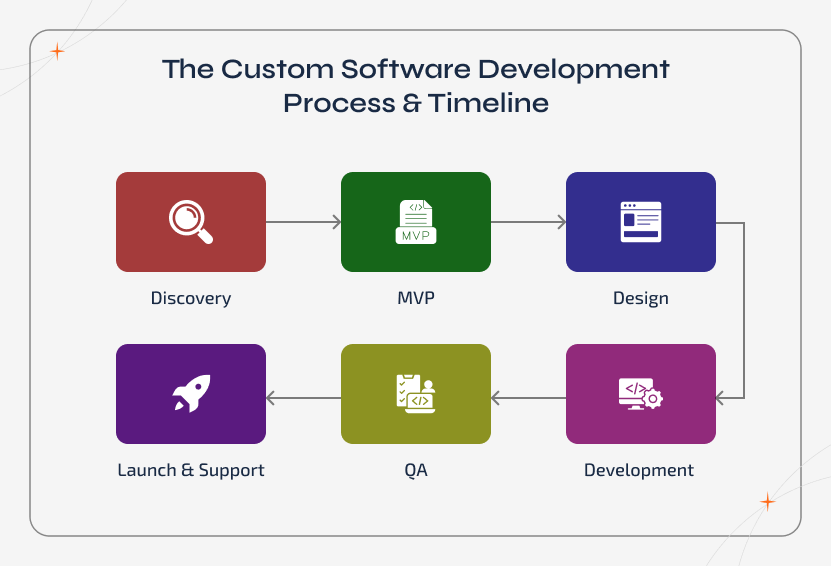
Below is what actually happens - and how long each step typically takes.
1. Discovery & Validation
This phase aligns the software with real business needs before any code is written. Teams usually define goals, target users, workflows, technical constraints, risks, and success metrics. Assumptions are validated at the early stage, so you don't invest in features that clearly won't deliver value.
Timeline: 1-2 weeks
Business Outcome: Clear requirements, validated direction, and lower project risk.
2. MVP & Feature Prioritization
It is not required to build everything at once. Features are categorized based on must-haves and nice-to-haves, depending on the business impact. This keeps the first release focused, faster to market, and within budget.
Timeline: 1 week
Business Outcome: A focused MVP that delivers value without overbuilding.
3. UX & UI Design
The design phase starts with wireframes and interactive prototypes that map user flows, screens, and interactions. The design decisions usually focus on speed, clarity, and ease of use, and not on visual trends. Designs are reviewed and refined before development begins.
Timeline: 2-3 weeks
Business Outcome: Fewer revisions during development and a better user experience from day one.
4. Development (Agile Sprints)
The product is built in short, iterative sprints. Features are developed, reviewed, and improved continuously with a transparent approach. Weekly demos and feedback loops keep stakeholders involved and allow adjustments without derailing timelines.
Timeline: 6-12 weeks (MVP scope)
Business Outcome: Steady progress with full visibility and flexibility.
5. Testing & QA
Before launch, the software is tested for functionality, stability, and performance. This includes functional testing, regression testing, and basic security checks to find issues early and prevent production failures.
Timeline: 1-2 weeks (overlaps with development)
Business Outcome: A stable, reliable product ready for real users.
6. Launch & Maintenance
The software is deployed to production with monitoring and optimization. Post-launch support covers bug fixes, performance tuning, updates, and planning for future enhancements as usage grows.
Timeline: 1 week
Business Outcome: A scalable system that continues to improve after launch.
This structured process ensures custom software development for small businesses is predictable, cost-controlled, and scalable. Thus, helping start-ups build confidently without unnecessary complexity.
Build vs Buy - When Custom Software Makes Sense
Not every problem needs to have custom software. For many startups and small businesses, the smartest approach is knowing when to buy, when to build, and when to combine both. The table below clearly explains the user cases of build vs buy.
| Use Case | Off-the-Shelf Software | Custom Software |
|---|---|---|
| Simple billing or invoicing | ✅ Works well | ❌ Overkill |
| Unique or evolving workflows | ❌ Limited | ✅ Ideal |
| Complex system integrations | ❌ Difficult | ✅ Designed for it |
| Intellectual property control | ❌ Vendor-owned | ✅ Fully owned |
| Long-term scalability | ⚠ Costly over time | ✅ Built to scale |
In-House vs Agency vs Team Augmentation - Which Model Fits Your Start-up?
Choosing the right delivery model can impact cost, speed, and execution quality just like the technology itself. Each option has its own perks, but they fit very different stages of growth.
1. In-House Development Team:
- This is best for mature products with stable, long-term roadmaps.
- Offers full control over people and processes.
- Has strong internal product ownership.
- Comes with high long-term costs (hiring, salaries, benefits, retention).
- It is slower to scale and harder to replace skills quickly.
Best Fit - You have predictable demand and long-term funding.
2. Software Development Agency:
- This is best for start-ups that need speed, structure, and reduced risk.
- Offers faster execution with proven processes.
- Comes with lower hiring and delivery risk.
- It has access to a full team (UX, QA, DevOps, and engineers).
- It is easier to scale up or down.
Best Fit - You want to launch or scale quickly without building an internal team.
3. Team Augmentation:
- Works best for start-ups with strong technical leadership in place.
- Senior engineers plug directly into your existing team.
- Offers high flexibility and faster ramp-up.
- Works best with an internal CTO or tech lead.
- Requires internal oversight and planning.
Best Fit - You need extra expertise or capacity, not full delivery ownership.
Know What Works for Most Start-ups:
For early and growth-stage start-ups, agency-led or hybrid models (agency + limited internal ownership) deliver the best balance of speed, cost control, and reduced risk. This is especially when time-to-market matters the most.
Why Security Matters in Custom Software Development for Startups
Security is one of the most essential factors to consider during custom software development for start-ups. The choices made during early development directly affect future risk, compliance costs, and customer trust.
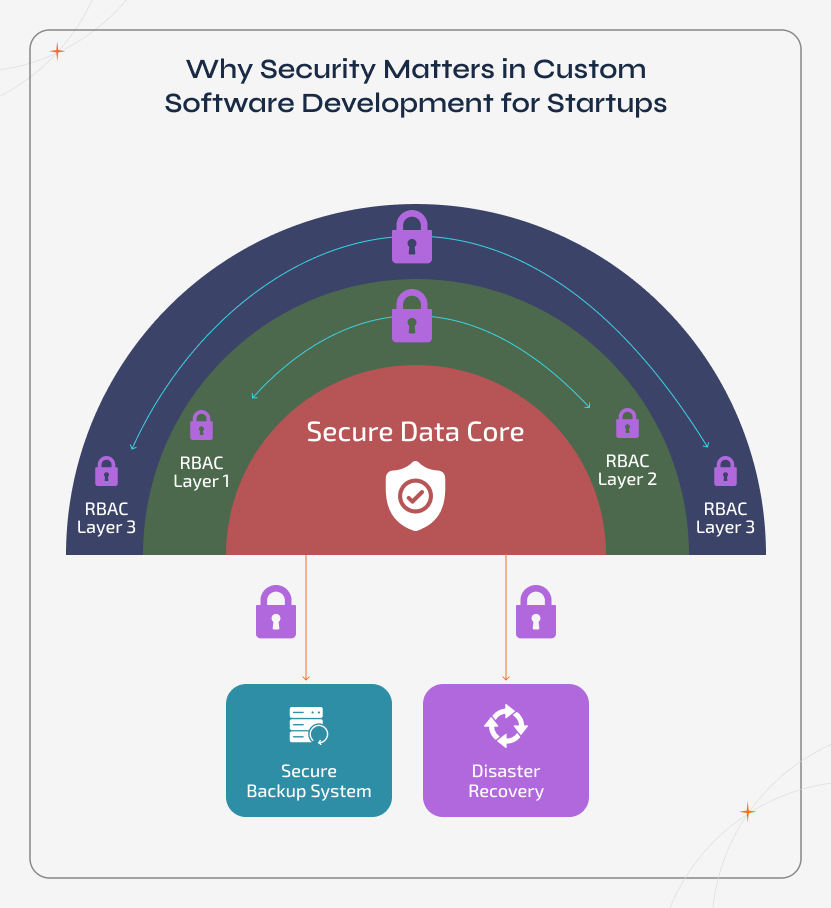
Every start-up must ensure the following security fundamentals are built in from day one:
- Role-based access control (RBAC) to limit what users and teams can see or change.
- Encryption in transit and at rest to protect sensitive data from breaches.
- Secure authentication and session handling to prevent unauthorized access.
- Regular patching and dependency updates to close known vulnerabilities..
- Reliable backup and recovery plans to protect against data loss or downtime.
When security is built into the architecture, it's easier to maintain, cheaper to scale, and far more effective.
This is where custom software development adds real value. i.e., it allows security to be designed into the system from the beginning, instead of being added after problems appear.
System Integration in Custom Software Development for Start-ups
Very rarely, start-ups operate on a single tool. Accounting, payments, CRM, marketing, and operations often work in separate systems. This involves manual work, data gaps, and brings in reporting issues as the business scales.
However, in custom software development for start-ups, integration is a core design decision. Instead of replacing the existing tools, custom software connects them through APIs and creates a unified system that shares data automatically and reliably.
Typical start-up integrations include:
- Accounting and billing tools - To keep financial data consistent.
- Payment gateways - For secure, automated transactions.
- E-commerce platforms - To sync orders, inventory, and users.
- CRM and marketing systems - To align sales and customer insights.
A well-planned integration often reduces manual effort, eliminates data mismatches, and gives founders a single source of truth. This is how custom software companies in the UK and other regions support growth by connecting what already works and removing operational friction.
Custom Software Development Costs in 2026
The cost of custom software development for startups and small businesses in 2026 is based more on scope, complexity, and long-term goals and less on company size. Instead of fixed prices, smart founders plan around cost drivers and phased delivery.
Key Cost Drivers that influence custom software development costs in 2026 include:
- Feature complexity and number of workflows.
- Platform choice (web app, mobile app, PWA, or hybrid).
- Third-party integrations and APIs.
- UX/UI depth and usability testing.
- Security requirements and access control.
- Testing, QA, and deployment needs.
When the system is more tailored and scalable, start-ups need to spend more on the initial investment to get a higher long-term return.
Typical Cost Ranges by Project Type - 2026
While exact pricing differs, small businesses and startups can expect these below ranges in 2026:
- Simple internal tools or workflow automation: $15,000 - $25,000 approx
- MVP software development or customer-facing application: $25,000 - $40,000 approx
- Scalable platform or multi-module system: $40,000+
Many startups reduce upfront costs by launching with an MVP and thereby start expanding the features based on real user feedback.
Timeline Expectations in 2026
Custom software development timelines will usually depend on the project size and not based on the budget:
- Small tools: 4-8 weeks
- MVPs: 8-14 weeks
- Larger systems: 3-6 months or more
By partnering with a trusted custom software development company in India and following an agile development approach, it is possible to release features in stages. This eliminates the need to wait for a single big launch.
Ongoing Costs to Plan for After Launch
Custom software development in 2026 is not a one-time expense. Hence, startups should budget for:
- Hosting & cloud infrastructure
- Bug fixes & performance optimization
- Security updates & dependency upgrades
- Feature improvements when the business grows
Many teams plan ongoing support as a small annual percentage of the initial build cost instead of a fixed monthly expense.
How Startups Can Control Custom Software Costs in 2026
Cost efficiency comes from planning, and it doesn't lie in the shortcuts:
- Start with a clearly defined MVP
- Prioritize must-have features only
- Reuse existing tools where possible
- Release in phases instead of building everything upfront
- Choose a development partner with strong scoping and documentation
With a clear and strategic approach, custom software development for startups in 2026 often costs less over time than stacked subscriptions, manual work, and constant tool switching.
How Sparkout De-Risk Start-up Software Projects
Often, start-up software failures occur when the scope isn't clearly defined, decisions are made in a rush, and systems that can't scale. De-risking a project means minimizing the uncertainty from happening before and during development, and not reacting after problems appear.
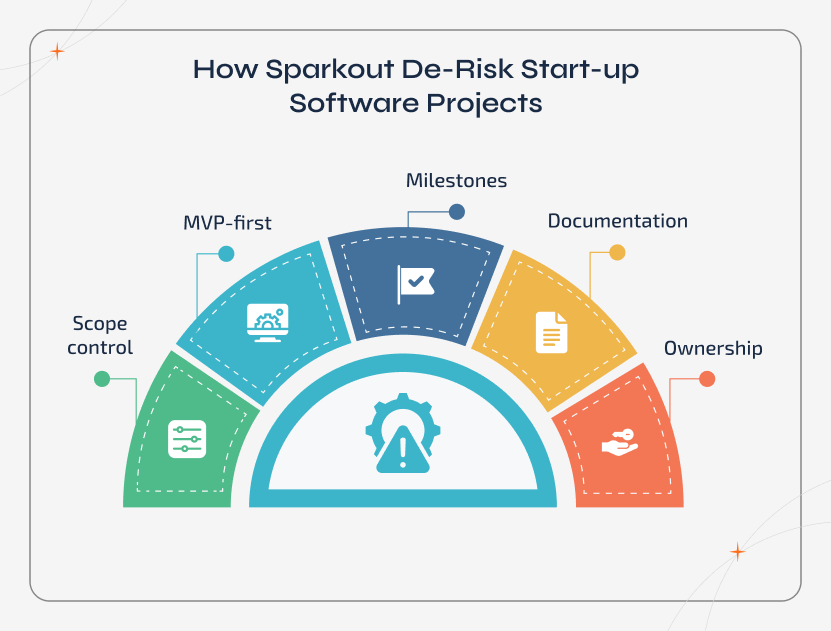
At Sparkout, we reduce risk through a disciplined, start-up-friendly approach:
1. Accurate scoping & change management
Using a
structured process, requirements are clearly defined upfront. Thus, start-ups
and small businesses can better handle the changes without taking up time or
spending out of their budgets.
2. MVP-first delivery
We focus on core functionality
first. i.e., we handle MVP-first delivery and thus help start-ups validate ideas
early, reduce cost, and avoid over-engineering.
3. Transparent milestones and reporting
We ensure the
progress is visible at every stage through demos, sprint reviews, and clear
delivery checkpoints.
4. Clean, well-documented code
Code is structured,
readable, and documented. This way, we make custom software development easier
to maintain, scale, or hand off later.
5. Full IP ownership and knowledge transfer
You own
100% of the source code, documentation, and architecture. There is no vendor
lock-in, and your team can take over anytime.
As a result, start-ups can get predictable delivery, lower technical risk, and long-term ownership.
How to Start Building Software That Attracts Investors
Investors don't just fund ideas but also fund execution and scalability. The quality of your software matters during technical due diligence and can directly affect your valuation.
Strong custom software development for start-ups helps fundraising by providing:
- Scalable Architecture - Systems are designed to handle growth without major rebuilds
- A clean, maintainable codebase - Readable, modular code reduces perceived technical debt and thereby increases investor confidence.
- Strong technical documentation - Simple docs like system diagrams and roadmaps show clarity, planning, and execution maturity.
- Clear performance and usage metrics - Reliable data on uptime, performance, and user behavior strengthens traction narratives.
Custom software development companies in Dubai and other countries are not just involved in launching a product. It's about building a credible, investable foundation that withstands scrutiny and supports long-term growth.
AI-Powered Custom Software for Start-Ups
AI has become a practical growth accelerator for start-ups. With the AI-powered custom software development, businesses can automate the routine work, improve decision-making, and deliver better customer experiences without hiring resources additionally.
Unlike off-the-shelf AI tools, custom AI software is built around your data, workflows, and business logic. So, it will give you better accuracy, control, and long-term flexibility.
High-ROI AI Use Cases for Start-Ups:
- AI chatbots for customer support & onboarding.
- Workflow automation to route tasks & reduce manual effort.
- Predictive analytics for demand, churn, or inventory planning.
- Personalization engines for content & product recommendations.
- AI-driven search for internal knowledge & data retrieval.
Custom AI allows start-ups to
- Own their data and models.
- Integrate AI directly into core systems.
- Scale usage gradually to control costs.
- Add security and access controls from day one.
Modern approaches like fine-tuned AI models, AI agents, and RAG-based systems help start-ups apply AI where it delivers real business value.
With a strategic approach, AI-driven custom software helps start-ups scale faster, operate smarter, and stay competitive-without unnecessary complexity.
Final Thoughts
Custom software development for small businesses is not about building large or complex systems. Rather, it is all about building the right solution at the right stage.
When approached strategically, it helps you:
- Operate more efficiently by removing manual work.
- Protect your intellectual property and product vision.
- Scale without friction as users, teams, and data increase.
- Deliver better customer experiences through tailored workflows.
When your business is outgrowing spreadsheets and stitched-together tools, custom software development for start-ups becomes a strategic investment and not an expense. It gives you control, clarity, and a stronger foundation for long-term growth.