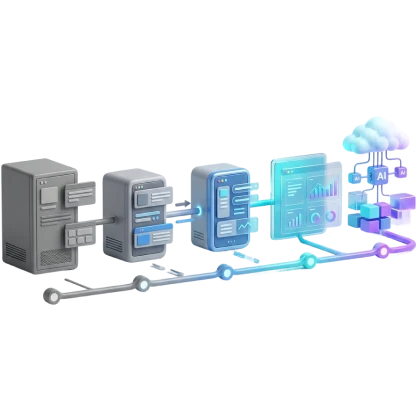



On a typical business day, an enterprise organization should rely on multiple systems to manage operations, which includes the older system. Ironically, when the market evolves and customer expectations increase, traditional software and frameworks face struggles to keep up. To overcome these, modern enterprise software companies are transforming the way they actually work. This allows businesses to respond quickly to the rapidly evolving landscape.
The following informative blog uncovers the latest enterprise software development trends shaping enterprise software, providing valuable insights for software development companies to remain competitive no matter what.
What is Enterprise Software Development in the Era of Rapid Technology Trends?
Enterprise software development is all about building large-scale applications that keep up with rapidly changing technology. Unlike the traditional methods that drag the timeline, modern software development focuses on speed and agility. Technologies like automation and AI are transforming how these systems work, making them smarter and more efficient.
At the same time, priorities have shifted. Security, user experience, and reliability are now as important as performance. In the era of rapidly evolving digital trends, enterprise software development is all about driving innovation and helping enterprises to stay competitive.
Why Business Must Adapt to Enterprise Software Development Trends
Changes are inevitable; it won’t slow down, and neither will your competitors. The way businesses operate today is directly tied to how quickly they adopt modern systems responsibly. Adapting to modern development trends is all about staying relevant in an environment where expectations keep rising.
Businesses that are actively evolving their software approach are better positioned to handle uncertainty and can handle the change.
Here’s why adapting to enterprise software development trends is mandatory:
- Staying Competitive: With modern tools, businesses can march forward more quickly and can keep up with enterprise technology trends.
- Improve Efficiency: Systems that are up-to-date reduce manual workload significantly and streamline everyday processes.
- Enhance Customer Experience: Smarter software enables personalized, quicker, and more reliable interactions with customers.
- Scale Responsibly: Trend-driven architectures make it much easier to scale without any constant rebuilding.
- Better Decision-Making: With advanced analytics and real-time insights, leaders can act with confidence instead of guesswork.
Top Enterprise Software Development Trends in 2026
The enterprise development trend in 2026 is being shaped by a transparent shift from traditional and process-heavy systems to intelligent and highly scalable architectures. To understand the current landscape even better, these trends can be grouped based on their level of adoption and business impact.
Some trends become essential for businesses, while others are significantly gaining popularity and might soon define the next phase of enterprise software development.
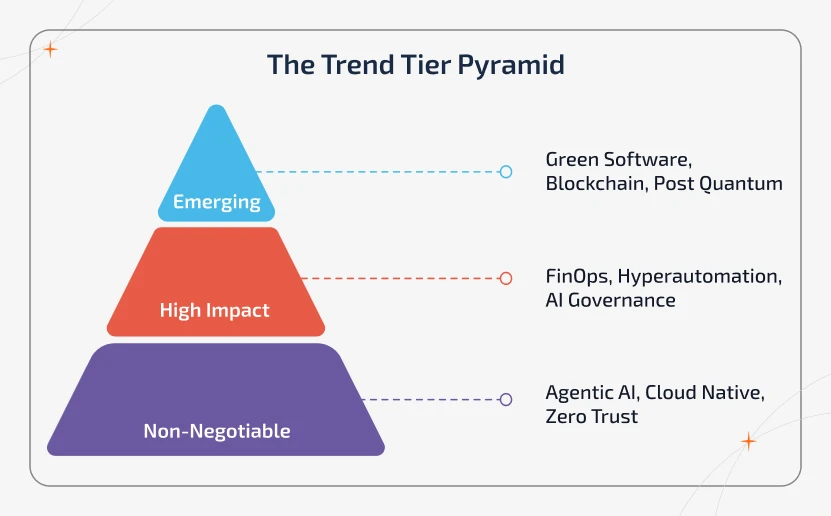
Here’s the overall data that reflects only the first quarter of 2026 competitive benchmarks:
Tier 1 - Non-Negotiable Trends
The following are the foundational trends that have already become essential for modern enterprise software. Toda’s businesses have to adopt them by hiring enterprise software development services to remain competitive and not hold anything back.
1. Transition from Gen AI to Agentic AI
Enterprise AI is moving beyond generating usual outputs using generative AI to completing tasks independently using Agentic AI. With this evolution, the systems can now handle business workflows like approvals, monitoring, and decision-making with minimal human intervention.
This drastic shift minimizes the operational delay and allows the internal teams to focus more on high-value work rather than carrying out the routine processes.
UiPath reports that nearly 37% of the IT executives have already implemented agentic AI in their workflows. Whereas 77% of industries plan to invest in it, displaying the rapid enterprise adoption of the autonomous systems.
2. AI-Driven Software Development Lifecycle
As technology improves, Artificial Intelligence has now been embedded across various phases of the software development. Teams are now using AI to accelerate delivery, pinpoint issues early, and boost the overall code quality.
Following this trend not only shortens the release cycles. It also enables more consistent and reliable software performance throughout the lifecycle.
GitHub data shows that AI tools like Copilot have been generating nearly 46% of code, with projections reaching up to 60% by the end of 2026.
3. Cloud-Native & Multi-Cloud Architecture
Similarly, cloud computing trends have now become the default approach. It is primarily used for building scalable enterprise systems. Enterprise businesses are now increasingly adopting multi-cloud strategies to reduce dependency on a single vendor.
By improving the system resilience, this approach supports better performance, flexibility, and long-term cost control.
In 2026, nearly 74% of enterprises have already adopted cloud-native approaches. Organizations that are leveraging these architectures report 20-40% lower development costs and 2-3 times faster release cycles.
4. Low-Code & No-Code Adoption
The days are no more when developers need standardized code to develop software. Now, low-code and no-code platforms are reshaping the way applications are built on an enterprise system. Enterprises can now create functional and well-performing applications without any deep coding knowledge.
Due to this, teams can now focus on more complex system requirements rather than focusing only on code. This significantly reduces the development backlog and boosts innovation across departments.
Low-code platforms are expected to power 75% of the newer applications by the end of 2026. The market is projected to reach $45 billion, while 48% of businesses report quick app delivery using this approach.
5. Zero-Trust Security Frameworks
Security and compliance are no longer limited to perimeter protection. A zero-trust framework requires continuous verification of users, devices, and system interactions, regardless of their location.
This approach is more important in distributed and cloud-based environments, where traditional security models are no longer sufficient.
Zero trust has moved from a strategic initiative to a baseline expectation. Around 86% of enterprises have started this adoption already, but only 2% have reached full maturity.
6. DevSecOps Integration
Speaking of security, it is now integrated directly into the development pipeline instead of being addressed at the final stage. With DevSecOps integration, it ensures that vulnerabilities are identified early through automated testing and continuous monitoring.
This actually reduces the risk of security breaches and helps organizations maintain compliance without dragging the development process.
Despite the widespread adoption, nearly 87% of the organizations are still exploiting vulnerabilities. They face these vulnerabilities in production, highlighting the flaws in traditional security approaches. It also states that teams that implement DevSecOps can resolve vulnerabilities up to three times faster and can detect over half of the issues during development.
7. Platform Engineering
To minimize the complexity and improve efficiency, software development companies have built internal platforms to stabilize the development workflows. These internal developer platforms provide pre-configured tools, processes, and infrastructure, allowing developers to focus on building features instead of managing environments.
Somewhere in mid or late 2026, mature platform engineering practices are expected to compress the release cycles from weeks to certain hours. Around 80% of enterprises are expected to have dedicated platform teams. Now, the focus shifts to building internal platforms that keep the development quick and consistent.
8. Composable & Modular Architectures
Most of toda’s modern enterprise systems are designed using modular components, which can be easily updated or replaced independently. This composable approach allows organizations to adapt to the latest trends in enterprise software development quickly without the need for rebuilding the entire system. It also reduces the downtime and improves long-term maintainability.
The custom enterprise software development market is projected to expand from $43.16 billion in 2024 to $146.18 billion by the end of 2030. This is driven by the demand for modular and adaptable systems that support continuous change without full builds.
9. Edge Computing
Edge computing enables data processing nearer to where it’s generated. This minimizes the latency and enables real-time decision-making. This networking philosophy is valuable in industries like healthcare, manufacturing, and logistics, where immediate insights can directly impact the operations and outcomes.
Based on recent market projections, the IoT market is expected to reach $41 billion by 2030, with edge computing enabling real-time processing across various industries, supported by 5G low-latency infrastructure.
Tier 2 - High Impact Trends
These enterprise software development trends are rapidly gaining momentum and are starting to give measurable business value. These trends are mandatory for businesses looking to stay ahead in the near future.
1. FinOps Integration
As the cost of cloud and AI skyrockets, organizations are embedding financial accountability into engineering decisions. FinOps practices ensure that teams consider cost efficiency during the software development, and not after that. By following this practice, you can avoid unexpected expenses and align technical decisions with business goals.
As organizations start to integrate FinOps directly into engineering workflows, teams can track and optimize cloud spending in real time. This will possibly cut off unnecessary cloud costs up to 30%.
2. Hyperautomation Across Processes
Hyperautomation is the blend of AI, robotic process automation, and workflow orchestration to automate complex processes end-to-end. Automating isolated tasks is no longer necessary. Now, organizations are streamlining their entire operations, leading to significant improvements in efficiency and accuracy.
By automating legal document processing, JPMorgan Chase’s COiN platforms save approximately 360,000 hours annually, demonstrating large-scale efficiency gains.
3. MLOps & AIOps Maturity
With the rapid increase of AI dependency, managing machine learning models in the production unit has become critical. Alongside MLOps and AIOps, businesses can get a structured process for monitoring, updating, and scaling models. This ensures that the AI systems remain accurate and aligned with the business needs.
Enterprise companies that implement MLOps and AIOps report 40-60% faster model deployments and up to 30% fewer production failures. This enables AI systems to move reliably from experimental stages to stable, large-scale production.
4. AI Governance
As AI adoption among enterprises increases day-by-day, governance needs to be stabilized. Organizations are implementing effective frameworks to ensure that the AI systems are ethical and compliant with evolving regulations. This becomes essential for building trust and avoiding legal risks.
With regulations like the EU AI Act taking effect, more than 80% of enterprises are implementing transparency frameworks within their AI systems to meet compliance requirements.
5. AI-Driven Personalization
Many enterprises are leveraging AI to create a more personalized digital experience. By analyzing user behaviour in real time, platforms can adjust the recommendations and interactions accordingly. This results in making the users feel more engaged and having a smoother overall experience.
AI-powered personalization contributes to around 35% of Amazon’s revenue. Recent studies show that it can increase sales by 10% or more, with up to eight times the ROI.
6. DevEx as Performance Metric
Enterprises recognized that developer productivity directly impacts business outcomes. By enhancing the tools, workflows, and onboarding processes, companies can minimize errors and make sure teams deliver results quickly and more efficiently. Like any other key metric, Developer Experience (DevEx) is being measured and optimized.
It’s predicted that nearly 90% of enterprise software engineers will be using AI coding assistants. As these tools become part of everyday development, DevEx matters more, as it plays a major role in how quickly developers get started and how productive they are.
7. Modern Backend Framework (.NET Core)
Modern frameworks like .NET Core do support cross-platform development and scalable architectures. They enable organizations to build strong enterprise applications while minimizing the development time and improving maintainability. This specific framework, alongside enterprise application development services, will benefit enterprises that are modernizing their legacy systems.
.NET and related technologies have been used by more than 25% of developers, with over 34% of web applications running on it. It gains popularity due to cross-platform flexibility and the ability to modernize older enterprise software without a complete rebuild.
8. Progressive Web Applications (PWA)
Progressive Web Applications combine the accessibility of web-based platforms with the performance of native apps. They offer features like offline access, push notifications, and faster load times without requiring separate development for multiple devices. This makes a cost-effective solution for delivering consistent user experiences.
PWAs have been shown to maximize user engagement up to 137% and enhance conversion rates by 36%. This makes PWAs the preferred choice for delivering app-like web experiences.
Tier 3 - Emerging Trends
These are the initial-stage trends with growing momentum that an enterprise must monitor and prepare for as the’re about to shape the future of enterprise software development.
1. Green Software Engineering
Sustainability becomes business’s top priority. So, organizations must focus on reducing the environmental impact of their software. This possibly includes optimizing the code, improving infrastructure efficiency, and lowering energy consumption across the systems.
Writing energy-efficient code and optimizing cloud usage can cut off infrastructure cost by 15-30%. Due to this, sustainability isn’t a niche anymore. It’s a competitive edge and one of the most important requirements for compliance in modern enterprises.
2. Blockchain Technology
In the past years, blockchain has been gaining popularity beyond cryptocurrency, specifically in the areas that require transparency and data integrity. Enterprises are now exploring its use in supply chains, identity management, and secure transactions to build more trustworthy systems.
In 2026, more than 60% of enterprises are already using blockchain for supply chain tracking, identity management, and others. At the same time, smart contracts in trade finance have already seen a rise of over 50%. This shows how quickly blockchain can move from hype to real-world business use.
3. Post-Quantum Cryptography
As quantum computing advances day-by-day, traditional encryption methods might become more vulnerable. So, enterprises are now adopting quantum-resistant algorithms to protect sensitive data and ensure long-term security.
After NIST’s 2024 standard, enterprises are accelerating the shift to quantum-resistant cryptography. This is driven by security risks and upcoming 2035 compliance requirements.

Additional Trends That Are Worth Watching in 2026!
Besides the software development trends that have been included, enterprises also need to keep an eye on the following trends.
- Industry cloud platforms
- API-first & event-driven architecture
- Digital Provenance
- Rust & memory-safe programming languages
- Sovereign cloud & data residency compliance
- AI-augmented testing & QA automation
How Enterprises are Adapting to New Software Development Trends
More than just a one-time implementation, enterprises are now viewing software development as a mandatory thing to carry on. To keep pace with the rapid technological shifts, organizations are actively redesigning their development strategies and embedding intelligence into their systems.
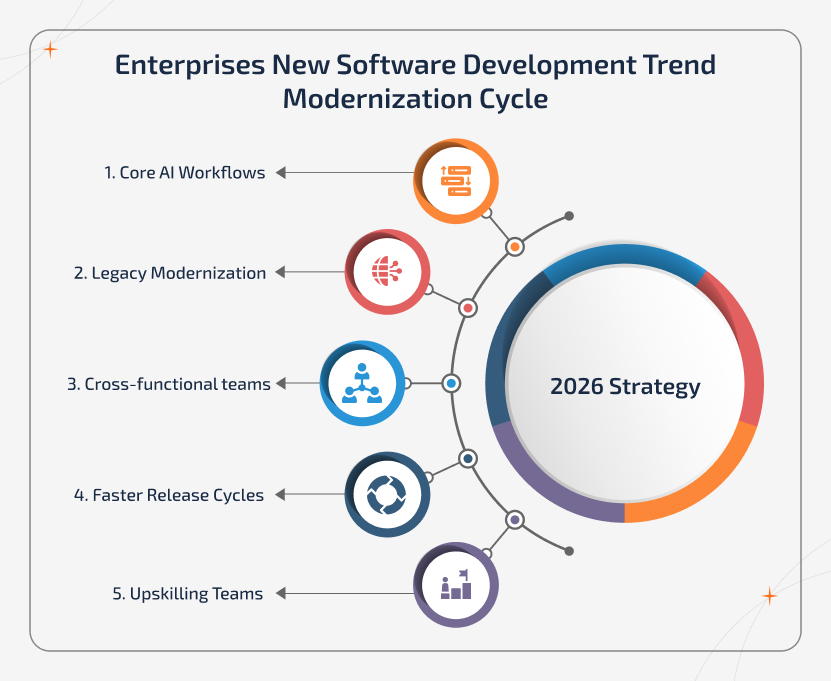
To achieve this, enterprises are adopting a combination of modern practices and technologies that benefit them. This includes:
- Embedding AI into core workflows
- Modernizing legacy systems
- Strengthening cross-functional collaboration
- Standardizing processes and workflows
- Prioritizing faster release cycles
- Improving system interoperability
- Enhancing monitoring and performance tracking
- Upskilling teams and adapting to new roles
Should You Adopt These Trends? A Quick Checklist
Before you jump on any of the software development trends to improve your enterprise, ask questions for yourself:
✅ Does it really solve the real problems your team faces currently?
✅ Do you actually have the infrastructure to support it today?
✅ Does it really align with your 12-24 month business goals?
✅ Is your team skilled enough to implement these trends without any major disruption?
✅ Can you pilot it small before committing enterprise-wide?
✅ Is there a compliance or regulatory reason pushing the adoption?
How to analyze your result (Based on the number of checks):
⮚ 5 - 6 → Yes → Adopt now, don’t wait further
⮚ 3 - 4 → Yes → Start piloting now, build toward full adoption
⮚ 1 - 2 → Yes → Monitor closely and revisit in 6 months
⮚ 0 → Yes → Just not the right time to implement, stay informed
Key Benefits of Adopting Modern Enterprise Software Development Trends
Adopting modern enterprise software trends brings countless benefits, which directly impact both day-to-day performance and long-term growth. Here are a few of them:
⏳ Faster Time to Market
With the latest trends, enterprises can run a streamlined development process that allows businesses to release new features more quickly than ever.
🔒 Stronger System Reliability
Improved monitoring and structured workflows minimize downtime and ensure consistent performance.
💰 Cost Optimization
Spending the resources responsibly helps in controlling the operational and software development costs that might drain your bank account.
🔮 Future-Ready Foundation
With future-ready solutions by their side, enterprises can be prepared to adapt to new innovations without any proper disruptions.
🤝 Improved Collaboration
Modern systems built with the latest trends enable better communication and alignment between departments. This reduces working in isolation and will improve the overall workflow efficiency.
🧑💻 Enhanced Customer Experience
Faster systems, better integrations, and responsible applications help to deliver smoother and more reliable user experiences.
Challenges in Adopting Enterprise Software Development Trends
Even though enterprises are embracing modern development practices, the transaction can introduce several operational and technical challenges. These ones often slow down the adoption and can require careful planning and execution.
Here are some of the common challenges faced by enterprises. This happens while introducing the latest software development trends:
Legacy System Constraints
Even in 2026, many enterprises continue to operate on legacy systems. These systems are tightly knotted and difficult to modernize. Integrating these systems with the cloud native or AI-driven solutions always requires significant refactoring or a complete replacement, which increases the complexity.
Skill Gaps
The adoption of the latest technologies, including DevOps and platform engineering demands new technical skills. In reality, many organizations face shortages in experienced talent. On the other hand, the existing teams always require extensive training to adapt to modern tools and practices.
High Implementation Costs
Modernizing legacy systems involves investment in infrastructure, training, tools, and migration efforts. The costs can be substantial. This is specifically for large enterprises that are managing multiple systems and global teams.
Organizational Resistance
The change from a traditional development model to an agile and new workflow often meets resistance from teams. This can slow down your digital transformation efforts and impact collaboration across various departments.
Security Concerns
When enterprises adopt cloud-native systems, AI-driven tools, and APIs, they should address increased risks around data security and governance. Balancing consistent control across the distributed systems becomes even more challenging while scaling.
Best Practices for Implementing Enterprise Software Development Trends Successfully
Adopting enterprise software industry trends in 2026 requires a balanced approach that blends strategic planning with practical execution. A planned execution ensures smoother transitions and better adoption.
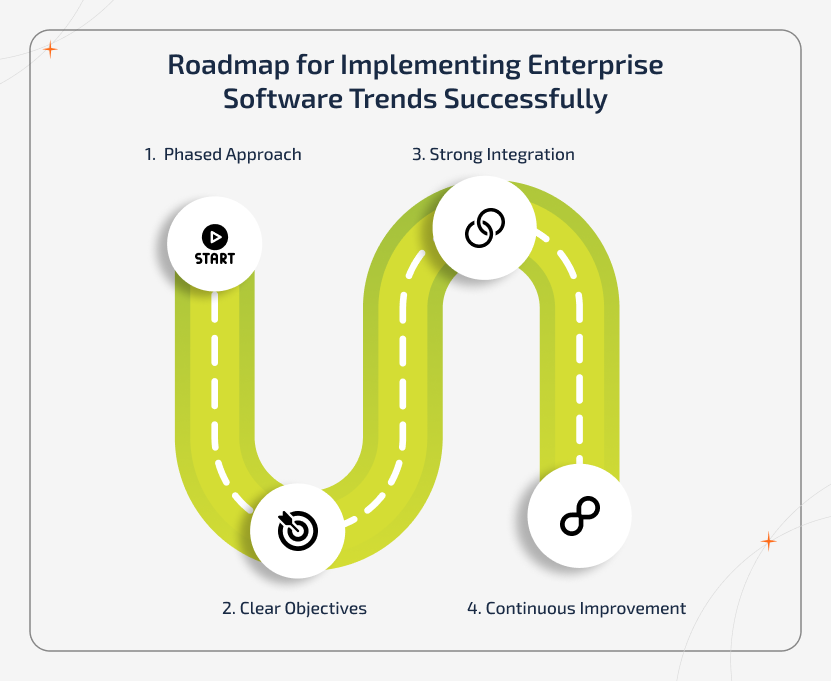
Adopt a Phased Approach
Make changes on the respective stages rather than doing it all at once to minimize the risk and avoid operational disruptions. With a phased rollout, teams can test, adapt, and improve at every step.
Define Clear Objectives
Establish a clear goal before the implementation to make sure every initiative aligns with the business priorities. This helps the teams to stay focused, track progress, and to achieve measurable outcomes.
Ensure Strong Integration
Make sure that the new systems integrate seamlessly with the already existing tools and respective platforms. This enables a smooth and reliable data flow across the departments and prevents inefficiencies that are caused by disconnected systems.
Enable Continuous Improvement
Continuously track the performance of the system and get feedback to identify the areas of improvement. Regular optimization ensures that the software remains efficient and aligned with the evolving business needs.
Future Outlook of Enterprise Software Development
The current trends in enterprise software development solutions are already reshaping the way businesses think. The future will be driven by more adaptive and intelligent systems. To make their organization stay competitive, they will focus on enabling continuous innovation, faster adaptability, and seamless integration.
Here’s what influences the future of enterprise software development trends:
- Rise of Autonomous Systems: Enterprises will increasingly leverage systems that can quickly act, device, and analyze independently.
- High Adaptive Architectures: The future enterprise systems will evolve continuously, allowing businesses to respond quickly to changes.
- Deeper Integration: Large Organizations will focus on creating connected environments, making it easier for data to flow across teams and functions without flaws.
- Focus on Innovation:Faster development cycle and continuous delivery allows enterprises to innovate and adapt rapidly in the evolving market.
Bottom Line
Enterprise software development isn’t slowing down, the new enterprise software market trends are accelerating the direction where execution matters the most. The latest trends of 2026 are setting a brand new standard for how the systems are built, scaled, and evolved over time.
For enterprises, the core focus is now simple, which is to build systems with clarity, purpose, and execute consistently. Because, in the end, it’s not only about following what’s trending currently. It’s all about using them responsibly for their lasting business impact.