


"How much does Flutter app development cost?" is often one of the first questions asked by businesses that plan to build a cross-platform mobile application. Understanding the cost early helps companies prioritize the features, plan timelines, avoid unexpected budget overruns, and hire Flutter app developers accordingly.
Flutter has become one of the most widely adopted frameworks to build mobile apps as it allows developers to create applications for iOS and Android using a single shared codebase. Thus, helps reduce development time and cost compared to building two separate native apps.
However, the cost to develop a Flutter app in 2026 varies widely based on factors like app complexity, design requirements, backend integrations, and developer location.
Whether you are a start-up building an MVP, a growing company launching a new product, or an enterprise investing in scalable digital products, understanding the Flutter app development cost helps make confident and risk-free decisions.
This guide explains:
- Typical Flutter app development cost ranges
- Key cost drivers and pricing factors
- Developer hourly rates by region
- Hidden expenses businesses often overlook
- Practical ways to reduce Flutter development cost
- When Flutter is more cost-effective than other frameworks
Quick Flutter App Development Cost Summary (2026)
Before exploring detailed pricing factors, take a quick look at the cost ranges offered by Flutter app development companies in 2026.
| App Complexity | Estimated Cost | Timeline | Typical Team |
|---|---|---|---|
| Basic Flutter App (MVP) | $20,000 - $40,000 | 1-3 months | 2-3 developers |
| Medium Complexity App | $40,000 - $90,000 | 3-6 months | 4-6 specialists |
| Complex / Enterprise App | $90,000 - $180,000+ | 6-12+ months | 6-10 experts |
Flutter apps are often 30-40% more cost-efficient than native development, because developers maintain a single codebase instead of two separate platforms.
Annual maintenance costs typically range between 15-25% of the initial development cost.
Major cost drivers include:
- App complexity and number of features
- UI/UX customization level
- Backend infrastructure and integrations
- Development team location
- Security and compliance requirements
What is Flutter?
Flutter is an open-source UI framework developed by Google that allows developers to build high-quality mobile, web, and desktop applications from a single codebase.
This app development framework uses the Dart programming language and provides a rich library of ready-made or pre-built UI components that help developers create visually consistent applications across multiple platforms.
Flutter's architecture offers fast rendering, responsive design, and seamless integration with backend systems. As most of the code is shared across platforms, development becomes much faster and more cost-efficient.
According to industry reports, Flutter has become one of the most widely used cross-platform frameworks by mobile app development companies as it is helping developers build apps faster while maintaining a consistent UI across platforms. For these reasons, many businesses choose Flutter as it offers faster development of high-performance mobile applications across multiple platforms.
Flutter Development Trends Impacting App Costs in 2026
Flutter is evolving as one of the most popular frameworks for cross-platform application development. There are several technology trends that shape how businesses build Flutter apps in 2026.
1. AI-Powered Mobile Applications
A lot of modern apps come with artificial intelligence to improve user experience. It includes features like AI chatbots, recommendation engines, predictive analytics, and smart search.
2. Rise of Super Apps
Super apps combine services like payments, shopping, messaging, and bookings. Flutter's cross-platform nature makes it easier to build scalable super apps.
3. Low-Code & Faster Development Tools
Low-code and AI-assisted coding platforms help Flutter developers build apps faster. These tools accelerate the development speed and minimize the overall development time.
4. Flutter for Web and Desktop Applications
Flutter is not just used for mobile apps but is also used for web and desktop applications. This helps businesses launch products across multiple platforms using one shared codebase.
5. Growing Enterprise Adoption
A lot of companies are adopting Flutter for digital product development as it supports cross-platform apps, faster development, and scalable architecture.
As Flutter continues to evolve, these trends are shaping how businesses plan their Flutter app development strategy and budget.
Flutter App Development Cost in 2026
The Flutter app development cost in 2026 varies depending on several technical and business factors. This includes application complexity, feature requirements, integrations, and infrastructure needs.
Businesses typically rely on Flutter as it helps reduce development costs while building high-performance cross-platform applications for both iOS and Android.
Below is an estimated cost range based on common app types:
| App Type | Estimated Cost | Best For |
|---|---|---|
| MVP Flutter App | $15,000 - $30,000 | Startups validating product ideas |
| Business App | $30,000 - $70,000 | Growing companies building internal or customer apps |
| On-Demand App | $50,000 - $90,000 | Marketplace and service platforms |
| Enterprise Flutter App | $90,000 - $180,000+ | Large-scale enterprise systems |
Key Factors Influencing Flutter App Development Cost
The Flutter app development cost depends on various factors. So, each decision you make for features, design, or team will directly impact the final budget.
1. App Complexity
Apps with basic features and simple workflows cost less. When you decide to add advanced features, real-time functions, or enterprise-level logic, development time and cost increase.
2. UI/UX Design
Relying on standard design components ensures keeping the costs under control. However, custom UI, animations, and brand-specific layouts involve more design and development effort. Hence, the development cost increases.
3. Backend Development & Integrations
The development costs increase when your app needs servers, databases, APIs, payment systems, and third-party services. i.e., the cost increases where there is more integration as it requires more development and testing work.
4. Security & Compliance
Apps that handle sensitive data, like fintech or healthcare apps, need extra security layers and compliance checks. This also adds to the overall Flutter app price.
5. Development Team & Location
-Hiring Flutter developer costs vary based on experience level and region. Senior developers and teams in high-cost regions even charge you more, but often deliver faster and with fewer revisions.
6. AI Feature Integration
Many modern Flutter applications feature AI-powered features that help enhance user experience and automate processes. Common integrations include AI chatbots, recommendation engines, predictive analytics, voice assistants, AI-powered search, etc.
All these implementations require additional APIs, machine learning models, and backend services. Thus, AI features can increase the Flutter app development cost, and it varies based on complexity and customization requirements.
Cost to Hire Flutter Developers by Region and Experience (2026)
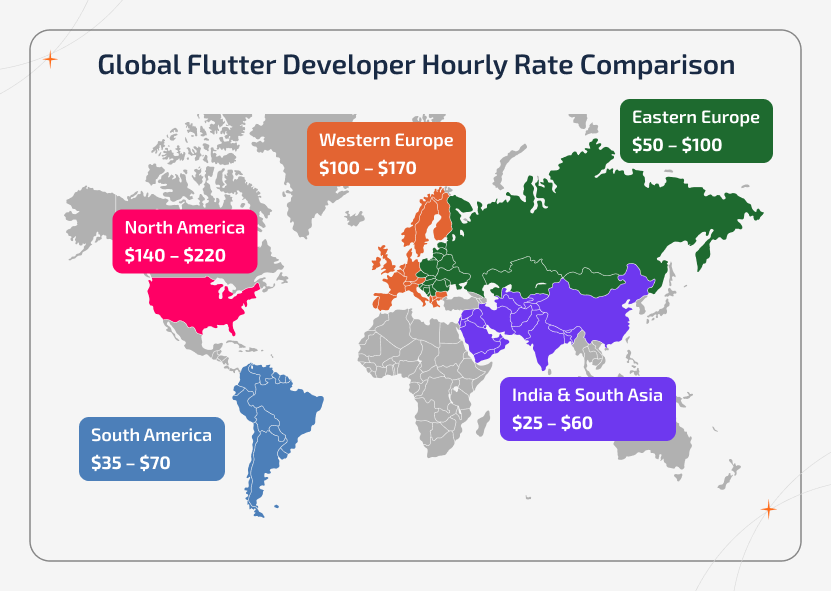
The cost to hire Flutter developers in 2026 varies widely depending on geographic location, developer expertise, and the complexity of the project. It is to note that those regions with mature tech ecosystems, such as North America and Western Europe, typically have higher rates, while offshore development hubs offer more cost-efficient options.
Flutter Developer Cost by Region
Given below is a typical hourly rate comparison for Flutter developers across different regions.
| Region | Average Hourly Rate |
|---|---|
| North America | $140 - $220 |
| Western Europe | $100 - $170 |
| Eastern Europe | $50 - $100 |
| India & South Asia | $25 - $60 |
| South America | $35 - $70 |
A lot of start-ups and enterprises choose offshore Flutter development teams as they help optimize costs while still giving access to experienced developers and scalable delivery models.
Flutter Developer Cost by Experience
Developer experience is another major role that determines the Flutter app development cost. Senior engineers with expertise in architecture, performance optimization, and scalable app development usually get higher hourly rates than junior developers.
| Experience Level | Hourly Cost |
|---|---|
| Junior Flutter Developer | $20 - $40 |
| Mid-Level Flutter Developer | $40 - $80 |
| Senior Flutter Developer | $80 - $120+ |
Often, senior Flutter developers are typically responsible for application architecture, complex integrations, and performance optimization, which are critical for enterprise-grade mobile applications.
Flutter App Development Cost Breakdown by Development Stage
Getting to understand the Flutter app development cost breakdown helps businesses plan their app development budgets more accurately. A typical Flutter project includes multiple development stages, and the overall cost depends on the complexity and scope of the application.
| Development Stage | Cost Share | Key Activities |
|---|---|---|
| Planning & Research | 5-10% | Product strategy, requirements analysis, & technical planning |
| UI/UX Design | 10-15% | Wireframes, prototypes, visual design, user flow |
| Flutter App Development | 40-55% | Frontend development, cross-platform logic, feature implementation |
| Backend Development | 15-25% | API development, database architecture, cloud integration |
| Testing & QA | 10-15% | Functional testing, performance testing, bug fixing |
| Deployment & Launch | 3-5% | App store deployment, release management |
For example, if a Flutter app development project costs $60,000, the approximate budget split may look like:
- Planning & research → $3,000 - $6,000
- UI/UX design → $6,000 - $9,000
- Flutter development → $24,000 - $33,000
- Backend development → $9,000 - $15,000
- Testing and QA → $6,000 - $9,000
- Deployment → $1,800 - $3,000
For the above, the
- Estimated Total Cost $50,000 - $70,000
- Typical Timeline: 3-5 months
Actual Flutter app development cost may vary based on custom UI design, advanced integrations, or scalability needs. Many businesses start with an MVP and then expand features after validating the product idea.
This structured approach helps businesses understand where the Flutter development budget is allocated throughout the project lifecycle.
Flutter App Development Cost by Industry Type
The Flutter app development cost can vary across industries as features, integrations, and compliance standards for each sector differ. In other words, some applications require advanced security, while others focus more on user engagement and transaction processing.
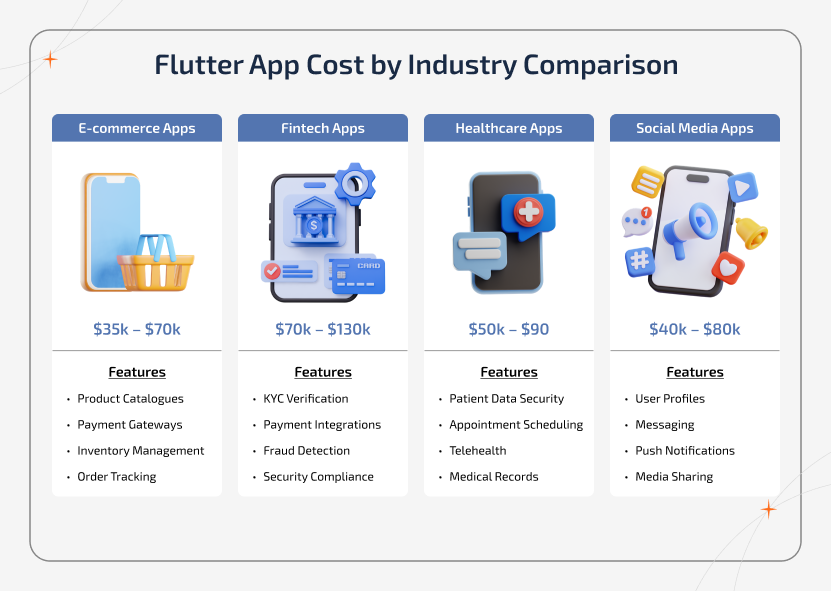
Take a look at the estimated cost range for Flutter apps in different industries:
1. E-commerce Apps
- Estimated Cost: $35,000 - $70,000
Flutter-based e-commerce apps often include features like product catalogues, shopping carts, secure payment gateways, inventory management, & order tracking systems. Integration with payment providers, logistics systems, and recommendation engines adds up to the overall development cost.
2. Fintech Apps
- Estimated Cost: $70,000 - $130,000
Fintech applications need advanced security features, payment gateway integrations, KYC verification, fraud detection systems, and regulatory compliance. This significantly increase in the development cost due to strong security standards and regulatory compliance needs.
3. Healthcare Apps
- Estimated Cost: $50,000 - $90,000
Healthcare applications include patient data security, compliance with healthcare regulations, appointment scheduling, and telehealth features such as video consultations and accessing medical records. Protecting sensitive medical data and meeting healthcare regulations adds technical complexity and overall development cost.
4. Social Media Apps
- Estimated Cost: $40,000 - $80,000
Social media platforms often include features like user profiles, messaging, activity feeds, push notifications, and media sharing. Features like real-time updates, content delivery, and scalable infrastructure add additional development effort.
Flutter App Development Cost by Features
The Flutter app development cost is often estimated based on the features included in the app. The development cost becomes higher when there are more features and complexity involved.
Given below is an approximate cost breakdown for common Flutter app features:
| Feature | Estimated Cost | Complexity |
|---|---|---|
| User Authentication | $1,500 - $3,000 | Low |
| Push Notifications | $1,000 - $2,000 | Low |
| Payment Gateway Integration | $3,000 - $6,000 | Medium |
| Real-Time Chat | $8000 - $15,000 | Medium |
| AI Recommendation Engine | $12,000 - $25,000 | High |
| Predictive Analytics | $15,000 - $30,000 | High |
| Voice Assistant Integration | $20,000 - $40,000+ | High |
Consider an example, the inclusion of features like authentication and notifications is relatively simple to implement, while capabilities like real-time chat or AI-powered recommendations need more advanced development and infrastructure.
The total Flutter app development cost can increase based on factors like feature customization, third-party integrations, scalability requirements, and backend complexity.
Hidden Flutter App Development Costs Businesses Often Miss
When estimating the Flutter app development cost, many businesses focus only on the development hours. However, they miss several additional factors that can increase the total project budget. Understanding these costs early can help businesses plan their projects more effectively.
1. Third-Party Integrations
Modern mobile apps integrate with services such as payment gateways, analytics tools, messaging services, and APIs. These integrations may come with subscription fees, API usage charges, or additional development effort. This, in turn, adds to the overall project cost.
2. Cloud Infrastructure
Apps that require scalable backend systems often depend on cloud services for hosting, storage, and serverless computing. Cloud infrastructure costs vary depending on factors such as the number of users, data storage needs, and usage patterns.
Typical monthly hosting costs may include:
- Small apps: $50 - $150 per month
- Medium apps: $150 - $500 per month
- Large platforms: $500+ per month
3. App Maintenance and Updates
Once after launch, apps often require continuous maintenance, bug fixes, and updates to remain compatible with new OS versions. Many companies allocate 15-20% of the initial development cost annually for maintenance.
4. Security and Compliance
Applications that handle sensitive user data may need additional investments in security testing, encryption, and regulatory compliance. This is especially important for industries like healthcare, e-commerce, and finance.
5. App Store Fees
Publishing an app on major platforms, such as the Apple App Store or the Google Play Store, includes registration and distribution costs.
- Google Play Store: $25 one-time registration fee
- Google Play Store: $99 annual developer fee
In addition to this, both platforms may charge commissions, 15% for small developers and 30% standard commission on digital transactions based on the app's monetization model.
Flutter App Development Cost for Multi-Platform Expansion
One of the key benefits of the Flutter app development approach is its ability to support multiple platforms using a single codebase. However, it is to note that expanding an app beyond mobile may require additional development work, UI adjustments, and testing, which can increase the overall project cost.
Since Flutter is increasingly used for POS systems, Smart TV apps, and IoT dashboards, take a look at the estimated cost impact when extending a Flutter app to additional platforms.
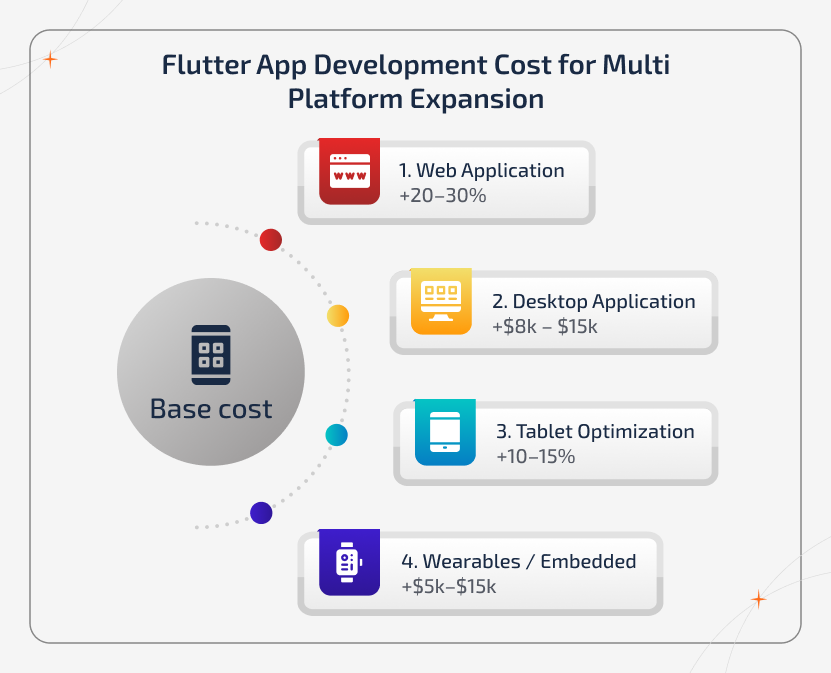
For instance, adapting a mobile app for web or desktop platforms involves layout adjustments, responsive design improvements, and additional testing across different screen sizes and operating systems.
As a result, businesses planning multi-platform Flutter applications should consider these expansion costs while estimating the overall development budget.
| Platform | Estimated Cost Increase |
|---|---|
| Web Application | +15 - 25% |
| Desktop Application | $10,000 - $20,000 |
| Tablet Optimization | +10 - 15% |
| Wearables / Embedded | $5,000 - $15,000 |
How to Reduce Flutter App Development Cost Without Compromising Quality
Reducing the Flutter app development cost doesn't mean compromising on the quality. With the strategic planning and decisions, businesses can effortlessly build high-quality apps while staying within the marketing budget. The smartest ways to control costs are as follows:
1. Start with an MVP
Businesses can start by building only the core features to test the idea. i.e., by building a Minimum Viable Product (MVP). This helps avoid unnecessary development and wasted money.
2. Reuse Flutter components
With the help of Flutter's strong ecosystem of ready-made widgets and reusable code, it is possible to reduce development time and effort.
3. Focus on Essential Features
Prioritizing must-have features often helps businesses control scope and thus prevents cost overruns. Often, teams use the MoSCoW prioritization method to decide which features should be included first:
- Must-have - Essential features required for launch
- Should-have - Important but not critical features
- Could-have - Nice-to-have features for future updates
- Won't-have - Features that can be postponed
This approach helps teams focus on delivering the most valuable functionality first.
4. Choose the Right Development Partner
An experienced Flutter development company can often reduce operational costs. By outsourcing, businesses can access skilled developers without the overhead expenses of building an in-house team. Thus, ensuring faster, cleaner results with fewer reworks.
5. Plan for Scalability Early
Choosing a well-structured architecture helps avoid expensive rebuilds as the app grows.
Thus, with smart planning, businesses can significantly reduce overall Flutter mobile app development costs while still delivering a reliable and scalable Flutter app.
How In-House Flutter Development Impacts Your App Budget
Building a Flutter app with an in-house team is all about having more than just developer salaries. Companies should plan for several ongoing expenses that will eventually increase overall costs. The in-house Flutter development costs by any top app development companies typically cover the following.
Typical in-house Flutter development costs include the following.
1. Developer Salaries & Benefits
Hiring full-time Flutter developers means businesses should deal with fixed monthly salaries, employee benefits, insurance, and performance incentives. These are recurring expenses and thus increase the overall cost of maintaining an internal development team.
2. Infrastructure and Development Tools
In-house teams often need development infrastructure that includes:
- High-performance hardware
- Software licenses
- Testing devices
- Cloud services & development environments
These are technical resources, and they add to the operational cost of building and maintaining applications.
3. Recruitment & Onboarding Costs
Hiring Flutter developers involves recruitment expenses, including job postings, interviews, onboarding, and training. The hiring process can also slow project timelines when suitable candidates are difficult to find.
4. Long-Term Operational Costs
Companies must also manage long-term expenses related to:
- Team management
- Ongoing app updates
- Employee retention
- Internal project coordination
For many organizations, the cost to hire Flutter developers internally can be significantly higher than outsourcing. This is true for short-term projects or MVP development.
Outsourcing helps businesses access experienced developers quickly without maintaining a permanent in-house team.
How Outsourcing Flutter Development Reduces App Costs
Outsourcing Flutter app development helps businesses control costs and thereby speed up the delivery. Rather than building and managing an in-house team, companies can work with experienced Flutter developers on flexible terms. The benefits of outsourcing Flutter app development include:
1. Flexible Engagement Models
It is possible to choose Flutter development hourly rates, fixed-cost, and dedicated team models based on your project requirements.
2. Faster Time-to-Market
By partnering with experienced teams, businesses can minimize app development delays while quickly starting and following proven development processes.
3. Access to Skilled Flutter Developers
By outsourcing, it is possible to work with specialists who have hands-on experience across different industries.
4. Predictable and Transparent Pricing
Businesses shall get to know the clear cost structures, and this helps them avoid getting into unexpected expenses.
Upon partnering with a reliable Mobile app development Agency or Super App Development Company, businesses can easily scale while reducing risks and thus keep Flutter app development costs under control.
In-House vs Outsourcing Flutter Development - A Closer Look
Businesses can choose from different hiring models when building a Flutter app. Each approach has its own advantages and challenges based on the project scope, budget, and long-term goals.
| Development Model | Advantages | Challenges |
|---|---|---|
| In-House Team | Full control over the development process and direct collaboration with the team | High operational costs, including salaries, infrastructure, and recruitment |
| Freelancers | Lower development cost and flexible hiring for short-term tasks | Limited scalability and potential reliability issues for large projects |
| Outsourcing Agency | Access to experienced teams, structured processes, and faster delivery | Requires clear communication and project coordination |
Selecting the right model depends on factors like project complexity, budget, and long-term product strategy. Often, businesses choose outsourcing as it offers a balance between cost efficiency and access to skilled development teams.
Flutter App Development Cost vs Other Frameworks
When comparing Flutter with native and other cross-platform frameworks, Flutter often stands out. In other words, Flutter balances cost efficiency, performance, and development speed better than other frameworks.
1. Lower Cost Than Native Development
Flutter uses a single shared codebase for iOS and Android. This, in turn, reduces the development and testing costs when compared to building two separate native applications.
2. Faster Development Cycles
Flutter's hot-reload capabilities and reusable UI components help developers build and test features faster than many traditional development approaches.
3. Reduced Long-Term Maintenance Costs
With a shared codebase, updates and bug fixes can be implemented once, and they can be applied across platforms. This significantly reduces long-term maintenance efforts.
Below is a quick comparison of Flutter with other development approaches.
| Factor | Flutter | React Native | Native Development |
|---|---|---|---|
| Code Reusability | High | Medium | None |
| Development Speed | Fast | Moderate | Slow |
| Development Cost | Lower | Medium | Higher |
| Maintenance Effort | Lower | Medium | High |
Because of this balance between cost efficiency and performance, Flutter has become a practical choice for both startups and enterprises looking to build scalable mobile applications without exceeding development budgets.
When Flutter App Development May Not Be the Best Choice
While Flutter is a powerful framework for cross-platform development, there are times when it may not be the most suitable option. This includes:
1. Deep Native Platform Integration
Apps that rely the most on platform-specific features or low-level system access may need native development for better control and performance.
2. Advanced 3D or High-Performance Games
Applications that need intensive graphics processing or advanced 3D rendering are often better suited for specialized game engines or native development.
3. Single-Platform Applications
When the application is designed specifically for only one platform (either iOS or Android), native development can sometimes offer more optimized performance and tighter platform integration.
Why Choose Sparkout for Flutter Development
At Sparkout, we help businesses plan and manage Flutter app development costs while building scalable and high-performance applications. Our development approach aims to deliver efficiency, transparency, and long-term product growth.
Our approach includes:
- We follow MVP-first product strategy to validate ideas faster and minimize unnecessary development costs.
- Reusable and scalable architecture that helps support future feature expansion.
- We offer transparent cost estimation to help businesses plan budgets with clarity.
- Global development teams experienced in cross-platform Flutter application development.
With the right strategy and experienced developers, businesses can confidently hire Flutter developers from Sparkout and thereby build reliable, scalable digital products.
Conclusion
Flutter is one of the most cost-effective frameworks for cross-platform app development. It is helping businesses build modern applications faster while keeping the development costs under control.
It not only lets the developers create iOS and Android apps from a single codebase but also reduces development time, simplifies maintenance, and improves overall efficiency. This approach helps businesses launch products faster while maintaining consistent performance and user experience across platforms.
It is to note that the Flutter app development cost can vary depending on factors like app complexity, features, integrations, development team location, and infrastructure needs. Getting to know these factors helps businesses plan their budgets effectively and thereby stay away from unexpected expenses during the development process.
With the right strategy, careful feature planning, and an experienced development partner, businesses can build scalable and high-performance Flutter applications that support long-term growth while staying within their development budget.