


Ever wondered how exactly that sleek app you use in your day-to-day life runs flawlessly on both your phone and browser without any issues? Actually, Flutter is the reason that makes it possible. By hiring a Flutter app developer, you can build applications that work across multiple devices, including mobile, web, and desktop, from a single codebase. This keeps everything fast, smooth, and consistent.
If you're a business owner, product manager, startup founder, or developer, this informative guide will show you exactly how to build Flutter app easily without getting stuck in between.
Just make sure you've got your app idea, target platforms, and development tools set up before diving in.
What is Flutter by Google?
Flutter is an open-source app development framework released by Google. It is primarily used by businesses to build apps for mobile, web, and desktop platforms using a single codebase. i.e., teams can take advantage of creating once and launching everywhere with Flutter. With this framework, you can:
- Build cross-platform apps from one shared codebase.
- Create fast, responsive mobile apps using Flutter.
- Develop modern Flutter web applications.
- Extend your product to desktop apps when needed.
The greatest advantage of Flutter is that businesses no longer need to manage multiple native codebases for Android, iOS, and web. This means faster development, lower costs, and easier long-term maintenance.
What is Flutter App Development?
Flutter app development is the process of designing, building, testing, and launching applications using the Flutter framework and the Dart programming language. It is the primary choice among teams as it supports creating high-quality apps that work seamlessly across different platforms without building a separate version for each one. Businesses are using Flutter app development for the following reasons:
- Build fast and reliable mobile applications.
- Support modern web application development.
- Create scalable enterprise-grade applications.
- Deliver feature-rich, consistent user experiences.
App development using Flutter offers the right balance of speed, performance, and flexibility. With all these advantages, it is widely preferred by start-ups validating an MVP to enterprises launching large-scale digital platforms. Above all, Flutter supports quick adoption of any changes, and scaling products becomes easier without increasing the development complexity or cost.
Before You Start Building a Flutter App
Before jumping into the development process, it's mandatory to set up the environment properly. This is because even a small mistake can slow down the performance, and the entire time and effort will be in vain.
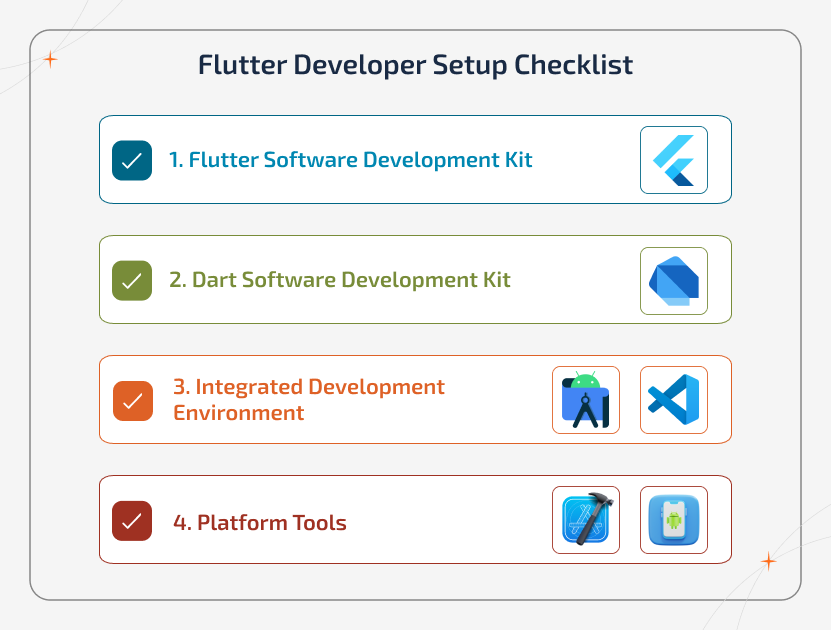
Initially, make sure you have the following ready:
- Flutter SDK: It's the core toolkit that is required to build a Flutter app from scratch.
- Dart SDK: Comes along with Flutter and is used for writing app logic (Use Dart 3 if you are concerned about safety and performance).
- IDE (Android Studio or VS Code): Helps to write and manage code easily.
- Platform Tools: Android Studio for Android and Xcode for iOS development.
Once everything is installed, run any simple command, let it be this:
Flutter doctorWhile running the command, you can see if your system is ready for Flutter development and highlight anything that is missing.
✅ If everything shows a green flag, then you're good to go.
❌ If not, then Flutter will tell you what exactly needs to be fixed before the development
How to Build a Flutter App - Step-by-Step Guide
It is vital to follow a clear, structured approach to build a Flutter app. This ensures faster delivery, fewer risks, and long-term results. The complete process of building a Flutter app is as follows:
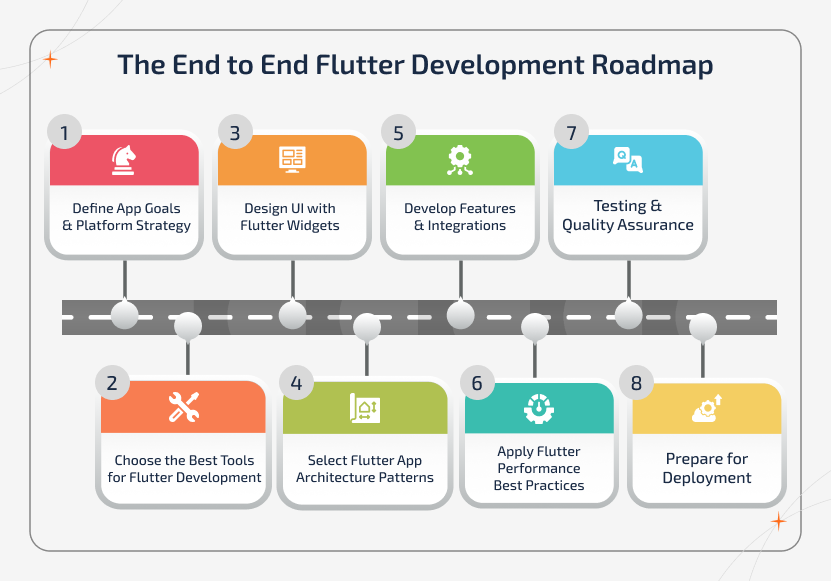
Step 1: Define App Goals & Platform Strategy
Business stakeholders and product owners start by defining the goals to be achieved in platforms like mobile, web, desktop, or all. With this, the development team starts planning a clear roadmap that covers app structure, timeline, Flutter app development cost, etc., while preventing scope creep.
Step 2: Choose the Best Tools for Flutter Development
Flutter developers and technical leads have to select the tools needed for efficient development. This includes Flutter SDK & Dart, Android Studio or VS Code, Firebase or backend services, and CI/CD tools for automation. With the right tools, engineering teams can work faster and maintain consistent quality, while reducing errors.
Step 3: Design UI with Flutter Widgets
UI/UX designers create screen layouts and user flows, while Flutter developers implement them using Flutter widgets. This ensures the app looks consistent across platforms while still matching native Android and iOS design expectations.
Step 4: Select Flutter App Architecture Patterns
Solution architects and senior Flutter developers decide the app's structure based on complexity and scale. Based on the app size and complexity, teams can choose from patterns like MVC for simple applications and MVVM, BLoC, or Provider or Riverpod for enterprise-grade apps. The right architecture choice to build Flutter app helps improve scalability, testing, and long-term maintenance.
Step 5: Develop Features & Integrations
Flutter developers now start to build core features like authentication, payments, and API integrations. If required, AI engineers or backend teams will add intelligent, data-driven capabilities to enhance the app's functionality.
Step 6: Apply Flutter Performance Best Practices
Developers and performance engineers work on optimizing the app by reducing unnecessary UI updates, improving state management, and monitoring memory usage. This way, they ensure smooth performance, faster load times, and better user experience.
Step 7: Testing & Quality Assurance
QA engineers and testers will now validate the app through unit, widget, and integration testing. This helps catch issues early while building Flutter app and thus ensures it works reliably across all devices and platforms.
Step 8: Prepare for Deployment
DevOps teams and Flutter developers prepare the app for release by submitting it to app stores, deploying web versions, or launching enterprise environments. They also take care of the configuration, monitoring, and post-launch processes.

Finalize architecture before development
Ensure to finalize your Flutter app architecture before UI development. Changing architecture mid-way is the biggest reason for Flutter projects to exceed timelines and budgets.
Run Your First Flutter App
Understanding the algorithm is great, but actually running a Flutter app makes more difference. Here's a simple walkthrough to help you go from setup to a fully working app in minutes.
Start by creating a new Flutter project and try to run it on Terminal or CMD:
flutter create my_app
cd my_app
flutter run
This will actually create a basic app and launch it on your device. After this, you can instantly see the action.
Once the dummy project is created, you can see a few important files and folders, namely:
- lib/ - This is the area where your main app code lives
- test/ - Mainly used for testing your app
- Pubspec.yaml - Manages the dependencies, assets, and app settings
After this, to see the quick change, launch the main file inside lib/ (usually main.dart) and update a random line like this:
Text("Hello, my first Flutter app!")Save it, and the Flutter will instantly update the app on your screen.
How to Deploy a Flutter App?
Once the Flutter app is ready, the next step is deployment. This is the stage where your app goes live on platforms like Android, iOS, and other devices.
Flutter actually simplifies the deployment since you're working with a single codebase. However, each platform has its own process, requirements, and approvals.
Deploying a Flutter App to Android [Google Play Store]
Publishing a Flutter app on Android is relatively easy and straightforward compared to iOS devices. Here are the steps you need to follow:
➜ Generate a Signed APK
Android requires a signed build for release. So run this command to generate an app bundle.
flutter build appbundleThis will create a .abbfile, which is used for Play Store submission.
➜ Create a Keystone
A keystone is mandatory to sign your application securely. Without this, you can't able to publish the updates later.
- Generate a keystone file
- Store credentials safely
- Configure it inside your Flutter project (key.properties & Gradle files)
➜ Configure App Details
Update important files before release:
- App name
- Version code & version name (pubspec.yaml)
- Permissions (AndroidMonifest.xml)
- App icon and splash screen
➜ Create a Google Play Console Account
Update important files before release:
- Sign up on Google Play Console
- Create a new application
- Fill in the app details like description, screenshots, categories, and privacy policy
➜ Upload & Publish
Update important files before release:
- Upload the .aab file
- Configure the pricing and regions
- Submit the app for review
Once approved, your application will be live on the Play Store.
Deploying a Flutter App to iOS [Apple App Store]
Comparatively, iOS deployment is slightly more complex due to Apple's strict guidelines and approval.
➜ Build the iOS Release
Run the following command
flutter build iosAfter that, open the iOS project in Xcode:
open ios/Runner.xcworkspace➜ Set Up Signing & Certificates
In Xcode:
- Connect your Apple Developer account
- Configure provisioning profiles
- Enable automatic signing
Note: Apple requires proper certificates for every app submission.
➜ Configure App Information
Update the following:
- Name of the application and bundle identifier
- Version and build number
- App icons and launch screen
- Permissions (Info.plist)
➜ Archive & Upload via Xcode
- Select "Any iOS Device"
- Click Product and choose Archive
- Upload the build to App Store Connect
➜ Submit via App Store Connect
- Add the app details (description, screenshots, and keywords)
- Set pricing and availability
- Submit for Apple review
Note that Apple's review process will take longer compared to Android and can include strict checks on UI, privacy and performance.
Key Features involved in Building Flutter App Development
Flutter is a popular framework as it helps teams build apps faster, reduces development efforts, and scales easily when the business evolves. Its core features support speed, performance, and long-term flexibility.
1. Hot Reload for Faster Development
Flutter's Hot Reload helps developers find changes instantly without restarting the app. This helps in fixing issues, testing ideas quickly, and speeding up development cycles.
2. Single Codebase for All Platforms
With Flutter, developers write code once and deploy Flutter app on mobile, web, and desktop platforms. This eliminates the need for separate native teams and thereby reduces development & maintenance costs.
3. Native-Level Performance
Flutter apps are directly compiled into native code, which means smooth animations, fast load times, and responsive user experiences, which is similar to fully native apps.
4. Strong Plugin Ecosystem
Flutter includes a wide range of ready-to-use plugins for features like payments, authentication, maps, and notifications. This allows development teams to add features faster without building everything from scratch.
5. Easy Third-Party Integrations
Flutter supports integrating with APIs, backend systems, cloud services, and enterprise tools. This makes it ideal for building apps that need secure integrations and future expansion.
All of the features make Flutter app development a smart choice for companies that want to launch faster, scale apps, and control costs.
Benefits of Flutter for Modern App Development
Businesses choose to build a Flutter app as it comes with numerous advantages for both start-ups and enterprises.
1. Faster Development Timelines
With one codebase, Flutter allows development teams to build apps for multiple platforms. This reduces the development cycles significantly and helps businesses launch products faster.
2. Lower Overall Development Cost
With a single development effort for all the platforms, top Flutter app development companies can eventually reduce spending on multiple teams and duplicate work. This makes Flutter especially valuable for businesses closely tracking mobile app development costs.
3. Simplified Maintenance
Updates, bug fixes, and feature enhancements are made once and applied everywhere. This reduces long-term maintenance effort and helps keep apps stable as they grow.
4. Supports Rapid Scaling
Flutter's flexible architecture allows apps to scale easily as user demand increases. Also, with WebAssembly (WASM) support, the Flutter apps will perform much faster. So that teams can add new features, platforms, or integrations without rebuilding the app from the beginning.
Thus, businesses focusing on cost efficiency and long-term value can opt for Flutter app development as it delivers measurable savings while supporting performance, flexibility, and growth.
Real World Use Cases of Flutter App Development
Flutter is not limited to a single type of application. With its flexibility, businesses can benefit across various industries to build scalable and high-performance apps for Android, iOS, desktop, and others simultaneously. Here are the two high-impact use cases where Flutter delivers maximum value.
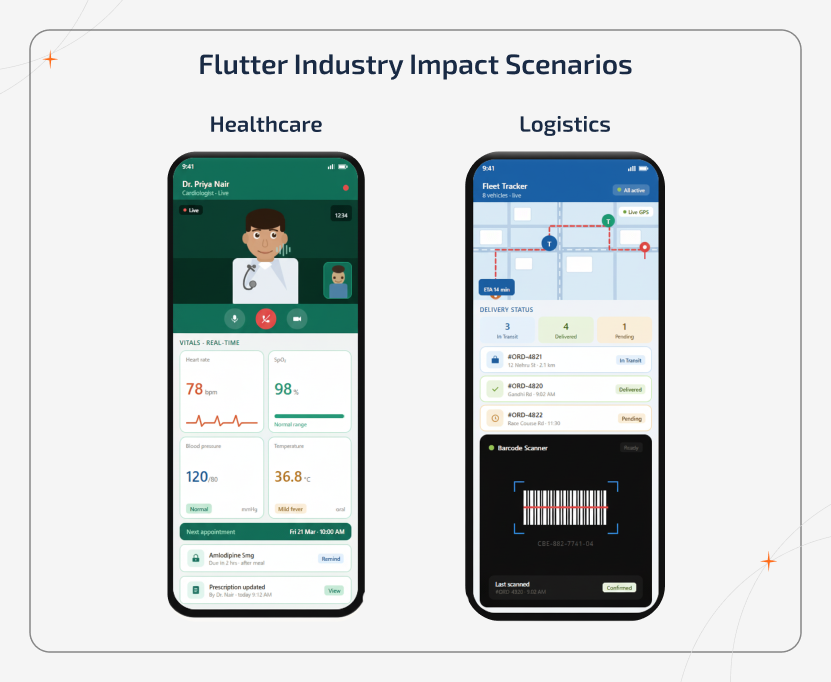
Healthcare Apps for Telemedicine
Recently, the healthcare industry experienced a massive growth in digital solutions, especially in telemedicine and patient engagement platforms. These applications require reliability and real-time communication.
In the healthcare domain, user experience plays a vital role, especially for patients who aren't tech-savvy. For them, Flutter's ability to create simple and intuitive interfaces using a single codebase ensures better accessibility and usability, which won't rob the bank.
A Flutter app is commonly used in healthcare to build:
- Appoint booking systems
- Patient portals and health tracking apps
- Telemedicine apps
- Remote monitoring
Leading platforms like Teladoc and Practo show how powerful digital applications can be in making healthcare more convenient for users. With Flutter, businesses can build apps that can run smoothly across platforms, delivering a user-friendly experience.
In the meantime, Flutter also supports integration with the following:/p>
- IoT and wearable devices
- Cloud-based health systems
- AI-driven diagnostics and recommendations
Logistics & Supply Chain Apps for Real-Time Tracking
Logistics and supply chain industries are growing with the need for real-time tracking and operational efficiency. Businesses in this space rely heavily on digital solutions to manage fleets, deliveries, and warehouses across multiple locations.
One of the main advantages of Flutter here is the ability to deliver real-time and high-performance across devices used by managers, drivers, and customers.
Flutter is increasingly used to build logistics and supply chain applications, including:
In the meantime, Flutter also supports integration with the following:/p>
- Fleet management systems
- Real-time delivery tracking applications
- Route optimization and dispatch platforms
- Warehouse and inventory management teams
Popular companies like DHL and Uber set strong benchmarks in real-time tracking and logistics operations, showcasing how critical performance and responsiveness are.
In the supply chain, Flutter also supports seamless integration with:
- IoT-enabled devices for fleet monitoring
- GPS and location tracking services
- Backend systems for order and inventory management
Why Flutter App Development is a Long-Term Business Advantage
From a business perspective, Flutter supports faster growth, smarter spending, and long-term scalability. The best part is all these can be gained without increasing the operational complexity.
1. Accelerated Marker Entry
Businesses can launch projects faster on multiple platforms. This helps them respond quickly to market demands and user feedback.
2. Cost-Efficient Product Ownership
The need for separate teams is not needed with Flutter. Thus, lowering the ongoing operations costs for the entire product lifetime.
3. Brand Consistency at Scale
A unified user experience across platforms boosts the brand identity and builds user trust whenever the product expands.
4. Future-Ready Expansion
Flutter helps businesses to add new features, platforms, and integrations without rebuilding the product. Thus, supporting long-term growth plans.
With all these, Flutter provides the greatest advantages for businesses by improving ROI. It also enables faster scaling and supports sustainable digital growth.
Why Choose Flutter for App Development in 2026
In 2026, businesses are expected to launch faster and scale smarter while controlling costs. This is where Flutter fits in these needs better than most of the native and cross-platform app development frameworks.
1. Fewer Developers & Faster Delivery
With Flutter, teams can build apps for different platforms with one codebase. This means faster development, even with smaller teams, and easier collaboration compared to managing separate native teams.
2. Near-Native Performance
Flutter apps are compiled into native code and thus deliver smooth performance and responsive UX. Thus, offering businesses a near-native experience.
3. Advanced UI & Animations
With Flutter, it is easier to build rich user interfaces, custom designs, and smooth animations. All these can be achieved without complex workarounds or heavy performance trade-offs.
4. Build to Scale for Super Apps
Flutter supports handling large codebases, multiple features, and high user traffic. Thus, it becomes a strong choice for businesses who aims to build multi-service or super apps that grow over time.
5. Plan for Scalability Early
Flutter supports handling large codebases, multiple features, and high user traffic. Thus, it becomes a strong choice for businesses who aims to build multi-service or super apps that grow over time.
Thus, for organizations partnering with a Super app development company, Flutter ensures to provide the right balance of speed, scalability, and performance. Due to its single codebase efficiency, Flutter is becoming a preferred framework. All these make it a future-ready framework for modern digital products.
Key Factors Influencing Building a Flutter App
The cost to build a Flutter app varies based on what you are building, how complex it is, and how the team is structured. Although Flutter is a cost-efficient framework, pricing still depends on a few key factors, and these are as explained below:
1. App Complexity
Basic apps with limited features will be of less cost, while the mid-level and enterprise apps with advanced functionality, workflows, and integrations involve more time and budget.
2. Target Platforms
Apps built only for mobile are more affordable than those that are designed for mobile, web, and desktop together. So, inclusion of each additional platforms add to the testing and optimization effort.
3. UI/UX Requirements
Simple and standard interfaces cost less. Those with custom designs, animations, and advanced user interactions will add to the design and development time.
4. Backend & Integrations
Apps that connect with databases, third-party APIs, payment gateways, and enterprise systems need additional development and security planning.
5. Team Location & Engagement Model
The development cost of a Flutter app varies based on an in-house team, offshore developers, or a dedicated Flutter app development company.
Put together, when compared to native development, Flutter app development cost is lower as teams build and maintain a single codebase for multiple platforms. This makes Flutter an ideal choice among start-ups that manage a tight budget and enterprises aiming to optimize long-term ROI.
Build In-House Vs Hire Flutter App Developers
A lot of the time, businesses find it challenging to build and scale Flutter expertise in-house. Hiring, training, and retaining skilled Flutter developers takes time and even slows down the product delivery.
| Aspect | Build an In-House Flutter Team | Hire Flutter App Developers |
|---|---|---|
| Hiring Speed | Slow recruitment & onboarding process | Quick onboarding with ready-to-work experts |
| Upfront Cost | High fixed costs, such as salaries, tools, & benefits | Lower initial cost with flexible pricing models |
| Skill Availability | Limited to hired talent | Access to experienced Flutter specialists |
| Time to Market | Longer development timelines | Faster delivery & quicker launches |
| Process Maturity | Processes need to be built internally | Proven delivery and development processes |
| Scalability | Hard to scale the team quickly | Easy to scale up or down as needed |
| Project Risk | Higher risk due to the learning curve | Reduced risk with |
Whether you are a startup or a growing enterprise, choosing to hire Flutter app developers from a trusted mobile app development agency or web app development company often delivers faster results, better cost control, and lower risk-without sacrificing quality.

Important to Know!
Most delays in Flutter projects are caused by hiring gaps and onboarding time - not development itself. Experienced teams reduce delivery risk significantly.
How Businesses Use Flutter and AI to Personalize User Experiences
Flutter works well with AI technologies and this makes it easier for businesses to build smart, responsive, and personalized applications. With Flutter, development teams can add AI-powered features that are as follows:
- Chatbots for instant customer support.
- Predictive analytics that helps anticipate the user needs and behaviour.
- Recommendation engines that suggest relevant content or products.
By combining Flutter with AI app development services, businesses can deliver apps that can learn from user interactions, automate decision-making, and personalize experiences at scale. The best part is that all these can be done without increasing the development complexity.
Common Mistakes to Avoid When Building a Flutter App
Occasionally, Flutter projects fail to deliver the desired results. It happens not because of the framework but due to execution mistakes and avoidable planning. Getting to know these early can save time, cost, and rework.
1. Choosing the Wrong App Structure
Choosing an architecture that doesn't match your app's size or future plans can make updates difficult and slow. In other words, a poor structure leads to messy code and higher maintenance effort.
2. Ignoring Performance Optimization
When the performance is not taken into consideration from the start, then the app's performance will be slow when the feature set grows. This results in poor user experience and lower app ratings.
3. Skipping Automated Testing
Performing only manual testing increases the chance of bugs reaching the users. It is vital to perform automated testing to catch issues early and prevent costly fixes after launch.
4. Poor Deployment Planning
Rushing the app release without proper deployment and monitoring plans can lead to crashes, downtime, and rollback issues.
The above mistakes increase the mobile app development cost, app development delays, and limit the scalability. Upon avoiding them, teams can build stable, high-performing Flutter apps that grow over time smoothly.
Flutter App Development Trends in 2026
As Flutter is evolving fast, keeping up with the latest trends helps businesses and developers make smarter decisions. Here are the latest Flutter app trends as of 2026.
Cross-Platform Super Apps
Businesses in 2026 are moving toward super apps that combine services like payments, shopping, and other essential features under a single platform. Flutter's single codebase makes it much easier to build apps that scale across devices.
AI-Powered Experiences
In today's business landscape, AI is everything. So, integrating AI agents into a Flutter app will be trending for smarter and more personalized user experiences. With this, predictive recommendations, chatbots, and real-time analytics are easier to implement.
Enhanced Support
Flutter's web and desktop performance has been improving in recent years, allowing near-native speed and smoother animations. With this, developers can now build enterprise dashboards and we portals without maintaining separate codebases.
Stronger Ecosystem & Packages
The Flutter ecosystem is rapidly increasing on pub.dev, with more packages and templates. This possibly helps developers to integrate features like state management, custom animations, reducing the development time and cost.
Lightweight Apps
Optimizing the size of the application and UI performance is the top priority. Tools and the best practices for memory management and widget efficiency ensure the apps run flawlessly on all devices.
Why Choose Sparkout to Build Your Flutter App
At Sparkout, we help businesses build Flutter apps that can scale, perform, and convert users. With deep Flutter engineering expertise with proven delivery frameworks, our team helps reduce risks, control Flutter app development cost, and speed up time-to-market by 40% approximately.
Sparkout stands out with:
- Being one of the top mobile app development agencies, we have specialists in Flutter for mobile app development, web app development, and enterprise-grade solutions using scalable architecture patterns.
- We use the right Flutter app architecture patterns to ensure long-term maintainability, performance, and feature expansion later.
- We follow industry-tested Flutter performance best practices to launch faster, stable, and high-rating apps across platforms.
- Our delivery model helps businesses control mobile app development cost and Flutter app development timeline and cost without compromising on the quality.
- We integrate Flutter with AI app development services to enable intelligent features like chatbots, recommendations, and analytics.
- You can hire a dedicated team, extend your in-house resources, or hire Flutter app developer specialists to build Flutter apps based on your timeline and budget.

Expert Insight!
Apps built to scale from day one require different planning than MVPs. Flutter supports both, but only when the development approach evolves with growth.
Final Thoughts - Is Flutter the Right Choice for your App?
Flutter is not just a development tool, but is a practical choice for businesses that want to build faster, spend smarter, and scale easily. By using a single codebase across platforms, Flutter helps teams minimize development timelines, reduce costs by 30 - 50%, and maintain consistent app quality.
Whether you want to launch an MVP or build a large enterprise application, Flutter offers the flexibility to grow without rebuilding your product from scratch. However, the success lies in partnering with the right mobile app development company that can plan and manage its performance while keeping Flutter app development cost under control and delivering long-term ROI.
Ready to Build a High-Impact Flutter App?
Partner with Sparkout to design, develop, & deploy secure, scalable Flutter applications faster.