


A manufacturing AI agent is an intelligent software system that monitors factory operations, reasons across ERP & MES systems, and executes governed actions in real time. In 2026, a manufacturing AI Agent will no longer be optional for factories that want to continuously optimize production performance, efficiency, and decision-making. It integrates the data across machines, enterprise systems, and industrial networks.
This guide is useful for those operations leaders, plant managers, OT & industry 4.0 engineers, CIOs & CTOs who want to:
- How AI agents are used in the manufacturing industry
- How to build a manufacturing AI agent step by step
- How agents differ from RPA and rule-based automation
- How to integrate legacy systems
- How to deploy safely with industrial guardrails
- What it costs to implement enterprise-grade AI agents in manufacturing
By the end of this guide, you will get to know how to approach AI agent development for manufacturing. This includes from architecture and ERP/MES integration to safety governance and cost planning.
What is a Manufacturing AI Agent - A Closer Look
A manufacturing AI agent is an autonomous software system that analyzes the factory data, reasons over it, makes decisions, and executes actions across connected systems. The best part is that it learns from outcomes continuously.
While the traditional automation follows pre-defined, static rules, a manufacturing AI agent can
- Monitor the real-time production data
- Analyze anomalies and predict outcomes
- Orchestrate actions across ERP, MES, CMMS, and PLC systems
- Improve performance over time
Manufacturing AI Agent vs Traditional Automation - What’s the Real Difference?
This comparison table highlights the key differences between traditional automation systems and a Manufacturing AI Agent. With this, manufacturers can get a clear understanding of how agentic automation in manufacturing goes beyond rule-based execution.
| System | What It Does | What It Cannot Do |
|---|---|---|
| Rule-Based Automation | Executes predefined logic & workflows | Cannot adapt to changing production conditions |
| RPA (Robotic Process Automation) | Automates repetitive UI & back-office tasks | Limited reasoning and no real-time machine-level control |
| Analytics Dashboards | Visualizes data & performance metrics | Does not make decisions or trigger actions autonomously |
| Manufacturing AI Agent | Monitors, analyzes, decides, acts, & continuously learns | Requires governance frameworks & safety guardrails |
Why AI Agents Are Essential for Modern Manufacturing
Modern factories started to operate in a highly dynamic and unpredictable environment. Here, demand shifts rapidly, supply chains may fluctuate, and machines behave differently under varying loads, and quality expectations rise continuously.
In this case, static, traditional automation finds it difficult to respond to
- Supply chain disruptions
- Machine performance fluctuations
- Unexpected quality deviations
- Skilled labour shortages
While the rule-based automation can execute the pre-defined workflows, it cannot adapt intelligently to varying conditions. Here comes the AI agents for manufacturing automation that start to address these gaps by offering
- AI-driven production line optimization based on real-time machine data
- AI agent–powered supply chain coordination across ERP & logistics systems
- Intelligent warehouse automation with autonomous task adjustments
- Continuous real-time monitoring and anomaly detection
They break operational silos and connect the machines, operational workflows, and enterprise systems into a unified decision-making layer. i.e., AI agents transform the manufacturing from reactive control to adaptive, data-driven optimization.
AI Agent's Role in Manufacturing - Know the Things to Consider Before Deployment
Before the actual implementation, manufacturers should define clear operational goals, technical needs, and governance rules. Without a proper plan, AI projects will end up facing delays, integration challenges, and safety risks.
1. Decision Boundaries
It is vital to clearly define the level of autonomy the AI agent will have in the beginning.
- Will the agent only provide recommendations or execute the actions automatically?
- Which decision types require human approval?
- What operational and safety constraints must never be overridden?
By creating decision boundaries, the AI agent will operate within the controlled, compliant, and safe parameters. This especially works in regulated or high-risk production environments.
2. Data Readiness
A manufacturing AI agent becomes effective based on the data it can access. Find whether your data infrastructure is structured, clean, or integrated across systems such as:
- PLC tags and machine signals
- SCADA data streams
- MES event logs
- ERP transaction records
- Vision inspection systems
- Historian databases
Most often, those data gaps, latency issues, or siloed systems will significantly limit the agent's performance. So, data harmonization should precede the deployment.
3. Deployment Model
Choosing the right deployment architecture plays a major role, and it directly impacts the performance, latency, and scalability.
- Edge AI for manufacturing - This is ideal for low-latency machine control and real-time anomaly detection.
- Cloud AI - It works for forecasting, optimization modelling, and cross-plant analytics.
- Hybrid AI agent architecture - This is the most common approach that balances the real-time edge decisions with cloud-based intelligence.
The deployment strategy should align with operational criticality and network constraints.
4. Success Metrics
It is vital for the AI initiatives to be tied to measurable business outcomes. So, define KPIs before deployment, such as:
- Reduction in unplanned downtime
- Improvement in OEE (Overall Equipment Effectiveness)
- Decrease in scrap and defect rates
- MTTR (Mean Time to Repair) improvement
Clear success metrics often ensure the manufacturing AI Agent provides measurable ROI and not just technical experimentation.
Planning these factors at the early stage helps reduce the implementation risk, prevents uncontrolled scope expansion, and ensures the AI agent works safely, efficiently, and strategically within the manufacturing ecosystem.
How Manufacturing AI Agents Work - The Runtime Loop
A manufacturing AI agent works in a continuous decision loop. This loop enables the agent to monitor, analyze, decide, act, and improve in real time. This operating loop provides autonomous, data-driven optimization across factory systems.
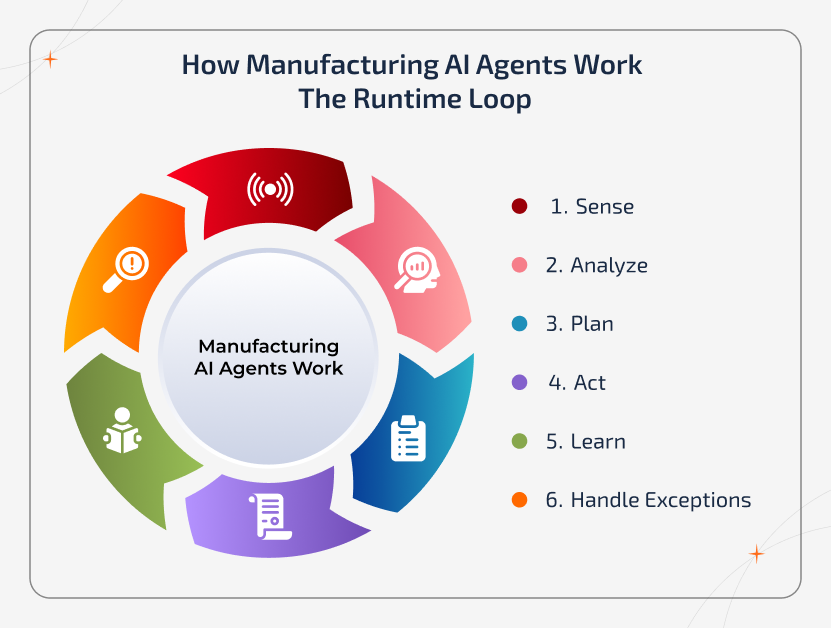
Here is the Manufacturing AI Agent Operating Loop:
1. Sense
The agent continuously collects real-time data from across the manufacturing ecosystem. This includes:
- Sensors & PLC signals
- ERP systems
- MES platforms
- Vision inspection systems
- Historian databases
This develops a unified operational view of the factory.
2. Analyze & Reason
The agent uses the machine learning models built for manufacturing environments to:
- Find the anomalies
- Forecasts demand or machine failure
- Identifies quality deviations
- Suggests the root causes
The agent moves beyond dashboards by interpreting the patterns and predict the operational impact.
3. Plan
Based on the analysis, the agent will find out the most appropriate next step to carry out, such as:
- Adjusting machine setpoints
- Rerouting production schedules
- Creating a maintenance work order
- Escalating issues to a supervisor
Here, the decisions are made within the predefined governance and safety constraints.
4. Act
The manufacturing agent executes actions via connected enterprise and operational systems. This often includes:
- ERP updates
- MES routing changes
- QMS containment workflows
- CMMS work order creation
- Controlled PLC write-backs (with guardrails)
It is this phase where intelligence becomes operational execution.
5. Learn
After carrying out the execution process, the agent incorporates any of the following feedback:
- Was the alert a false alarm?
- Was the defect confirmed?
- Did rerouting reduce downtime?
With this, it continuously improves the model accuracy and future decision quality.
6. Handle Exceptions
As the real-world factory environments are complex, the agent must safely manage:
- Conflicting data signals
- Missing or delayed inputs
- Network disruptions
- Safety constraint violations
Thus, exception handling often ensures stability and compliance.
This continuous Sense → Analyze → Plan → Act → Learn loop is what separates manufacturing automation with AI agents from that of the traditional, rule-based systems. i.e., Traditional automation works based on predefined instructions while a manufacturing AI Agent adapts, optimizes, and improves over time
Core Components of a Manufacturing AI Agent Architecture
A manufacturing AI agent architecture is a layered system that covers real-time monitoring, governed decision-making, and cross-system orchestration across the factory and enterprise stack.
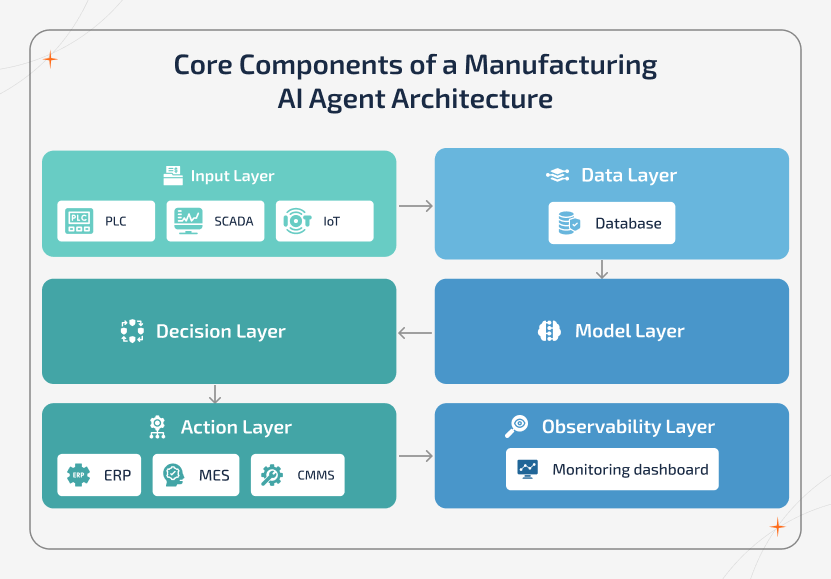
Quick Summary: A Manufacturing AI Agent architecture is a layered system that connects factory data, enterprise systems, and autonomous decision-making. It enables real-time monitoring, governed execution, and cross-system orchestration.
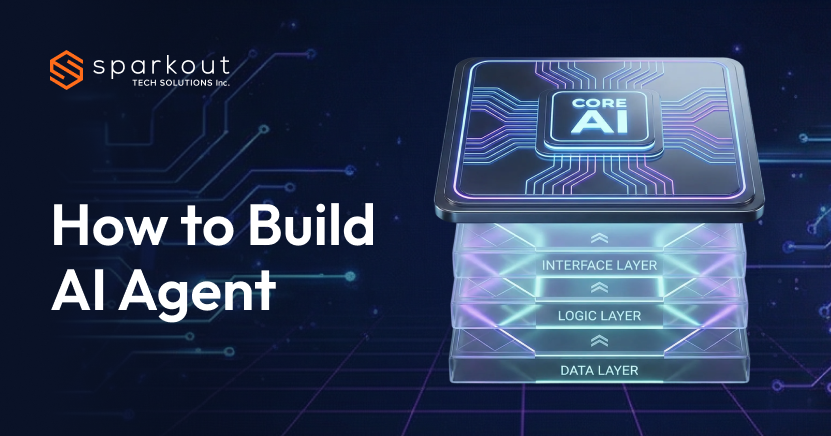
At an enterprise level, any factory-ready AI agent is always built across six structured layers:
1. Input Layer – Provides Operational Visibility
This layer is used to capture the live operational and business signals from:
- PLC and SCADA systems
- Industrial IoT sensors
- Vision inspection systems
- MES and ERP events
- Operator and maintenance logs
The input layer offers the real-time context required for autonomous factory intelligence.
2. Data Layer – Offers Reliable Context Foundation
In this layer, the raw, unfiltered data is standardized, secured, and structured via:
- Streaming ingestion and synchronization
- Data validation and feature engineering
- Labeling workflows (defects, downtime, anomalies)
- Secure storage with access controls
It is this layer that ensures decisions are made based on trusted, aligned data rather and not based on fragmented signals.
3. Model Layer – Works as an Intelligence Engine
The Model Layer ensures to provide reasoning and prediction through:
- Predictive maintenance models
- Demand forecasting models
- Vision-based defect detection
- Anomaly detection algorithms
- LLM-based reasoning for document and SOP interpretation
- Retrieval-Augmented Generation (RAG) for grounded responses
The model layer is where the machine learning in manufacturing becomes operational intelligence.
4. Decision Layer – Offers Governed Autonomy
In the Decision layer, intelligence is converted into controlled action. It combines:
- Business rules and operational thresholds
- Safety constraints and deterministic guardrails
- Human-in-the-loop approvals
- Exception handling workflows
All of these ensure that the AI agent in manufacturing works within enterprise and safety boundaries.
5. Action Layer – Handles Cross-System Execution
In this layer, the agent will start to execute the decisions by orchestrating:
- ERP updates that cover inventory, procurement, and order adjustments
- MES routing and scheduling changes
- QMS quality alerts
- CMMS maintenance work orders
- API integrations and RPA for legacy systems
The action layer offers the shift from insight to enterprise-wide execution.
6. Observability Layer – Involves AgentOps & Governance
Enterprise deployment requires continuous oversight, and this is made in this layer through:
- Model drift detection
- Performance and latency monitoring
- Audit trails and decision traceability
- Version control and rollback support
This layer ensures scalability, compliance, and operational trust.
Know the Types of AI Agents in Manufacturing
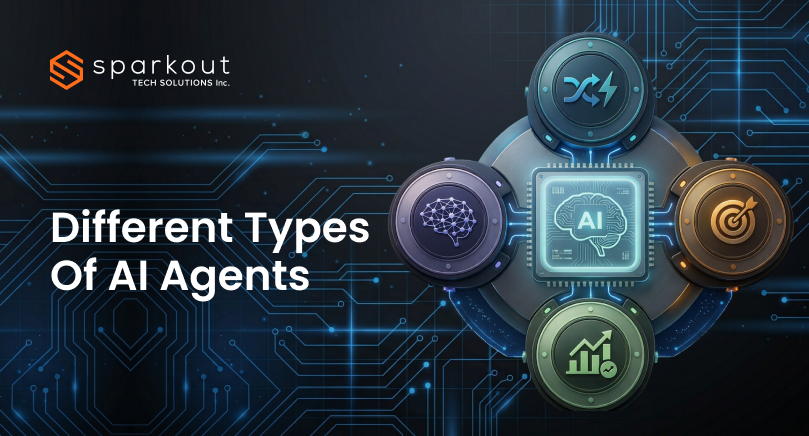
It is to note that not all AI agents are the same, as they differ in terms of their functionalities from one another. Choosing the right types of AI agent depends on the use case complexity and latency needs.
- Rule-Based Agents - Suitable for simple threshold alerts and for deterministic workflows.
- Machine Learning Based Agents - Used for forecasting, anomaly detection, and predictive maintenance.
- LLM-Based Agents - Ideal for SOP interpretation, operator guidance, quality document reasoning, and semantic search across plant documentation.
- Multi-Agent Systems - They are specialized agents that work with quality agent, maintenance agent, scheduling agent, and supply chain agent.
- Edge AI Agents - They are often deployed near the machines for low-latency decision-making.
- Cloud AI Agents - Used for analytics, planning, and cross-site forecasting.
Breaking Manufacturing Silos - ERP, MES, QMS, & CMMS Orchestration
Manufacturing sectors often have lots of systems such as ERP, MES, QMS, and CMMS. i.e., all of them usually work in isolation.
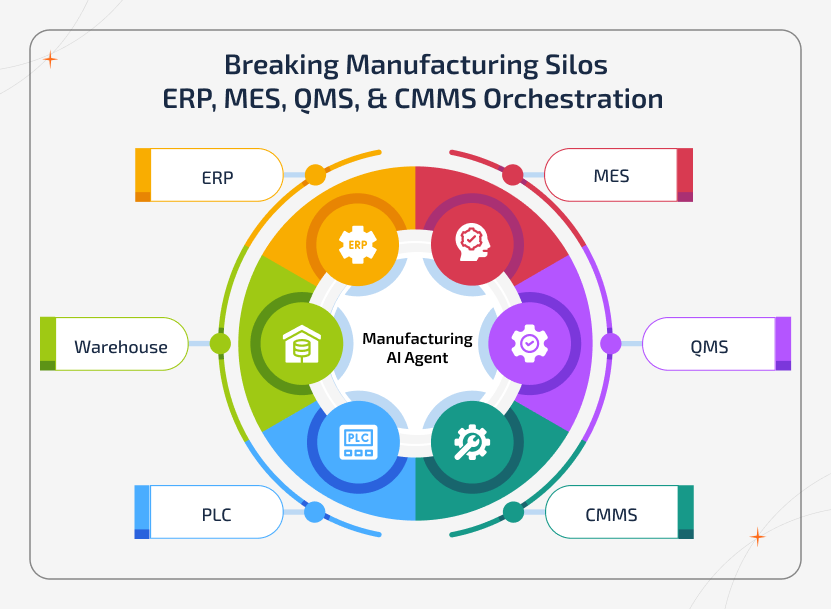
A manufacturing AI agent changes this by acting as the orchestration layer across the entire factory ecosystem. Instead of isolated workflows, it creates unified operational intelligence across systems in real time. Thus, it can simultaneously
- Read ERP production orders, inventory levels, & supplier data
- Monitor MES routing, cycle times, downtime, & OEE
- Analyze QMS inspection results & nonconformance records
- Trigger CMMS work orders & maintenance schedules
With this unified approach, real-time decision-making is made better across the entire production ecosystem. This shift from the isolated execution to enterprise-wide orchestration defines modern AI agent automation solutions in manufacturing.
Human-Agent Collaboration in Smart Factories using AI Agents
Often, it is misunderstood that the manufacturing AI agent replaces the human operators. However, it is not the case, and the AI agent works as a governed decision-support and execution partner. Thus, manufacturing agents are meant to enhance human performance and not be a replacement for operators.
Enterprise-grade AI agents in manufacturing units work under a human-on-the-loop model in which autonomy is balanced with human oversight.
1. Controlled Autonomy in Low-Risk Scenarios
In operationally safe and low-impact situations, manufacturing AI agents act autonomously and independently. This includes:
- Triggering threshold-based alerts
- Generating data summaries and shift reports
- Recommending inventory reorders
- Flagging minor quality deviations
Automating these routines helps improve the responsiveness without operational risk.
2. Human Approval for High-Impact Decisions
When the decisions affect safety, cost, and production continuity, then agents will request human approval. The higher-impact decisions cover:
- Machine setpoint adjustments
- Production rerouting
- Supplier changes
- High-cost material containment
- Schedule reallocation
Thus, ensures safety, operational trust, and accountability.
3. The Operator Feedback Loop
The operator feedback loop is a continuous improvement taken when the operator confirms defect validity, root cause categorization, downtime reason codes, and maintenance resolution outcomes.
This feedback loop helps improve model accuracy, reduces false alarms, prevents alert fatigue, and strengthens governance. Over time, the Manufacturing AI Agent becomes more precise and context-aware.
How AI Agents Preserve Tribal Knowledge in Manufacturing
In lots of factories, valuable expertise is not stored in formal systems. It is often found in the notebooks, emails, spreadsheets, and the experience of senior technicians.
But, when the experienced employees leave, there is a high chance that knowledge will often disappear.
With a Manufacturing AI Agent, it is possible to capture and organize this expertise by learning from:
- Maintenance logs
- SOP documents
- Repair histories
- Root cause analyses
- Technician notes
This eventually converts informal knowledge into structured, searchable intelligence.
Industrial RAG in Practice
Using Retrieval-Augmented Generation (RAG), the AI agent pulls answers directly from verified plant documents instead of generating generic responses.
- For example, when a technician asks: 'How do I fix pressure instability on Line B?'
The agent quickly retrieves the relevant repair cases, SOP steps, and previous corrective actions. It then provides a clear, step-by-step answer based on approved documentation.
With this approach, there will be a possible reduction in onboarding time, easily preserves institutional knowledge, improves Mean Time to Repair (MTTR), and increases operator confidence.
By combining orchestration, human collaboration, and knowledge capture, a Manufacturing AI Agent will become an intelligent support system for the entire factory.
How to Build a Manufacturing AI Agent - A Step-by-Step Guide
Building a manufacturing AI agent involves defining clear decision rules, preparing reliable industrial data, integrating enterprise systems, implementing governance controls, and deploying in controlled phases.
Below is a practical implementation framework:
Short Answer - A manufacturing AI agent is built by defining what decisions it can take, preparing factory data, training AI models, connecting systems like ERP & MES, and deploying it with safety controls and regular monitoring.
For more technical overview on how to build AI agent systems beyond manufacturing, you can explore our detailed AI agent development guide.
Step 1: Define Decision Scope and Operational Boundaries
The first step involves clearly defining what you want your manufacturing AI Agent to do. So,
- Identify the target use case. This shall be predictive maintenance, quality inspection, or supply chain optimization.
- Define measurable KPIs covering downtime reduction, OEE improvement, and scrap rate reduction.
- Determine if you want your agent to recommend actions or execute autonomously.
- Create approval workflows and safety constraints.
Clear boundaries prevent uncontrolled automation and reduce operational risk.
Step 2: Build a Unified Industrial Data Foundation
A manufacturing AI agent requires structured, high-quality data. This step involves:
- Collecting data from PLCs, SCADA systems, historians, MES, & ERP platforms.
- Cleaning, normalizing, and labelling datasets.
- Defining the defect and performance standards.
- Implementing retention policies & securing the access controls.
Hence, the agent cannot make accurate decisions without integrated and reliable data.
Step 3: Train and Validate Manufacturing AI Models
It is vital for the model selection to better align with the defined use case.
- Vision models for AI-powered defect detection
- Forecasting models for demand and production planning
- Anomaly detection models for predictive maintenance
- LLM + RAG systems for knowledge retrieval and operator support
Validate models using industrial-grade metrics like precision, recall, MAE, and acceptable false alarm thresholds. It is to note that the reliability is essential even before moving to execution. Many enterprises look for top AI agent platforms before development to find out whether to build from scratch or use an existing orchestration framework.
Step 4: Integrate with Enterprise and Operational Systems
It is a must for a manufacturing AI agent to connect across the systems to take meaningful action. Hence, it is essential to integrate with:
- ERP systems for order and inventory updates
- MES for routing and downtime management
- QMS for nonconformance handling
- CMMS for maintenance scheduling
- PLC systems (initially read-only for safety validation)
This integration helps transform the insights into operational impact.
Step 5: Implement Governance and Safety Guardrails
After the integration, it is crucial for the autonomous system to operate within strict controls. Hence,
- Enforce hard machine and process limits
- Provide human-in-the-loop approvals where required
- Prevent overrides of physical interlocks
- Apply role-based permissions and audit logging
Strict governance ensures safe, compliant, and controlled automation.
Step 6: Deploy Using an AgentOps Framework
By following a gradual and monitored deployment, the manufacturing AI agents bring measurable success.
- Launch in shadow mode
- Pilot on a single production line
- Monitor model drift, latency, and decision accuracy
- Maintain version control and rollback capability
Thus, a continuous monitoring approach ensures long-term stability and performance.
A manufacturing AI Agent is successfully built when it moves from controlled recommendations to governed autonomy. This ensures delivering measurable operational improvements without compromising the safety or reliability.
Manufacturing AI Agents Use Cases
Manufacturing AI agents are used across maintenance, production, quality, supply chain, and warehouse operations. Unlike traditional automation, they do not just report the data but also analyse the context and take actions across the systems.
1. Predictive Maintenance AI
A manufacturing AI agent continuously monitors vibration, temperature trends, and machine history to detect early signs of equipment failure.
When risk thresholds are crossed, it can:
- Automatically schedule maintenance
- Adjust production plans
- Create a CMMS work order
All of these help prevent unplanned downtime and improve asset reliability.
2. AI for Production Line Optimization
By analysing cycle times, throughput variation, and machine utilization, the manufacturing agent can effectively find out the bottlenecks across the line. With this, it can
- Reroute jobs
- Rebalance workloads
- Adjust scheduling parameters
Hence, it is possible to maintain optimal flow and improve OEE.
3. AI Agent for Supply Chain Risk Management
Using ERP order flow, supplier lead times, and demand signals, the agent can
- Detect potential material shortages
- Reorder risks
- Trigger procurement adjustments
- Notify alternate suppliers before disruptions affect production
This helps minimize the stockouts and production disruptions.
4. AI Agent for Warehouse Automation
With real-time inventory visibility, the agent is capable of
- Predicting the stockout or overstock risks
- Can initiate replenishment workflows
- Dynamically adjust the inventory allocation
With this, warehouse efficiency and balance across SKUs are improved.
5. AI-Powered Defect Detection
When connected to vision systems, the agent is capable of
- Classifying defects in real time
- Isolates nonconforming parts
- Trigger QMS workflows
- Adjust upstream machine parameters
This helps reduce scrap and improve quality consistency.
6. Real-Time Operational Monitoring with AI Agents
By continuously analysing IoT sensor data and machine performance signals, the agent can
- Detects abnormal behaviour
- Escalates critical events
- Adjusts parameters within safety limits
This enables faster response and prevents cascading failures.
AI Agent Blueprints Across Manufacturing Sectors
Manufacturing AI agents are not the same for every industry in terms of processes, regulations, equipment, and production goals. As every sector operates differently, AI agents must be designed in such a way that they match the specific systems, data, and compliance requirements.
Check out the industry-specific AI Agent application from the table below:
| Industry | AI Agent Application |
|---|---|
| Automotive | Real-time weld defect detection Robotic quality monitoring |
| Electronics | SMT line optimization Micro-defect inspection |
| Pharmaceuticals | GMP compliance monitoring Batch deviation detection |
| Food & Beverage | Shelf-life prediction Cold-chain risk monitoring |
| Textiles | Automated pattern defect detection Fabric quality analysis |
Thus, each vertical needs a manufacturing AI agent that is customized to its equipment, data structure, regulatory environment, and performance KPIs. While the architecture remains the same, the models, decision logic, and safety constraints should often align with the industry-specific standards.
Cost of Building a Manufacturing AI Agent
The cost of building a manufacturing AI agent varies based on the scope, autonomy level, system complexity, and development scale. Often, development cost of AI agent in manufa turing fall into two main categories, such as the build costs and ongoing operational costs.
1. Build Costs or the Initial Investment
The initial investment includes the foundational setup that are required to design and deploy the agent. This includes:
- Data engineering & integration
- ERP, MES, PLC, & system connectivity
- Model development & validation
- Data labeling & preparation
- Edge hardware, when real-time control is required
- Security & governance configuration
The total investment differs based on use case complexity and level of automation.
2. Run Costs or Ongoing Operational Costs
Once after the deployment, the agent needs continuous management and optimization:
- Performance monitoring (AgentOps)
- Model retraining & drift management
- Cloud compute or edge processing costs
- Governance audits & compliance updates
- Maintenance of integrations
Estimated Investment Ranges:
Although the actual costs is based on the architecture and scope, some typical ranges include:
- DIY pilot or proof of concepts costs $1,000–$10,000
- Platform-based implementation costs$10,000–$50,000
- Enterprise-grade deployment with an experienced AI agent development company engagement costs $50,000+
Factors That Increase Complexity and Cost
The costs of manufacturing an AI agent may increase significantly due to the following reasons:
- Write-back control to PLCs or machine parameters
- Multi-site or cross-plant deployment
- Strict compliance & regulatory requirements
- High-availability or low-latency edge environments
The higher the governance, validation, and infrastructure investment required for those agents that are more autonomous and integrated.
Manufacturing AI Maturity Model
Organizations evolve into a fully autonomous Manufacturing AI Agent in three stages.
Stage 1: Reactive
Factories rely on dashboards & basic alerts.
Systems report KPIs like OEE, downtime, and scrap. However, humans make all decisions.
Here, the focus is all about "What happened?"
Stage 2: Predictive
Factories choose predictive maintenance AI and anomaly detection.
Systems predict the failures and performance issues before they occur. This helps improve the planning and reduce downtime.
Here, the focus is all about "What is likely to happen?"
Stage 3: Agentic
Autonomous agents in factories often monitor the real-time data, orchestrate ERP, MES, QMS, and CMMS systems, and execute actions within governance limits.
Production becomes continuously optimized and doesn't require manual adjustments.
Here, the focus is all about "What should be done - and execute it safely."
Most organizations progress gradually, starting with a single production line pilot and then scaling across plants.
Challenges & Best Practices for Manufacturing AI Agents
Implementing a manufacturing AI agent is an operational transformation, and organizations may come across system-level and human-level challenges during deployment.
The Key Challenges:
- Legacy PLC Connectivity - Older systems often lack modern integration capabilities.
- Poor Data Quality - Incomplete or inconsistent data that helps reduce the model accuracy.
- Alert Fatigue - Too many notifications can lower the operator's trust.
- Change Resistance - Teams may at times hesitate to depend on the autonomous decision systems.
Best Practices:
- Businesses can start with a single high-impact use case to prove the value.
- Choose a phased rollout by following a shadow mode approach.
- Rely on human-in-the-loop governance before enabling full autonomy.
- Monitor the model drift continuously to maintain the accuracy.
- Define strict safety boundaries to prevent operational risks.
Following a structured approach helps manufacturing AI agents to deliver measurable improvements without compromising on reliability and safety.
Advantage of Manufacturing AI Agent Over a Traditional Chatbot
Although both chatbots and manufacturing AI agents rely on AI technologies, they differ fundamentally in terms of the roles they take up in industrial environments.
| Feature | Chatbot | Manufacturing AI Agent |
|---|---|---|
| Text-based interaction | Yes | Yes |
| Machine and PLC integration | No | Yes |
| Autonomous operational decisions | No | Yes |
| Cross-system orchestration (ERP, MES, QMS) | No | Yes |
| Textiles | Limited | Yes | Executes production-level actions | No | Yes |
Key Difference:
Chatbots are designed to assist with communication, such as answering questions, retrieving information, and supporting operators.
Manufacturing AI agents works beyond conversation. It connects to machines and enterprise systems, helps in making contextual decisions, executes actions within the set safety limits, and continuously improves the production performance.
Why Choose Sparkout Tech to Build Your Manufacturing AI Agent
As a leading AI development company, Sparkout Tech builds enterprise-grade Manufacturing AI Agent solutions designed to work in real-world environments. Our approach involves building beyond model development, such as building secure, scalable, and production-ready AI agent platforms that can be integrated with industrial systems seamlessly.
Hire AI agent developer specialist from Sparkout to:
- Integrate ERP, MES, QMS, CMMS, and PLC systems into a unified intelligent layer.
- Enable AI across industrial IoT (IIoT) environments.
- Implement machine learning models customized for manufacturing use cases.
- Deploy edge AI for low-latency, real-time decision-making.
- Integrate industrial-grade governance, safety controls, and compliance frameworks.
We design manufacturing AI agents that move from pilot to production with structured architecture, controlled autonomy, and measurable operational impact.
So, those looking to transition from static automation to intelligent, adaptive manufacturing systems can choose Sparkout Tech as we deliver agents with technical depth and industry expertise.
Conclusion
For industrial sectors, having a manufacturing agent is more than just an automation upgrade. It acts as an intelligent layer that connects the machines, systems, and decision across the factory.
Starting from predictive maintenance to demand forecasting and quality inspection, Manufacturing AI agents help factories to function more efficiently and respond faster to the problems.
As manufacturing evolves toward Industry 5.0, the transition is no longer about adding more dashboards. It is all about enabling real-time, data-driven decision-making across operations.
Those factories that implement AI agents for manufacturing automation today can position themselves for higher efficiency, improved quality, reduced downtime, and stronger operational resilience in the coming years.