



Software development in the current era is no longer happening in just one office space. This has expanded beyond borders, and teams are now working from around the world connected fully online. Companies have started hiring remote development teams today to speed up product delivery, reduce costs, and scale faster. However, businesses that hire remote development teams must also focus on managing them effectively. It is vital to have the right processes, tools, and culture to keep everyone aligned and productive.
The truth is, a remote development team can outperform the in-house setup when managed properly. They eventually offer the flexibility, scalability, and continuous delivery while staying focused on business growth.
Here in this blog, you will get to know how to build, manage, and scale a high-performing remote software development team while taking full control of delivery, quality, and outcomes.
What is a Remote Development Team?
A remote development team involves a group of software developers, testers, designers, and tech leads who work from different locations across the globe. They collaborate via modern communication tools, follow your structured approach, and stay fully aligned with your delivery goals without being in the same office.
Rather than spending months to hire locally, you can instantly access specialized talent and scale your mobile app development capacity.
With the help of remote teams, you will be able to:
- Reach the top engineering talent faster without the location limitations.
- Significantly reduce the hiring and infrastructure costs.
- Scale up or down the teams quickly as your project expands.
- Maintain faster delivery with multi-time-zone workflows.
- Keep full control over productivity, timelines, and code quality.
Whether you want to hire a remote development team or extend your existing in-house team, remote developers offer you the flexibility to build and deliver software without delays.
The Real Challenges of Managing Remote Development Teams
Although remote teams can help you unlock massive results, they also come with unique management challenges. As per Yomly statistics, about 29% of remote workers say they struggle with gaps in team communication. When people work from different places and time zones, leaders must be more intentional about how work happens.
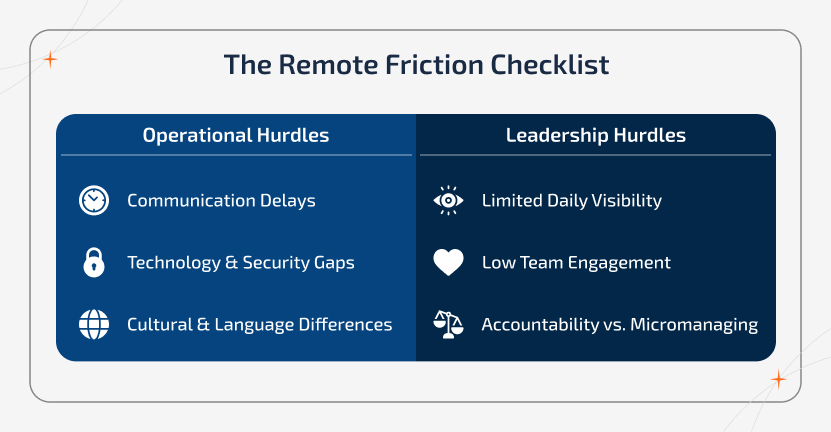
Some of the common challenges involved in managing remote teams include:
1. Communication delays and scheduling issues
Usually,
when the teammates are present across multiple time zones, quick clarifications
can take hours. Even taking simple decisions sometimes turns into long
back-and-forth messages.
2. Limited visibility into daily work
Another challenge
is
that you can't walk up to someone's desk or see progress in real time. Without
the right tools and check-ins, managers will feel disconnected from what's
actually happening.
3. Cultural and language differences
Diverse thinking
is a
strength; however, communication styles, expectations, and wording can sometimes
lead to misunderstandings.
4. Technology gaps and security concerns
Remote teams
often rely heavily on tools and secure access. So, if there are any hardware
issues, network problems, or unsecured systems, work progress can get blocked
and create risks.
5. Keeping people engaged and connected
Many times, the
remote developers can feel isolated if not included actively. Building trust and
team culture involves constant effort when working virtually and managing remote
developers.
6. Balancing accountability without micromanaging
Leaders
must track performance through outcomes and transparency. i.e., this cannot be
done by constantly monitoring or interrupting developers.
All of these challenges don't mean remote work doesn't work; rather, they simply require the right structure.
Strong Remote Team Management focuses on:
- Clear processes
- Transparent goals & KPIs
- Consistent communication
- A culture of accountability and trust
With the right leadership approach, a remote team can deliver with greater speed, efficiency, and ownership than a traditional in-office team.
Remote Team Management Trends Shaping the Future of Work
Remote work is becoming a primary means for software teams to operate. With better tools and smarter processes, companies can effortlessly manage the distributed teams more effectively than ever before. There are several key trends driving this transformation, and they are as follows:
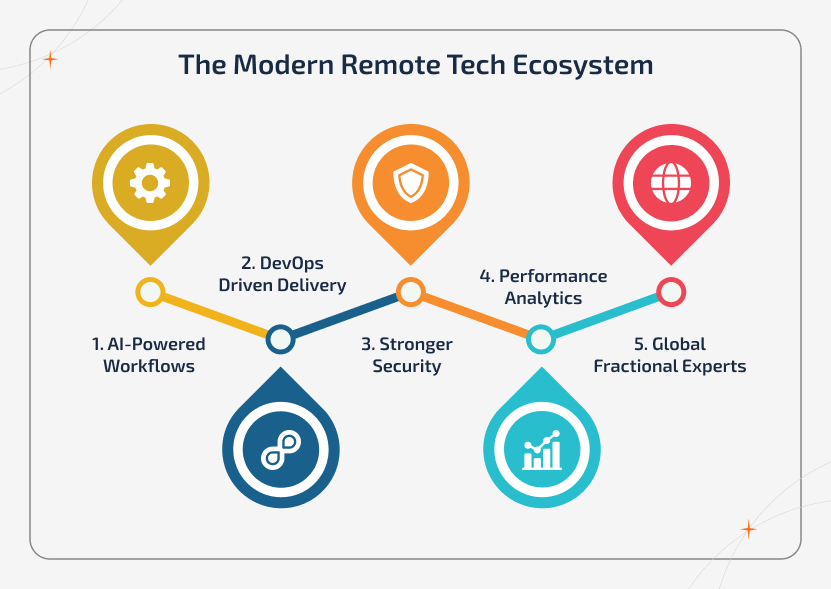
1. AI-Powered Management Workflows
AI tools are helping
business leaders automate reporting, find out the risks early, and make improved
decisions. Thus, these tools are reducing the effort spent on manual
coordination.
2. DevOps-Driven Delivery
Automated CI/CD pipelines help remote teams to deploy
faster, fix issues quickly, and maintain consistent code quality without being
in the same location.
3. Stronger Security & Compliance Measures
With the
increase in remote teamwork, advanced access controls, data encryption, and
secure cloud environments ensures systems and intellectual properties are safe.
4. Greater Visibility Through Performance Analytics
Modern
platforms are involved in tracking progress, productivity, and workload in
real-time. Thus, business leaders get the confidence and clarity on how projects
are moving.
5. Global Hiring & Access to Fractional Experts
Companies can start hiring the right skills from anywhere
and even bring in specialists when needed. Thus, optimizing the speed as well as
the mobile app development cost.
Businesses that are embracing these modern remote team management trends are capable of executing faster, staying more agile, and outperforming the competitors who are still relying on traditional, in-office workflows.
Best Practices for Managing Remote Development Teams
Making a successful remote development is not just about hiring talented engineers. Rather, it is all about creating a well-defined structure and alignment that they need to deliver their best work. These practices help business leaders build trust, transparency, and long-term accountability across remote teams.
1. Define clear goals & measurable KPIs
Ensure every
sprint has well-defined deliverables and owners. So, the progress is always
visible, and the results are quite easy to evaluate.
2. Leverage asynchronous communication
It is vital to
use
tools that allow updates, task clarifications, and decisions to happen without
waiting for overlapping time zones. So, work keeps moving 24/7.
3. Adopt a documentation-first approach
In order to
eliminate confusion and ensure everyone always has reliable context, it is
better to store and document the decisions, requirements, and processes in
shared platforms.
4. Rub consistent agile ceremonies
With weekly
planning,
daily standups, and demo cycles, it is possible to keep priorities aligned.
This, in turn, allows the teams to have a steady feedback loop and improve
continuously.
5. Schedule Regular 1:1s and performance check-ins
With
personal conversations, it is possible to block issues early, provide career
growth, and keep remote developers connected to the bigger vision.
6. Recognize achievements and celebrate progress
Public
wins, shoutouts, and small wins help create a positive culture where people feel
valued and not isolated behind the screens.
With strong workflows and open communication, remote developers can stay empowered, motivated, and accountable. This opens up the possibilities for gaining higher-quality results and faster delivery.
Cost of Hiring a Remote Development Team
The cost of hiring a remote development team depends on several factors, including the developer's experience level, tech stack used, location, and the complexity of the project. Compared to the traditional in-house hiring, remote teams helps businesses in reducing operational expenses on various overheads.
On average, here's the hourly cost of remote developers based on their expertise:
| Developer Level | Hourly Cost (Appx) |
|---|---|
| Junior Developer | $20 - $40/hour |
| Mid-Level Developer | $40 - $80/hour |
| Senior Developer | $80 - $150+/hour |
Apart from the experience level, the hiring cost also varies depending on the region. Developers from Western Europe and North America will charge higher rates, whereas skilled ones from Asia or Eastern Europe will offer competitive pricing.
Based on needs, you can also choose dedicated team engagement models. If your project is not too complex, a remote development team of three to five developers can cost between $8,000 and $40,000 per month, depending on experience.
Common Mistakes to Avoid When Managing Remote Developers
Managing remote developers can bring significant results when the right processes are in place. However, many startups and mid-range businesses struggle because they repeat common management mistakes unintentionally. Recognizing these issues earlier will help leaders to maintain productivity.
Missing Outcome Focus
One of the major mistakes that
every company makes is measuring productivity based on how long the developers
stay online. In most of the remote teams, results matter more than the screen
time. The project leaders must focus on completed tasks, sprint goals, and code
quality instead of tracking hours.
Unclear Task Expectations
Remote developers mostly rely
on clear instructions to proceed with their work effectively. If the
requirements and deliverables aren't clearly defined, it always leads to
confusion and constant rework.
Too Many Meetings
Frequent meetings will interrupt the
developers and reduce their focus. The remote teams will perform better when the
meetings are short and scheduled only if necessary. Also, it's better if the
routine updates can be shared through the project tools instead.
Weak Team Management
If the communication focuses only
on tasks, the developers might feel disconnected from the team. Recognizing the
achievements and encouraging regular interaction will help them maintain
collaboration and motivation.
Poor Communication
Using multiple
tools without any clear rules will create confusion among teams. They should
define what platforms are used for discussions, updates, and documentation. A
transparent approach helps everyone stay aligned.
Communication Strategies for Managing Remote Developers
In order to build a successful remote development team, it is important to have the best communication. When the teams are spread across different locations and time zones, it is vital to share the information clearly, consistently, and without any delays. Given below are some of the best strategies that help business owners keep everyone aligned:
1. Short and focused daily standups
A quick status
update
ensures work in progress, priorities, and blockers to everyone in the team. This
eliminates the need for unnecessary meetings.
2. Clear communication rules and expectations
Ensure to
define which channels to use for urgent messages, task updates, and
documentation. You can even set response-time standards and handoff guidelines
to keep the work running smoothly across time zones.
3. Context-rich messages with complete details
Ensure
to
provide all the relevant links, files, and requirements at once. This way, you
can help avoid repeated clarifications and keep tasks moving forward
independently.
4. Real-time visibility through the dashboard
Leaders
and
developers can make use of the project boards and progress tracking tools to
know the information. This even helps reduce confusion and misalignment.
5. Open communication and collaboration culture
Encourage
getting questions, feedback, and new ideas. With this, remote developers will
feel confident when they know communication is accepted without being judged.
When the communication is structured, transparent, and proactive, teams spend less time fixing misunderstandings and more time building the best software solutions. Above all, clear communication not just prevents rework but also strengthens trust and teamwork throughout the software development process.
How Business Leaders Can Build a High-Performance Remote Software Development Culture
Culture stands as the backbone for every successful remote development team. Even if people work from different places, they will perform best when they feel trusted, supported, and connected to the same goals. So, when the developers believe in the mission and know their work matters, they take more ownership, solve problems faster, and stay committed to delivering a better product. Here is all that you should know to build that environment:
1. Trust developers to own outcomes
Provide the team
with the autonomy and let them make technical decisions. Accountability grows
when the engineers feel responsible for their results.
2. Invest in continuous learning and skill growth
Business leaders shall encourage training, certifications,
and knowledge-sharing. Teams that enhance their skills keep your product
future-ready.
3. Offer flexibility around working hours
It is good to
focus on results and not screen time. Flexibility helps improve productivity,
job satisfaction, and long-term retention.
4. Create meaningful virtual interactions
Working
online from remote places doesn't mean that team bonding should disappear. Host
virtual catchups, game sessions, and interest activities to keep team
relationships strong.
5. Recognize progress and celebrate achievements
Public
appreciation builds confidence. Small wins can fuel consistent high performance
across the team.
6. Keep everyone aligned to shared values and mission
Regularly reinforce why the work matters. Purpose drives
engagement, especially in remote environments.
It is to note that the high-performance remote culture is built through intentional leadership. When the developers feel trusted, connected, and valued, they deliver faster releases, better software quality, and stronger ownership.
Tools Used for Managing a Remote Development Team
Development teams working remotely perform their best when they have the right digital ecosystem supporting them. Given below is the list of tools available globally that help developers streamline communication, collaboration, and software or product delivery.
| Purpose | Tool Category | Tool Examples | Business Value |
|---|---|---|---|
| Project + Workflow Management | Small Business Task Management App | Jira, Asana, ClickUp | Helps teams plan, track, and deliver work efficiently |
| Communication & Collaboration | Team Time Management Tools | Slack, Microsoft Teams, Zoom | Keeps communication fast, organized, and aligned across time zones |
| Performance & Productivity Tracking | Team Resource Management Tool | Hubstaff, Toggl Track | Enhances visibility into workload and utilization without micromanaging |
| Source Code Management + CI/CD | Remote Developer Collaboration | GitHub, GitLab, Bitbucket | Enables faster deployment, code quality checks, and secure version control |
It is obvious that productivity rises when your remote development team has clear workflows, reliable communication, and real-time visibility. At Sparkout, we help you choose, set up, and manage the right tools so your remote team works and delivers peak performance from the beginning.
How to Track Productivity in a Remote Development Team
Remote productivity increases when the teams know what they need to achieve and how work is moving forward. Instead of tracking online hours, great leaders will focus on the results their developers deliver and the impact their work brings in.
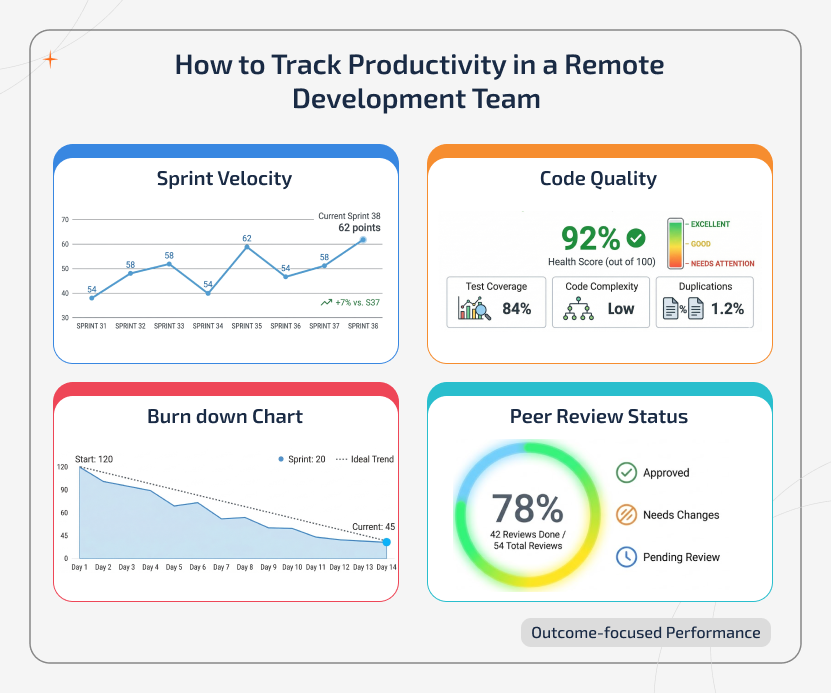
Some of the smart ways to measure remote development team success include:
1. Sprint velocity tracking
This helps you to
understand
how much work the team can reliably deliver every cycle.
2. Code quality metrics
With the help of tools, it is
possible to check the bugs, maintainability, and technical debt. Thus, you can
ensure clean and scalable code.
3. Burn-down charts
Bring in to show whether the team
is
on track to complete the tasks before the sprint ends.
4. Peer code reviews
Ensure to improve the knowledge
sharing, detect issues early, and strengthen the team standards.
5. Outcome-focused performance reviews
Go ahead to
evaluate the developers based on results, ownership, and delivery, and not on
their online presence.
So, when the progress is clearly visible and data-backed, remote development teams will ensure to deliver their best work without needing micromanagement.
How to Manage Time Zone Differences in a Remote Development Team
As said earlier, when remote developers work from different regions, time zone differences will slow down communication and decision-making. However, by following the right approach, businesses can turn timezone challenges into an advantage and keep the development moving flawlessly. Here are some tips for those who are curious about how to manage remote developers from different time zones.
Create Overlap Hours
Even though the teams are spread
across countries, having a few overlapping working hours helps improve
collaboration. These shared hours can be useful for sprint planning, important
decisions, and decision-making.
Follow Clear Handoff Process
A structured handoff will
help teams to carry out the work smoothly across different time zones. Before
you end the workday, developers can be able to update the task status, highlight
risks, and share useful links and documentation. This allows the next team to
carry out the work without any confusion.
Assign Clear Decision Owners
Most of the delay occurs
when no one knows who should make the final call. Assigning clear owners for
tasks, approvals, and technical decisions will help avoid potential flaws and
keep the projects moving forward.
Document Everything Properly
Proper documentation helps
the remote teams work independently. When the requirements, processes, and
updates are clearly documented, developers from various time zones can able to
access the information anytime without waiting for any explanation.
Use Asynchronous Communication
The
remote teams should not depend entirely on real-time meetings. Tools like
project boards, shared documents, and instant messaging platforms allow
developers to share updates, ask questions, and move tasks forward without even
waiting for others to be online.
Tips for Managing Remote Software Development Teams
Even the smallest of improvements in how you manage the remote custom software development team can bring in big gains in productivity and product quality. The tips below will help your full-stack remote development team to be fully aligned, secure, and focused on delivery.
1. Automate builds & code checks
This saves time and
minimizes errors. Thus, developers can focus on solving real problems.
2. Prioritize security from the beginning
To prevent
bigger issues at a later point, it is better to secure access, follow clean code
practices, and compliance rules.
3. Have a few overlapping work hours
Even one or two
hours of real-time collaboration helps teams move faster when in case of making
urgent decisions.
4. Reduce unnecessary meetings
It is better to keep
discussions short and focused. You can share updates asynchronously, so work
continues without any hiring or mobile app launch delays.
5. Share the productivity vision regularly
You can remind the team about what they are building and
why. This, in turn, keeps them motivated and helps improve decisions.
Security Best Practices in Remote Software Team Management
With developers working from multiple locations and devices, security is one of the top priority. Your code, data, and intellectual property must remain protected through continuous, built-in security practices.
Here is how to keep remote development secure:
- Use secure access controls like VPNs, Single Sign-On (SSO), and Identity & Access Management (IAM). This ensures that only authorized people can access your systems.
- All the laptops and devices should meet security standards. It is vital to use strong passwords and have encrypted storage by default.
- Limit access based on role and responsibility with proper permissions. Ensure to track all the activities.
- Contracts and policies should clearly protect your product ideas, code, and internal data.
- Identify risks early before they impact your business using security audits and automated scanning tools.
As your remote development team grows, your security measures should grow with it. With strong and proactive security, your team can innovate and deliver products without risks.
How to Hire a Remote Development Team - A Step-by-Step Approach
Hiring and managing remote software developers should be easy and convenient, especially when business growth depends on development speed, quality, and expertise. Follow this simple process to hire web developers who are talented for your product team:
Step 1: Define the roles and skills you need
Map your
project requirements, tech stack, and responsibilities. Thus, you will get every
hire mobile app developers and
web developers directly supporting the product delivery.
Step 2: Partner with a trusted Remote Development Team provider
Instead of spending months recruiting, a trusted Remote
Development Team provider like Sparkout will give access to pre-vetted
developers who fit your culture and goals from day one.
Step 3: Assess both technical capability and communication
Our team of experts evaluates coding skills, system
thinking, teamwork, and clarity to ensure remote development success.
Step 4: Set expectations with a smooth onboarding plan
At Sparkout, we follow an onboarding process that ensures
developers understand your workflows, tools, KPIs, and security standards right
away.
Step 5: Implement the right collaboration tools for full visibility
With project dashboards, CI/CD pipelines, and async updates,
we keep your progress clear. Thus, you will stay fully in control even remotely.
Step 6: Scale your team as your product grows
Add
talent fast, swap roles as needed, or extend capacity anytime. Thus, you don't
have to deal with hiring delays or overhead costs.
Upon following the right process, you hire a full-stack Remote Development Team that delivers outcomes, not excuses. At Sparkout, we don't just find developers, we build dedicated remote teams that work like your in-house team, perfectly aligned to your product vision.
Real-World Examples of Companies Successfully Managing Remote Development Teams
Today, many well-known mobile app development companies have successfully adapted to remote development teams. Here are some of the real-world examples that show why managing a remote development team matters.
GitLab
GitLab is one of the perfect examples of a
fully remote company with no headquarters. Their entire team works remotely from
different parts of the world. Yet, this company continues to build and improve
one of the widely used DevOps platforms.
This company manages its distributed workforce through robust documentation, asynchronous communication, and transparent workflows. By continuously following this approach, developers can collaborate without the need to go to the office.
Automattic
Here's another example, Automattic, the
company behind WordPress, that operates with a globally distributed team. Their
developers, designers, and product team work from multiple countries while
collaborating through structured communication and shared tools.
This kind of remote-first approach helps the company build and maintain one of the most widely used website platforms in the world.
Shopify
Back in the days, Shopify adopted a "digital
by default" approach that allowed its employees to work remotely. By supporting
distributed development teams, Shopify enables rapid innovation and access to
talent from different regions.
This model helped the software development company scale the platform and support millions of online businesses worldwide.
The above examples show that with the right leadership, tools, and processes, remote development teams can deliver strong business outcomes. Firms that actually embrace remote collaboration gain access to a larger talent pool, enhance development speed, and stay more flexible in this rapidly evolving landscape.
Remote vs In-House Development Team: What Should Businesses Choose?
Based on the hiring strategy, budget, and project needs, businesses will choose between remote and in-house development teams. The comparison below highlights the key differences between the two models.
| Factors | Remote Development Team | In-House Development Team |
|---|---|---|
| Talent Access | Firms can hire developers from anywhere in the world, giving access to a larger talent pool | Hiring is limited to developers available in the local job market |
| Hiring Speed | The teams can build much more quickly through remote hiring or development partners | The recruitment often takes longer because the companies must source and interview local candidates |
| Cost | Businesses can possibly save on office space, infrastructure, and other operational expenses | The costs are higher due to the office setup and workspace requirements |
| Scalability | The teams can be expanded or reduced easily depending on project needs | Due to the traditional hiring process, scaling takes more time |
| Collaboration | It required structured communication through digital tools | Face-to-face communications make the collaboration easier for some teams |
| Flexibility | Teams can work across time zones | They only follow fixed working hours |
In most of the situations, remote development teams offer greater flexibility and quick access to skilled talent. This makes a strong choice for businesses that want to scale quickly and stay competitive.
Conclusion
Managing a remote development team might seem challenging at the initial stage. However, with the right structure, communication, and mobile app testing tools, it becomes one of the significant advantages of your business. Transparent goals, well-defined workflows, and strong collaboration practices will help remote developers stay aligned and productive even if they work from different locations, time zones, and schedules.
When managed effectively, remote teams can offer flexibility across global talent and the ability to scale development even faster. By developing the right processes and culture, businesses can turn remote collaboration into a powerful way to deliver high-quality software and grow their products efficiently.
Build Your High-Performing Remote Development Team Today
Partner up with experts from Sparkout to manage skilled remote developers and accelerate your product delivery.