



While running a business, every project manager comes across the struggle where a mountain of IT projects shouts for attention, but the situation doesn’t favour them. This makes them constantly juggle, deciding which project deserves the green light at the moment and which can wait, leaving the deadlines looming and the expectations never rest. For them, prioritizing IT projects isn’t just a strategic choice, it’s more like a survival instinct.
One wrong call and everything will go in vain, so make the right decision to unlock efficiency and innovation. In this blog, we’ll break down how to prioritize IT projects effectively, so your decisions drive real business results.
What Does Prioritizing IT Projects Actually Mean?
Prioritizing IT projects is nothing but assessing initiatives to determine the project’s strategic importance, potential impact and resource requirements. Implementing this approach ensures that organizations focus on projects that actually deliver maximum business value while staying aligned with the end goal. This also helps project heads to manage workloads efficiently and prevent flaws in execution.
In short, IT project prioritization is about making informed, deliberate decisions so that every project is carried out meaningfully for the organization’s success.
Why IT Projects Collapse Without Clear Prioritization?
If IT projects are launched without a defined priority structure, the internal teams will end up chasing tasks instead of delivering outcomes. Here are the key reasons why IT projects fail without a clear prioritization.
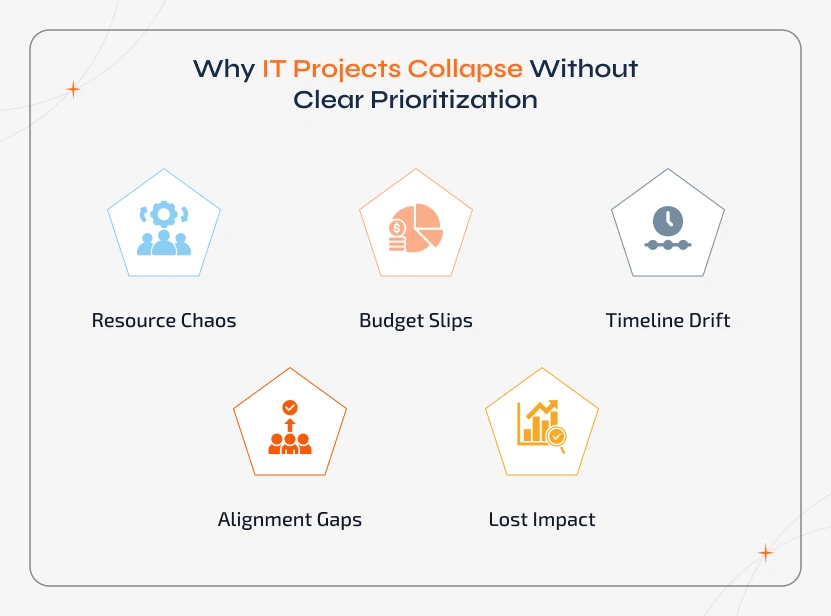
Resource Chaos
In the absence of prioritization, major talents get scattered across many initiatives. This reduces focus and productivity and high-value projects will drag behind simply because the employees aren’t available at the right time.
Budget Slips
Prioritization slips might lead teams to invest time and money into a low-impact project, while the high-impact projects stay underfunded. Due to this, the business will face bloated budgets, constant rework, and missed financial targets.
Timeline Drift
When every project feels urgent, nothing will move on time. Teams are forced to juggle conflicting tasks with zero clarity on which project needs immediate attention. This leads to project slips and creates frustration among teams, making a timely software rescue the only way to get things back on track.
Alignment Gaps
When a department starts operating with different priorities, it causes inconsistency in decision-making, duplicated efforts, and also causes workflow conflicts. Moreover, lack of alignment eventually stalls execution.
Lost Impact
When the wrong project gets attention among teammates, the organization will most likely miss market opportunities and fail to stay competitive in this fast-paced world.
Common Challenges Businesses Face in Prioritizing IT Projects
Businesses, especially startups, often struggle with prioritization because it requires balancing resources, teams, and demands. Here are the core challenges faced by startups when they try to prioritize projects.
Managing Stakeholder Pressure
The priority will keep changing due to leadership updates, market moves, or unexpected technical issues on the development side. Due to this, teams will struggle to maintain the momentum, creating rework, delays, and burnout.
Evaluating Project Value
Project heads usually don’t have clear numbers on ROI, long-term impact, or how much work will actually help the internal team. When no one has solid metrics, it’s definitely hard to compare projects or make defined choices.
Uncertain Technical Complexity
Many companies, especially startups, will underestimate how complex a project can become once the development process begins. Hidden dependencies, integration challenges and old systems can completely turn the tables around, and also lead to difficulties in fixing software projects.
Eradicating Resource Bottlenecks
At times, key specialists get overloaded across various projects, causing slowdowns in critical areas. If the talent is stretched thin, even the high-value projects lose their efficiency. On the other hand, leaders will end up firefighting with issues instead of driving value.
Balancing Short Term
Immediate business needs clash with the long-term strategic goals. For most of us, quick wins feel urgent while the foundation initiatives keep getting postponed. As priority lacks, organizations risk short-sighted decisions that limit future growth.
Project Prioritization Frameworks We Use at Sparkout
Organizations mostly rely on structured frameworks to compare project value, understand impact, and allocate resources effectively. Similarly, at Sparkout, we use strategic IT planning and frameworks so that business leaders move from guesswork to clear and measurable decision-making.
MoSCoW Method
This specific framework helps teams to classify project requirements into several fragments, including Must Have, Should Have, Could Have, and Won’t Have. It is useful when your project involves multiple departments and changing needs.
RICE Scoring
RICE Scoring framework evaluates projects based on Reach, Impact, Confidence, and Effort. This unique approach helps teams to identify which initiative offers the highest return on effort and robust business benefit.
Value vs Effort Matrix
With this framework, the projects are plotted based on expected business value and the required effort. This allows businesses to find a simple way to identify quick wins and postpone minimal value tasks.
Cost of Benefit Analysis
This framework compares the predicted benefits of a project with the costs required to complete it thoroughly. Most of the business leaders use this to justify investments and to prioritize high ROI initiatives.
Weighted Scoring Method
In this project scoring model, teams assign scores to projects across multiple platforms, like risk, revenue, compliance, and complexity. This creates a balanced and data-driven prioritization list.
Agile Backlog Prioritization
Agile internal teams use story points, grooming sessions and sprints to refine and order project tasks. This ensures continuous alignment with your business goals and capacity.
Criteria to Evaluate Project Before Prioritization
Before a software development project moves into the prioritization stage, it must meet some specific evaluation criteria. These are the ones that verify whether the initiative is feasible, valuable, and aligned with organizational direction. This IT project selection criteria ensures only the qualified projects enter the priority pipeline.
1. Strategic Alignment Criteria
- Does the project support key business objectives?
- Does it really align with the current departmental and organizational goals?
2. Value & Benefit Criteria
- Will the project actually generate measurable business outcomes?
- Does it improve revenue, efficiency, customer experience, and compliance?
3. Feasibility & Resource Criteria
- Can the team deliver results without disturbing ongoing priority work?
- Are the required skills, tools, and budget available?
4. Risk & Dependency Criteria
- Does success rely on project dependency management?
- What technical, financial, or operational risks exist?
5. Operational Impact Criteria
- Does it actually create major changes that require training or process adjustments?
- Will it reduce bottlenecks or improve existing workflows?
6. Timing & Urgency Criteria
- What is the cost of delaying or not executing the project?
- Is there a regulatory deadline, customer expectation, or market window?
Effective Techniques to Prioritize IT Projects
Even though prioritizing an IT project is complicated, Sparkout has a clear solution for all. By using simple, yet actionable strategies, internal teams can focus on what really matters and move quickly without wasting any time or resources.
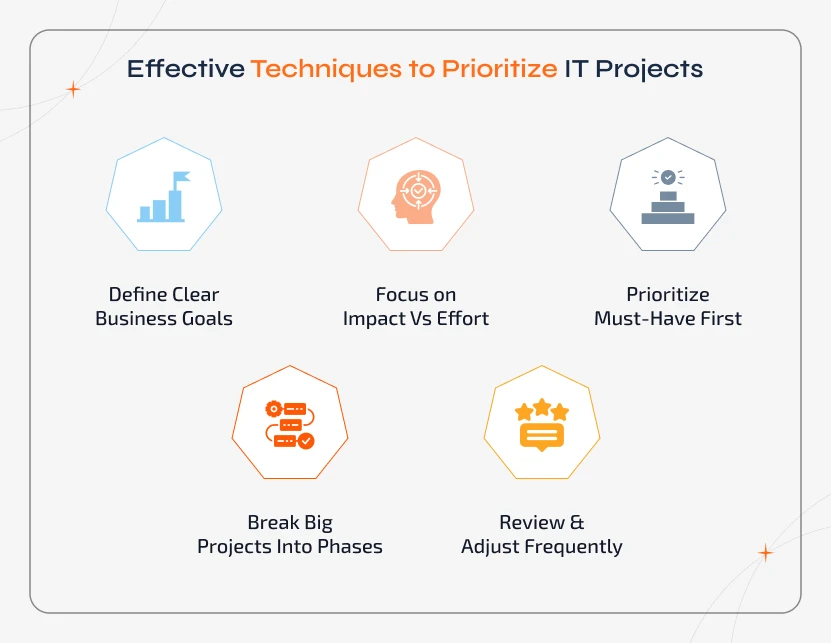
1. Define Clear Business Goals
Before committing to a project, you have to know the detailed overview. The software project should align with your company’s growth and efficiency, which makes it easier to separate what truly matters and what’s just noise.
2. Focus on Impact Vs Effort
Make sure to evaluate which project will deliver the most value with minimal effort. Quick wins also matter, but don’t ignore initiatives that might take a bit longer but deliver major long-term business benefits.
3. Prioritize Must-Have First
Make sure to identify the essential tasks or projects that are non-negotiable. This includes compliance updates, critical system fixes, and urgent customer needs. Give priority to these, while the rest can wait for a bit longer.
4. Break Big Projects Into Phases
Gain proper knowledge to split larger projects into smaller and manageable steps. This approach makes things easier, helps in measuring progress, evaluating resource needs, and adjusting priorities if things change.
5. Review & Adjust Frequently
As the business evolves, priorities will shift. So, ensure you revisit your software project regularly and make sure it is aligned with the shifting goals, feedback, and market dynamics.
How Data-Driven Decision-Making Transforms IT Project Choices?
Data-driven decision-making helps in choosing IT projects based on actual facts instead of personal opinions or loud voices in the business environment. When teams start to track things like expected ROI, user demand, and operational gaps, they can get a clear picture of what actually matters. This makes teams easier to filter out the low-value ideas and highlight the ones that bring real business wins.
Data also reduces teams' guesswork while planning timelines and resource allocation. Now, teams can able to compare multiple projects by overseeing the cost, impact, risk level, and how each one supports long-term growth.
Finding the Right Balance Between Quick Wins and Strategic Projects
While prioritizing IT projects, organizations will always be in a dilemma of choosing between quick wins and long-term strategic initiatives. If we’re talking about quick wins, it offers immediate benefits, boosts team morale, and delivers results fast. But the catch is, they may not always align with the business vision. On the contrary, long-term strategic projects will deliver the results slowly, but will build scalable systems, strengthen the operation, and ensure a lasting impact on business.
Whatever the aspect you choose, the real skill lies in finding the right balance. Project evaluation and selection based on urgency and resource availability, teams can decide which one to choose and to invest in. In the end, a balanced project portfolio management ensures that IT efforts create quick value while steadily shaping the firm’s long-term success.
Key Benefits of Efficient Partnering in IT Project Prioritization
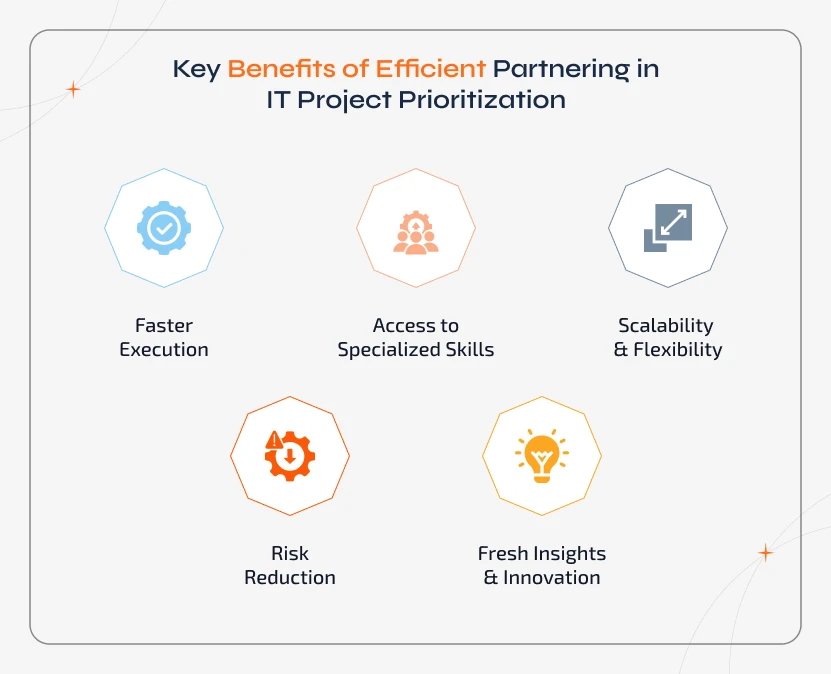
Partnering efficiently with the right vendors or external teams accelerates the IT project prioritization by blending expertise, resources, and new perspectives. Here are the key benefits why you should partner up with a dedicated team in prioritizing IT projects.
Faster Execution
Dedicated partners and vendors often have the required resources available, which helps in accelerating the project delivery. This allows the internal teams to focus on evaluating and executing multiple projects at the same time, reducing potential backlogs. Even if any issue occurs, we help in recovering the IT project much quickly.
Access to Specialized Skills
An outsourcing partner usually brings expertise and experience that might not exist among the internal teams. They can guide teams in assessing the project's feasibility and pinpointing high-value initiatives. This ensures that prioritizing IT projects is carried out based on practical insights instead of assumptions.
Scalability & Flexibility
Efficient partners allow organizations to scale the resource up or down based on business needs. When there’s a sudden high-pressure project, the outsourcing team can jump in fast and provide respective solutions. This kind of flexibility helps you focus on the right project at the right time.
Risk Reduction
Sharing business responsibilities with an experienced partners will reduce operational and execution risks. Their expertise helps to predict the potential roadblocks and optimize the project’s feasibility before committing internal resources. This makes the prioritization decisions smart and more reliable.
Fresh Insights & Innovation
Compared to the internal team, external partners have diverse perspectives and innovative approaches, as they work with multiple organizations. These insights can be useful for the upcoming projects with strategic value, helping businesses in prioritizing initiatives that contribute to long-term growth.
How Sparkout Helps Businesses in Prioritzing IT Projects
Being one of the leading modern tech development and consulting companies, we help organizations cut through clutter and pick IT projects that deliver real value. By partnering with Sparkout, businesses can move faster, stay aligned with long-term goals, and confidently invest in software projects that matter the most.
1. Structured Evaluation Framework
At Sparkout, we use a systematic scoring method that actually compares every project by cost, impact, complexity, and long-term value. This approach eliminates guesswork and helps teams to make smart choices with clarity and logic.
2. Composable AI Expertise
With our AI-driven insights, our outsourcing team highlights what deserves attention first and what’s after that. This helps teams to avoid low-value initiatives, and you can focus on high-impact outcomes.
3. Faster Decision Cycles
By following ready-to-use workflows, smart automation, and partner-driven execution, our outsourcing team will minimize the time taken to validate and prioritize software projects.
4. End-to-End Support
From idea assessment to implementation planning, our dedicated team at Saprkout guides you in every step, ensuring the software project moves forward smoothly.
5. Alignment With Business Goals
Our Sparkout team ensure that each prioritized project directly supports growth, efficiency, and long-term strategic decisions. This will keep the IT roadmap planning stable, focused, and perfectly aligned with the company’s vision.
Winding Up!
To conclude, prioritizing an IT project isn’t just about reacting to what feels urgent. It’s really about using data, balancing quick wins with long-term value, and partnering with a reliable firm to make decisions faster. By following the right structure and clarity, startups and businesses can avoid wasting effort and focus on projects that drive growth.
As technology keeps evolving, companies that choose IT projects wisely will gradually move forward without any barriers. In the meantime, Sparkout makes the process smoother with expert insight.