


Brokerages, property managers, and commercial firms are now using AI in real estate to simplify workflows, close deal cycles, and make better decisions. This shift is driven by structured AI agent development that enables the Real Estate AI agent to unify pricing, leads, compliance, & operations beyond simple automation. These systems connect lead management, pricing insights, marketing trends, and property operations into one intelligent platform.
Unlike traditional real estate automation tools that solve individual tasks, these AI agents work across systems. i.e., They analyse the market signals, qualify buyers in real time, automate the property workflows, forecast pricing trends, and continuously refine operations using machine learning in real estate.
Whether you are evaluating smart real estate solutions or just exploring AI platforms for real estate automation, this article provides a roadmap that aligns strategically and technically with current industry adoption trends.
What's Covered in this Guide:
- Where real estate automation tools actually create ROI
- How AI agents for property price predictions work in practice
- The difference between a real estate chatbot and a true autonomous AI agent
- The architecture behind a scalable real estate AI platform
- How enterprises are implementing AI real estate software securely
What is a Real Estate AI Agent?
A Real Estate AI Agent is an AI-powered system that analyses the data, makes contextual decisions, and autonomously executes the real estate tasks across sales, marketing, and property management workflows.
It can effortlessly handle tasks such as:
- Lead qualification
- Property price prediction
- Tenant communication
- Listing optimization
- Deal pipeline management
Unlike a traditional real estate virtual assistant or rule-based real estate chatbot, modern real estate systems function as autonomous AI agents. They observe the patterns, reason across structured and unstructured datasets, take contextual actions, and improve over time.
It integrates seamlessly with CRM systems, MLS feeds, and marketing platforms to perform multi-step actions with minimal human intervention. Besides, it continuously optimizes the performance using machine learning in real estate.
Real Estate Chatbot vs AI Agent - What’s the Difference?
For enterprises relying on AI in real estate, this distinction helps find whether they adopt a basic chatbot for simple queries or choose a powerful automation system that can manage workflows, make decisions, and scale with the business.
Is There an AI Real Estate Agent
Yes. Real estate AI agents are being deployed across the property ecosystem, and that includes residential brokerages, property management firms, commercial real estate enterprises, and online real estate marketplaces.
Some of the major platforms, like Zillow and Redfin, are using AI to offer property recommendations, predictive pricing, and automated customer engagement.
A true real estate AI agent goes beyond the recommendation engines. It not just analyzes or suggests, but it autonomously executes the tasks across those integrated systems, manages workflows, and continuously improves the performance in real-time.
How a Real Estate AI Agent Works
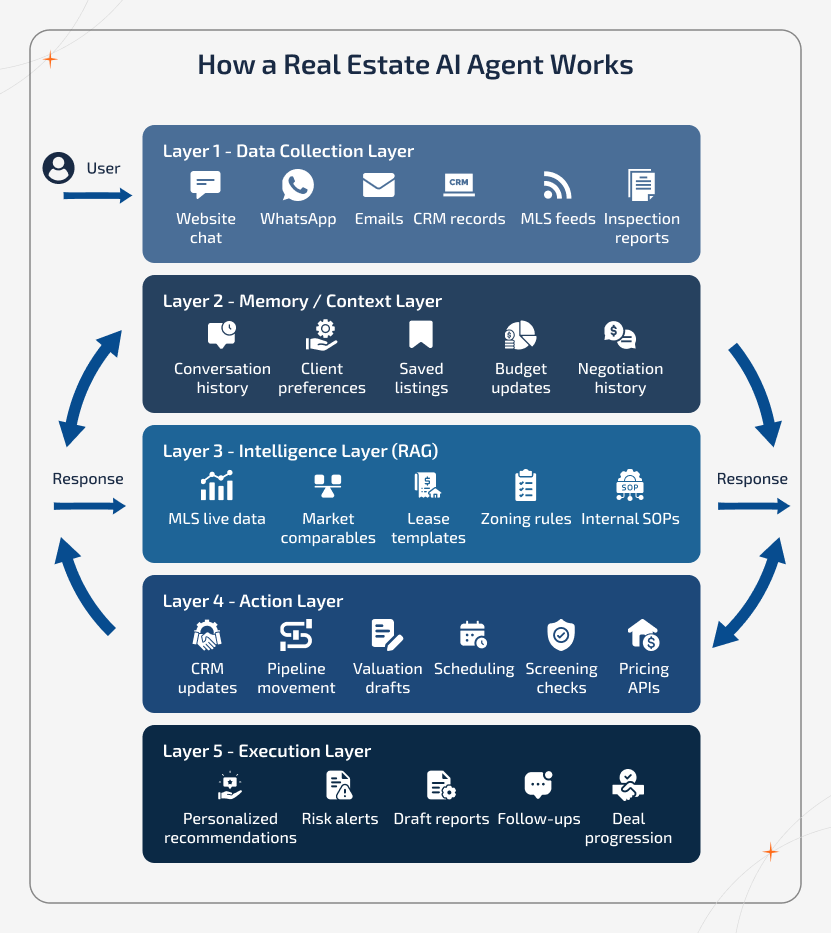
A real estate AI agent works as a multi-layer intelligent system. Rather than responding to queries, it processes the data, stores context, reasons with knowledge, takes action, and delivers measurable results. It is split into five connected layers as follows:
Short Answer: Core components of a real estate AI platform include Data Collection Layer > Context Layer > Intelligence Layer > Action Layer > Execution Layer
1. Inputs or Data Collection Layer
Here, the agent will continuously collect the inputs from website chat, SMS, WhatsApp conversations, emails, phone call transcriptions, CRM records, MLS feeds, property images, inspection reports, and even from the IoT sensors.
In this layer, the structured and unstructured data are consolidated to thereby build a real-time understanding of both the customer and the property.
2. Memory or Context Layer
It may take around weeks or months to unfold real estate transactions. Unlike traditional automation, the agent remembers the conversation history, client preferences, saved properties, budget updates, and negotiation context.
This persistent memory helps respond intelligently across multiple touchpoints and not as isolated interactions.
3. Knowledge or Intelligence Layer
The agent uses the live MLS data, market comparables, lease templates, zoning regulations, internal SOPs, and pricing policies to make better decisions.
With RAG or Retrieval-Augmented Generation, responses are connected to factual business data to ensure accuracy and compliance.
4. Tools or Action Layer
It is in this phase that the real estate AI agent becomes fully operational. It becomes capable of creating CRM tasks, moving deals across pipeline stages, generating valuation drafts, scheduling appointments, sending listing documents, triggering contract workflows, calling pricing APIs, and running screening checks.
Without the support of this action layer, the agent stays conversational. Whereas with it, the agent becomes an execution engine.
5. Outputs or Execution Layer
This layer delivers business outcomes such as personalized recommendations, automated follow-ups, alerts, risk flags, draft reports, and optimized deal progression.
Instead of assisting the teams, the AI agent augments and speeds them up.
Types of AI Agents Used in Real Estate
There are different types of AI agents that exists and they operate at different levels of autonomy and intelligence. In real estate, they range from simple reactive systems to fully learning, optimization-driven agents.
1. Reactive Agents
These are agents that respond instantly to predefined triggers. They do not store the memory or reason deeply. Rather, they just react to the inputs.
- Ex: A 24/7 listing agent that answers property-related questions or shares the boundaries when a buyer submits an inquiry.
- Best Suitable for - Quick response automation & Front-line engagement.
2. Model-Based Agents
These are agents that help maintain an internal stage. They, in turn, track the context and update information over time. Thus, supports more personalized interactions.
- Ex: A buyer preference tracker that remembers the budget, property type, location and refines the suggestions accordingly.
- Best Suitable for - Relationship-based sales cycles & Ongoing client engagement.
3. Goal-Based Agents
The goal-based agents work toward a defined outcome. Rather than just providing a response, these agents in real estate plan actions to achieve specific objectives.
- Ex: An AI agent configured to 'book three property showings this week' by following up with leads, checking calendars, and sending confirmations.
- Best Suitable for - Sales acceleration & Pipeline progression.
4. Utility-Based Agents
These AI agents check multiple possible outcomes and choose the one that offers maximum value based on defined metrics such as price, occupancy rate, or conversion probability.
- Ex: A rental price optimization agent that adjusts pricing based on demand, seasonality, and local market trends.
- Best Suitable for - Revenue optimization and strategic decision-making.
5. Learning Agents
These are the most advanced agents that continuously improve performance using feedback and historical data.
- Ex: A lead scoring system that refines qualification criteria over time based on closed deals and conversion patterns.
- Best Suitable for - Long-term performance improvement and predictive intelligence.
In practice, modern Real Estate AI Agents are a combination of multiple types. Thus, they can react in real time, remember context, pursue goals, optimize outcomes, and learn continuously.
AI Agents vs Chatbot vs Workflow Automation
A clear understanding between these three is vital when planning real estate automation,
1. Chatbot - Answers questions
It is a Conversation Layer and is designed for conversation. It responds to the user queries based on predefined scripts or trained responses. It is helpful for
- Answering FAQs
- Basic property details
- Capturing basic lead information
While AI chatbot development primarily focuses on conversational interfaces, real estate AI agents extend beyond dialogue into orchestration, decision-making, and cross-system execution. Note that chatbots will be communicative, but it doesn't take any independent actions.
2. Workflow Automation - Follows Rules
It is a Process Layer that executes the predefined rules and helps improve efficiency. This focuses on operational efficiency.
For example:
- If a form is submitted → assign it to an agent.
- If a deal moves to the next stage → send a notification.
- If the lease expires → trigger reminder.
This improves speed and consistency across systems like CRM and property management tools. However, it cannot think, adapt, or make decisions beyond the programmed logic.
3. AI Agents - Reasons, acts, & adapts
A real estate AI agent goes beyond answering or following rules. i.e., it combines reasoning with action. It analyses data, makes contextual decisions, executes actions across systems, and improves based on outcomes.
Consider that an AI agent can:
- Pull market comparable automatically
- Summarize lease clauses with citations from verified documents
- Create & update CRM entries
- Flag inconsistencies in inspection reports
- Trigger follow-ups based on buyer intent signals
This is referred to as operational intelligence. Instead of assisting one step in the process, a Real Estate AI Agent can manage the entire workflow across sales, leasing, valuation, and property management.
A Quick Comparison:
| Chatbot | Workflow Automation | Real Estate AI Agent |
|---|---|---|
| Answers questions | Follows predefined rules | Reasons, acts, and adapts |
| Front-end interaction | Backend process triggers | Cross-system orchestration |
| No decision authority | Logic-based execution | Context-aware decision-making |
| No memory | Limited state tracking | Persistent contextual memory |
| Support tool | Efficiency tool | Intelligent execution engine |
Real Estate AI Agent Use Cases By Role
A real estate AI agent functions as an intelligent execution layer across the property lifecycle. It takes control of the automation, decision-making, and optimization customized to the stakeholders in the real estate ecosystem.
1. Real Estate AI Agents for Brokerages
A real estate AI agent accelerates the revenue for the brokerages. The agent can
- Qualify & score leads
- Surfaces MLS data based on buyer intent
- Schedule showings
- Generate optimized listing content
- Maintain CRM accuracy
- Automates follow-ups
As a result, agents offer faster deal progression, higher conversion rates, and cleaner pipeline management.
2. Real Estate AI Agents for Property Managers
In property management, the AI agent helps reduce operational workload and improve tenant experience. Common use cases include:
Maintenance request triage & urgency detection
- Automated rent reminders & lease renewal alerts
- Tenant screening workflow support
- Predictive maintenance using IoT signals
- Ticket prioritization & escalation
- Lease abstraction & clause summarization
This shifts operations from reactive issue handling to proactive property optimization.
3. Real Estate AI Agents for Investors
For investors, a real estate AI agent will act as an intelligent portfolio assistant. It can:
Use Cases:
- Analyzes real-time deals
- Generate rent & sales comparable
- Send portfolio performance alerts
- Conduct property-level risk scoring
- Identifies market sentiment trends
- Detect propensity-to-sell opportunities
Thus, investors receive dynamic, data-driven recommendations instead of relying on static dashboards.
4. Real Estate AI Ag₹ents for Developers & Asset Managers
Developers and asset managers use AI agents to optimize asset value and long-term performance. Key applications include:
- Energy usage optimization
- Space utilization analysis
- Demand forecasting based on market signals
- Disaster preparedness modeling
- ESG & sustainability performance tracking
The result is a transformation of asset management from monitoring-based to intelligence-driven.
Why Does This Matter in 2026:
As AI in real estate continues to evolve, role-specific AI agents are turning into essential systems. Whether it is about improving sales efficiency, tenant retention, portfolio performance, or asset value, a real estate AI agent helps businesses automate processes and scale business operations across systems.
How a Real Estate AI Agent Manages the Full Lifecycle - From Lead to Close
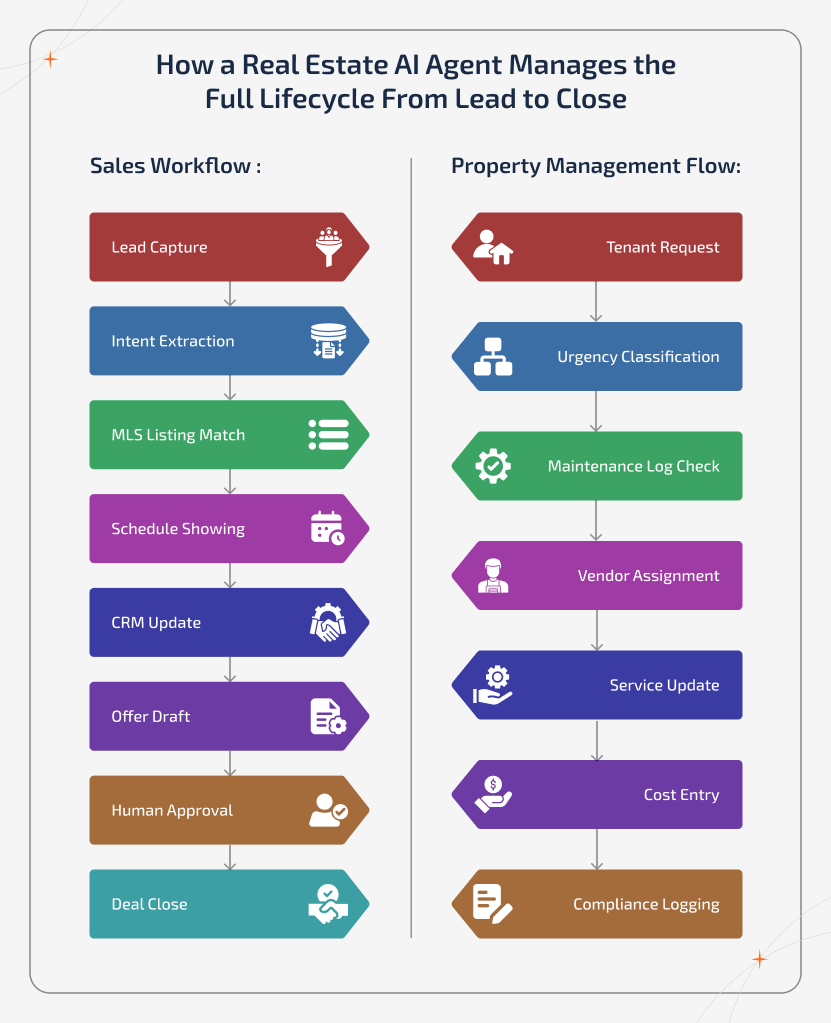
A real estate AI Agent becomes more powerful when it is deployed across the entire property lifecycle and not for a single touchpoint. Thus, it can manage the workflows from initial inquiry to deal closure, and from the tenant request to problem resolution.
1. Sales Workflow Example
In a brokerage environment, the lifecycle starts as soon as a new lead is captured. Now, the real estate AI agent analyses the inquiry, extracts buyer intent, and automatically pulls relevant listings from MLS data.
With that, it coordinates showing availability, schedules appointments, creates or updates CRM records, and finally sends the reminders to both the buyer and the agent.
As engagement progresses, the agent starts to draft the offer summary, prepare structured follow-up plans, and then alert a human advisor when strategic approval is required.
AI agent orchestrates the entire sales workflow while ensuring human oversight wherever required. Thus, eliminating the manual coordination in each step.
2. Property Management Workflow Example
In property management, the lifecycle starts with the tenant request.
For instance, when a maintenance issue is submitted, the Real Estate AI agents classify the urgency based on past patterns and contextual data. The agent will check for the maintenance logs, assign an appropriate vendor, update the service issue, and revert the confirmation to the tenant.
When the issue gets resolved, the agent makes the entry of associated costs, updates property records, and maintains an auditable history for compliance and reporting. Thus, the result is a faster resolution, improved tenant satisfaction, and streamlined operational tracking.
Traditional automation handles the isolated steps, while real estate AI agents can manage the end-to-end workflows efficiently.
How Do Multi-Agent Real Estate AI Systems Work
Modern real estate AI agent systems rely on multiple specialized agents instead of one single AI that handles everything. This approach is referred to as multi-agent orchestration. Here, each agent takes up a specific role, and they are as follows:
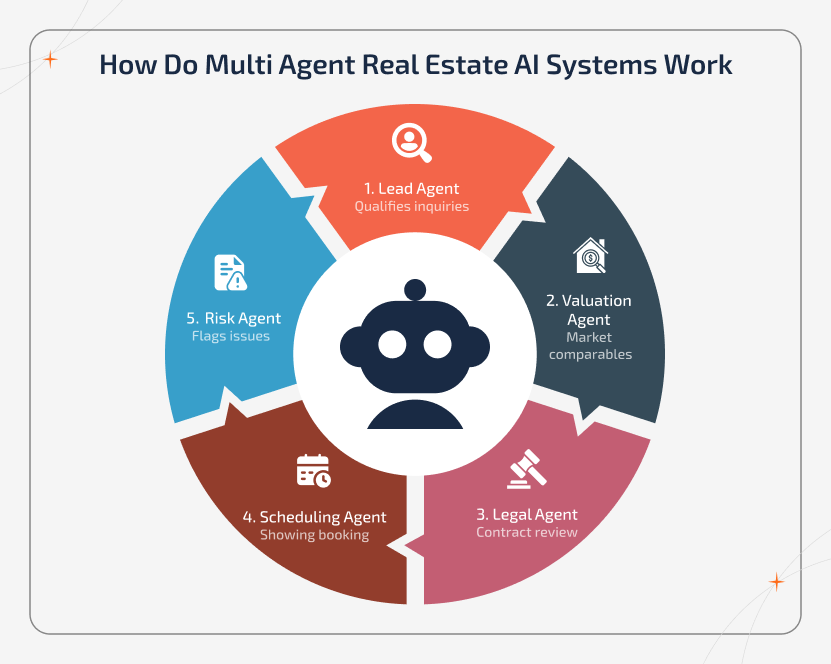
- A Lead Agent - Helps qualify new inquiries
- A Valuation Agent - Performs market comparisons
- A Legal Agent - Helps review contracts or disclosures
- A Scheduling Agent - Processing booking showings
- A Risk Agent - Helps flag potential issues
These agents are coordinated with a central Master Orchestration. This decides which agent should act, in what order, and ensures that the workflow moves smoothly.
For instance, when a new lead enters the system:
- The conversation agent responds and collects the intent, the valuation agent pulls comparable properties, the scheduling agent books a showing, and if the deal progresses, the legal agent starts to prepare the draft documents.
The thing here is, all the agents work in a coordinated sequence. Instead of one AI trying to do everything, multiple specialized agents will work together. This helps improve the accuracy, speed, and scalability. Thus, multi-agent orchestration turns a real estate AI agent into a team of digital specialists that works in sync.
Agentic RAG - Compliance-First AI for Real Estate
The decisions in the real estate industries requires accuracy, compliance, and traceability. All these can be ensured with the help of Agentic RAG (Retrieval-Augmented Generation). With RAG, AI agents do not just rely on memory alone, but actively retrieve verified data before responding. So, in the real estate context, it means:
- Collects listing details from the MLS feed directly.
- Quoting lease clauses from the correct contract version.
- Checking zoning rules from approved municipal sources.
- Referencing internal brokerage policies before drafting disclosures.
Here, each response can include traceable citations or system logs.
How Visual Intelligence Agents or Vision-Language Models Transform Real Estate Operations
In 2026, modern real estate AI agents not just deal with text and data. With the help of vision-language models, they can analyse the images, understand visual context, and turn property visuals into actionable insights.
Instead of manually reviewing photos and floor plans, visual intelligence agents can
- Auto-tag property images such as kitchen, pool, balcony, living room, etc.
- Detect visible structural issues.
- Generate listing descriptions from uploaded photos
- Suggest virtual staging styles, and extract features from floor plans
In simple terms, the visual intelligence agents will turn property images into structured information that supports marketing, pricing, and risk assessment. This brings computer vision directly into real estate operations.
AI-Powered Intelligent Document Processing (IDP)
Since the real estate industry generates a large volume of documents, reviewing them becomes time-consuming and requires human oversight. The documents include leases, inspection reports, contracts, disclosures, and amendments.
With Intelligent Document Processing (IDP), a Real Estate AI Agent can read, extract, and analyse the key information automatically. For instance, it can:
- Extract important lease clauses
- Find rent escalation terms
- Identify missing signatures or incomplete sections
- Summarize lengthy inspection reports
- Flag high-risk amendments or unusual contract language
Teams will be able to directly receive structured summaries and highlighted risk areas within minutes, saving time involved in scanning hundreds of pages. This capability is critically important in commercial real estate (CRE) and underwriting, as contracts will be complex with strict compliance standards and higher financial risks involved.
Thus, IDP converts those unstructured documents into clear, actionable insights and thereby helps teams work faster, reduce errors, and manage risk more effectively.
Real Estate AI Agent Adoption - Current Trends & Maturity Levels
Currently, AI adoption in real estate is moving from experimentation to structured implementation. Industry insights from organizations like the National Association of Realtors report the growing use of AI in lead generation, marketing automation, and client engagement. At the enterprise level, large brokerages use platforms like Salesforce and embed the CRM automation into core operations. This signals that the automation is becoming infrastructure and not just a pilot initiative.
In 2026, the AI adoption in real estate falls into two major categories:
- Basic Adoption - This is focused on efficiency and support tasks. This includes content drafting and chatbot-based responses.
- Advanced Adoption - It is centered on operational intelligence, and this includes workflow automation, document intelligence, predictive analytics, and cross-system AI orchestration.
The gap that exists between these two levels shows the shift from using AI as a tool to deploy a Real Estate AI Agent as a strategic business system.
Risk & Compliance Checklist for Real Estate AI Agents
Deploying a Real Estate AI Agent often requires clear governance and control in addition to technical capability. Since AI systems impact pricing decisions, tenant screening, and legal documentation, compliance and risk controls should be built into the system from the beginning.
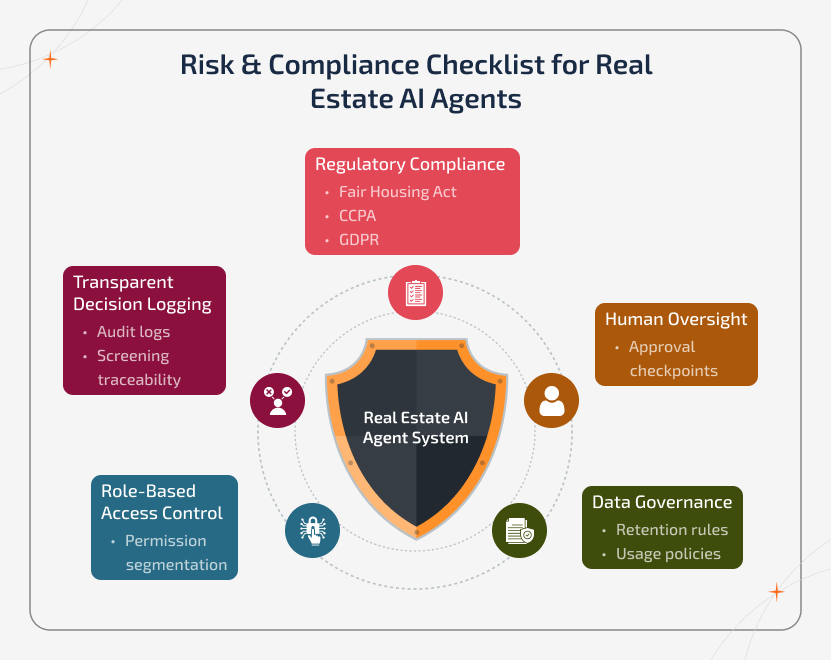
Key Considerations Include:
1. Regulatory Compliance
AI systems should align with regulations like the Fair Housing Act and data protection laws like CCPA & GDPR. Thus, helps eliminate the automated decisions from bringing in bias, discrimination, or unlawful profiling.
2. Transparent Decision Logging
An audit log should be generated for every screening decision, pricing recommendation, or document modification made. This helps ensure traceability and support regulatory review when needed.
3. Human Oversight for High-Stakes Actions
Critical outputs such as tenant screening results, pricing adjustments, contract drafts, or risk flags should require human approval before execution. AI can recommend, but the accountability should remain with the licensed professional.
4. Data Governance & Retention Policies
By setting up clear rules, it is possible to define how long customer data is stored, how it is used, and when it is deleted. Real estate transactions often involve sensitive financial and identity information.
5. Role-Based Access Control
Not every team member should access all the AI outputs. Permissions should be set and structured to limit the exposure to confidential data and high-risk decisions.
Thus real estate AI agent should be designed as a compliance-first system. i.e., automation should increase the efficiency, but with human decisions to remain in control for the critical decision.
How to Protect Sensitive Real Estate Data in AI Systems - Know the Guardian Layers
A real estate AI agent should be built with strong data protection standards. Real estate transactions often involve sensitive financial records, identity documents, lease agreements, and payment information. All of these makes the security as a non-negotiable factor.
Key protection layers include:
- PII masking - Used to prevent the exposure of personal information.
- Encryption at Rest and in Transit - Helps secure stored and transferred data.
- Secure API Integration - Used to protect system-to-system communication.
- Role-Based Access Control Policies - This is used to limit the data visibility.
- Strict Data Isolation - Ensures the brokerage data is not used for public model retraining.
The above guardian layers help protect the confidential client and financial information. It also ensures maintaining trust, compliance, and enterprise-grade security.
Build vs Buy - What to Choose for Real Estate AI Agent
Businesses looking to adopt a real estate AI agent have to choose between purchasing an existing SaaS platform or building a custom solution. This is one of the primary decisions to be taken, and the right choice often depends on the operational complexity, integration needs, and long-term strategy.
When Buying a SaaS Solution Makes Sense:
A ready-made platform will work well when your workflows are relatively standard and you require fast deployment.
If your end goal is to automate the lead capture, enable basic CRM integration, or introduce AI-Powered communication without deep customization, SaaS tools will deliver quick value with lower upfront investment. This approach works for the teams that
- Follow common brokerage or property management workflows
- Doesn't require deep MLS or legacy system integration
- Choose predictable subscription pricing instead of development cycles
When analysing SaaS solutions, many enterprises compare features across top AI agent platforms to review orchestration, MLS integration depth, compliance controls, and multi-agent scalability before making a long-term adoption.
When Building a Custom Real Estate AI Agent is Better
Custom development is important when you're dealing with complex processes, compliance requirements, and data strategy. Thus, a tailored solution fits if:
- Your internal rules & approval workflows are highly specific
- Deep MLS, ERP, or property management integrations are required
- Regulatory and compliance standards require tighter control
- You want to use property data as a competitive advantage
- You decide to implement multi-agent orchestration across departments
Thus, a custom real estate AI agent helps you design the architecture, governance controls, and intelligence layers for your business.
A Short Note:
You shall choose to:
- Buy for speed and standardized automation
- Build for control, scalability, and long-term differentiation
The better and optimal approach that works for many enterprises is choosing the hybrid version. i.e., starting with SaaS to validate use cases and then build custom AI agents as automation becomes the core infrastructure.
Real Estate AI Agent Cost Breakdown & Key Investment Drivers
The cost of implementing a Real Estate AI agent depends mostly on the AI model itself. In other words, the development cost of an AI agent system varies based on the infrastructure, integrations, and governance requirements. There are several factors that influence the overall investment:
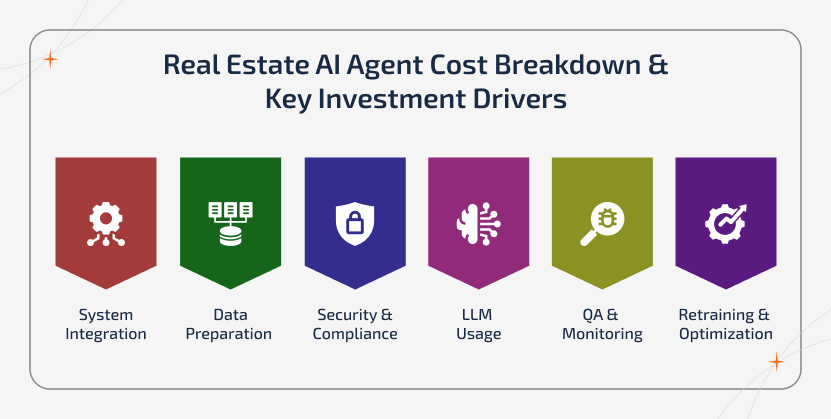
1. System Integration
The factors that impact the development effort include Deep MLS integrations, CRM connections, property management platforms, and API dependencies. The higher the integration complexity, the more systems are involved.
2. Data Preparation and Clean-up
AI performs best with clean and structured data. So, normalizing CRM records, fixing duplicates, organizing lease documents, and preparing historical datasets requires upfront effort.
3. Security & Compliance Controls
Encryption layers, role-based control, audit logging, and regulatory safeguards also add architectural complexity. However, these are essential for real estate operations.
4. LLM Usage & Scaling
Often, costs increase with usage volume. Lead traffic, document processing frequency, image analysis, and multi-agent orchestration all influence the token consumption and infrastructure scaling.
5. Quality Assurance & Monitoring
AI systems need continuous evaluation for test cases, output validation, risk flagging, logging, and performance benchmarking.
6. Retraining & Optimization
Over time, prompt tuning, model adjustment, and retraining with updated data are important to maintain the accuracy and alignment with business rules.
Why Is Ongoing Maintenance Important:
Unlike traditional software, a real estate AI agent is based on 'set and forget.' It indeed requires continuous monitoring, performance tuning, compliance reviews, and system updates.
The agent will stay accurate, secure, and aligned with evolving market conditions with the prompt engineering, guardrail refinement, logging audits, and regression testing. Thus, the true cost of real estate AI agents involves not just the development, but is all about the sustained intelligence management.
Step-by-Step Roadmap to Build a Real Estate AI Agent
Building a real estate AI agent begins with a structured AI strategy consulting to find high-impact workflows, define boundaries, and align automation with measurable business results. The most successful implementation begins small, validates the impact, and expands gradually. The key to successfully build AI infrastructure lies in disciplined execution and governance from day one.
Step 1: Define a Single Workflow
The first thing any business stakeholders should do is to define one high-impact use case. It shall be anything like lead qualification, showing scheduling, or lease abstraction. It's better to avoid automating everything at once.
Step 2: Set Clear Scope Boundaries
Product leaders and compliance teams define boundaries. i.e., they can define what the agent will and will not do. This establishes the limits on decision authority, escalation rules, and human approval requirements. This helps prevent scope creep and risk exposure.
Step 3: Identify & Prepare Data Sources
In this step, data and operations teams get involved and start mapping required inputs such as CRM records, MLS feeds, lease documents, and internal policies. Thus, giving clean and structured data before integration.
Step 4: Design the Conversation & Action Flow
Now, the product and AI teams will outline how the agent interacts with users and what actions it can trigger. It includes defining escalation paths and approval checkpoints.
Step 5: Build the Knowledge Layer (RAG)
AI engineers will start to implement a retrieval layer that connects the agent to verified knowledge sources. This ensures responses are factually accurate and in compliance with MLS data, policy documents, or lease templates.
Step 6: Integrate Core Systems
Engineering teams will connect the agent to CRM platforms, MLS databases, calendars, document systems, and pricing APIs via secure integrations.
Step 7: Implement Governance Controls
Security and compliance teams embed the logging, audit trails, access controls, and human approval rules. This applies especially for pricing, screening, and legal outputs.
Step 8: Pilot with a Controlled User Group
Now the agent is deployed to a limited team. With this, performance, user behaviour, errors, and decision accuracy are monitored closely.
Step 9: Monitor, Optimize, & Expand
AI teams will refine the prompts, improve workflows, upgrade guardrails, and retrain components if necessary. After becoming stable, the system expands to additional workflows and departments.
Organizations looking to build AI agent systems for real estate should avoid over-engineering in the initial phase. It's better to start small, validate ROI, and expand gradually. A real estate AI agent becomes reliable infrastructure only when it is built and scaled through disciplined execution.
Measuring ROI of a Real Estate AI Agent
To understand the value of a Real Estate AI Agent, ROI must be tied to operational and revenue impact and not based on technical performance. Key metrics to track include:
- Lead response time - Used to track how quickly inquiries receive first contact
- Lead-to-showing conversion rate - Tracks movement from inquiry to appointment
- Time-to-close - Measures speed from first interaction to finalized deal
- Time spent per lease review - Tracks reduction in document processing effort
- Maintenance ticket resolution time - Provides operational efficiency gains
- CRM data accuracy - Helps track improvement in record cleanliness and updates
- Cost per lead - Tracks marketing efficiency improvements
Follow a simple evaluation model to measure effectively:
- Measure the baseline - Capture the current performance metrics before deployment.
- Run a controlled pilot - Introduce the AI agent within a defined workflow or team.
- Compare performance changes - Evaluate improvements in speed, conversion, cost, and accuracy.
- Scale based on proven impact - Expand deployment only after measurable gains are validated.
Thus, ROI should not be assumed. Rather, it should be tested, benchmarked, and proven before scaling.
Why Choose Sparkout to Build Real Estate AI Agent
Building a real estate AI agent needs deep workflow understanding, secure integration, and long-term governance. As a leading AI agent development company, we deliver scalable, compliant automation systems. Enterprises looking for flexible engagement models can hire AI agent developer teams from Sparkout to speed up the implementation while maintaining full architectural control. Sparkout approach involves:
- Workflow Expertise - We design around real brokerage, leasing, & property management processes.
- Deep MLS & CRM Integration - We connect your AI agent to operational systems for true execution capability.
- Compliance-First RAG Architecture - Our team ensures outputs in verified data to reduce risk and improve accuracy.
- Security & Governance Built In - With us, encryption, audit logs, access controls, and strict data isolation come standard.
- Human-in-the-Loop Design - Our agents are developed to ensure the high-risk decisions always include approval checkpoints.
- Ongoing Monitoring & Optimization - We continuously refine the prompts, performance, and guardrails.
Thus, we don't just deploy AI features. Instead, we build real estate AI infrastructure designed for long-term impact.
Conclusion
A Real Estate AI Agent is not just a marketing chatbot. It is an operational intelligence layer integrated across the business.
In 2026, success is not defined by simply trying the AI tools. Rather, it involves treating AI as part of your core operations.
Those who adopt this approach will achieve faster response times, cleaner data, smarter decision-making, and better margins.
Lastly, AI will not replace real estate professionals. But firms powered by Real Estate AI Agents will outperform those without them.