


"As per PwC's 2025 Digital Trends in Operations Survey , it was found that about 96% of operations and supply chain leaders mentioned that digital tools improve visibility into end-to-end supply chain costs. This eventually shows the critical role of modern software in today's complex supply networks."
With supply chains growing more complex in 2026, choosing spreadsheets or isolated tools is no longer a sustainable option. This is where Supply Chain Management Software takes charge. Upon choosing the right software, businesses can get real-time visibility, better inventory control, manage suppliers, and respond faster to demand changes.
Here in this blog, you will get to know how supply chain management software actually works, the different types available, and how to select the right solution based on your business needs. This section offers a detailed guide for start-ups scaling operations or a growing mid-market businesses, or enterprises evaluating supply chain management software for better visibility, control, and resilience.
What is Supply Chain Management Software - A Simple Introduction
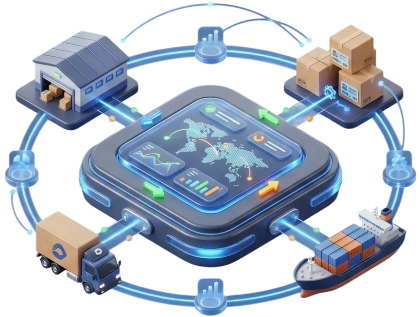
Supply Chain Software is a digital system that helps businesses to transfer products smoothly from suppliers to factories, warehouses, delivery partners, and finally to customers. Thus, there is no need to use too many spreadsheets or maintain separate systems.
With SCM software, everything is managed from one place. i.e., businesses can
- Efficiently track inventory
- Process orders
- Manage deliveries
- Work with the suppliers
- Check out simple reports
Therefore, it can be used online (SaaS), as a large enterprise system, or as custom supply chain management software built for specific needs. Thus, with the SCM software, businesses can avoid delays, reduce costs, and make better decisions.
Why Do Businesses Need Supply Chain Management Software Today
In 2026, supply chains require multiple suppliers, locations, and delivery partners to work together at the same time. Without the right system, businesses may struggle to track what is happening and where problems are starting.
In order to overcome these issues and stay in control, businesses shall rely on supply chain management software. With this,
- Businesses can get end-to-end visibility of what is happening across inventory, suppliers, orders, & deliveries in real-time.
- Respond faster to market changes by adjusting production and stock levels before shortages or overstock happen.
- Reduce supplier and delivery risks by finding the issues at an early stage and avoiding disruptions across the supply chain.
- It is possible to make smarter decisions using data-driven planning & forecasting instead of guesswork.
- SCM software helps scale operations without manual work and disconnected tools.
No matter if it is a start-up or an enterprise, supply chain management software is no longer optional. It is a foundational system that handles everyday operations, scalable growth, and long-term business resilience.
Want to Take Control of Your Supply Chain?
Get a custom supply chain management solution designed for your business.
Common Problems Businesses Come Across Without Supply Chain Software
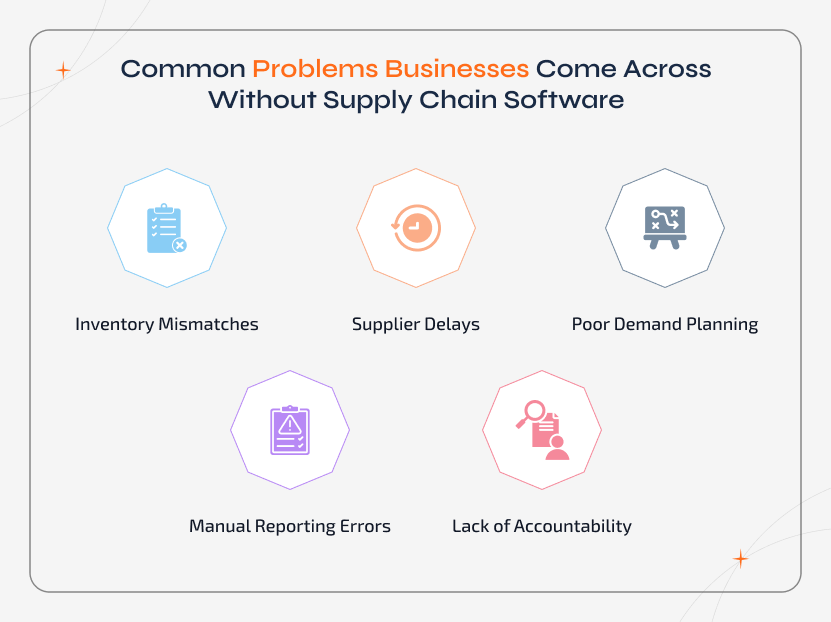
When there is no proper supply chain management software, businesses end up with manual processes and disconnected tools. This creates errors that impact the costs, delivery performance, and customer satisfaction. The most common problems that businesses face without supply chain software are as follows:
1. Inventory Mismatches
Often, teams will not have real-time stock availability in hand, and this leads to either frequent stockouts or excess inventory. This results in lost sales and poor inventory control.
2. Supplier Delays
When there is no proper system to track the supplier performance and delivery time, delays happen, and it will often affect the production and order fulfilment.
3. Poor Demand Planning
Taking accurate decisions becomes hard. Most decisions will be based on guesswork or outdated data, and businesses can't keep themselves prepared to meet the demand spikes or seasonal changes.
4. Manual Reporting Errors
Spreadsheets and manual updates often increase the chance of getting into risks. This includes data entry errors, mismatched reports, and slow access to accurate data.
5. Lack of Accountability
When the data is spread across different tools and teams, it becomes unclear who owns which tasks. This eventually causes delays and missed responsibilities.
Many times, businesses recognize these issues only after struggling to fix the broken systems or migrating from outdated software. By that time, the costs would have increased, and operational efficiency would have already affected.

Without supply chain software, everyday operations rely more on people than systems. Thus, making delays and errors unavoidable as the business scales.
How Supply Chain Management Software Makes Daily Operations Easier
Supply chain management software helps manage everyday work more easily by bringing all the supply chain activities into one system. With SCM software, businesses can manage everything from one single dashboard without switching between tools, emails, and spreadsheets. Businesses can achieve the following with the right supply chain management platform:
SCM software makes day-to-day operations easier by:
1. Automating routine supply chain tasks - It eliminates the manual updates, approvals, and repetitive tracking work that slows down the teams.
2. Centralized data across teams - It stores all the inventory, orders, suppliers, and logistics details in one shared system. With this, everyone can use the same data and get involved in accurate workflows.
3. Providing actionable insights - It supports converting real-time data into clear reports and alerts. These can be used by teams while responding to any issues.
4. Reduced dependency on spreadsheets - SCM software is the best replacement for error-prone spreadsheets. It offers a reliable, real-time platform that improves the accuracy.
With agile custom software development, businesses can refine these systems continuously as operations evolve. The SCM software is capable of adapting to new workflows & market changes and hence makes everyday operations effortless.
Simplify Daily Supply Chain Operations
Replace spreadsheets and manual work with a system built for real operations.
How to Choose the Right Supply Chain Management Software
Choosing the right supply chain management software is not only about picking the tool with the most features. It is about choosing a solution that matches how your business actually works and evolves with you over time.
So, the right software must work for your industry type, support handling everyday operations, and integrate easily with your existing systems. Due to the complexity of supply chains, businesses started looking for greater long-term value by working with experienced supply chain software companies or investing in custom solutions rather than relying on generic tools.
ERP vs Supply Chain Management Software - What's the Difference?
ERP systems are used to manage core business operations such as finance, HR, and procurement. They offer basic supply chain capabilities while they are often transactional and lack real-time operational depth.
Whereas, supply chain management software focuses on planning, execution, and optimization across inventory, suppliers, logistics, and distribution. It offers real-time visibility, better flexibility, and faster responsiveness to disruptions.
Businesses use SCM software with ERP systems for a deeper control, advanced prediction, and faster decision-making across complex supply chain networks.
Important Things to Consider When Choosing SCM Software
Just before selecting supply chain management software, it is important to focus on the following factors as they impact both daily operations and long-term growth.
Key areas to evaluate include:
1. Scalability - The software should grow when your supply chain becomes more complex.
2. Integration capabilities - SCM software must connect smoothly with ERP, CRP, accounting, and logistics systems.
3. Data accuracy and real-time visibility - With reliable data, teams can make faster and better decisions.
4. Security and access control - Strong security is essential to protect sensitive supply chain data.
5. Reporting and analytics - Clear reports help track performance and identify improvement areas
6. Risk management and optimization - Advanced platforms support supply chain risk management and optimization, which in turn helps reduce disruptions and improve efficiency.
So, choosing the SCM software that works the best in the above areas is vital for better control, reduced risks, and long-term value for your business.
Common SCM Implementation Challenges & How to Avoid Them
Often, implementing the supply chain management software is complex when there is no proper strategy followed. The most common challenges include:
1. Data Migration Issues - Implementation delay due to inconsistent and unstructured legacy data. This can be avoided by auditing and cleaning data even before the migration.
2. Change Management Gaps - Teams may take time to follow the new workflows. This can be effectively overcome with early stakeholder involvement and phased rollouts.
3. Low User Adoption - Due to complex interfaces, usage becomes slow. Custom workflows and role-based access help reduce the training time.
Addressing all the above challenges early helps ensure smoother implementation and faster value realization.
What ROI Can You Expect from Supply Chain Management Software
The ROI from supply chain management software is not just about cost reduction. Businesses involve in seeing measurable improvements like:
- Increased inventory turnover by optimizing stock levels.
- Reduced delivery lead times through better planning and coordination.
- Lower operational costs by minimizing manual work, delays, and excess inventory.
Over time, improved visibility and predictive planning offers stronger supply chain resilience and sustained profitability.
Key Features That Define the Best Supply Chain Software in 2026
The best supply chain management software in 2026 is not just involved in tracking orders and inventory. It helps businesses predict issues, automate workflows, and make smarter decisions in real time.
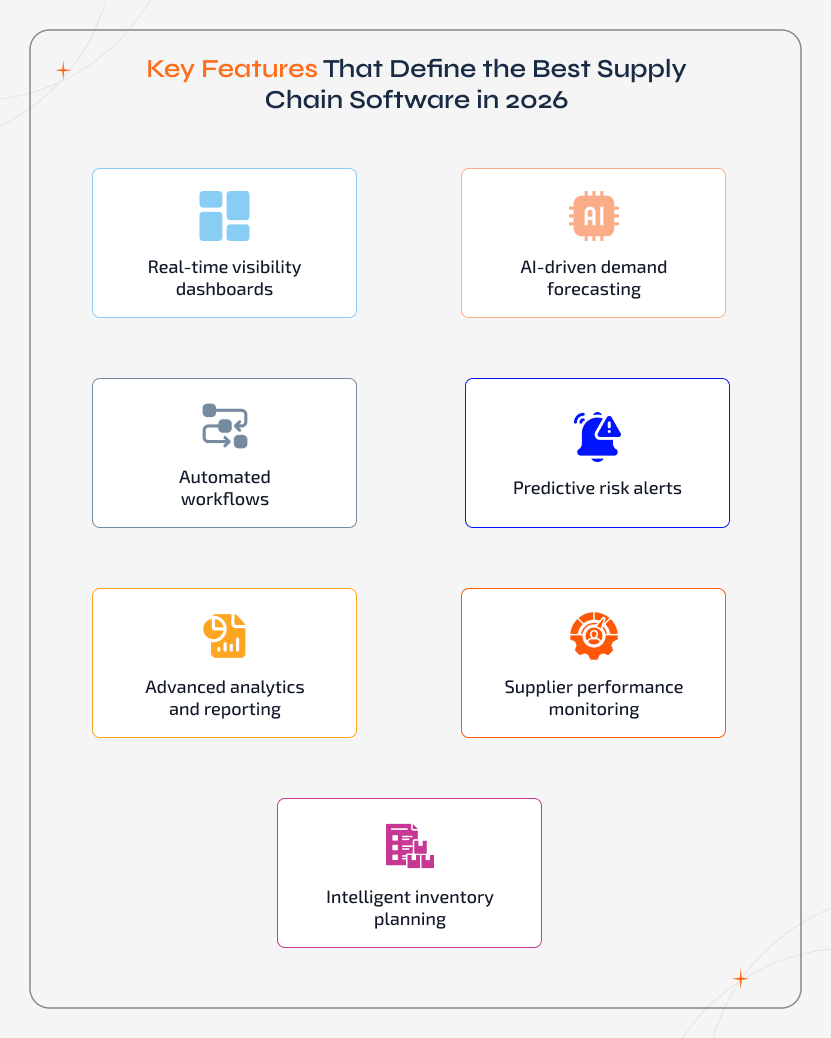
Leading supply chain software solutions typically include:
1. Real-time visibility dashboards that help monitor inventory, orders, and logistics across the entire supply chain.
2. AI-driven demand forecasting that predicts the demand more accurately using historical and live data.
3. Automated workflows speed up approvals and updates.
4. Predictive risk alerts help find supplier, inventory, or delivery risks before they impact operations.
5. Advanced analytics and reporting, which turn supply chain data into actionable insights.
6. Supplier performance monitoring that helps track reliability, lead times, and compliance in one system.
7. Intelligent inventory planning that optimizes stock levels to avoid shortages and excess inventory.
All these features help businesses shift from reactive problem-solving to proactive supply chain optimization.
The best supply chain software prevents problems-it doesn't just report them.
How AI Makes Supply Chain Predictive
AI is redefining the way supply chains are planned, managed, and optimized. Those AI-powered supply chain software help with predicting the issues and work in such a way to resolve them early. Instead of responding to disruptions once after they occur, AI-powered supply chain management software predicts the issues early and recommends right actions in real time. Hence, businesses need not involve reacting to problems at a later stage.
With AI supply chain software, businesses can:
- Seamlessly predict the demands with precision by analysing past sales, seasonal trends, and real-time data.
- The AI-powered supply chain software optimizes inventory automatically and recommends how much to restock. This supports staying away from excess stock and shortages.
- AI helps find the warning signs early by analysing supplier delays or logistics disruptions before they affect the business workflows.
- Machine learning models help turn complex data into clear recommendations and teams can work on that quickly. Thus, AI plays a major role in making better decisions in supply chain management.
So, businesses shall consider all of the above aspects to invest in AI software development to build more powerful supply chains.
AI Maturity in Supply Chain Management
AI adoption in supply chain management happens in multiple stages. Understanding this maturity curve helps businesses find out where they are today and the capabilities they need to invest in the future.
1. Rule-Based Automation or Foundation Stage
In this stage, supply chains rely on pre-defined rules and triggers to automate routine tasks like stock alerts, order updates, and basic reporting. This reduces manual effort, but decisions are still reactive.
2. Predictive Intelligence or Optimization Stage
Here, AI models analyse past data, seasonal patterns, supplier behaviour, and real-time signals to predict the demand, inventory needs, and potential disruptions. Supply chains move from reacting to problems to predicting them before they occur.
3. Prescriptive Decision Support or Control Stage
AI moves beyond prediction by recommending specific actions, such as how much to reorder, which supplier to prioritize, or how to reroute shipments, etc. Teams will get faster, data-driven decision support while maintaining human insights.
4. Autonomous Supply Chains or Advanced Stage
AI systems continuously learn and self-optimize. Inventory levels adjust automatically, logistics routes rebalance in real-time, and supply decisions execute with minimal human intervention.
Why AI Maturity Matters:
Businesses operating at higher AI maturity levels experience the following:
- Fewer supply disruptions.
- Faster response to demand changes.
- Lower inventory carrying costs.
- Stronger supply chain resilience.
In 2026 and beyond, competitive advantage will belong to organizations that move beyond basic automation and build predictive and autonomous supply chain capabilities.
Types of Supply Chain Management Software
Supply chain management software is not a single tool. Rather, it is a group of systems that work together to move products from suppliers to customers without delays. Given below are the types of SCM software that focus on a specific part of the process.
1. Inventory Management Software
These are software that primarily answer one basic question: What do we have and where is it?
It efficiently tracks stock levels in real time, prevents stocks from running out, and avoids overstock that leads to overspending.
- Example: A retail brand uses inventory management software to avoid running out of fast-selling items during a sale and to stop over-ordering slow-moving products.
2. Order Management Software
These type of systems manages things after a customer places an order successfully. It keps all the orders in one place, routes them to the right warehouse or supplier, and ensures timely delivery.
- Example: An eCommerce company uses order management software to route online orders to the nearest warehouse. This is the reason for faster deliveries.
3. Warehouse Management Software
These types of software are used to control what happens inside the warehouse. It helps in storing the items properly, guides picking and packing, and minimizes mistakes while moving goods within the facility.
- Example: A distribution center uses warehouse management software to guide workers on where items are stored, which products to choose, and how to pack them correctly.
4. Transportation Management Software
These systems are used to take over as soon as the goods leave the warehouse. It actually plans the delivery routes, manages freight costs, tracks shipments, and helps ensure on-time delivery.
- Example: A logistics team uses transportation management software to choose the best delivery routes, track trucks in real-time, and thereby reduce fuel costs.
5. Supplier Management Software
This software is mainly used to establish a good relationship with the vendors. It helps in tracking supplier performance, contracts, compliance, and delivery reliability. With this, businesses can see reduced risks and delays.
- Example: A manufacturer uses supplier management software to track supplier delivery times and find vendors who cause delays.
6. Demand Planning & Forecasting Software
These are systems that work in such a way by looking ahead instead of reacting late. With the help of historical data and AI-driven insights, these software types predict the future demand and help plan inventory, production, and purchasing.
- Example: A consumer goods company relies on AI-driven predictionsto increase production before peak seasonal demand.
7. Logistics & Distribution Software
This software is responsible for the final movement of goods. It helps coordinate the shipping, last-mile delivery, returns, and regional distribution to ensure products reach customers smoothly.
- Example: A global brand that uses logistics and distribution-type software to manage deliveries across regions and handle customer returns efficiently.
The above-listed are all the systems that form a complete supply chain management platform that helps businesses stay organized, help avoid disruptions, and scale operations with confidence.
Industry-Specific Supply Chain Management Use Cases
Supply chain challenges vary by industry. Here is how SCM software delivers value across different sectors:
1. Manufacturing
Manufacturers rely on SCM software to synchronize production planning, manage supplier dependencies, and reduce downtime caused by material shortages.
2. Retail
Retailers use SCM systems to predict demand accurately, optimize inventory across locations, and prevent stockouts during peak seasons.
3. Logistics
Logistics providers use SCM software to track shipments in real time, optimize delivery routes, and improve last-mile performance.
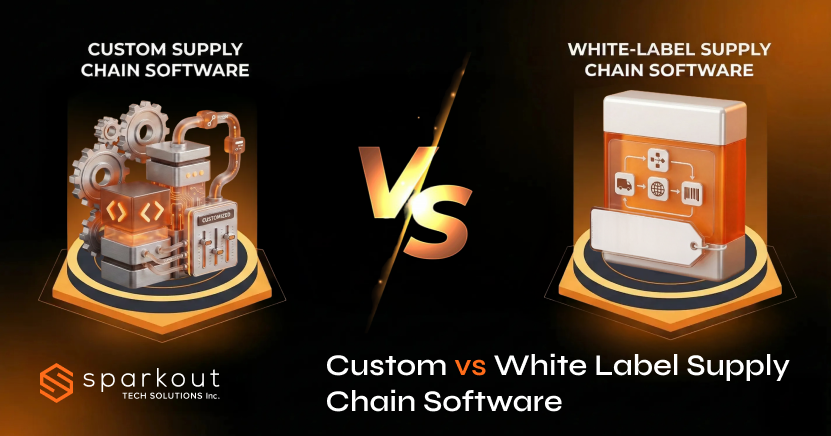
Off-the-Shelf (SaaS) Vs Custom Supply Chain Management Platforms
There are two main types of supply chain management platforms that exist in the current period. All of them are designed to serve different needs, growth plans, and budgets. This includes:
1. Buying Ready-Made Supply Chain Software (SaaS)
These are subscription-based, ready-to-use platforms hosted in the cloud and come with flexibility and remote access. They reduce the infrastructure costs and are easier to maintain.
These platforms follow fixed workflows, are fast to set up, come with predictable monthly costs, and work well for standard processes. However, these platforms have limited customization and flexibility when operations grow.
Best Suited for:
- Startups & small teams.
- Standard inventory & order workflows.
- Faster go-live with minimal setup.
Limitations:
- Fixed workflows that may not always match complex operations.
- Customization & integrations are most often limited.
- Costs increase as users, modules, and data scale.
2. Custom Supply Chain Management Software
Custom-built platforms are designed based on exact workflows, integrations, and scalability needs. They require higher upfront investment and support long-term control, adaptability, and provide a competitive advantage.
Custom supply chain solutions are also cloud-deployed, but unlike SaaS, these systems evolve with your business operations instead of forcing your teams to adapt to the software.
Best Suited for:
- Growing & enterprise-level businesses.
- Complex supply chains with multiple systems.
- Long-term optimization, automation, & AI integration.
Key Advantages:
- Workflow-specific design & automation.
- Offers smooth integration with ERP, logistics, and partners.
- Provides better control over data, security, & scalability.
How to Choose the Right Approach:
When you are dealing with supply chain processes that are mostly standard, and speed matters more than flexibility, SaaS can work for you.
However, if your business operations are growing, highly integrated, and constrained by off-the-shelf tools, then custom supply chain management software offers you with stronger long-term value.
So, selecting the right approach depends on the complexity of your supply chain and how much you expect to evolve in the future.
SaaS vs Custom SCM Software: Which One Fits Your Business
This comparison table helps you identify the difference between off-the-shelf SaaS and custom supply chain management software and decide on which aligns with your workflows, scale, and long-term goals.
| Factors | SaaS SCM Software | Custom SCM Software |
|---|---|---|
| Setup Speed | Fast | Moderate |
| Customization | Limited | High |
| Long-term Cost | Increases with scale | Stable |
| Integrations | Standard | Tailored |
| Scalability | Restricted | Flexible |
Not sure which SCM software is right for your business?
Get expert insights based on your workflows and find a solution that truly fits.
How to Know If You Need Custom Supply Chain Software - Checklist to Consider
Often, not all businesses start with custom software. They look for a shift when they face operational complexities.
Off-the-Shelf Software is fine until your:
- Supply chain processes are most often standard.
- Rely on minimal integrations.
- The team rarely uses spreadsheets to manage workflows.
- Business involves basic reporting needs &
- You aren't expecting any major process changes soon.
Custom supply chain software is required when:
If more than two points from the custom column apply to your business, then it clearly shows that off-the-shelf tools are likely slowing you down.
How a Custom Software Development Company Builds the Right Supply Chain Solution
A trusted software development company starts to understand how the supply chain of any business works and finds where the problems exist. Relying on a custom software development agency means you are not just building features but are finding solutions. The typical process involves:
1. Business Process Analysis
The agency starts to understand how inventory, orders, suppliers, and logistics currently work.
2. Supply Chain Mapping
The SCM software development company finds the gaps, delays, and improvement areas across the entire supply chain flow of your business.
3. Architecture Planning
They start to design a flexible system that offers support for future growth and integrations.
4. AI & Analytics Integration
Now, the team starts to apply AI software development to make better predictions, reporting, and decision-making.
5. Scalable Development
Finally, the agency starts to build custom supply chain management software that is secure, reliable, and ready for scalability.
6. Continuous Optimization
With agile custom software development for start-ups or enterprises, they refine the features when your business operations evolve.
Hence, it is vital to partner with an experienced custom software development company to handle supply chain application development that actually fits your business workflows instead of working with generic software.
Cost of Supply Chain Management Software
The real cost of SCM software varies based on software types, features, and business size.
Factors that really impact SCM software cost:
- Number of supply chain modules, such as inventory, logistics, suppliers, etc.
- Level of customization and integrations.
- AI, analytics, and automation requirements.
- Security, compliance, and scalability needs.
Although the exact pricing depends on business needs, businesses can expect the following price ranges:
1. SaaS Supply Chain Management Software
Most of the SaaS platforms charge a subscription fee.
- Small to mid-sized businesses - $500-$3,000 per month
- Enterprises with advanced features and users - $5,000+ per month
The costs will further increase as you add users, integrations, storage, or analytics.
2. Custom supply chain management software
Those custom solutions come with one-time development costs based on the complexity
- Basic custom system - $30,000-$60,000
- Mid-level system with integrations and analytics - $60,000-$120,000
- Enterprise-grade, AI-enabled platforms - $150,000+
Most often, custom software comes with higher upfront costs, reduces long-term subscription fees, avoids feature limitations, and scales without constant pricing upgrades.
Want a realistic cost estimate without guesswork?
Request a tailored cost and ROI breakdown based on your supply chain complexity, business size, and growth plans.
How Supply Chain Software Supports Compliance & Traceability
In 2026, modern supply chain management software helps businesses stay compliant with industry regulations by maintaining auditable records across the supply chain.
The key compliance benefits are as follows:
- Improved product traceability is required across suppliers, warehouses, and distribution channels.
- Automated documentation for audits that simplifies regulatory inspections.
- Transparent tracking of supplier activities helps monitor compliance, performance, and accountability.
For industries like food, manufacturing, pharmaceuticals, and logistics sectors, strict regulatory requirements directly impact the operational continuity, audit results, and regulatory risk exposure.
Custom SCM solutions provide greater control over compliance workflows and reporting standards.
When & Why to Partner with Sparkout for Supply Chain Management Software
As supply chains become too complex, it is vital for businesses to shift from off-the-shelf tools that cannot match the workflows or scale efficiently. This is where Sparkout steps in as a trusted custom software development company and designs supply chain solutions that match your operational needs.
As a proven custom software development agency, we deliver solutions from inventory and logistics to supplier coordination and analytics. Our team uses custom supply chain management software development, AI software development, and agile custom software development practices to build systems that scale securely and evolve when your business grows. Thus, Sparkout is the right partner for companies looking for long-term value.
By choosing Sparkout, a top custom software development company, your supply chain technology gets measurable business outcomes.
Conclusion
Choosing the right Supply Chain Management Software is a strategic decision for any business. The right solution directly impacts efficiency, resilience, and growth.
Whether you are looking to choose a SaaS platform or a custom-built system, investing in the software that fits your business flow helps gain better visibility, stronger control, and helps adapt to business changes.
In 2026, the right supply chain software not only helps in managing operations, but also turn your supply chain into a real competitive advantage.