


In 2026, managing supply chains has become more complex than ever. Most often, businesses rely on multiple vendors, warehouses, logistics partners, and internal teams to ensure smooth operations. When everything works together, the supply chain works better. But when even one link is disconnected, risks start to appear. This is where Supply Chain Risk Management becomes essential.
This guide will explain what supply chain risk management is all about, the common risks involved, and how modern supply chain software and supply chain risk management software helps businesses find risks early and keep supply chains stable. Whether you are facing delays frequently or struggling to keep teams and partners aligned, this guide will help you understand where the real risks come from and how to address them efficiently.
What is Supply Chain Risk Management All About
Supply Chain Risk Management (SCRM) is a structured process of identifying potential risks across your supply network, understanding how they impact the operations, and taking preventive steps to avoid delays, losses, and disruptions.
In this current era, supply chains are under constant pressure. Recent reports show that nearly 80% of businesses have experienced at least one major supply chain disruption in the last year, and many experienced repeated issues affecting production, delivery, and customer satisfaction.
In 2026, global operations come across:
- Persistent supply chain disruption
- Growing vendor risk management challenges
- Rising operational and logistics risk
- Increased cyber supply chain risk management threats
These risks don't come from major global disruptions alone. They begin with small internal issues like disconnected vendors, siloed warehouse systems, and teams that work with incomplete information.
Whenever these small issues go unnoticed, they trigger missed deliveries, higher software development costs, and customer dissatisfaction. Hence, businesses started adopting proactive supply chain risk management software. Thus, companies can identify risks earlier before they escalate and keep their supply chains running smoothly in an unpredictable world.
The Real Problem Behind Supply Chain Risk - Root Causes Explained
The biggest risk involved in supply chain resilience is not just the sudden demand changes or global events. It involves poor coordination across the supply chain. When vendors, warehouses, logistics partners, and internal teams work in isolation, problems don't occur early. Information will stay scattered, decisions will be delayed, and small issues will turn into costly setbacks quickly. This usually occurs due to:
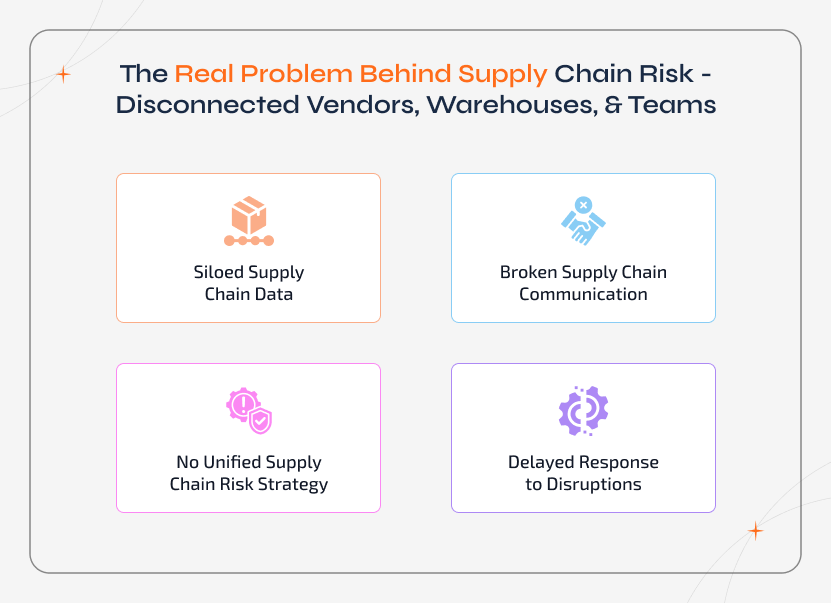
1. Siloed Supply Chain Data
Critical information will stay on different systems across procurement, inventory, logistics, and vendors. Without a single collective data point, teams can't see risks at an early stage.
2. Broken Supply Chain Communication
At times, updates from suppliers and logistics partners may not reach the right teams on time. As a result, businesses react only after a delay happens instead of preventing them.
3. No Unified Supply Chain Risk Strategy
Every other team manages risks differently or fails to manage them. Without a shared approach, risks happen through gaps between teams and partners.
4. Delayed Response to Disruptions
Whenever a supplier fails or a shipment is delayed, teams often spend time finding out what had happened instead of focusing on fixing it.
The lack of supply chain visibility makes supply chain risk assessment incomplete. As a result, it becomes hard for businesses to measure risk across vendors, warehouses, and logistics networks. As a result, supply chain risk mitigation weakens, and the whole of business operations becomes disrupted.
In order to reduce risk, companies should rely on connected systems, shared data, and coordinated teams. With this, it is possible to detect issues early and respond faster before this turns into a serious problem for the customers or revenue.
Want to Identify Hidden Risks in Your Supply Chain?
Find where disconnections exist and how they increase supply chain risk.
Major Types of Supply Chain Risks Businesses Face in 2026
Businesses come across operational disconnection whenever vendors, warehouses, and internal teams work in an isolated environment instead of a connected system. This lack of coordination slows down responses, hides the risks, and often increases the impact of disruptions.
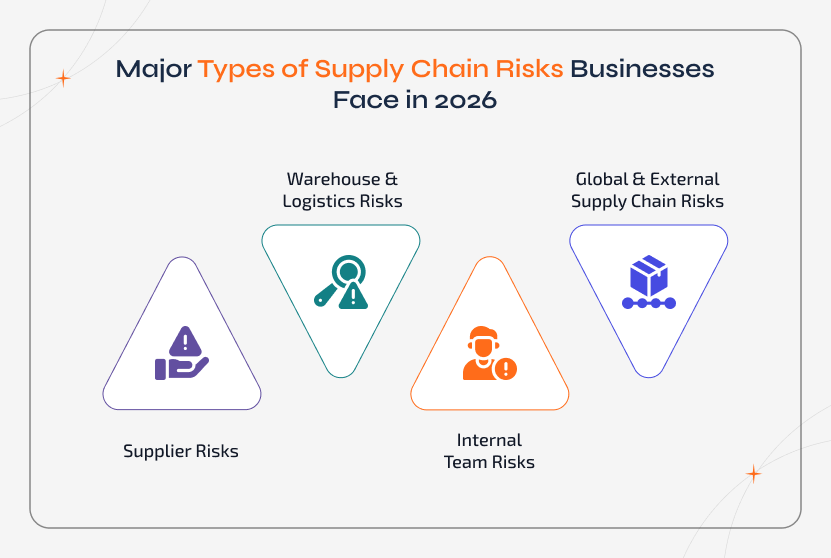
1. Supplier Risks
If suppliers work outside a connected ecosystem, businesses find it difficult to monitor the performance and detect issues early. As a result,
1. Limited Vendor Risk Management Visibility
It becomes difficult for businesses to clearly see the supplier reliability, delivery status, and risk indicators across all the vendors.
2. Delayed Identification of Supplier Failures
Supplier delays and quality issues can be discovered only after production or deliveries are affected.
3. Poor Execution of Supply Risk Management Strategy
Without the real-time vendor data, risk plans become reactive rather than being preventive.
4. Increases Dependency on Manual Follow-Ups
Teams will often rely on emails, calls, and spreadsheets to track the supplier updates. This eventually slows down the decision-making.
Without vendor risk management software, early warning signs are often missed. This results in avoidable supply chain disruptions and last-minute planning on how to avoid them.
2. Warehouse & Logistics Risks
When warehouse systems operate independently, there is a chance for the visibility across inventory and logistics to break down. This creates:
1. Vendor & Warehouse Misalignment
Warehouses get late or incomplete information about incoming shipments from the suppliers.
2. Inventory Inaccuracies & Stockouts
Stock levels will not often reflect real demand or supply. This leads to overstocking or missed orders.
3. Poor Supplier-Warehouse Coordination
Lack of shared data brings in delays in receiving, picking, and dispatching goods.
4. Higher Logistics Risk Management Costs
Operational expenses increase with emergency shipments, storage inefficiencies, and last-minute rerouting.
So, whenever warehouses don't work in sync with vendors and logistics teams, then uncoordinated logistics operations become unavoidable.
3. Internal Team Risks
Even with reliable suppliers and an efficient warehouse, sometimes risks occur and slow down everything due to internal silos. This results in:
1. Lack of Collaboration in Supply Chains
Procurements, logistics, finance, and operations teams work with different data and priorities.
2. Conflicting Priorities Between Teams
At times, the cost-saving goals will clash with delivery timelines and inventory availability.
3. Slower Management of Supply Chain Disruptions
Teams end up spending time aligning internally rather than responding to the issues quickly.
4. Weak Supply Chain Risk Analysis
Decisions made using partial data will result in incomplete or delayed risk assessments.
The disconnected decision-making often slows down the action when speed matters the most. Thus, turning manageable issues into major disruptions.
4. Global & External Supply Chain Risks
Apart from internal operations, businesses also need to manage external risks that are outside direct control but heavily impact the supply chain continuity. The major global and external risks include:
1. Geo-Political Disruptions
When conflicts occur between regions, trade routes are shut down, delay in cross-border shipments, and there is restricted access to critical supplier regions.
2. Climate & Environmental Events
Extreme weather conditions like floods, droughts, storms, etc., affect manufacturing facilities, transportation, and raw material sourcing.
3. Regulatory & Compliance Changes
Frequent updates to trade regulations, safety standards, and compliance requirements increase the operational complexity and delay in shipments.
4. Trade Restrictions & Policy Shifts
Tariffs, sudden policy changes, etc., impact the import export costs, supplier availability, and cross-border logistics planning.
When these external risks are not monitored continuously, then there occurs supplier delays, inventory shortages, and rising logistics costs with or very little warning.
Industry Insights: Companies with connected supply chain systems respond to disruptions up to 3× faster.
Are You Struggling With Hidden Supply Chain Risks?
Get real-time visibility across vendors, warehouses, and teams-before disruptions escalate.
Cyber Supply Chain Risks Businesses Often Overlook
Cyber risks are not just about internal systems. In modern supply chains, every vendor connection increases exposure. Common cyber supply chain risks include:
- Vendors accessing internal systems & platforms.
- Shared data files with insecure transfer methods.
- API integrations between ERP, WMS, logistics, & supplier systems.
When there is no proper monitoring, these entry points leads to data breaches, operational downtime, and compliance violations.
How Supply Chain Software Reduces Risks From Disconnected Vendors
With modern supply chain risk management software, it is possible to get all the supplier-related information under one connected system. Rather than looking on multiple sources like emails, spreadsheets, or manual follow-ups, businesses can get real-time visibility of vendor activities and risks involved.
With one connected, centralized supplier data, the software supports:
1. Real-Time Vendor Risk Management
It is possible for the businesses to track supplier status, delivery progress, and potential risks as they occur. This helps avoid discovering problems after a delay has occurred.
2. Automated Supplier Performance Monitoring
With the help of data, the supplier performance is continuously measured. The data includes delivery timelines, order accuracy, and compliance, reducing dependency on manual reviews.
3. Early Alerts for Delays, Compliance Gaps, & Failures
The system detects the issues early. This includes late shipments, quality concerns, or contract breaches. With this, teams can act before operations are impacted due to common supply chain mistakes.
4. Stronger Supply Chain Risk Mitigation Planning
With clear risk insights, businesses can easily plan alternatives such as backup suppliers, inventory adjustments, or route changes in advance.
With this approach, organizations shift from reactive problem-solving toward preventive risk planning in supply chains. This helps them address common supply chain challenges, reduce disruptions, control costs, and maintain consistent service even when suppliers face challenges.
How Supply Chain Software Eliminates Warehouse-Level Risks
Warehouse risks often occur due to poor coordination. i.e., due to inventory systems, suppliers, and logistics teams that fail to share the same data. Supply chain software helps connect these systems into a single platform and offers a clear, up-to-date view of warehouse operations.
With connected warehouse systems, businesses get:
1. Unified visibility across warehouses & suppliers
Teams can check the inbound shipments, stock levels, and supplier updates in one place. This eliminates the need for last-minute adjustments.
2. Accurate inventory forecasting
With the help of real-time inventory data and demand patterns, businesses can effortlessly plan stock levels better and avoid overstocking or stockouts.
3. Reduced vendor and warehouse misalignment
Warehouses get supplier information on time. Thus, ensuring goods are received, stored, and dispatched as planned.
4. Faster response to operational bottlenecks
Problems such as delayed shipments, space constraints, or picking delays are found early. Hence, teams can act before fulfillment is impacted.
By improving visibility and coordination, supply chain software strengthens logistics risk management and keeps order fulfillment stable. This even works during unexpected disruptions.
How Supply Chain Software Aligns Teams & Improves Coordination
Poor internal coordination is one of the biggest causes of supply chain disruption. Often risks increase, and decisions become slow when the teams work with different data and tools. Hence, modern supply chain software is used as it breaks these silos by making everyone onto a single platform that has shared, real-time information.
By breaking down silos, these platforms support:
- With shared dashboards, the team will be able to access the same data. This helps reduce risks, confusion, and conflicting reports.
- With a unified view, teams can agree on certain actions like rerouting shipments, switching suppliers, etc. This eliminates long back-and-forth discussions.
- Automated updates and alerts help replace scattered emails and calls. Thus, ensuring the information is passed on to the right people at the right time.
- Improved supply chain risk strategy execution helps in making better responses.
Overall, when the teams are aligned and informed, they respond faster and recover quickly. This eventually minimises the operational impact and helps maintain business operations.
Align Your Teams Before Disruptions Slow You Down
Connect teams, data, & decisions with one platform built to reduce supply chain risk fast.
How Supply Chain Risk Management Works - Step-by-Step Process
Supply chain risk management works as a continuous loop that helps businesses detect risks at an early stage, prioritize the right actions, and prevent disruptions before they impact operations.
The process involves four simple steps:
1. Find Risk - It involves in finding the weak points across suppliers, warehouses, logistics, and internal workflows before issues occur.
2. Measure Risk - Use real-time data and risk scoring to assess the likelihood and business impact of each risk.
3. Fix Risk - Activate mitigation plans such as alternate suppliers, shipment rerouting, or inventory buffers.
4. Monitor Risk - Track risks continuously with alerts and dashboards to catch new issues early.
With a structured approach, teams move from reactive problem fixing to preventive planning. Thus, reduce the disruptions, costs, and recovery time in complex supply chains.
How Supplier Risk Scoring Prevents Vendor-Led Disruptions
Supplier risk scoring classifies vendors based on delivery reliability, quality, and compliance. Thus, teams will get a clear view of where disruption is most likely to happen.
- High Risk - Frequent delays or compliance issues.
- Medium Risk - Occasional performance gaps.
- Low Risk - Consistent and reliable suppliers.
Supply chain risk management software updates these scores automatically using real-time performance and incident data. Thus, helping teams prioritize mitigation and reduce dependency on high-risk vendors.
Clear risk scores help businesses act faster, focus on the right suppliers, and prevent disruptions.
Manual Vs Software Risk Management
A lot of businesses are still tracking supply chain risks manually with the help of spreadsheets and emails. While this seems to work at a small scale, it becomes unreliable when operations grow.
| Manual Risk Tracking | Supply Chain Risk Management Software |
|---|---|
| Spreadsheets & emails | Real-time dashboards |
| Reactive decisions | Proactive alerts |
| Delayed visibility | Instant risk detection |
| High error rates | Data-driven accuracy |
Software helps replace the guesswork with real-time insights. Thus, teams prevent disruptions instead of reacting when the damage occurs.
Key Areas Businesses Must Fix First to Reduce Supply Chain Risks
Supply chain risk neither occurs nor grows because of one failure. It grows when small gaps stay unfixed for too long. Businesses that reduce risk successfully focus on a few key areas before anything else.
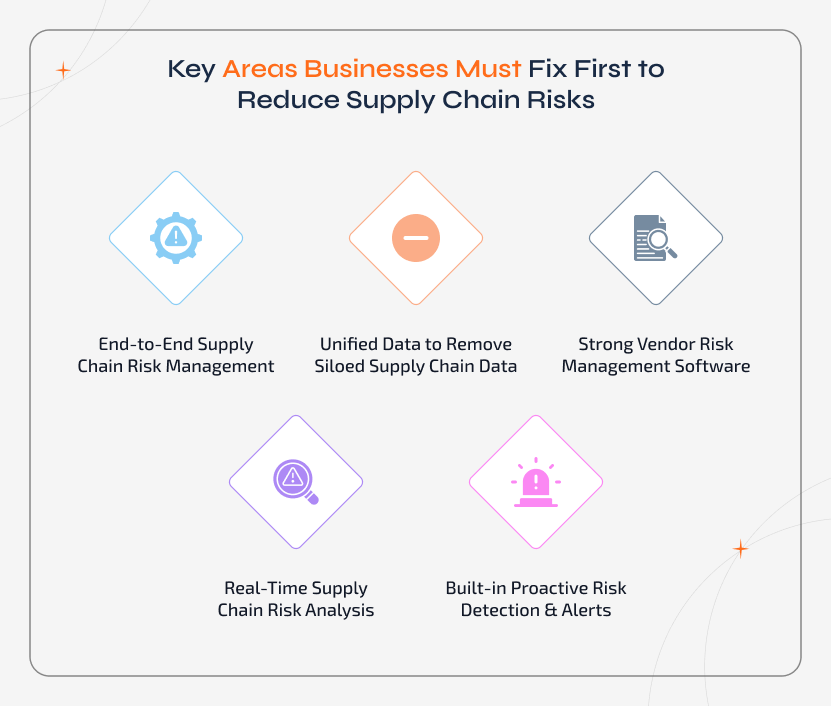
What Needs Immediate Attention:
1. End-to-End Supply Chain Risk Management
As risks cannot be handled in isolation, companies need visibility across suppliers, warehouses, logistics partners, and internal workflows. This helps them find where disruptions are likely starting instead of where they end.
2. Unified Data to Remove Siloed Supply Chain Data
When the teams rely on separate systems, decisions get delayed, and risks remain unidentified. A single data foundation will help everyone work on the same information at the same time.
3. Strong Vendor Risk Management Software
Suppliers are seen as the earliest source of disruptions. With continuous monitoring, businesses can find the reliability, compliance, and delivery issues before they affect the supply chain operations.
4. Real-Time Supply Chain Risk Analysis
Static reports fail in a rapidly changing market space. With the live risk analysis, teams can respond while there is time to prevent the impact.
5. Built-in Proactive Risk Detection & Alerts
Early warning signs will turn potential disruptions into manageable events. Automated alerts help the team work immediately rather than reacting under pressure.
Fixing the above areas not just reduces risks in the current time, but it also creates a resilient, scalable supply chain foundation to handle future operations without uncertainty.
Real-World Supply Chain Risk Examples
Supply chain risks are easier to understand when seen in real situations:
- A supplier delay causes missed production deadlines and order backlogs.
- A warehouse stockout that occurs due to inaccurate inventory data.
- A late shipment that impacts customer delivery as logistics teams were not informed on time.
All the above issues often occur in small numbers but later escalate without early warning signs.
Additional Business Benefits of Modern Supply Chain Risk Management Software
Modern supply chain risk management software does more than protect operations from disruption. It helps improve how businesses work, decide, and grow. Thus, helps turn risk management into a competitive advantage. Beyond reducing risks, businesses also get the benefits such as:
1. Faster Decision-Making - With real-time insights, business leaders can act quickly in handling supplier issues, inventory changes, and logistics disruptions.
2. Lower Operations Costs - Often, early risk detection minimizes expenses related to emergency shipments, penalties, excess inventory, and last-minute problem fixing.
3. Improved Customer Trust - Fewer delays and more reliable delivery build confidence with customers and partners. This happens even during uncertain conditions.
4. Better Compliance and Governance - With the automated tracking and reporting, it is easier to meet regulatory, contractual, and internal compliance requirements.
5. Long-Term Supply Chain Resilience - Businesses move from short-term fixes to sustainable systems as this adapts as market suppliers and demand change.
By following the right approaches, supply chain risk management becomes a growth enabler. Thus, organizations can make use of it to scale better, protect margins, and maintain stability in the evolving market.
Why Supply Chain Risk KPIs Matter
In addition to tracking metrics, it is important to understand how each KPI plays a major role in minimizing the risks.
- Supplier reliability score - This helps find the vendors who most likely cause delays or failures.
- Inventory accuracy - It prevents stockouts, overstocking, and fulfillment issues.
- Disruption recovery time - This helps measure how quickly operations return to normal soon after an issue.
These KPIs help teams act early, prioritize the fixes, and strengthen overall supply chain resilience.
Why Choose Sparkout for Supply Chain Risk Management Solutions
Sparkout helps enterprises move beyond fragmented tools and manual processes. We deliver connected, intelligent supply chain risk management solutions that are built for real-world complexity.
What Sets Sparkout Apart:
1. End-to-End Supply Chain Risk Management Software
We provide a single platform that connects the suppliers, warehouses, logistics partners, and internal teams together. Thus offering you complete visibility across your supply chain.
2. Advanced Vendor Risk Management
The supply chain software development solutions delivered by us are designed in such a way that they can continuously monitor supplier performance, compliance, and reliability. So, you can detect vendor-related risks even before they disrupt supply chain operations.
3. Intelligent Supply Chain Risk Analysis
Real-time analytics and risk scoring featured in our solution help turn any raw data into actionable insights. With this, teams can make faster, more informed decisions.
4. Scalable Platforms Designed for Global Operations
We build systems that grow with your business, supporting multiple regions, vendors, and supply networks without performance loss.
At Sparkout, we follow a custom software development approach that prevents failures before they happen, instead of reacting after damage is done. With proactive risk detection and early alerts, our team helps businesses stay resilient, efficient, and prepared for whatever comes next.
Are You Ready to Reduce Supply Chain Risk at Scale?
Get a tailored risk management solution built for your operations.
Conclusion
We can identify that most supply chain failures don't happen as the risks are invisible. Rather, they happen because systems, partners, and teams are not well connected.
So, whenever vendors, warehouses, logistic partners, and internal teams work in silos, even the visible risks take time to work. As a result, information arrives late, decisions stall, and even small issues turn into major disruptions.
By investing in the right supply chain risk management strategy and software, businesses can
- Involved in identifying risks in supply chains earlier through connected, real-time data.
- Act faster with shared insights and automated alerts.
- Possible to reduce the impact of disruptions by responding before issues become serious problems.
- Can build lasting supply chain resilience that scales with growth.
In 2026 and beyond, businesses that replace fragmented tools with connected systems will be more resilient. Connected supply chains turn uncertainty into an advantage by responding faster, staying stable, and delivering better results, even during disruptions.