


Users, user interface, user experience, and UI/UX are common words in the talking town. These terms are frequently used in discussions about mobile applications and digital products. While it is widely discussed, its actual value in the UI/UX development process, especially in mobile app development for business, is often underestimated or overlooked.
It is time to give some credit to the UI/UX systems and understand their role in shaping a successful mobile application. So, you really want to know how UI/UX design in mobile app development actually influences the business? Then take a closer look at this informative blog.
A Brief Understanding of UI UX Design in Mobile App Development
The UI and UX just mean what your user interacts with on your app's frontend and how easy it is for them to use your app. Therefore, the significance of mobile app design in its development cannot be understated. The effective incorporation of both UI and UX results in a seamless and interactive app with a simplified interface, which in turn cultivates a broader and more dedicated customer base for the business. UX and UI are totally different areas in the field of mobile app designing, even if they require a similar knowledge base and skill set.
Users desire effortless app navigation with minimal touches (UX). The UX designer is dedicated to ensuring the app performs seamlessly across all mobile devices and platforms. This includes easy navigation, quick checkout process, simple login, task completion speed, and more.
On the other hand, the UI designer is committed to crafting a captivating interface that simplifies user interaction. Included elements are buttons, colours, fonts, layouts, animations, screen design, spacing, visual hierarchy, and others.
When the expertise of both the UI and UX designers is combined, the resulting mobile app development for business solutions becomes not only intuitive but also captivating and compelling for the end users.
Why Businesses Focus on UI/UX Design in Mobile App Development?
It can also be pointed out that the aspects of UI/UX are the most vital steps in the whole process of mobile app development for business. From this, it is clear that both UI and UX are related functions, and thus, they need to complement each other for the best results. Top software development companies such as Sparkout also highlight the fact that UI/UX should not be considered as two different things, but rather as interconnected concepts.
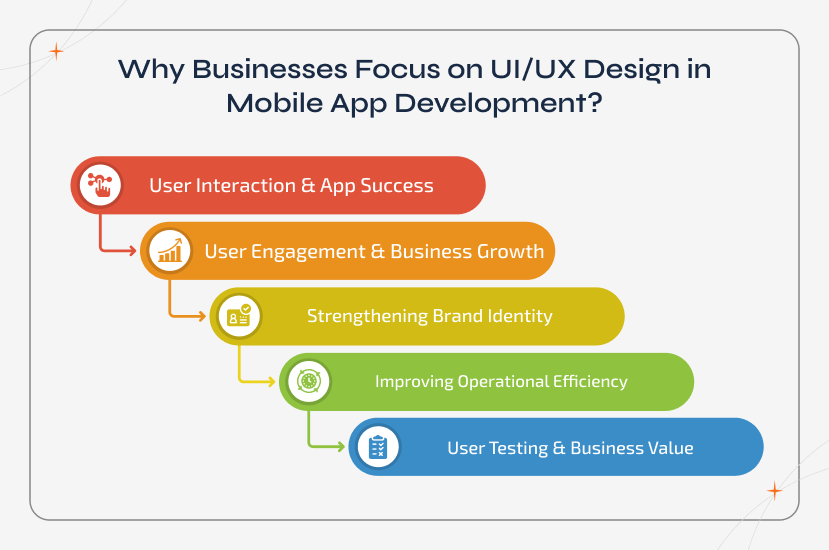
User Interaction & App Success
Organizations identify competitors and
audiences/ user profiles during the concept development to establish the best user experiences. This
process assists in the identification of overall issues and potential opportunities within existing
products to enhance the navigation of the app itself. By identifying the intent, needs, and wants of
the customers, more usage will be made when those needs are met through the employment of the mobile
application.
User Engagement & Business Growth
When launching a new app, relying
solely on app download marketing is not sufficient. You should make the user interface and user
experience a priority to make sure that you get long-term success when approaching mobile app
development for business. This requires ongoing updates to adapt to changing consumer behavior and
preferences.
Strengthening Brand Identity
A mobile app is a great tool that businesses
use for brand communications in the digital era, with a focus on UI/UX design. If you look at any
successful app, you can see that they convey a brand mission and values in a very effective way.
For example, in the case of a ride-sharing app, it should prioritize functionality and ease of use in its UI/UX. This helps you to create greater loyalty and trust with your customers. Apps designed with UX that reflect the brand's unique selling proposition tend to cultivate strong customer loyalty and trust.
Improving Operational Efficiency
In today's competitive market, having
apps that are faster and more efficient provides a significant advantage. You can improve your app's
performance to a great extent by improving its user interface and user experience design. Ensuring
that tasks can be completed quickly is essential for user satisfaction. By incorporating faster
technology and optimizing navigational flow, app speed and overall efficiency can be greatly
enhanced.
User Testing & Business Value
User testing remains as one of the
significant steps that fall under the process of UX since it assists the developers in identifying
the potential of a mobile application and, more importantly, its potential errors from real users.
Such feedback becomes a foundational basis for UX in mobile app development for business.
Though this may prove to be time-consuming, it has been established that the benefits accrued from user testing outweigh the challenges by far and for a very long time. App development agencies realize high cost and time advantages due to the guarantee of the market's release of only high-quality products. Moreover, user testing is the key to maintaining brands' credibility and satisfying consumers' need for quality and dependability.
Core UI/UX Design Principles in Mobile App Development for Business
A strong UI/UX in mobile app development for business is guided by fundamental design principles that ensure efficiency and long-term value. Here are the core principles that help organizations build apps that are intuitive and aligned with user expectations.
📜 Simplicity
Ensure to design clean interface that primarily
focuses on essential functions. Throw away the noise, keep things clean, and make things easy for
users to focus without feeling overwhelmed.
📜 Clarity
Make sure every tap, click, and movement in the
interface makes sense. Buttons should feel obvious, navigation should feel natural, and users must
never have to stop and think about what that should do next.
📜 Consistency
Keep everything consistent across the application,
so it feels familiar and effortless to use. Usual patterns, layouts and behaviours make users know
what to expect without relearning anything.
📜 Mobile-First Usability
Build the application having
mobile-first design in mind. Design for small screens, easy thumb reach, and smooth one-hand use, so
everything feels natural and comfortable.
📜 Accessibility
Design having everyone in mind, not just the
average user. Ensure to use clear text, strong contrast, and quick interaction, so that the
experience feels comfortable for all users.
📜 Performance-Oriented UX
Make the
application feel fast and fluid. Do focus on speed, smooth transitions, and instant responses so
every interaction feels effortless.
7 Steps to Build a Business App that Excels in UI/UX Design
The development process of a mobile application may exhibit some degree of variation based on individual requirements. Nevertheless, there are typically seven essential steps that must be completed.
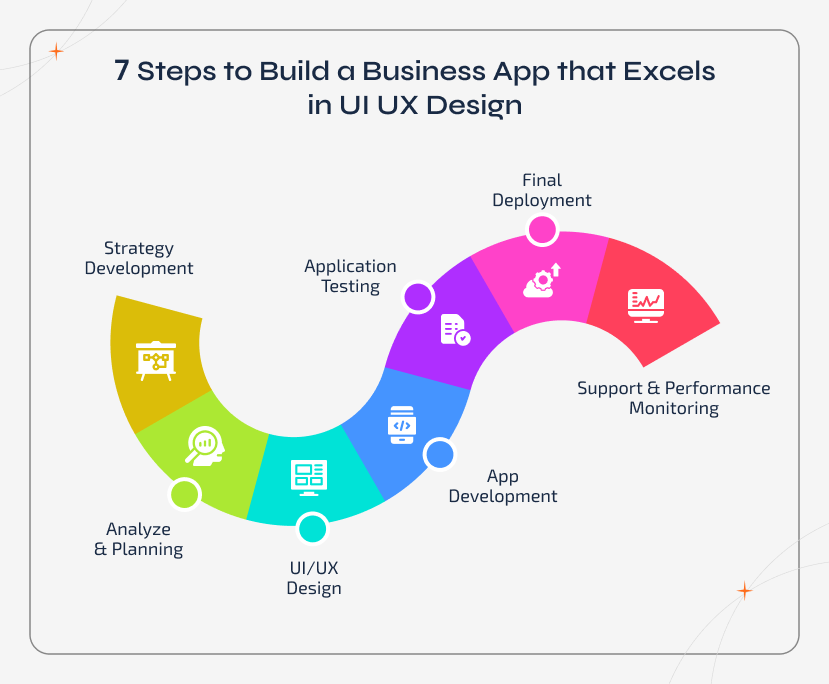
Strategy Development
The initial phase of mobile app development is
strategy formulation, which can be broken down into four key steps: 'identifying objectives',
choosing competitors', 'selecting the platform', and 'picking a monetization method'.
When you are building an app, start by identifying its main objectives and researching your major competitors. Decide on the platform you'll be using and choose the right monetization method if you are building a consumer application. This could include in-app advertising, in-app purchases, subscriptions, affiliate marketing, or paid apps.
Analyze & Planning
The second step you need to do with mobile app
development for business is conducting a thorough analysis and planning of your project and use
cases. We can divide this step further into three parts: functional and nonfunctional
requirements, product roadmap, and choosing the right technology stack.
First, specify the actions for your mobile app, document them in the functional requirements, and consider non-functional requirements. Define your app's roadmap, prioritize features for the Minimum Viable Product (MVP), and identify the technology stack needed for your mobile project.
UI/UX Design
You can give your users an amazing experience with a
well-designed app. The UI UX phase should focus on intuitiveness, user friendliness, engagement,
and overall engagement to keep the users coming back.
Invest in design elements that make the navigation effortless, interactions smooth, and the overall experience enjoyable. This phase ensures that your application is visually appealing while serving its functional purpose effectively.
App Development
This is the stage where your application comes to life.
The development involves coding, integration, and building both front-end and back-end components
according to the planned design and architecture.
Developers will turn design and functionality requirements into a full working product, ensuring the features are implemented efficiently and the app performs reliably across intended devices.
Application Testing
Testing ensures that your application works as
intended and meets the required quality standards. This phase includes functional testing,
performance testing, security testing, and usability testing.
As testing pinpoints bugs, crashes, and usability issues early, teams can fix problems before the launch. Also, a well-tested app provides a smooth and reliable user experience.
Final Deployment
This step mainly focuses on releasing a fully
optimized application that delivers a consistent UI UX experience across devices and platforms. It
includes final performance checks, security reviews, and production setup.
Ensuring a smooth onboarding experience at launch helps in creating a strong first impression and helps in setting up the foundation for users' trust and long-term engagement.
Support & Performance Monitoring
Post launch, ongoing support and performance monitoring are critical. This actually includes tracking user feedback, fixing bugs, updating features, and analyzing app performance metrics.
Continuous monitoring ensures the application remains stable, secure, and up-to-date. Regular updates and support help retain users and improve the application's performance over time.
Unleash the Latest Mobile App Trends in UI UX Design for Your Business
The business of developing mobile apps is dynamic and has been growing for a while now. Based on the UI/UX design trends identified earlier, it can be pointed out that technological progress, buyers' needs, and other factors directly affect mobile apps. This cannot be the only reason, but undoubtedly, being informed about the trends is one of the main aspects of attaining success.
The market shows that mobile app resellers require embracing new trends that would enable them to address their clients appropriately. The same goes for the content creators and producers who are eager to go even further with the building of their brands in the field of mobile app development for business. Here are some of the latest mobile app trends that are conquering today's business landscape.
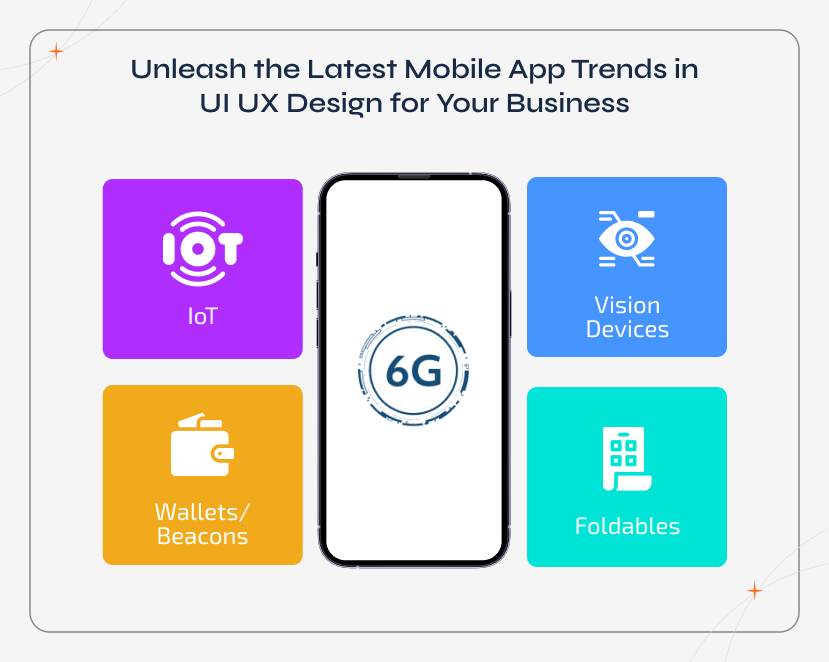
Internet of Things (IoT) App Integration
The Internet of Things (IoT) is not a new concept, but with the rise in mobile usage across various industries, it has created numerous opportunities. People are now accustomed to using technology to enhance their daily lives. IoT means the expanding network of internet-connected devices that offer convenience and automated control to users.
Smart home technology is a prime example of the increasing impact of IoT and mobile app development. Mobile apps now allow users to remotely adjust the thermostat in their homes, lock or unlock their front doors, and connect to home security systems.
Apps For Foldable Devices
In the past decade, mobile phones have transitioned to touch screens with minimal or no physical buttons. Recently, foldable smartphones like the Samsung Galaxy Z Fold7 5G, Google Pixel 10 Pro Fold, and Samsung Galaxy Z Flip7 5G have gained popularity. When it comes to mobile app development for business, app developers need to ensure their apps seamlessly adapt to foldable devices' changing display sizes.
6G Technology
You can say that 5G and emerging 6G technologies are big factors in defining what app trends we see moving forward. By 2025, global 5G connections crossed over 2 billion, with adoption growing faster than any previous mobile generation, while 6G has entered active research, testing, and pilot development phases worldwide.
Technologies are expected to deliver ultra-low latency, massive network efficiency, extreme traffic capacity, and speeds far beyond 4G, with 6G projected to exceed 5G capabilities significantly in real-time processing, AI integration, and immersive connectivity.
This will significantly enhance the functionality of mobile apps, empowering developers to integrate new features without negatively impacting app performance. It's really important that developers and mobile app resellers make use of the speed and capabilities of next-generation 5G and future 6G networks during the testing and development stages of building their app.
Development For Vision Devices
Vision technology has been on the rise for years and is changing the way mobile apps are developed. Apple's continued announcements at recent WWDC events 2025 around vision devices, spatial computing, and deep app integration mark a significant development in this space.
By 2026, we will see more mobile apps being designed with vision devices in mind, offering users the ability to discover, download, and use apps directly within immersive spatial environments instead of traditional mobile interfaces.
Artificial Intelligence (AI)
You might have noticed that AI & ML are gaining more and more popularity in mobile app development for business. However, this is just the beginning, and we have more to explore with the technologies we have coming out every day. When we think of AI, we often first consider virtual assistants like Siri or Alexa, but it has many other applications in app development.
Using AI in your business applications for use cases such as summarizing, detecting patterns, etc., can help you reduce the time taken to carry out your business processes.
If you're planning to add AI features to your mobile apps, here are some good ideas for you:
- Multimodal AI
- On-device AI processing
- Real-time AI assistants and copilots
- Generative UI/UX personalization
- AI-powered automation workflows
- Context-aware intelligence
- Digital twins and AI simulations
- Autonomous decision systems
- Spatial AI for vision and immersive devices
You can already see that AI is making apps more intelligent and improving their performance. From backend systems to frontend user experience, AI is poised to change the way you build apps in 2026 and beyond.
Beacon Technology
Beacon technology, widely adopted in retail, healthcare, and hospitality, enhances mobile app functionality. Developed in 2013, it enables push notifications for sales and tracks buyer behavior. The technology's primary benefit is proximity marketing, and its global market has surpassed $31.61 billion by 2026, continuing strong growth driven by enterprise adoption and large-scale commercial deployment.
Mobile Wallets & Mobile Payments
The methods of making payments through mobile devices are also changing. Mobile payment methods that involve debit/credit cards like Apple Pay, Google Pay, and Samsung Pay are on the rise. Global mobile wallet transactions have grown exponentially and now operate at a multi-billion-dollar scale worldwide.
Smartphone users are increasingly embracing mobile payments and using app features for payments on wearables and connected devices. Therefore, integrating mobile wallets into apps should become a standard in the future for mobile app development for business.
Chatbots
We've been familiar with chatbots for over a decade. The first interactions with these bots were on AOL Instant Messenger in the late 1990s. They have advanced significantly and gained popularity on websites, becoming the new standard for customer service. While millions of apps exist, only a small fraction utilize chatbots, but this is rapidly changing in 2026 as AI-powered conversational systems become mainstream across mobile platforms.
As chatbots are powered by AI, their responses are becoming more human-like, contributing to the rapid growth of the global chatbot market. Virtual assistants now facilitate a large share of customer service interactions across industries. To this effect, chatbots have fully entered the mobile application development market.
Common UI/UX Mistakes Businesses Should Avoid During Mobile App Development
At times, even the best ideas can fall flat if the UI/UX is mismatched during the mobile app development process. Here are some of the common UI/UX deisgn mistakes businesses will make that they should watch for.
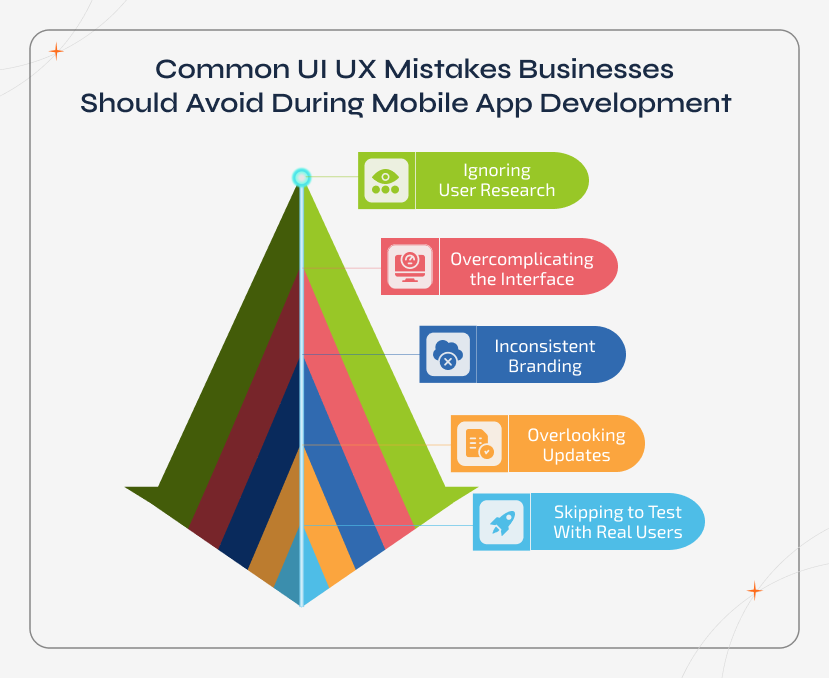
Ignoring User Research
Designing without understanding your target
audience is a big no-no. Skip the initial research process, and you risk creating an application
that doesn't meet real user needs, which leads to poor adoption, low engagement, and app
development delays.
Overcomplicating the Interface
Colorful screams, too many options, or
confusing navigation always frustrate users. Simplicity is always the key when it comes to UI UX
design, as it prioritizes intuitive flows and clean designs.
Inconsistent Branding
The UI/UX design must reflect your brand
consistency. Any mismatched colors, fonts, or messaging dilutes the brand identity and reduces
user trust.
Overlooking Updates
Launching a product and forgetting it totally is
one of the biggest mistakes made by many startups. Continuous improvement based on analytic and
user feedback is essential to keep the app relevant and engaging.
Skipping to Test With Real Users
Ignoring
usability is a common fly trap. User testing uncovers hidden pain points, reveals confusing
interactions, and ensures your application is intuitive for real-world usage.
Most Popular Mobile App Development Tools for UI UX Design
The development for business involves using automated mobile app testing tools and technologies to build applications for smartphones, tablets, laptops, and smartwatches, with Android and iOS as the dominant platforms. Developers must consider device limitations such as screen size, computing power, user interaction, and platform differences when choosing a language. Selecting the right platform strategy (single or multi-platform) is essential to ensure scalability, performance, and user satisfaction.
1. Swift
Swift is Apple's programming language for creating apps on iOS, macOS, tvOS, and watchOS. It works with Cocoa and Cocoa Touch frameworks, allowing you to build native and web apps. One of the main benefits of Swift is that it requires significantly less code to achieve similar results .
Additionally, Swift incorporates modern features such as generics and closures, which streamline and optimize the coding process. According to trusted sources, Swift has captured a valuable market share of 2.36% among various programming languages used for mobile app development for business.
2. Java
Java is a versatile programming language that is concurrent, class-based, and object-oriented. It is specifically designed to have minimal implementation dependencies. With Java, developers can write code once and run it anywhere, which means the code can run on different platforms without needing to be recompiled.
Java applications are typically compiled to bytecode (class files) that can run on any Java virtual machine (JVM) regardless of the computer architecture. According to a trusted source, Java is used as the server-side programming language for 5.4% of all websites.
3. Python
Python is a versatile programming language suitable for web development, data analysis, and machine learning. It is a dynamic and easily readable language, offering extensive functionality while maintaining readability and development speed. Due to these qualities, Python is an excellent choice for building mobile apps. It has been utilized to create apps for various platforms, including Android, iOS, and Windows Phone.
Although Python is primarily used for back-end and web app development, app developers can use it to build fully functional mobile apps. If you want to develop an outstanding application to enhance your business's productivity, consider hiring app developers from well-established app development firms.
4. PHP
The development world calls PHP a server-side scripting language. You can create dynamic web pages easily using it. It is very popular for developing mobile apps and websites, as well as for system administration, desktop development, gaming, and more. Despite launching in 1995, PHP has continually evolved to implement new features and improve performance till today. Today, over 33 million domains worldwide run on PHP, making it one of the top choices for writing websites or applications.
Top Mobile App Development Frameworks for UI UX Design
Mobile app development for business requires frameworks that support performance, scalability, and cross-platform compatibility. Developers must account for device limitations, platform differences between Android and iOS, and the need for multi-device accessibility. The right framework helps ensure applications remain user-friendly, secure, and capable of meeting business goals at scale.
1. Flutter
If you are a React Native fan, you may find Flutter interesting. Flutter is Google's mobile UI framework, designed to enable developers to build apps for both iOS and Android using a single codebase. It is a great alternative to the traditional Android SDK and iOS SDK in mobile app development for business, as it allows you to write once and deploy to both platforms with ease.
Flutter is gaining popularity in cross-platform mobile development and offers impressive capabilities. It uses Google's Dart programming language, which is easy to learn and highly performant. According to Google, more than 1 million developers use Flutter every month.
2. React Native
Facebook launched React Native to help developers use a single codebase to build mobile apps for both Android and iOS devices without rewriting the code in multiple code editors or frameworks. It's gaining popularity for addressing issues with hybrid app development tools. With React Native, developers can quickly build robust native apps using their JavaScript skills, thanks to its low learning curve.
3. Cordova
Cordova, dating back to 2010, was originally for creating hybrid mobile apps using HTML5/CSS/JavaScript. It now serves as a platform for developing apps for multiple platforms without requiring code rewrites. According to the recent survey, Cordova's current market share among cross-platform mobile frameworks is estimated to be below 10%, with most sources placing it between 1% and 5% as of 2025 - 2026.
This framework allows using JavaScript, CSS, and HTML while providing access to native APIs. Plugins are available for features like user authentication and barcode scanning. Despite other frameworks covering more ground, Cordova remains a great option for mobile app development for business.
4. Xamarin (.NET MAUI)
Xamarin, replaced by .NET MAUI, is a framework for cross-platform software development. It is a useful framework that allows you to easily create applications with native performance for iOS, Android, and Windows devices from a single codebase. With this, developers can write in C#, use open-source libraries, and share code across different mobile devices. You can build high-quality apps that work across different platforms.
All this without needing a separate mobile development team for each device platform. What's more, Xamarin is backed by Microsoft. In 2026, Xamarin still powers many cross-platform mobile apps, with over 5,000 Android apps built using the framework, and these apps collectively achieving more than 2 billion downloads worldwide, showing that Xamarin remains a solid choice for business apps even as developers transition toward newer .NET tools.
The Ultimate Enterprise Mobile Application Development Strategy for UI UX Design
Follow a structured mobile app development approach to define your vision, prioritize users, and streamline core business processes.
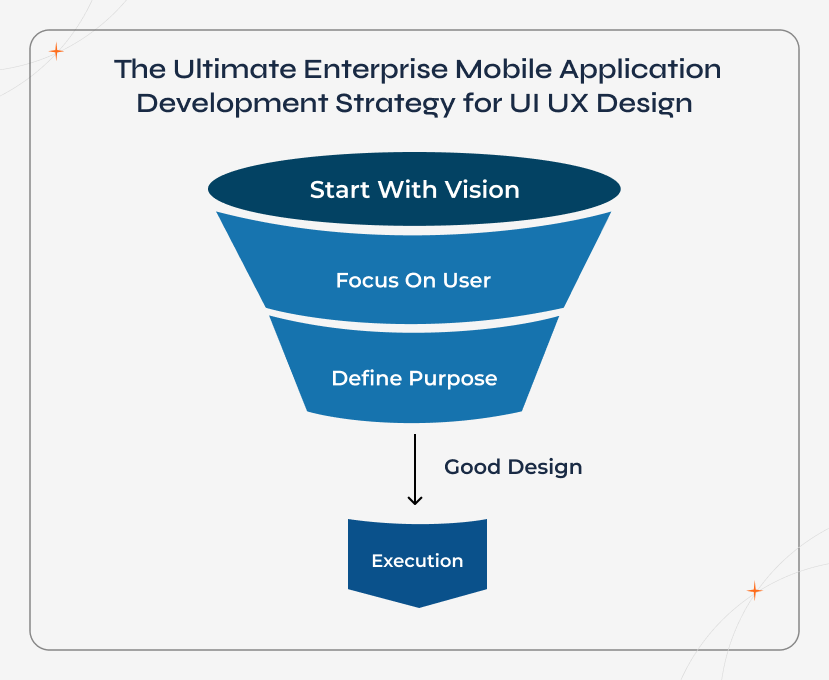
Vision ⇾ Users ⇾ Purpose ⇾ Priorities ⇾ Planning ⇾ Execution
☁ Revolutionize Your Business - Use enterprise mobility to make your internal team more productive, simplify operations, and give customers a better experience.
☁ Know Your Users - Focus on employees as the core users to ensure adoption and maximum impact.
☁ Define the Purpose - Build your application to automate tasks and simplify the process, so your teams can work smarter, not harder.
☁ Set Your Priorities - Keep consistency, security, and scalability front and center to support growth in recent times and in the future.
☁ Plan Strategically - Take time to map the workflows, define what's needed, and anticipate challenges before you dive into development.
☁ Execute With Experts - Partnerup with Sparkout Tech, one of the leading mobile app development companies, to turn your ideas into a high-quality enterprise app that actually delivers results.
Winding Up!
We understand that starting out with mobile app development for business can be very challenging. We hope that after reading through the blog, you now have a good understanding of how you can use UI/UX to your advantage when you're building a mobile app. A robust UI UX design is the key driver of user retention. When the app feels easy and smooth to use, users stick with it, build a habit, and turn into long-term users instead of one-time downloads.
Moreover, if you want to build your own UI/UX focused mobile app with experienced professionals who know the ins and outs of the business, book a call with our consultant today.
Ready to Build a Mobile App that Retains Users?
Get started with Sparkout's UI/UX-focused mobile app development team today to get the maximum output.