


Founders are always looking out for the best and brightest ideas. If that also explains your situation, then you're probably on your way to starting custom software development for your next project. Building your digital product and making it a success can be a challenge, whether you're a new business or an established one. However, it may be a challenge that completely changes your life forever. If you're in the same shoes, then we have put together everything you need to know about building your custom software in this blog.
So, without wasting any more time, let's jump right into the end-to-end of building a custom software.
What Does Custom Software Development Actually Mean?
We hear complex jargon about tech all the time, but the term "custom software development" is exactly what it sounds like. Custom software development is nothing but designing, building, and maintaining software that is created specifically for your business needs and workflows, rather than using generic solutions.
You have a business idea that requires an app, and you're building the application from scratch. Now, you could be wondering, "Isn't every software and application supposed to be built from scratch by someone?" This is a very good question for you to ask, and although all apps have to be coded (unless you're using a No-Code tool to build your software), there are times when you may not need to create your software from scratch.
For example, if you're building a piece of software similar to another one in the market, you can use white-label solutions that are already out there. Let's just say that you're building a software like Airbnb for your rental business. Here, custom software development may not be needed because you can easily find a service provider that already has a rental platform, and you can customize it to your branding and business needs. This is what white labelling is, and unless you have a very complex rental business that requires you to build the product from scratch, you can easily choose white labelling.
However, if you have a unique idea like building a fintech app, you will have to start from scratch. Fintech software development is often tricky because you're trying to solve a problem that no one else has solved, and for that, you need custom software development.
Who Actually Needs Custom Software Development?
This again is a very good question because, as we spoke about earlier, you don't always have to build products from scratch. However, if your ideas are unique and you're planning to tackle a market as no one else has done before, then building from scratch just might be your way forward.
As you might already know, there are other options out there, like No-Code, for example. No-Code tools are often a go-to choice for founders looking to build an MVP for startups or a Proof of Concept. However, custom software development provides you with the flexibility to build scalable systems that No-Code tools just can't achieve. Don't get me wrong, No-Code tools have their place and are a great idea if you're building something like a Proof of Concept. But when you're building for your customers, and you want to build a complete software solution, then building from scratch is the right step forward.
Creating your software as a custom development solution would be right for you if you are:
- An established business is trying to solve your internal problems.
- You have a unique idea that requires custom software application development to build complex features.
- If you are a well-funded startup or a bootstrapped business with a good budget, looking to ship a new digital product into the market.
- Your product idea is centred around emerging technologies like AI/ML, blockchain and so on.
In these cases, your best bet is to build your software from scratch.
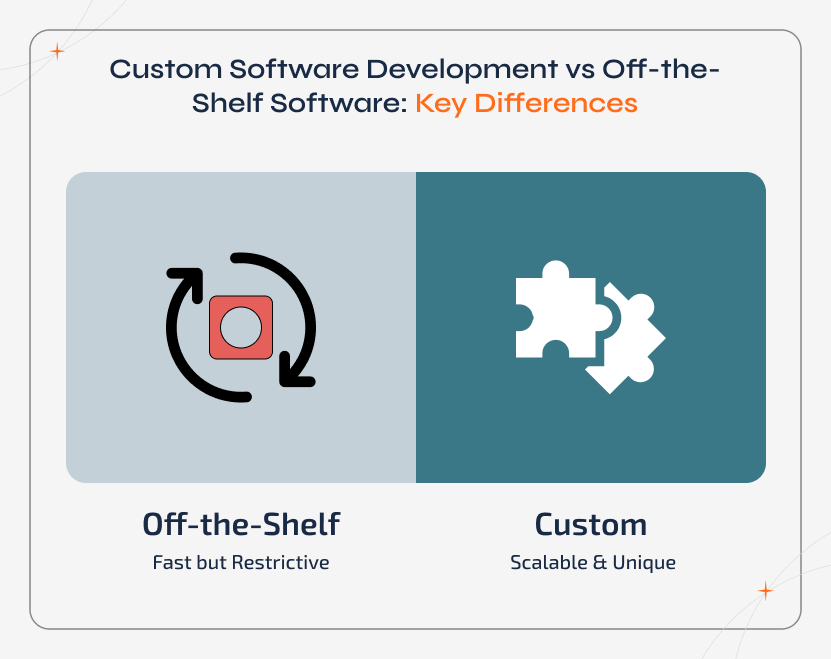
Custom Software Vs Off-the Shelf Software: Know the Differences
When your team starts planning a new digital product, one of the biggest decisions is whether to build custom software or purchase an off-the-shelf solution. Even though both approaches solve user problems, they vary in different ways.
In the meantime, if you're confused choosing between these two software, then take a look at the comparison table below and choose the one according to your needs.
| Criteria | Custom Software | Off-the-Shelf Software |
|---|---|---|
| Purpose | Specifically built according to your business goals | Built for common, mass-market needs |
| Business Fit | Fully aligns with your workflows | You adjust your workflows to fit the software |
| Customization | Easily customizable based on the requirements | Limited to available settings |
| Integrations | Can be integrated easily with any system or API | Restricted to supported integrations |
| Scalability | Designed specifically to scale with growth | It often has limitations when the complexity grows |
| Development Timeline | Longer initial build time | Faster to deploy |
| Cost | Higher initial investment and maintenance | Lower upfront cost and subscription fees will persist |
| Security | Tailored security and compliance controls | Shared and standard security model |
Here's a quick check on when to buy and when to build:
Buy Off-the-Shelf Software if:
Build CustomSoftware if:
Types of Custom Software Solutions
A custom software solution will take many forms, depending on what problem the business is trying to solve. Here, we've listed some of the most general types of custom software solutions and where exactly they're used.
1. Enterprise Software
These software solutions are
built specifically for large organizations to manage complex operations. Some of
the generic features include role-based access, workflow automation, and system
integration, which can improve efficiency.
2. Internal Business Tools
This custom software is
built specifically for teams to streamline internal processes, such as
approvals, reporting, and task management. With these tools, businesses can
reduce manual work and improve overall team productivity.
3. Customer-Facing Applications
This specific software
is used by end users through web or mobile applications. The features usually
focus on personalization, performance, and usability to enhance custom
experience and engagement.
4. SaaS Products
It is built as a subscription-based
platform for multiple customers. This typically includes multi-tenant
architecture, billing systems, and scalable architecture.
5. Marketplace Platforms
With marketplace software, it
connects buyers and sellers on a single platform. Some of the core features
include user management, listings, payments, and dispute handling.
6. Compliance & Security Software
By following strict
regulations, this software is designed for industries such as finance and
healthcare. This includes features like audit logs, data encryption, and access
control.
7. Workflow Automation Software
This software is built
to automate repetitive or rule-based tasks across departments, which often
improves speed, accuracy, and operational consistency.
8. Industry-Specific Solutions
The
software is tailored for niche industries like logistics, education, and
healthcare. These systems solve domain-specific challenges that most of the
generic software cannot address.
Factors to Consider Before Building Custom Software
Before you start the development, it's mandatory to step a little back and validate whether the custom software is right to proceed. The section below helps you avoid costly mistakes and misalignment later.
- Must Solve Real Business Problem: Make sure that the software addresses an actual need and gives measurable value to your business.
- Fit Into Existing Workflows: The custom software should integrate naturally with how your team works and support your process without showing any flaws.
- Integrations & Compliance: Examine which tool or platform the software must connect with and ensure it meets industry regulations and security standards.
- Plan for Budget: One of the important things to consider before building custom software is planning a budget. Only this ensures how quickly you need the product to launch.
- Clarify Ownership & Access: Before the development, decide who actually owns the code, intellectual property, and documentation to avoid future dependencies.
A Practical Look at the Custom Software Development Process
Only a structured development process ensures that the software is built properly on time and aligned with your business goals. Here's the end-to-end custom software development lifecycle.
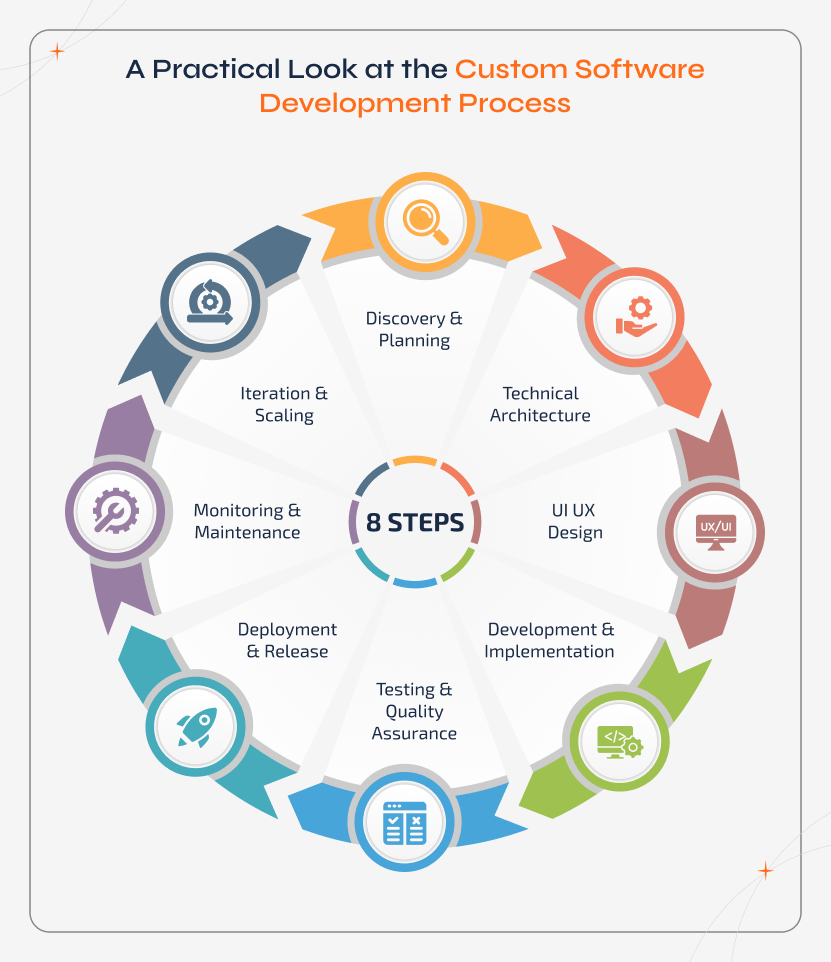
Step 1: Discovery & Planning
The initial stage focuses
on understanding the business goals, user needs, and constraints. Teams align on
goals at the early stage to avoid potential scope confusion in later days.
Step 2: Technical Architecture
In this stage, the
technical foundation of the product is clearly defined. Here, the decisions are
made around system structure, technologies, and how exactly the software.
Step 3: UI UX Design
The design for the custom
application focused on smooth user flows and intuitive user interfaces. The
primary goal is to make the customized application software easy to handle while
supporting real user behaviour.
Step 4: Development & Implementation
Further, the
developers start to build the custom software in phases, prioritising core
features first. With this approach, businesses can gain early validation and
controlled progress.
Step 5: Testing & Quality Assurance
In the next stage,
the application will be tested across different scenarios to ensure it works
properly and as expected. This helps in locating bugs, performance issues, and
usability problems before the final launch.
Step 6: Deployment & Release
After testing, once the
software is in a stable condition, it is deployed to a production environment.
This is the stage when the real users begin to interact with the product.
Step 7: Monitoring & Maintenance
Once the product goes
live, ongoing maintenance ensures that the software runs smoothly. Potential
fixes and minor improvements are made based on the usage and feedback.
Step 8: Iteration & Scaling
When
your business starts to grow, the software must evolve. So, additional features
are added, and the performance is optimized to support increased users and data.
Business Benefits of Custom Software Development
The great thing about building your software from scratch is, of course, the control that you will have. Here, you will not only have control over your development process but also over the quality of the product. For example, custom software development may be the choice if you're building an HRMS software. The requirements for a business when handling human resources will be unique.
There are a few things that all businesses need, but there may be things like how you track your employees' productivity that are unique to your process. Building from scratch here means that you can curate your software just the way you want it.
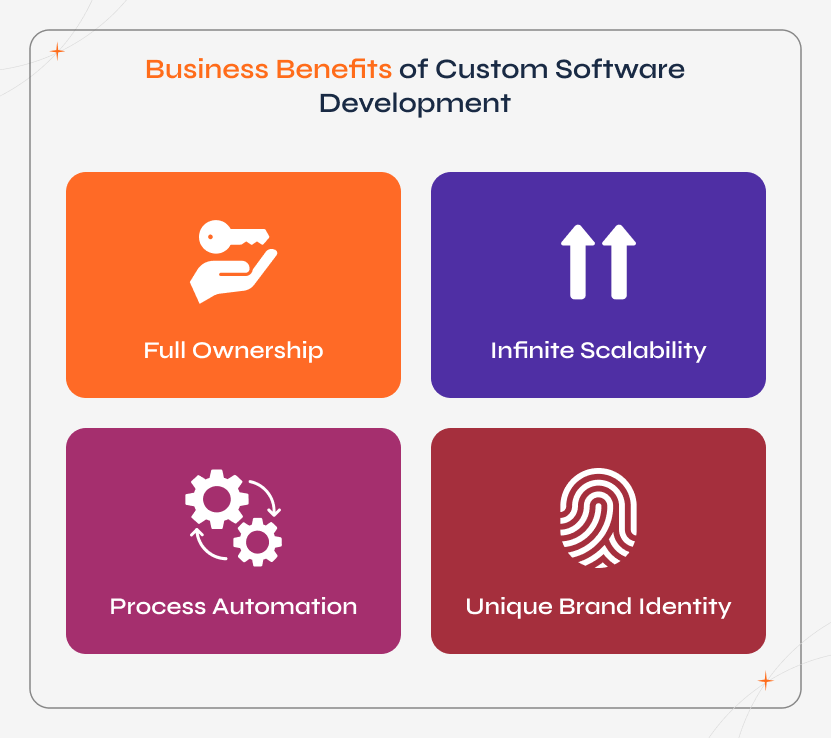
With that said, let's summarize some major benefits you will get.
- Decide exactly how you want your software to look, feel and function.
- Extremely flexible when you look at making customizations for your software.
- Get deep control over the quality of your product with custom software development.
- Build economic models that are tailored to your business needs.
- Experiment with different ideas and make changes to your software with user feedback.
- Building scalable, stable and robust software solutions that can handle real-world traffic as your business scales.
Common Use Cases of Custom Software by Industry
With custom software, businesses can improve internal operations while delivering better customer experiences. Here are five core industries where custom solutions are commonly used.
Healthcare
- Internal compliance and reporting tools.
- Electronic Health Records (EHR) with secure access.
- Patient monitoring and appointment scheduling systems.
Finance & Fintech
- Fraud detection and risk management systems.
- Internal dashboards for compliance and analytics.
- Digital payments and wallet platforms.
Retail & E-commerce
- Personalized shopping and loyalty platforms.
- Customer data and behaviour analytics tools.
- Inventory and order management systems.
Manufacturing
- Internal workflow and operation automation tools.
- Production planning and inventory tracking software.
- Quality control and performance monitoring systems.
Logistics & Transportation
- Real-time shipment and tracking systems.
- Internal resource and operations management tools.
- Fleet management and route optimization software.
How Custom Software Helps in Different Departments
Beyond delivering values around IT sectors, custom software development touches every part of your business. Different teams benefit in specific ways, improving efficiency, reducing errors, and cutting off manual workload.
Human Resources
In the HR department, custom HR
software automates employee onboarding, attendance tracking, and performance
reviews. Fewer manual spreadsheets and handoffs mean the HR teams can focus on
different strategies rather than doing admin tasks.
Finance
Finance teams can gain real-time access to
budgets, expense tracking, and invoicing. Moreover, with smart automation,
custom software will reduce potential errors and speed up reporting, giving
management faster insights for decision-making.
Sales & Marketing
Custom CRM and marketing automation
tools will streamline lead management, track customer interactions and
personalize campaigns. This will gradually reduce the time spent on multiple
platforms and boost conversion rates.
Operations
With workflow management and inventory
tools, operations teams can track resources, optimize supply chains, and
coordinate tasks efficiently. Fewer handoffs and automated alerts will keep
everything on schedule.
Overall, custom software not only streamlines the above departments but also improves efficiency across customer support, R&D, healthcare, tourism, e-commerce, and more, helping teams to collaborate seamlessly.
How can Custom Software Development Help Startups?
Startups always have to stay nimble, and many startups are building product-based businesses. In this case, unless you're in a space where you're building an existing type of product, you will need to build your software from scratch. Even in the case of service-based agencies, custom software development is a great choice for startups to build a product once and then resell it by white-labelling it for your clients. Many new agencies or agencies that want to launch a new product build products from scratch.
Additionally, if you're building an internal tool for your business, for example. You will need to custom-program your software because you're building a solution for your business and to solve your business's specific problems.
How Can You Calculate Custom software development cost in 2026?
When it comes to building your digital product with custom software development, the costs will be subjective depending on what you are trying to build and how you are building it. You have two choices here: either build your software by hiring and assembling a team, or you can hire a software development agency.
Beyond the custom software development cost, hosting and maintenance will also affect the total pricing. Usually, cloud deployment has the lowest upfront cost and scales easily, while on-premise setups require a higher initial investment but offer more control. After launch, ongoing maintenance, including bug fixes, updates, and security patches, which should be planned as a recurring cost.
Having these things in mind, hiring a team, as you may have thought about, gives you control over who works on what part of your digital product. However, chances are that this will carry a fairly good amount of overhead. If you're a smaller business launching a new product, hiring a team for custom software development may prove to be expensive. On the other hand, if you're using an agency for your project, then you will have a lot more flexibility because you can delegate your product development to experts who can take this off your plate.
Here, your challenge will be to find the right agency for your project. There are plenty of agencies out there, and hiring the right agency for your project is crucial if you want a robust product. When you're hiring an agency for your custom software development needs, make sure that you have the expertise, team strength and experience building the kind of products you want to build.
Mistakes That Can Detail Custom Software Projects
Even a well-planned project can go out of hand when certain critical details are overlooked. Understanding these generic pitfalls at early stages will help you avoid delays, wasted budget, and long-term technical headaches.
- Building software without validating real user needs or internal workflows, which will possibly lead to low adoption.
- Trying to launch the custom software with too many features instead of focusing on a strong MVP (Minimal Viable Product).
- Starting the development with unclear requirements that keep juggling in mid-project.
- Instead of performing testing throughout the development, treat it only as a final checkbox.
- Ignoring long-term maintenance, updates, and ownership responsibilities.
How to Choose a Custom Software Development Partner
Choosing the right development partner is crucial, as they understand your business goal, follow a structured process, and support you beyond the product launch. This is where experienced custom software development companies like Sparkout focus on long-term product success rather than just delivery.
However, if you're unaware of the aspects, then here are some things you need to consider while choosing or switching a custom software development partner.
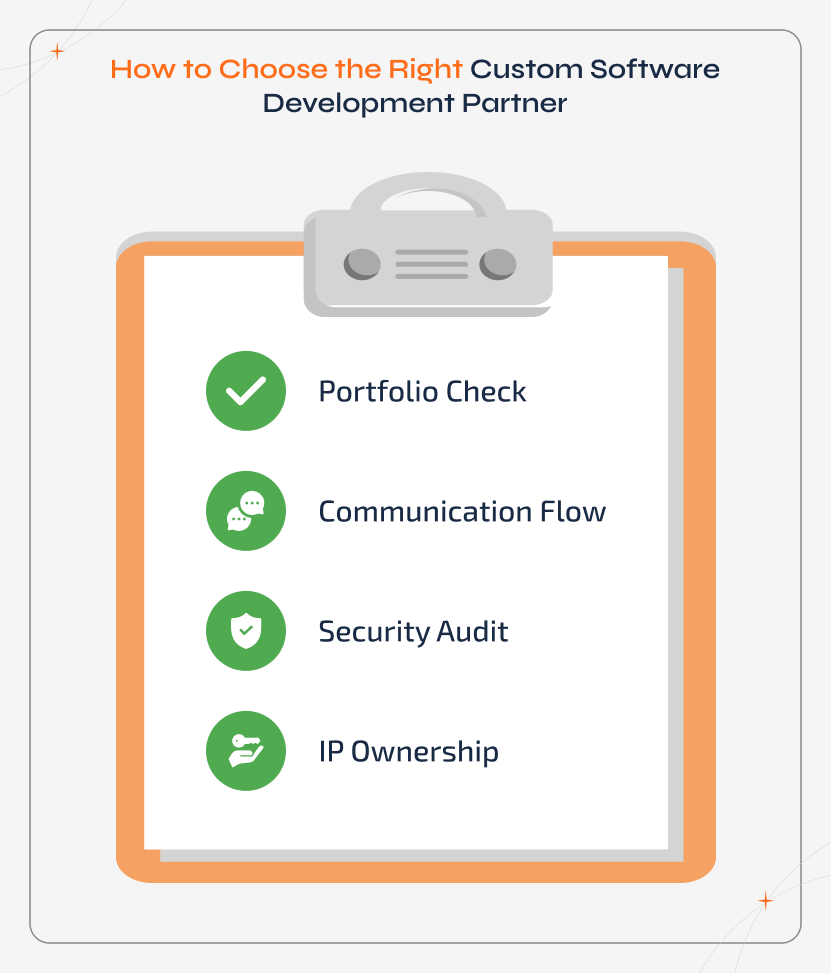
Experience & Track Record
At the start, review the
partner's portfolio and see if they have built similar products that you're
working on or handled complex projects. This is because relevant experience
reduces risk and boosts decision-making.
Process & Communication
A dedicated software
development partner follows a transparent discovery and development process and
communicates with you regularly.
Security & Testing
The team must follow standard
security practices and must have a defined QA process. This ensures that the
product is stable, secure, and reliable at launch.
Support, Ownership & Contracts
Make sure you clarify the post-launch support terms,
maintenance responsibilities, intellectual property ownership, timelines, and
how exactly the change requests are handled.
Winding Up
I hope that now you have a better idea about how building a custom product can help your business. When you're building a digital product for your business, it's important to understand the scale of the project that you're trying to do. Many founders approach custom software development incorrectly because they think that they have to build everything in one go. Realistically, you may not need that. You can easily take your project in phases and only build what you need at that particular time. To understand how to approach this, you may want to consider getting help from an experienced agency that has a good track record of building and shipping products, as well as a good team of experts.
Consider sharing this knowledge with a founder you know if this blog post helps you out.