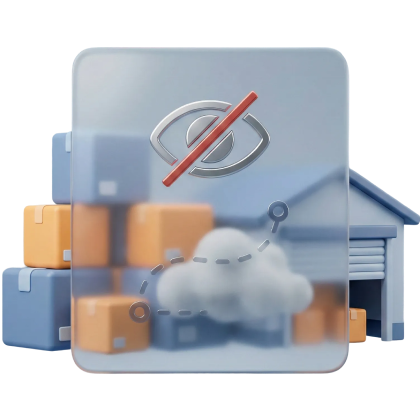



During a peak sales period, the delivery commitments are often made based on assumed inventory availability. Maybe if the inventory data is inaccurate or delayed, the business will face multiple issues, including missed timelines and service disruptions. Here, the main issue is not demand or logistics capacity, but the lack of supply chain visibility.
By missing this blind spot, businesses will face a major financial loss, which prevents monitoring shipments, tracking inventory, and anticipating disruptions. When the data is spread across disconnected systems and updates arrive late, decision-making becomes reactive rather than well-planned. This will lead to higher supply chain software development costs and operational inefficiencies.
In this informative blog, we’ll explore how a lack of supply chain visibility can disrupt operations and the necessary remedies to get it back on track.
What Does Supply Chain Visibility Really Mean?
Supply chain visibility means being aware of what exactly is happening at every stage of your product’s journey. This means having real-time access to inventory levels, shipment locations, and supplier performance, so that you can anticipate potential issues before they escalate. When you actually oversee your supply chain management, the decisions become proactive, so that you can save time and money.
In practice, supply chain visibility spans multiple layers, including inventory visibility, logistics visibility, supplier visibility, demand visibility, and production visibility. Altogether, these visibility types give businesses a complete end-to-end view of operations, making it even easier to act fast and stay in control.
Beyond just tracking good, visibility is all about understanding the flow of info, spotting flaws, and responding to disruptions much quickly. High visibility allows businesses to optimize resources, minimize delays, and maintain customer trust.
The Hidden Impact of Limited Supply Chain Visibility
Without proper supply chain software development, supply chain visibility will create hidden challenges that actually go beyond delays and inefficiencies. Beyond these, limited supply chain visibility exposes businesses to critical operational and financial issues. When issues arise, the lack of real-time data makes it even harder to detect problems early, which increases the chance of revenue loss.
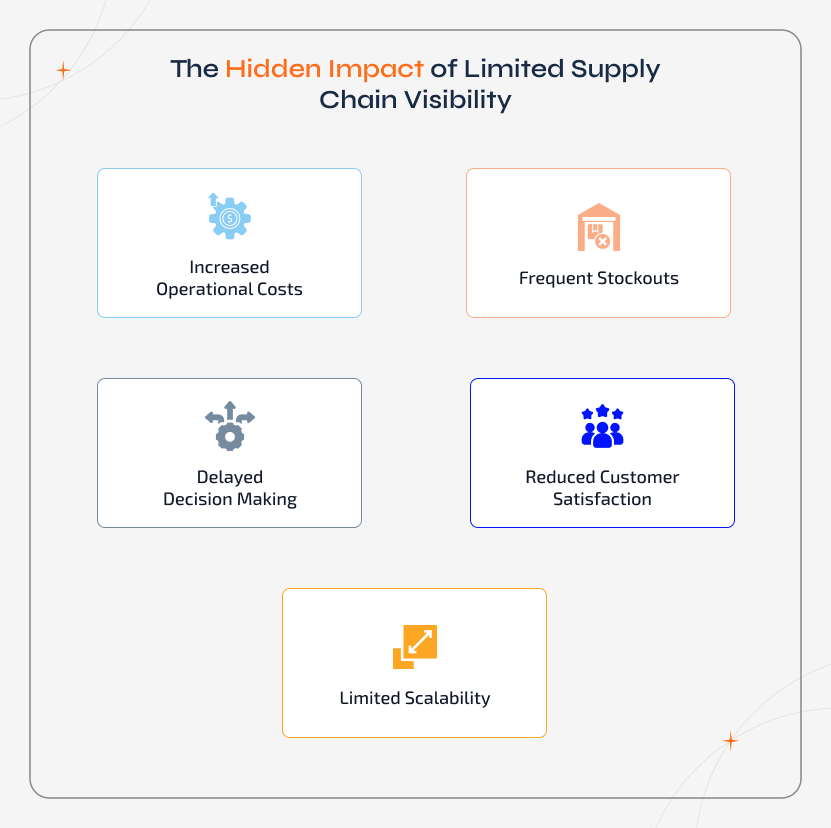
In the meantime, understanding these challenges early will prevent your business from potential flaws and gain customer trust, and pave the way to long-term business growth.
Increased Operational Costs
When the supply chain data
is unclear, businesses are forced to overstock products to avoid shortages or
pay high costs for last-minute shipments. These reactive decisions will inflate
transportation, storage, and procurement expenses, which have been avoided
earlier with better visibility.
Frequent Stockouts
Due to poor visibility, it makes it
difficult for various businesses to balance between supply and demand more
accurately. As a result, businesses might face empty shelves on one end, whereas
a lack of inventory visibility on the other end. This will reduce the overall
supply chain efficiency.
Delayed Decision Making
Without any real-time insights
into inventory movement and supplier performance, internal teams are forced to
rely on manual reports and assumptions. This will slow down decision-making and
limit the ability to respond quickly to demand spikes.
Reduced Customer Satisfaction
Delayed deliveries, wrong
order updates, and inconsistent service will always lead to frustrated
customers. Over time, these issues will ruin trust and loyalty, push customers
toward competitors who can deliver even faster with reliability.
Limited Scalability
Lack of supply
chain visibility increases exposure to supply disruptions, supplier failures,
and compliance risks. This makes the scaling operations difficult, as businesses
can’t confidently expand without a clear understanding of the performance of the
supply chain.
Common Reasons Businesses Lack in Supply Chain Visibility
The following factors are the ones that commonly contribute to a lack of supply chain visibility across the supply chain operations. Addressing these issues is essential for improving supply chain transparency and operational control.
Disconnected Systems & Data Silos
When the inventory,
procurement, and logistics teams work on different systems, the information gets
scattered across platforms. Lack of integration at this level makes it difficult
to track the movement or to get a real-time view of operations, leading to
delays and misaligned decisions.
Missing Real-Time Data
In the absence of real-time
visibility, teams were forced to rely on delayed reports and manual status
checks. Due to this, inventory changes, shipment delays, and supplier issues are
often found too late. This leads businesses to react after the problem has
already impacted operations.
Dependency on Manual Process
Too much dependence on
spreadsheets and manual data entry will slow down the workflows and increase the
risk of potential errors. When the operation scales, these processes become even
harder to manage, limiting the accuracy standards and reducing the overall
supply chain efficiency.
Poor Partner Collaboration
Limited data sharing with
suppliers and logistics partners creates visibility gaps beyond internal
operations. Without any clear communication and shared insights, tracking
shipments, monitoring supplier performance, and eradicating issues becomes more
complex.
Lack of Supply Chain Tech
Outdated supply chain systems and disconnected
tools often struggle to support modern supply chain demands. Without integrated
platforms and automation, businesses will lack transparency and respective
insights needed to manage complexity and respond quickly to change.
Real World Scenario: What Visibility Gaps Look Like?
Imagine this scenario:
A retailer during the summer season promises next-day delivery for a popular gadget. The sales team checks the system, sees the item “in stock”, and assures customers. Hours later, the warehouse team realizes the stock is actually in a different facility, which is being delayed in transit. The orders are rerouted at the last minute, deliveries slip, and customers get frustrated and begin to call support.
This isn’t just a rare edge case. Similar to this, industry reports show that over 60% of businesses still lack end-to-end supply chain visibility, which leads to inefficiencies in real-time. Also, during major disruptions, more than 70% of companies report revenue loss due to visibility gaps, turning small delays into costly operational failures.
This classic scenario shows what a lack of supply chain visibility in the real world is. At first, the business thought it had accurate information, but without real-time tracking and integrated systems, important details were missing. The result? Extended time, additional cost, and broken customer trust.
Technologies Enabling End-to-End Supply Chain Visibility
Today’s modern technologies play a vital role in eliminating the lack of supply chain visibility across complex systems. These technologies enable end-to-end supply chain visibility, real-time insights, seamless data flow, and better control for accurate delivery.
Internet of Things (IoT)
IoT devices, including sensors
and GPS trackers, offer live insights on shipment conditions, exact location,
and current status. Visibility at this level will help in detecting delays,
damage risks, and environmental issues before they impact operations.
Cloud-Based Platforms
By leveraging cloud-based supply chain
platforms, businesses can centralize data across many departments and
partners. These platforms do enable seamless data sharing, enhance
collaboration, and ensure that everyone works with the same up-to-date
information.
AI & Advanced Analytics
With custom AI software development
and supply chain data analytics tools, businesses can turn raw supply chain data
into actionable insights. They support risk identification, demand forecasting,
and also performance optimization. This helps businesses at any level in
eradicating the lack of supply chain visibility and to make informed decisions.
Real-Time Tracking Systems
Modern technologies embedded
with real-time tracking provide continuous updates on the inventory movement and
shipment location. This helps businesses in monitoring goods across warehouses
and transit points, which leads to reducing uncertainty and improving delivery
accuracy.
Blockchain Technology
Alongside Blockchain technology,
a top custom software development company
assists in creating a secure and transparent record of supply chain
transactions. By providing fully secured data across stakeholders, Blockchain
improves traceability, reduces disputes, and builds trust throughout the supply
chain.
System Integrations & APIs
Integrated systems and APIs connect ERP, TMS, WMS, and
partner platforms into a single view. This will remove data silos and enable
end-to-end visibility across the entire supply chain.
How AI Helps to Improve Supply Chain Visibility?
Instead of delivering static reports, Artificial Intelligence enhances supply chain visibility by turning real-time data into valuable insights. By leveraging predictive analytics, AI helps businesses in the supply chain sector to identify potential inventory shortages and anticipate delays before they disrupt the workflow.
With AI supply chain visibility, businesses can also trigger real-time alerts when the shipments deviate from planned routes or any unexpected risks arise. So, teams can respond immediately rather than reacting later. By continuous pattern analyzation across inventory, supplier data, and logistics, AI improves the forecasting accuracy and provides a clear view of the supply chain.
Steps to Start Improving Supply Chain Visibility
The following aspects provide a practical starting point for businesses that look to gain clear control over their supply chain. These factors focus on improving transparency, accuracy, and responsiveness across your everyday operations and help in reducing the lack of supply chain visibility.
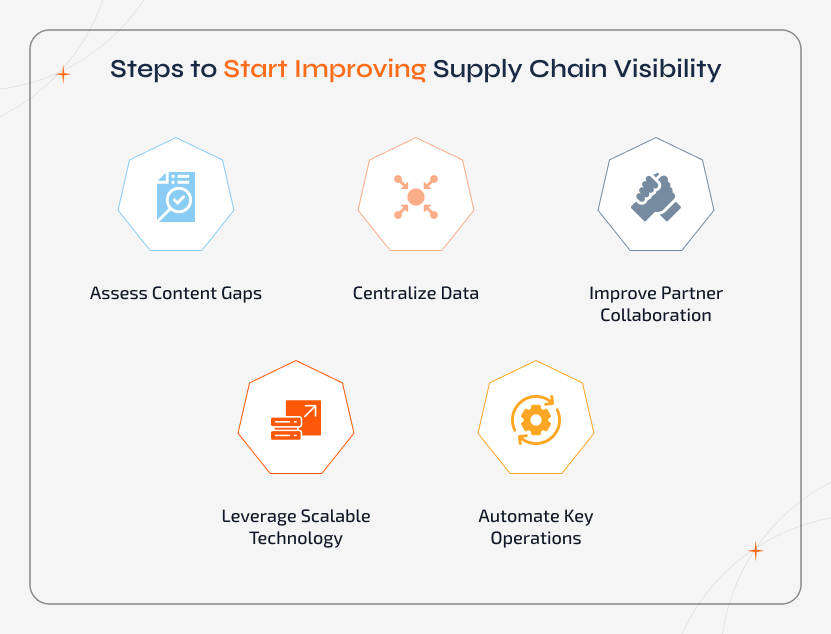
Assess Data Gaps
Start by identifying where the
visibility breaks down across your supply chain. Ensure to review the data flow,
system limitations, and process delay to understand which area lacks timely and
accurate information.
Centralize Data
Make sure you bring inventory,
logistics, and supplier data into a single accessible platform. A centralized
data ensures that teams work with consistent information and reduces dependency
on fragmented tools.
Improve Partner Collaboration
Without wasting a second,
strengthen data sharing with suppliers and logistics partners. Transparent
collaboration will improve the coordination, reduce blind spots, and ensure a
smoother supply chain execution.
Leverage Scalable Technology
Adopt flexible and
integrated technologies that can grow along with your business. A scalable
solution will support automation, analytics, and long-term visibility
improvements without adding complexity.
Automate Key Operations
Automation
does reduce manual efforts across inventory updates, order processing, and
shipment tracking. This can be done by leveraging our agile custom software
development team. By minimizing human intervention, businesses can improve data
accuracy, speed up workflows, and gain more consistent visibility across the
supply chain.
Mistakes to Avoid for a Better Supply Chain Visibility
Identifying and clearing the lack of supply chain visibility is not just about adding tools or any other systems. It’s all about avoiding common missteps, which helps us to ensure transparency that actually delivers operational value.
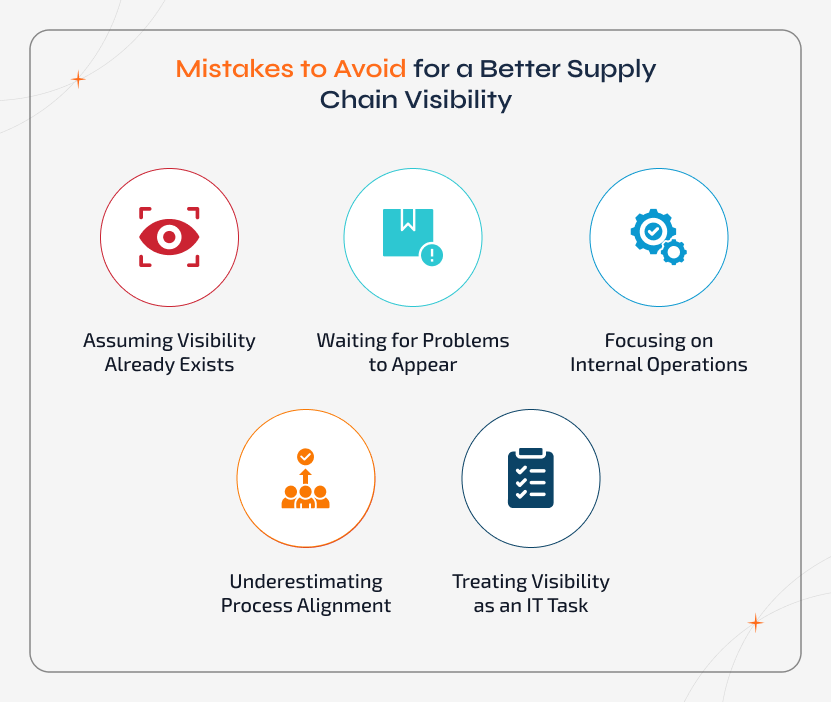
Assuming Visibility Already Exists
Many teams believe
that they actually have visibility just because the data is available somewhere
else. But in reality, the information is often outdated, incomplete, or
scattered, which leads to false confidence and poor decisions, and leads to lack
of supply chain visibility.
Waiting for Problems to Appear
Visibility efforts will
often be triggered only when the delay or loss occurs. This reactive mindset
will limit the ability to prevent disruptions, even before they impact
operations.
Ignoring Suppliers
Businesses often tend to improve
visibility within their own systems while ignoring the suppliers and logistics
patterns. This will possibly create a blind spot in areas where the disruptions
most commonly occur.
Underestimating Process Alignment
Even with the right
tools, unclear workflows and responsibilities will reduce visibility. In the
absence of an aligned process, data will exist but does fails to support timely
action.
Treating Visibility as an IT Task
Rather than a business priority, supply chain visibility is
often viewed as a technological issue. Without any involvement from leadership,
operations, and procurement, visibility initiatives will fall short.
Why Choose Sparkout for Supply Chain Visibility Enhancement?
Partnering with a custom outsourcing team like Sparkout will help supply chain businesses gain a deeper supply chain visibility by aligning the technology, processes and data into a unified system. Instead of relying only on fragmented tools, Sparkout’s tailored approach ensures real-time insights, smoother collaboration, and better operational control, and do reduces the lack of supply chain visibility.
Custom-Build Solutions
Our team assists in custom software development
built around your specific workflows, data needs, and business goals. This
ensures end-to-end visibility without forcing any of your operations to adapt to
rigid, off-the-shelf systems.
Seamless System Integration
We connect your existing
ERP, logistics, inventory, and partner platforms into a single ecosystem. This
will eliminate data fragmentation and provide a centralized view of the supply
chain activities.
Real-Time Analytics
Our dedicated solutions focus on
real time tracking challenges and actionable insights. Using accurate data and
analytics, businesses can identify disruptions early and make informed
decisions, improving overall performance.
Future-Ready Approach
Our Sparkout
team builds supply chain systems that do scale as your business evolves. From
smart automation to advanced technologies, our dedicated solutions support
long-term visibility, flexibility, and operational resilience.
Ending Note
As the supply chain continues to grow more complex, only visibility will define how well the business adapts to future change. With the market constantly shifting and customer expectations climbing higher, the supply chain monitoring needs to move beyond basic efficiency. Also, it needs to become even smarter, faster, and more responsive. Organizations that mostly invest in transparency are better positioned to navigate uncertainty and encourage them to make confident data-driven decisions.
Looking ahead, the supply chain visibility will shift from being a competitive advantage to a business necessity. Firms that embrace innovation, collaboration, and continuous improvement will build supply chains that are scalable, resilient, and future-ready. The path is clear for those who spot a lack of supply chain visibility early, and in the future, they will lead the way in a more connected and demanding global market.
Turn Visibility Gaps Into Business Clarity
Gain real-time visibility with Sparkout and get actionable insights to eliminate potential delays, control costs, and protect revenue.