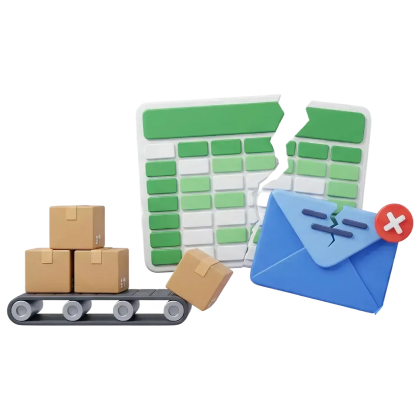



It’s the start of the business week. A supplier confirms the shipment via email, the inventory levels are tracked in multiple Excel files, and the internal operations team cross-checks data across departments. For them, each update looks correct in isolation, yet no one has any idea what is actually happening around the supply chain operations.
This is the reality of organizations that are still managing supply chain operations through Excel spreadsheets and follow e-mail-based communication. Legacy supply chain management tools that were once convenient have become barriers to speed, accuracy, and visibility. When the supply chain scale and customer experience rise, these kinds of manual systems will create operational gaps that lead to delays and revenue loss.
In this blog, we’ll explore how Excel and emails are undermining the modern supply chain operations, potential risks that businesses often overlook, and quick alternatives that leading teams are adopting in today’s landscape.
What are Supply Chain Operations & Why They Matter?
Supply chain operations are commonly referred to as the end-to-end process involved in planning, sourcing, storing, and delivering goods to customers. This possibly includes demand forecasting, procurement, logistics, inventory management, and coordination across suppliers and distributors. When these operations run smoothly, businesses will meet demand on time, manage costs, and respond quickly to market changes.
Efficient supply chain operations have a direct impact on customer satisfaction, cash flow, and overall business performance. During the continuous workflow, even small inefficiencies will trigger stockouts, excess inventory, delayed deliveries, and higher operational costs. Overall, robust supply chain operations in today’s market drive long-term growth.
Where Excel & Email Still Play a Role in Supply Chain Operations?
Excel spreadsheets and email communication are still commonly used across multiple areas of supply chain operations, especially where systems are disconnected or manual processes persist.
- Demand forecasting and planning
- Purchase order creation and updates
- Order processing
- Change approvals
- Supplier communication and follow-ups
- Shipment tracking
- Delivery confirmations
- Warehouse planning
- Inventory tracking and stock reconciliation
- Issue resolution
- Production scheduling coordination
- Performance reporting
- KPI tracking
- Compliance documentation and audits
How Excel & Emails are Breaking Supply Chain Operations
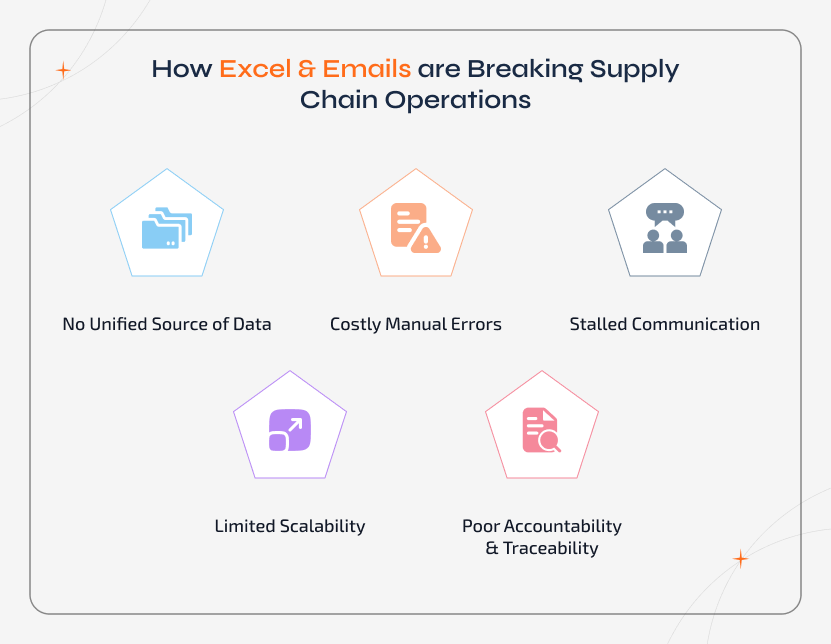
Outdated tools like Excel and email were never built specifically for managing complex operations, as it outgrown its current supply chain system. As the complexity grows, these systems will create issues that weaken the performance across the entire supply chain and damage the company’s reputation.
No Unified Source of Data
Excel files usually sit in different folders, inboxes, and desktops, whereas long email threads scatter information across teams. Due to this, everyone ends up working from a different version of the same data, and no one’s sure which numbers are accurate. This confusion kills the visibility, which leads to bad decisions and forces teams to redo the same work again.
Costly Manual Errors
Supply chain data changes rapidly, but Excel relies heavily on manual inputs. A missed update, broken formula, and outdated attachment can easily trigger inventory mismatches, incorrect forecasts, and delayed orders and shipments.
Stalled Communication
E-mail-based coordination will create potential delays when approvals, clarifications, or updates are needed. Most of the time, critical information gets buried in inboxes, and the response time will extend from a few minutes to several hours, or even days. This slows down the entire supply chain system.
Limited Scalability
What actually works fine for a small setup starts to fall apart when you scale. When order increases, the suppliers will grow, and locations will expand. Here, Excel will turn into a mess and email chains become hard to track. This results in operational flaws that slow down teams when speed matters the most.
Poor Accountability & Traceability
With only spreadsheets and emails, it’s too difficult to track who actually made the change, when and why it happened. Due to the lack of supply chain visibility and traceability, it turns audits, issue resolution, and performance analysis into bigger headaches than they should be.
What Excel & Email Breakdown Looks Like in Real Time
Here are some of the real-time examples that show the breakdown of Excel and email across departments.
- Manufacturing: A production line pauses because the raw material usage wasn’t updated within the time period, and procurement views only the shortage hours later.
- Logistics: A shipment is delayed in transit, but the update is buried in an email. Due to this, the team finds out only after the customer escalates.
- Retail: A store is selling out of a fast-moving SKU, while inventory still sits in another warehouse just because the Excel isn’t updated yet.
How to Solve These Problems Using Supply Chain Management Software
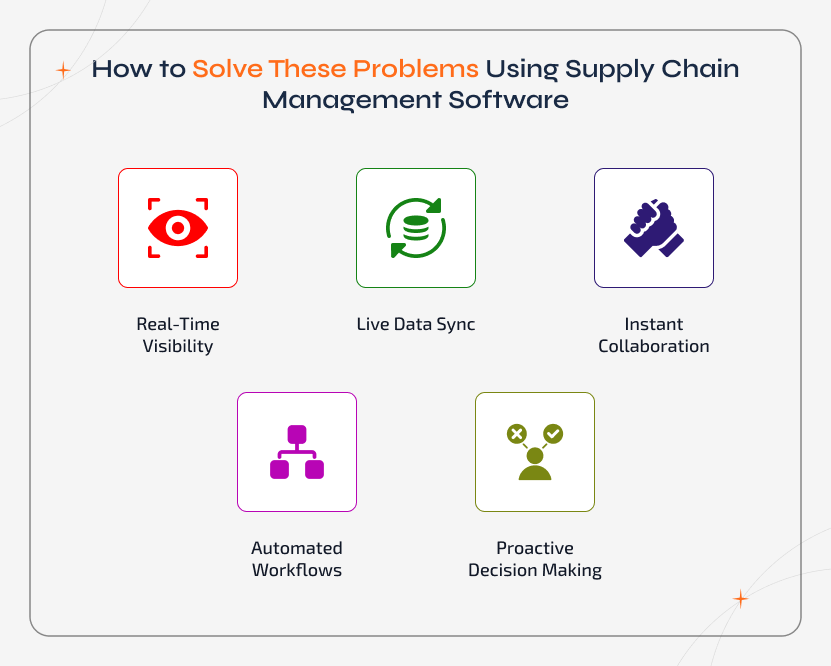
Instead of using the traditional Excel and email approaches, modern supply chain management software, on the other hand, resolves operational breakdowns. This works by enabling real-time data flow, visibility, and quick execution. Instead of reacting to outdated spreadsheets and emails, with supply chain software development, teams can monitor and act instantly across the operations.
This shift doesn’t require replacing everything at once. Most teams can implement this by digitilizing a single process, like inventory tracking or order management. Further, you can expand gradually when confidence grows.
Real-Time Visibility
Using custom software development, live dashboards will provide instant updates on inventory, orders, and shipments. Using this, teams can easily detect disruptions as they happen and can take corrective action without waiting for manual reports and email confirmations.
Live Data Sync
Leveraging this supply chain tracking software, all supply chain data will update automatically across the system. Important changes made by a specific team or a partner can be reflected immediately for everyone. This eliminates version conflicts and outdated information.
Instant Collaboration
Built-in communication replaces email chains with contextual and real-time discussions. With this, teams and partners can rectify these kinds of issues quickly with shared data and clear accountability.
Automated Workflows
Critical processes like data approvals, alerts, and updates run automatically in real time. This will reduce potential delays, manual errors, and dependency on follow-up emails.
Proactive Decision Making
Real-time analytics and alerts will allow teams to anticipate the issues before they even escalate. Instead of reacting to problems after they occur, decisions are made based on accurate information.
Know the Difference Between Legacy Tools vs Modern Supply Chain Software
The table below highlights how exactly the traditional Excel and email-based workflows compare with the modern supply chain software across speed, accuracy, and visibility.
| Excel & Email | Modern Supply Chain Software |
|---|---|
| Slow updates and delayed responses | Real-time update across teams |
| Rely heavily on manual data entry | Automated workflows and alerts |
| Multiple versions of the same data | Single source of truth |
| The information is scattered across inboxes | Centralized and structured data |
| Hard to scale as the operation grows | Built to scale with growth |
| Limited visibility and control | Clear and end-to-end visibility |
Key Benefits of Migrating from Excel to Supply Chain Software
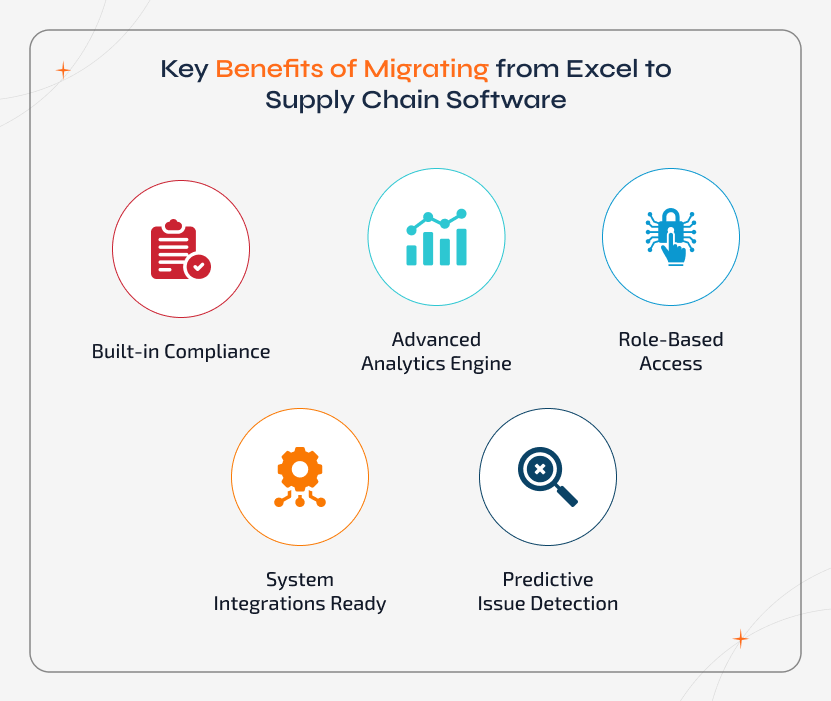
Migrating from a generic Excel approach to a dedicated supply chain software introduces the capacity that actually goes beyond basic tracking and reporting. These system-level advantages help organizations build resilient and well-governed supply chain operations.
Built-in Compliance
Supply chain management software enforces standardized workflows and approval rules across various operations. An automated audit will track every change and make compliance and internal reviews too easy for businesses to manage.
Advanced Analytics Engine
Unlike spreadsheets, using the supply chain software will continuously analyze the historical and live data. This will enable deeper insights into demand patterns, supplier performance, and operational flaws, supporting smarter optimization decisions.
Role-Based Access
Agile custom software development platforms allow organizations to define the user roles and permissions. This will prevent unauthorized changes, protect sensitive data, and ensure accountability across teams and partners.
System Integrations Ready
Modern supply chain software integrates seamlessly with ERP, WMS, TMS, and other supplier systems. This will remove the manual data transfer and keep the information synchronized across the entire tech stack.
Predictive Issue Detection
Using the data-driven logic and alerts, the supply chain software pinpoints potential risks before they erupt. Having this in mind, teams can proactively address delays, customer complaints, shortages, or performance issues quickly.
Other Essential Needs to Build Smarter Supply Chain Solutions
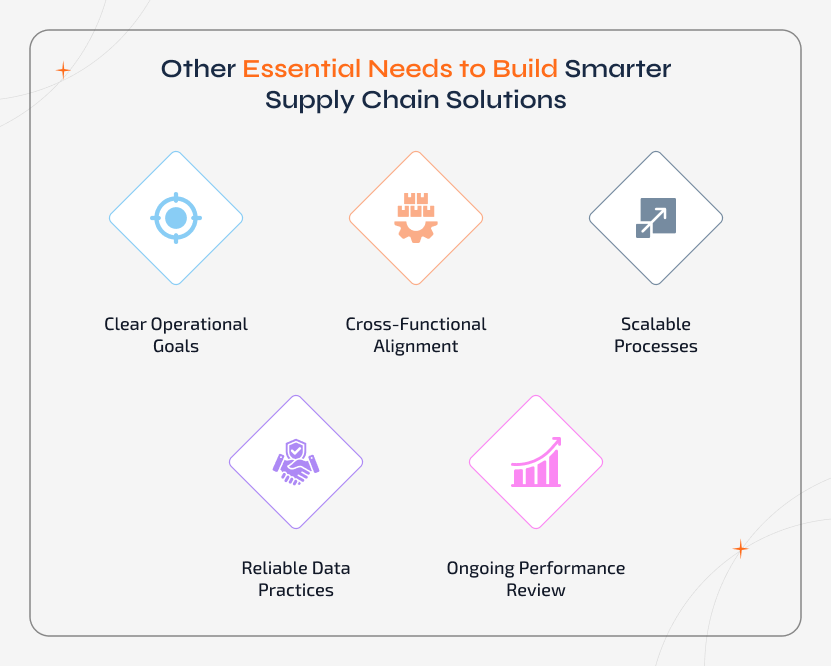
If you need to build a smarter supply chain solution, you have to think beyond tools and platforms. It requires a robust operational foundation that truly supports consistency, coordination, and long-term improvement across the supply chain operations.
Clear Operational Goals
Defining clear goals helps organizations in prioritizing supply chain initiatives and measure success effectively. When the actual objectives are aligned with business outcomes, decision-making becomes more focused and consistent.
Cross-Functional Alignment
The supply chain performance depends on how well different teams work together. Perfect alignment between logistics, procurement, sales, and operations will reduce miscommunication and ensure smoother execution.
Scalable Processes
The processes should be flexible enough to handle increased volume, new partners, and changing market conditions. Scalable workflow prevents operational strain as the current supply chain grows.
Reliable Data Practices
An accurate and well-maintained data forms the backbone of effective supply chain management. Consistent data practices will improve planning, forecasting, and operational reporting.
Ongoing Performance Review
Continuous performance reviews helps in identifying flaws and improvement opportunities. At the same time, continuous evaluation allows teams to adapt quickly and refine the supply chain strategies over time.
Enhance Supply Chain Operations With Sparkout
Modern trends demand real-time visibility, control, and reliability across every business supply chain and operations. Being one of the leading supply chain software companies, Sparkout Tech helps businesses move beyond just spreadsheets and email-driven workflows by providing a unified platform built specifically for clarity and speed.
Unified Data View
Sparkout helps in centralizing inventory, orders, and operational data into a single, real-time view. This helps in eliminating data fragmentation and boosts the team to work consistently across the supply chain.
Liver Order Tracking
Sparkout helps in tracking orders and shipments at every stage, from initial procurement to final delivery. With real-time updates, teams can identify delays early and take corresponding action before the issue even escalates.
Intelligent Alerts
We at Sparkout proactively notify your teams about the expectations, delays, and performance deviations. These kinds of alerts will enable quick responses and reduce the dependency on manual follow-ups and email communication.
Actionable Insights
With real-time analytics, our team will transform supply data into meaningful insights. By leveraging this, teams can easily identify the latest trends, optimize operations, and make informed decisions with absolute confidence.
Preparing Supply Chain Operations for the Next Five Years
Over the next five years, the supply chain operations will face rising complexity driven by market volatility, increasing customer expectations, and global disruptions. As time passes, organizations must adapt to systems that support real-time visibility, faster execution, and data-driven decision making across the entire supply chain. Static tools like email and Excel will struggle to support this shift, as they lack speed and the integration required to manage in the dynamic supply networks.
Preparing for the future means building a flexible and software-driven foundation that can scale and adapt without relying on manual work. Businesses that invest early in these connected platforms, automation, and structured data will be better positioned to maintain operational resilience in this upcoming supply chain environment.
Future-Proof Your Supply Chain Operations Now
Email and Excel were never designed to carry out the speed, complexity, and interconnected nature of the modern supply chain operations. What actually felt manageable in the past has now turned into a source of risk and creates blind spots that hold the organization back.
As the trend continues to evolve, the actual supply chain challenge will advance faster. So, the future-ready operations across the supply chain need real-time visibility, connected systems, and decisions powered by live data, not just outdated spreadsheets or endless email threads.
More than just a technological upgrade, the shift from spreadsheets and inboxes is a strategic move towards scalability and long-term competitiveness. Organizations that act early will be better positioned to adapt and stay ahead in the increasingly unpredictable supply chain landscape.
Boost Your Supply Chain Efficiency Today
Take control now and transform your supply chain with real-time software solutions.