


In 2026, supply chain challenges are not just becoming a serious issue for business operations. Rather they are the strategic risks that directly decrease profitability, customer trust, and growth. As per Maersk survey on supply chain disruptions, Nov 2025, 4 in 5 supply chain leaders report that disruptions are expected to continue for at least the next two years, driven by geopolitical tensions, tariff issues, and shifting trade patterns.
These issues in supply chain management no longer deal with operations teams. They, in turn, affect the profitability, customer trust, compliance, and long-term scalability. As business operations become more complex, modern supply chain management demands smarter systems, better data, and flexible technology support.
To best manage these growing challenges, businesses are rapidly turning to rely on supply chain management software that offers real-time visibility, predictive insights, and centralized control across operations.
This blog explains the most critical challenges of supply chain management, why they are increasing in 2026, and how businesses can regain control with software-driven solutions in detail.
What is a Supply Chain
The modern supply chain is no longer just the physical movement of products. Rather, it is the continuous flow of data, decisions, and coordination that moves a product from raw materials to the end customer. In simple terms, a supply chain involves connecting suppliers, manufacturers, warehouses, logistics providers, and customers through real-time information.
Modern supply chains operate based on data signals like demand forecasts, inventory levels, supplier performance, shipment status, and customer orders. These data guide every step from sourcing, manufacturing, to warehousing, inventory control, transportation, and final delivery. Thus, the supply chain ensures each action happens at the right time without any delays.
When all of the above steps work together smoothly, businesses can effortlessly control costs, avoid delays, and meet customer expectations. But when the data is delayed, manual, or disconnected, even the small gaps will quickly grow into issues in supply chain management. This is why efficient supply chain management today is a data problem before it becomes a logistics problem.
Did You Know? Most supply chain failures start with small gaps such as delayed data, manual approvals, or disconnected systems. Over time, these gaps grow into serious supply chain issues.
Why Businesses Face More Supply Chain Problems in 2026
Over the years, supply chain software development has become complex and face global instability. i.e., Businesses started working with multiple countries, various suppliers, operating across countries, and serving customers who expect faster delivery and real-time order updates. All these make it harder to plan, track, and control every step of the supply chain. The factors that are increasing pressure on businesses include:
- Unstable demand & poor forecasting often make it difficult to plan inventory and production accurately.
- Rising logistics and transportation costs impact margins and pricing.
- High supplier dependency, geopolitical risks, and sudden traffic on trade fluctuations also increase the chances of delays, cost spikes, and disruptions.
- Sustainability and compliance requirements are adding new rules around sourcing, reporting, and transparency.
- Limited visibility across extended supply networks makes it hard to detect problems early.
Hence, without modern Supply Chain Management Software, these global and operational risks turn into serious supply chain problems. Businesses with manual processes and disconnected systems will end up reacting to issues rather than paying attention to preventing them. This eventually leads to delays, higher costs, and reduced customer trust.
Businesses also rely on legacy ERP systems to manage their supply chain operations. Although ERPs are effective for recording transactions and what-if maintaining financial control, they were not actually designed to handle real-time visibility, dynamic risk scenarios, or rapid operational change.
Traditional ERPs react to what has already happened. While modern supply chain software, especially custom-built systems, focuses on what is likely to happen next using real-time data, predictive insights, and flexible workflows.
Signs Your Supply Chain Needs Modern Software - A Quick Checklist:
If your business falls into two or more categories, your supply chain likely needs better visibility, automation, and system integration.
Key Supply Chain Challenges Businesses Face in 2026
In 2026, supply chain challenges will no longer be related only to operational issues. They directly affect revenue stability, customer experience, regulatory compliance, and overall business workflows. While organizations across industries face similar supply chain problems, the real difference lies in how quickly they identify the risks involved and implement scalable solutions.
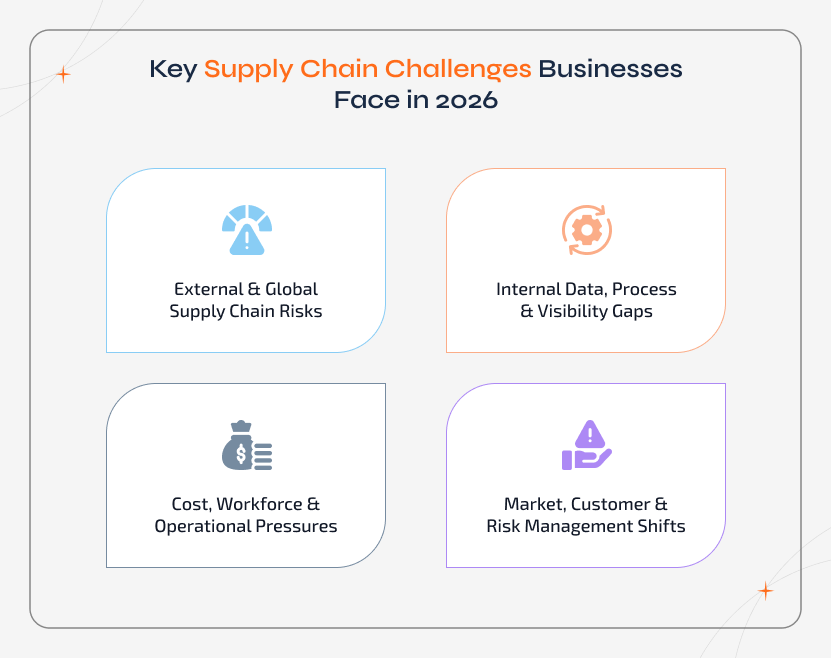
Below are the most common and costly issues in supply chain management that modern enterprises are dealing with today.
1. External & Global Supply Chain Risks
These are challenges that occur largely outside direct business control, but have the highest disruption impact in 2026. As per global trade analysts, geopolitical and climate-related disruptions are the reason for over 60% of large-scale supply chain failures.
1. Material Scarcity & Raw Material Shortages
Shortage of materials is one of the most commonly known global supply chain challenges faced by businesses across industries. Limited availability of essentials like metals, plastics, glass, etc., can halt production.
Why does this happen:
- Supplier dependency on specific regions.
- Global demand spikes.
- Weather events and geopolitical problems.
How businesses manage it:
- By increasing suppliers across regions.
- Maintaining stocks for safety instead of relying only on just-in-time models.
- Use ERP systems to track inventory levels in real time.
A proactive approach helps businesses stay away from production delays and reduce the impact of supply disruptions.
2. Port Congestion & Global Shipping Delays
Due to port congestion and climate-related disruptions, sea freight becomes unpredictable. When major ports slow down, shipments are delayed, inventory plans fail, and delivery commitments are missed.
What causes port delays:
- Seasonal demand surges.
- Regulatory changes.
- Low water levels and extreme weather.
Risk mitigation:
- Regional supplier diversification.
- Alternative shipping routes.
- Partial domestic sourcing.
By planning for port-related disruption, businesses can maintain supply continuity when global shipping slows down.
3. Environmental & Social Responsibility Pressure
Businesses face increasing pressure to make their supply chains more responsible and transparent. Governments, customers, and investors now expect clear action on sustainability and ethical practices.
Key pressures:
- Regulatory compliance.
- Carbon reduction goals.
- Ethical sourcing expectations.
Effective actions:
- Supply chain sustainability audits.
- Energy-efficient logistics.
- Waste reduction initiatives.
Addressing environmental and social responsibility helps businesses follow rules, protect their brand image, and build long-term customer trust.
2. Internal Data, Process & Visibility Gaps
These are fixable problems and the strongest argument for modern custom software. Thus, making custom supply chain software essential for visibility and control.
1. Lack of End-to-End Supply Chain Visibility
If businesses lack supply chain visibility, identifying problems becomes too late. i.e., it may happen after shipments are delayed, inventory runs out, or costs increase. When there is no clear, real-time view of the whole supply chain, teams will end up reacting instead of planning ahead.
Common visibility gaps include:
- Limited insight into supplier operations.
- Delayed inventory updates.
- Disconnected systems across teams.
Best practices:
- Centralized dashboards.
- Real-time data tracking.
- Automated reporting across procurement, production, and logistics.
Lack of supply chain visibility makes it difficult for businesses to find the risks at an early stage, respond faster, and maintain smooth operations. So, improving supply chain visibility helps companies detect issues faster, make faster decisions, and keep their supply chains running without disruption.
2. Poor Data Sharing Between Teams
When teams work without shared and up-to-date data, even small changes can disrupt the entire supply chain. Without data visibility across departments leads to slow responses and costly misalignment.
Common problems:
- Production increases without logistics readiness.
- Procurement is unaware of demand shifts.
- Delayed response to disruptions.
Solution:
- Digital supply chains with centralized data access.
- Real-time alerts for key changes.
With better data sharing, teams will stay aligned, respond faster, and prevent many supply chain disruptions.
3. Warehouse Congestion and Poor Inventory Organization
When the warehouse is not properly organized, it can slow down requirements, increase errors, and even raise the operating costs when the order volume increases.
Signs of warehouse issues:
- Excess dead stock.
- Incorrect inventory counts.
- Slow picking and packing.
Best solutions:
- Regular warehouse audits.
- Automated picking and sorting.
- Modern WMS implementation.
Having efficient warehouses helps reduce errors, speed up order fulfillment, and lower operating costs.
4. Legacy Systems, Manual Processes, and Disconnected Tools
Despite the increasing complexity, a lot of businesses still rely on outdated software, spreadsheets, and email-based workflows to manage the supply chain activities. These legacy systems slow down the operations and make real-time decision-making difficult. Thus, turning routine tasks into costly delays.
Issues caused by manual systems:
- Delayed order processing.
- Inaccurate inventory data.
- Slow response to disruptions.
- Limited automation.
How businesses fix it:
- Use integrated supply chain platforms.
- Automate procurement and inventory workflows.
- Enable real-time dashboards and alerts.
By moving away from manual processes and disconnected supply chain management tools, businesses get better control, reduce errors, and respond faster. This way, supply chains become more efficient, scalable, and resilient.
5. Poor Communication Across the Supply Chain
Whether it is within the teams or with the suppliers, poor communication slows decision-making and brings in avoidable costs. Whenever information is not conveyed smoothly, even the smallest of issues turn into major supply chain disruptions.
Typical communication issues include:
- Siloed departments.
- Duplicate quality checks.
- Delayed issue reporting.
What works:
- Shared communication platforms.
- Cross-functional alignment.
- Transparent supplier collaboration.
Teams can respond faster, reduce errors, and keep the supply chain moving efficiently with clear communication.
3. Cost, Workforce & Operational Pressures
Increasing logistics costs, inflation, and labour shortages adds constant pressure to supply chain margins. Without efficient processes and automation, these challenges will directly impact forecasting accuracy, profitability, and cash flow.
1. Rising Freight & Transportation Costs
Freight and transportation costs increase due to fuel price fluctuations, container shortages, and growing global shipping demand. These rising costs will additionally add pressure on businesses involved in ecommerce and international trade.
Key impacts include:
- Lower profit margins.
- Higher customer prices.
- Delivery delays.
How to reduce impact:
- Route optimization.
- Transportation Management Systems (TMS).
- Partnering with logistics specialists.
Hence, by managing transportation costs effectively, businesses can protect margins and also meet delivery expectations.
2. Supply Chain Restructuring & Reshoring
In order to reduce risk and improve reliability, many businesses are moving supply chain operations closer to home through nearshoring or reshoring. Although this approach improves control and resilience, the transition itself can become challenging.
Why restructuring is complex:
- Facility relocation costs.
- Supplier transitions.
- Temporary inefficiencies.
Smart restructuring strategies:
- Phased transitions.
- Buffer inventory during changeovers.
- Clear contingency planning.
With a planned approach, businesses can easily restructure supply chains without interrupting the operations or customer needs.
3. Inflation, Labor Shortages, and Workforce Pressure
Economic pressures will also impact every part of the supply chain. As a result, cost control and workforce management become more difficult.
Key challenges:
- Rising labor costs.
- Driver shortages.
- Inflation-driven supplier price hikes.
How businesses respond:
- Process automation.
- Productivity-focused investments.
- Lean operational practices.
Managing cost and workforce pressure helps businesses protect margins and maintain service levels.
4. Market, Customer & Risk Management Shifts
Customer expectations and market conditions keeps changing faster than ever. Hence, businesses should keep service levels high to manage demand uncertainty, supplier risks, and security threats.
1. Inaccurate & Complex Demand Forecasting
Customer demand has become less predictable, which makes accurate forecasting a major challenge for businesses. Sudden market shifts can quickly make plans outdated and increase supply chain risk.
Key forecasting challenges include:
- Sudden demand spikes.
- Product virality.
- Long production cycles.
How businesses improve forecasting:
- By combining historical data with real-time signals.
- Using AI-driven forecasting tools.
- Avoiding over-reliance on lean inventory alone.
Businesses can respond faster, reduce stockouts, and control excess inventory with better forecasting.
2. Changing Customer Expectations & Buying Behaviour
Customer expectations will shift rapidly as speed and flexibility is now seen as standards. So, businesses need to meet these demands without increasing costs or complexity.
New customer expectations include:
- Faster shipping options.
- Real-time order tracking.
- Omnichannel fulfillment.
How businesses adapt:
- Smarter inventory allocation.
- Warehouse Management Systems (WMS).
- Automated stock alerts.
Businesses can improve customer satisfaction and maintain operational efficiency by adapting to changing buying behaviour.
3. Weak Supplier Relationships
Suppliers play a key role in finding the risks early and supporting operations from running during disruptions. When relationships are weak, businesses lose visibility and flexibility when they need it the most.
Risks of weak relationships:
- Limited flexibility during shortages.
- Missed early warnings.
- No priority access during disruptions.
Benefits of strong partnerships
- Preferential treatment.
- Better pricing and terms.
- Collaborative problem-solving.
Getting strong supplier relationship management software helps businesses handle disruptions better, and it also helps reduce their impact.
4. Lack of Supply Chain Resilience Planning
Even the highly optimized supply chains may break when there is no proper contingency planning. Many times, businesses respond to disruptions only after they happen rather than preparing for them in advance.
Why this matters:
- No scenario planning.
- No backup suppliers.
- Slow recovery from disruptions.
How leaders fix it:
- Risk scoring for suppliers.
- Scenario modeling.
- Business continuity planning.
With strong resilience planning, businesses can efficiently handle shocks, recover faster, and protect revenue during uncertainty.
5. Cybersecurity Risks in Digital Supply Chains
When supply chain handling becomes more digital, there is a high possibility for it to get exposed to cyber threats. Attackers target the vendors, logistics platforms, and ERP systems to disrupt the operations.
Key risks:
- Third-party vendor breaches.
- Ransomware attacks on logistics systems.
- Data manipulation impacting forecasts.
Mitigation:
- Zero-trust access.
- Vendor security audits.
- Secure API integrations.
With strong cybersecurity, it is possible to protect continuity, prevent costly downtime, and safeguard sensitive data.
Still Facing These Supply Chain Challenges?
Identify gaps in visibility, processes, and systems before they impact costs and customer experience.
Why Supply Chain Risk Management Matters More in 2026
Supply chain risk goes beyond delays or shortages. It directly impacts the revenue, compliance, and customer trust. Businesses are now working in an environment formed due to geopolitical tensions, climate disruptions, growing cyber threats, and changing trade rules.
When there is no proactive risk management, companies are forced to reactively fix the issues, which in turn increases the cost and slows down the recovery.
This is where modern supply chain risk management software helps businesses shift from reactive responses to predictive control by:
- Finding suppliers and logistics risks early.
- Monitoring global events that may disrupt operations.
- Running scenario planning to test 'what-if' disruptions.
- Triggering real-time alerts before issues escalate.
By integrating risk intelligence into everyday operations, businesses can easily protect the margins, improve resilience, and recover faster whenever disruptions occur.
Legacy ERP vs Modern Supply Chain Software - What Businesses Must Know
A lot of organizations still rely on traditional ERP systems to manage supply chain operations. Although ERPs are useful for core transactions, they were not designed entirely to handle today's fast-moving, globally distributed supply chains.
Know where legacy ERP systems fall short:
- Limited real-time visibility across suppliers and logistics.
- Complex workflows that are difficult to adapt.
- Reactive reporting rather than predictive insights.
- Heavy customization needed for modern needs.
How modern and custom supply chain software differs:
- Provides real-time, end-to-end visibility.
- Adapts to current workflows instead of forcing process changes.
- Rely on AI-driven forecasting and risk detection.
- Integrates effortlessly with ERP, WMS, TMS, and third-party tools.
ERP systems are designed to record what already happened, whereas the modern supply chain software helps businesses predict what might happen next. This shift from basic transactional handling to smarter, connected systems is essential for staying competitive in 2026.
Why Generic Software Fails to Support Modern Supply Chains
A lot of businesses are still using generic tools that were actually never meant to deal with supply chains. Businesses choose this off-the-shelf software as it is quick to set up and breaks down when operations grow or become more complex. However, without the right supply chain management software, companies end up facing the following issues:
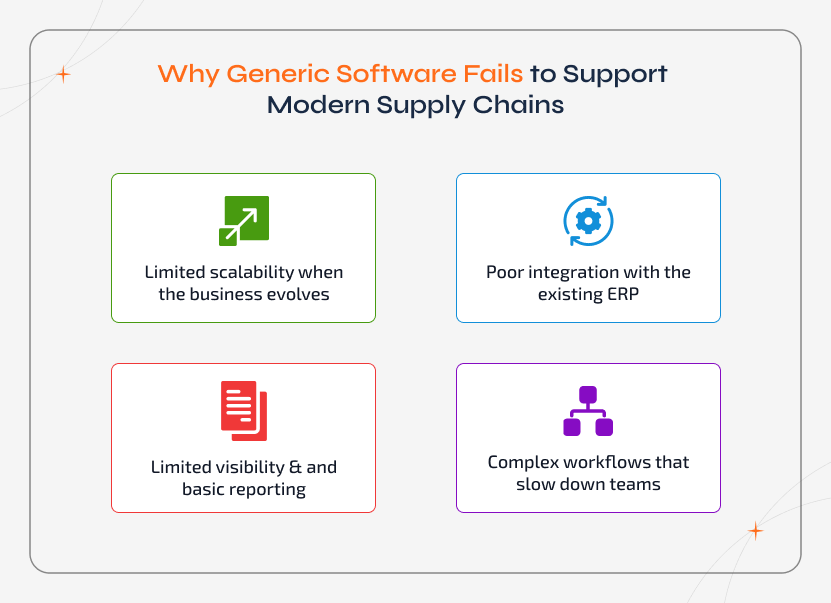
1. Limited scalability when the business evolves
Generic software will find it hard to handle increasing order volumes, suppliers, locations, and data loads. As a result, business growth becomes difficult and costly.
2. Poor integration with the existing ERP
Those off-the-shelf tools do not always integrate smoothly with ERP, logistics, inventory, and warehouse systems. This results in data silos and manual work.
3. Limited visibility & and basic reporting
Due to limited analytics and static reports, teams will find it hard to get real-time insights into inventory, orders, and delivery performance.
4. Complex workflows that slow down teams
Due to fixed workflows, teams will be forced to work around the system. As a result, manual effort increases and reduces operational efficiency.
For all these reasons, organizations started looking for supply chain software companies that deliver flexible and custom software solutions to supply chain problems that adapt to their process and needs. In other words, Custom supply chain software does the opposite of generic tools. i.e., it adapts to your workflows, integrates with your existing systems, and evolves as your business operations grow.
With increasing order volumes, suppliers, and global dependencies, it is better to rely on custom supply chain software.
How Software Development Simplifies Supply Chain Operations
Modern supply chain software helps businesses replace manual work and disconnected tools with a single connected system. So, instead of reacting to problems after they happen, teams get better control and visibility across the entire supply chain.
With the right software, businesses benefit from:
- A single dashboard that can be used to monitor inventory, orders, and logistics.
- Get real-time data updates across all systems and teams.
- Make use of smarter demand planning with predictive insights.
- Get automated alerts and workflows that eventually help reduce delays and errors.
- Easier collaboration with suppliers and partners.
Advanced supply chain optimization software and supply chain risk management software help businesses to respond faster, reduce disruptions, and operate with greater confidence. This can be availed even when the market conditions are unpredictable.
How Software Turns Supply Chain Challenges into Business Outcomes
Modern supply chain software does more than just automate tasks. It is capable of connecting operational challenges to measurable business outcomes. Get to know how leading organizations are using technology to take control of operations:
| Supply Chain Challenge | Software-Driven Solution | Business Impact |
|---|---|---|
| Lack of supply chain visibility | Centralized dashboards with real-time inventory, order, supplier, & logistics data | Faster decision-making, early issue detection, fewer delays, improved customer satisfaction |
| Inaccurate demand forecasting | AI-driven forecasting with past data, real-time demand signals, & market trends | Reduced stockouts, lower excess inventory, improved forecast accuracy, better cash flow control |
| Rising logistics & transportation costs | Transportation optimization tools with route planning, carrier performance tracking, & cost analytics | Protected profit margins, predictable delivery timelines, & reduced shipping overhead |
| Supplier disruptions & risk exposure | Supply chain risk management software monitoring supplier performance, regional risks, & disruption signals | Less unexpected disruptions, faster response times, stronger supply continuity |
By connecting challenges directly to technology-driven solutions, modern supply chain software helps businesses gain proactive control.
Why Custom Software Development is the Smarter Choice for Supply Chains
While modern supply chain software helps improve business operations, generic tools often fall short as complexity increases. Many SaaS and off-the-shelf supply chain tools work well for standard use cases, but they fail when operations become more complex. It is because these platforms rely on fixed workflows, limited customization, and predefined integrations. All these factors force businesses to adapt their processes to the tool.
However, custom software development simply does the opposite, as it is built to handle business processes as required. With custom supply chain software, businesses get the advantage, such as:
- Workflows designed to match the real operational needs.
- Smooth integration with the existing ERP, logistics, and inventory systems.
- Strong control over data security, compliance, and access.
- Scalable architecture that supports growth without rework.
To get all these advantages of custom software, partnering with an experienced custom software development agency helps businesses build supply chain systems that adapt to market shifts and emerging challenges.
Thinking about choosing custom supply chain software?
See if a custom solution fits your processes and growth needs.
How Custom Software Solves Modern Supply Chain Challenges
In the ever evolving market changes, modern supply chains face constant change from growing order volumes to unpredictable demands and operational challenges. With the help of custom-built software, businesses can not just handle today's challenges but also what comes next.
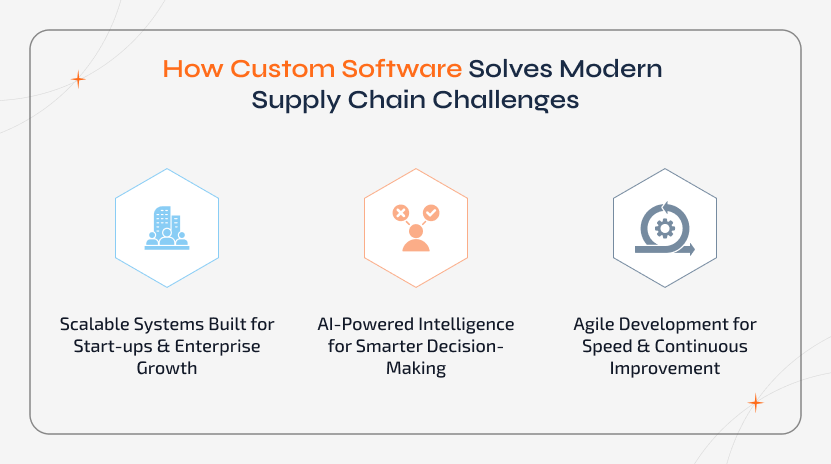
With the right development approach, businesses can:
1. Scalable Systems Built for Start-ups & Enterprise Growth
Custom Software development for startup growth helps with scaling operations without being limited by tools. So, systems grow alongside order volumes, suppliers, and distribution networks.
2. AI-Powered Intelligence for Smarter Decision-Making
Custom AI software development helps improve forecasting, demand planning, and anomaly detection. So, teams can make better decisions instead of reacting to disruptions.
3. Agile Development for Speed & Continuous Improvement
Agile Custom Software development ensures faster delivery, flexibility, and continuous improvement. Thus, businesses can adapt workflows, integrations, and features when market condition changes.
The above approaches help businesses stay competitive, reliable, and adaptable even if the complexity arises at any time later.
Understanding the Cost of Custom Supply Chain Software Development
The custom software development cost for supply chain systems differs based on major factors like system complexity, integration needs, security requirements, and automation. As every supply chain business works differently, there is no one-size-fits-all.
Key cost-driving factors include:
- Number of modules, such as inventory, procurement, logistics, analytics, etc.
- Integrations with ERP, WMS, TMS, and third-party platforms.
- Level of automation and AI-driven features.
- Security, compliance, and access control needs.
- Team size, development timeline, and engagement model.
Typical cost ranges for different types of systems are tabulated below:
| Supply Chain System Type | Typical Scope | Indicative Cost Range |
|---|---|---|
| Basic Supply Chain System | Core modules, limited integrations, basic reporting | $25,000 - $50,000 |
| Mid-Level Integrated Platform | Multiple modules, ERP/WMS integrations, automation | $50,000 - $120,000 |
It is to note that the costs vary primarily based on several factors. This includes how many existing systems like ERP, WMS, or TMS, etc., need to be integrated, the level of automation required, and whether AI-driven forecasting or risk modelling is required.
Although custom development requires a higher upfront investment, it comes with numerous benefits. This includes, but is not limited to, lowering long-term expenses by reducing manual processes, minimizing errors, avoiding ongoing license fees, and scaling without constant tool replacement.
Want a Clear Cost Estimate for Your Supply Chain Software?
Get a realistic cost estimate based on your workflows, automation needs, and growth plans without guesswork.
Why Choose Sparkout for your Supply Chain Software Development
If you are businesses owner or a start-up founder or anywhere in between and are constantly facing supply chain challenges, then you need a reliable technology partner more than just having software. Sparkout helps companies modernize their supply chain operations with secure, scalable, and business-ready solutions.
Why businesses trust Sparkout:
1. Strong Supply Chain Domain Expertise
We build custom software systems for inventory, logistics, and forecasting that solve real operational challenges.
2. Truly Custom-Built Solutions
Unlike rigid, off-the-shelf tools, we built software for the supply chain that fits your workflows, integrations, and growth plans.
3. AI-Driven Insights & Automation
We use analytics and automation to improve visibility, reduce risk, and support faster decision-making.
4. Scalable & Future-Ready Architecture
The solutions we develop at Sparkout grow with your business without any performance or integration limitations.
5. Agile Delivery with Clear Communication
Using Agile Custom Software Development approach, we deliver the best supply chain management software that delivers faster value with full transparency.
Sparkout is a top custom software development company where you can turn complex supply chain problems into efficient and data-driven systems.
Conclusion
In 2026, supply chain challenges are unavoidable, and it is vital for companies to start investing in the right supply chain management software, automation, and custom-built solutions. With these, businesses can get greater visibility, make decisions faster, and have stronger operational control.
By choosing the custom software and technology, businesses can avoid disruptions and build a stronger supply chain. Those businesses that invest in modern, custom-built supply chain software get real-time visibility, predictive risk insights, and the agility required to respond before the issues escalate.
So, don't want for the disruption to expose the hidden gaps in your supply chain. Rather start by checking your visibility, data flow, and system flexibility. Modernizing your supply chain prevents failure, builds resilience, protects margins, and helps stay competitive in the coming years.