


For years, AI agents have been constantly expanding their role in business, making it one of the core parts of daily workflows. This growing demand in AI agent development accelerated the rise of ‘multimodal AI agents’, a new generation of intelligent systems designed to operate with greater context and adaptability.
In this informative blog, we’ll explore everything you need to know about multimodal AI agents, like how they work, key benefits, use cases, and much more.
What is Multimodal AI Agent?
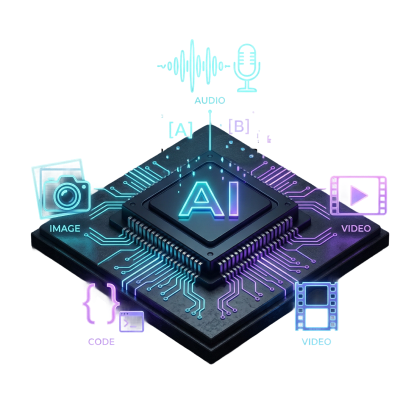
A multimodal AI agent is an intelligent system that processes multiple types of data at the same time. It acts the opposite of traditional AI, which handles only one input at a time. These inputs, called ‘modalities’, include text, Images, audio, video, and sensor data.
By blending all these inputs, multimodal agents interpret context with greater accuracy. They read facial expressions, detect voice tone, and analyze the visuals all at once for more human-like interactions. That’s why these agents are becoming a core part of agentic AI development .
Quick Facts on Multimodal AI Agents 2026!
📊Market size: About to surpass $3B+ in 2026, growing at 32.7% CGAR through 2034.
🤖40% of Gen AI solutions will be multimodal by 2027.
🏢80% of enterprise software will be multimodal by 2030.
📡Processes 5 input types, including text, image, audio, video, and sensor data.
📈79% of organizations are already adapting AI agents globally.
🔬Top Models in 2026 - GPT-4o, Gemini 2.0, Claude, Project Astra.
The Complete Architecture of Multimodal AI Agents
A multimodal AI agent is built on a layered architecture that transforms raw data into intelligent action. Each layer plays a unique role in transforming perception into reasoning and reasoning into execution. Here’s the detailed multimodal AI architecture:
Altogether, these layers form a continuous intelligence pipeline where the perception flows into understanding, reasoning, and execution.
Why Multimodal AI is the Future of Agentic AI Development?
Agentic AI involves building smart systems that can think, make decisions, and take action on their own. Multimodal AI agents are a leap forward and enable AI systems to work with multi-input AI models such as text, images, and voice, thus allowing businesses to develop applications that interact with the real world just like humans.
Traditional single-modal agents fail to respond when the environment demands context beyond the trained input. In contrast, multimodal AI systems and multi-sensor AI agents offer better understanding, making them perfect for industries like healthcare, robotics, and autonomous vehicles.
How do Multimodal AI Agents Work?
The working of a multimodal AI agent is not as complex as you think it is. It works by processing multiple types of inputs at the same time and turning them into a unified understanding, reasoning, and action.
Sense
The multimodal agent collects inputs simultaneously from text, image, audio, video, and sensors.
Understand
Further, it connects all the inputs together to form a single unified context instead of processing them separately.
Decide
Using memory and reasoning, it evaluates the context and determines the best action to perform.
Act
At last, it further executes the decision autonomously in real-time across physical or digital environments.
Key Components of Multimodal AI Agents
Multimodal AI agents are built on a few core technologies that work together to help the system understand the environment and take appropriate actions.
Natural Language Processing (NLP)
Natural Language Processing helps the AI agent understand and speak human language, including meaning, emotion, tone, and context.
Roles of Computer Vision
Computer Vision helps the agent understand images and videos, recognize objects, read environments, and pick up visual details.
Speech & Audio Intelligence
This component helps the agent understand tone, accents, voice, sounds, emotion, stress, and background context precisely before execution.
Multimodal Learning Models
Multimodal learning models connect text, images, audio, and other inputs into a single unified complete contextual picture.
Reasoning & Decision Systems
This is the thinking layer that helps agents remember context, make choices, decide what to do next, and turn understanding into action.
Traditional AI Agents vs Multimodal AI Agents - Know the Differences
The major difference between multimodal and traditional AI agents lies in the scope of perception and reasoning. One processes the data, and the other understands reality. Here’s the major difference between these two.
| Aspect | Traditional AI Agents | Multimodal AI Agents |
|---|---|---|
| Input Types | Single data type (text, image, or audio) | Multiple data types (text + image + audio + sensors) |
| Understanding | Isolated one-dimentional interpretation | Contextual and cross-modal understanding |
| Decision Quality | Limited and reactive | Rich, adaptive, and situational |
| Flexibility | The adaptability is low to the latest scenarios | High adaptability across environment |
| Real-World Capability | Controlled, structured settings only | Works in complex and real-world conditions |
| Use Case Power | Task automation in an AI workflow | Intelligence-driven autonomy |
Potential Benefits of Multimodal AI Agents
The more context AI can understand, the more accurately it can act. Multimodal agents bring that context together in real time.
Less Errors
By analyzing information from various sources at once, multimodal agents can verify the context, minimize errors, and make reliable decisions.
Faster Responses
Real-time processing across various inputs helps the agents understand situations quickly and take necessary actions without delays.
Adaptable Across Industries
Whether it’s healthcare, manufacturing, retail, logistics, or finance, multimodal AI agents can operate effectively in a wide range of environments.
Natural Interactions
Alongside these agents, users can communicate through voice, text, images, or gestures, and the agent understands their intent seamlessly.
Scales With Business
New data sources, tools, and use cases can be added without rebuilding the entire system, making the multimodal AI easier to scale over time.
Real World Use Cases of Multimodal AI Agents
Often, multimodal AI applications showcase how combining different types of data brings smarter and more powerful results. Take a look at the real multimodal AI agents examples:
Healthcare
Alongside healthcare diagnostic agents, hospitals and clinics can combine patient speech, medical records, imaging scans, and vital data to support risk detection and decision-making.
Modalities:
- Audio: Patient speech & tone analysis
- Vision: MRI, CT scan & image reads
- Text: Medical records & history
- Sensors: Vitals & biometric data
6-33% improvements in diagnostic accuracy when AI assists the experts.
Mobility
By fusing the radar, video, LiDAR, GPS, and sensor inputs, the multimodal AI agents enable real-time perception, hazard detection, and adaptive driving behaviour in complex physical environments.
Modalities:
- Vision: Camera & video stream feeds
- GPS & Sensors: Location & environment data
360° environmental awareness through fused multimodal perception in real time.
Retail
Retail AI agents interpret facial expressions, voice tones, browsing behaviour, and purchase history to deliver smarter recommendations and deeper customer engagement.
Modalities:
- Vision: Facial expression & emotion detection
- Audio: Voicetome & sentiment analysis
- Behavioral Data: Browse & purchase patterns
40% higher conversion rates with AI-driven personalized recommendations.
Education
Educational AI agents use voice, gestures, handwriting, and written input to understand the learning pattern and adapt content delivery in real time for personalized and responsive education experiences.
Modalities:
- Audio: Voice & speech pattern recognition
- Gestures: Body language & hand movement
- Text: Written input recognition
2x faster learning outcomes with adaptive AI-personalized content delivery.
Finance
Multimodal AI agents analyze the voice tone during calls, transaction patterns, and behavioral signals altogether to detect fraud, assess risk, and automate compliance in real time.
Modalities:
- Audio: Voice stress & tone on calls
- Docs: KYC, contracts & reports
- Behavioral Data: Transaction & usage patterns
60% reduction in false fraud positives using multimodal signal analysis.
From planning to deployment, we help you create AI agents that seamlessly understand and process multiple data types.
How to Build Multimodal AI Agents
Building AI agents with multimodal models involves combining software engineering with machine learning, data fusion, and agentic AI multi-modal security logic. The steps to get started in the construction of a multimodal AI agent are as follows:
Step 1: Define Intelligence Layer
Before you select any modality or technology, the initial step is to define what the AI agent really means to do.
While defining, ask:
- What decisions will the agent make autonomously?
- What environments will it operate in?
- What risks must it avoid?
- What actions will it trigger?
Beyond being just a model, it acts as a decision-making system, so that clarity at this stage determines the entire multimodal AI agent architecture diagram.
Step 2: Design the Perception Layer
Once the purpose has been defined, get ready to choose the right modalities. Instead of just randomly adding text, vision, and audio, each modality must serve a purpose in perception and reasoning.
For example,
- Text (language understanding)
- Audio (speech, tone, and ambient sound)
- Vision (images, video, and gestures)
- Sensors (IoT, GPS, temperature, motion, and biometrics)
The ultimate goal is to create a perception system that mirrors how the human mind understands the world with multiple senses working together (ex: eyes + ears + memory + context + reasoning).
Step 3: Build Multimodal Data Pipelines
Usually, a multimodal AI system depends on properly aligned data to deliver an accurate output. This means the data must be paired and synchronized across modalities.
This includes:
- Image ↔ Caption pairing
- Video ↔ Audio synchronization
- Sensor ↔ Event labeling
- Instruction ↔ Visual context linking
This is the stage where data preprocessing, normalization, synchronization, and labeling become more crucial. Proper alignment ensures that every modality describes the same event, intent, or object, which is what enables contextual understanding instead of fragmented perception.
Step 4: Implement Fusion Intelligence
Once the data alignment passes its way, the system architecture must support multimodal learning. This possibly involves designing how exactly the inputs are encoded, transformed into embeddings, and combined into a unified representation.
Here, you define how the modalities talk to each other:
- Feature fusion (early fusion)
- Representation fusion (mid fusion)
- Decision fusion (late fusion)
This fusion layer becomes the core of the AI agent, which allows it to interpret complex real-world situations instead of processing isolated signals.
Step 5: Train with Multimodal Learning Strategies
Training a multimodal AI agent actually requires more than just the basic training. Instead, here’s how you use layered learning approaches:
- Pre-training on large multimodal datasets
- Individual learning for cross-modal alignment
- Fine-tuning on the domain-specific data
- Use transfer learning to reduce AI agent development costs by adapting pre-trained models.
- Self-supervised learning for effective scaling
This phase creates a deep-modal understanding rather than surface-level integration.
Step 6: Embed Agentic Decision Logic
This is the step where the system becomes an AI agent instead of being just a modal. Decision-making layers are introduced, including:
- Memory modules
- Goal planning systems
- Context tracking
- Reinforcement learning
- Rule-based safety layers
- Policy engines
This step actually enables autonomous decisions, adaptive behaviour, multi-step reasoning, environment - aware actions.
Step 7: Build Action & Interface Layer
Now, the multimodal AI agent has the capabilities to act. This step focuses on integrating the following:
- APIs
- Dashboards
- System triggers
- Workflow automation
- Human feedback loops
- Robotics interfaces
Whether it triggers the workflow, interacts with users, controls systems, or supports operations, this layer converts intelligence into real-world impact.
Step 8: Deploy, Monitor & Evolve
Deployment is actually not the final stage that is involved in building a multimodal AI agent. It’s more like the starting point of the agent’s lifecycle. Post-monitoring involves:
- Real-time monitoring
- Drift detection
- Performance evaluation
- Feedback learning loops
- Continuous retraining
- Security and compliance layers
The multimodal AI agents must evolve with the changing environments, user behaviour, and data patterns to stay effective and relevant.
In the meantime, if you are looking to speed up the development process, partner with an AI agent development company to get custom multimodal AI solutions that align with your business needs.
Multimodal Dataset Quality Checklist
Before you train anything, your dataset must definitely pass the sanity tests below:
✅ Coverage: Different scenarios, environments, lighting, behaviours, accents, and contexts
✅ Bias Control: Avoid skewed demographic, geographic, and behavioral data.
✅ Low Noise: Broken intelligence will cause misaligned captions, wrong labels, and corrupted audio.
✅ Consistency: The same object and event mean the same thing across the modalities.
✅ Balance: All modalities should be fairly represented (it means not 90% text and 10% images)
✅ Real-World Variance: Not just perfect studio data, but messy real-world data too.
Top Platforms to Consider for Multimodal AI Agent Development
Whether you're a developer or company owner, the following are the top AI agent platforms and tools you should look into for building multimodal AI agents:
OpenAI - CLIP & GPT-4o
Most Popular
Enables advanced multimodal reasoning across images, text, and audio. This makes it ideal for building AI agents that understand and respond in real time.
Meta AI - ImageBind
Best for Cross-Modal
It provides a unified cross-modal embedding. This allows AI agents to connect multiple sensory inputs without requiring paired training data.
Google DeepMind - Flamingo
Best for Vision-Language
It supports few-shot vision-language learning, which enables AI agents to interpret visual context and generate precise responses.
HuggingFace - Multimodal Transformers & Datasets
Best for Prototyping
Offers a flexible and open-source ecosystem with pretrained multimodal models and datasets. This is used for rapid prototyping and custom AI agent development.
Rasa & LangChain - Agentic Orchestration
Best for Orchestration
It enables developers to orchestrate conversational AI with external tools, memory, and multimodal capabilities for building end-to-end intelligent multi-modal AI systems.
Compliance & Ethics in Multimodal AI Agent Development
Multimodal AI agents posses sensitive data across text, voice, and video, making compliance non-negotiable across every deployment.
Data Privacy
Multimodal agents collect data across multiple channels, so compliance with GDPR, HIPAA, and CCPA is required across every input modality.
Bias Auditing
Training data that lacks diversity across demographics, geographies, or behaviour leads to biased output. Regular audits across all modalities ensure the agent performs fairly.
Access Control
These multi modal agents operate across sensitive environments, including healthcare and finance. Defining clear permission boundaries prevents unauthorized interaction or modification.
Model Governance
Multimodal agents evolve through continuous retraining across multiple data types. Documenting model versions, data sources, and retraining cycles ensures accountability.
Explainability
The more data types a multimodal agent processes, the harder it becomes to interpret the decisions. Each decision must be traceable and explainable across every modality involved.
Cost of Building & Implementing Multimodal AI Agents
So, how much does multimodal AI software development actually cost? This section answers that. Just like understanding the technical considerations, getting to know the cost of implementation is vital.
In general, the cost of multimodal AI agent development depends on modality complexity, customization, data requirements, development tools, and system integration needs. Based on that, here’s the approximate cost.
Approximate Cost Estimates:
| Stage | Scope | Typical Cost |
|---|---|---|
| Prototype | Basic multimodal concept, 1-2 modalities, and a small dataset | $10k - $50k |
| Pilot | Real users, multiple modalities, and initial real-world testing | $50k - $200k |
| Production | Full-scale deployment, real-time processing, and enterprise-ready | $200k - $1M+ |
Hidden Costs to Watch:
- Data labeling and preprocessing
- Evaluation and testing
- Real-time infrastructure
- Maintenance and retraining
If you think the development is going over budget, here are some possible ways to save costs:
- Start small with a pilot before scaling up.
- Choose open-source AI agent tools.
- Partner with an AI development company to obtain modular or reusable frameworks.
- Minimize upfront costs by combining single-modal AI with multimodal AI capabilities to create hybrid agents.
Challenges Associated with Building Multimodal AI Agents
Despite the potential advantages, building multimodal AI agents does come with its own challenges. These include, but are not limited to:
Data Alignment
For teams, aligning and synchronizing information from different modalities can be quite complex and will require extensive data processing.
Resource Demands
Multimodal agents need larger datasets and greater computing capability. This will lead to an increase in development and operational costs.
Signal Conflicts
Different inputs will provide contradictory information, making it challenging for the AI agent to determine the correct response.
Processing Speed
Handling various data streams can simultaneously increase the latency and impact real-time performance.
Decision Transparency
When more modalities and data layers are added, understanding how the agents reach decisions becomes more difficult.
Overcoming these challenges is critical and requires solid data pipelines, robust models, and an experienced development team like Sparkout.
Why Choose Sparkout Tech as Your AI Agent Development Company
Whether you're starting to integrate AI from scratch or have a vision and want to bring it to life, Sparkout Tech is the trusted AI agent development company you need to reach. We don’t just build AI agents. Instead, we architect intelligent ecosystems that drive measurable business impact.
Deep Agentic Expertise
The expertise team at Sparkout specializes in designing autonomous AI agents that are capable of reasoning, planning, decision-making, and contextual execution across complex workflows.
Expertise-Grade Infrastructure
This firm leverages robust and scalable AI development frameworks and platforms to ensure performance, reliability, and seamless system integration.
Advanced Capabilities
From text and vision to audio and structured enterprise data, Sparkout builds multimodal AI agents that fuse diverse data streams into intelligent and real-time actions.
Cloud-Native Deployment
Business-focused AI agents built by Sparkout assist modern infrastructure and enable secure deployment across cloud-native, hybrid, and distributed environments with flawless scalability.
Long-Term Support
Every solution developed by Sparkout is tailored to your industry, workflows, and compliance needs. Beyond deployment, we provide continuous optimization, monitoring, and evolution to keep the AI agents future-ready.
The Future of Multimodal AI Agents
If you read this far, you’ll realize that multimodal AI is no longer a future concept. It’s actively reshaping the industries, and by 2027, 40% of all GenAI solutions will be multimodal. Here’s what's emerging next.
CORE
Multi-Agent Collaboration
Instead of a single AI doing all the work, multiple specialized agents will work together in researching, reasoning, and executing tasks as a team.
Wrapping Things Up
Autonomous agentic ecosystems are the future of multimodal AI agents as they can interact with environments, people, and other agents. Hence, we can expect them to navigate physical spaces, communicate naturally, and make real-time decisions.
As businesses and developers look forward to innovating, investing in multimodal AI solutions will be a strategic advantage in thriving in a dynamic environment. The integration of multi-modal AI frameworks with agentic AI development principles will bring about general-purpose AI agents with real-world impacts.
Ready to Build AI that Thinks Like Humans?
Partner up with Sparkour Tech today and start your multimodal AI journey with expert guidance.