



Ever found yourself watching your own custom software development effort slipping through your fingers, leading to missed deadlines and mounting pressure? If so, then you’re not alone. Many organizations, in the starting or middle stage, have come across this red zone. This is where the progress falls, and stakeholders start to lose confidence. However, a failing project doesn’t mean it’s doomed for real. It just needs the right people and strategy to pull them back into the race in the name of software project rescue.
For your understanding, rescuing a failing software project is similar to stabilizing a train that’s in motion. You can’t stop it, but guide it back on track. Once you pinpoint what makes the project fail, you can rebuild momentum with smart and clear ideas.
What is Software Project Rescue?
Software project rescue is actually a process of reviving a failing or struggling project. Like, the ones that are behind schedule, over budget, or not aligning with the business goals. More than just dealing with the bad code, software development project rescue revolves around identifying where things went wrong and realigning the internal teams accordingly for better outcomes.
To keep things clear and simple, software project rescue is a structured intervention to bring clarity, restore progress, and realign teams to achieve better outcomes.
Main Causes of a Software Project Failure
At times, even well-funded and well-intentioned projects can fail without early intervention from a software rescue consultant.
For business leaders and project managers, acknowledging the actual fact behind this failure can make the difference between recovery and a complete software project reboot. Here are the potential reasons behind a project that loses its direction.
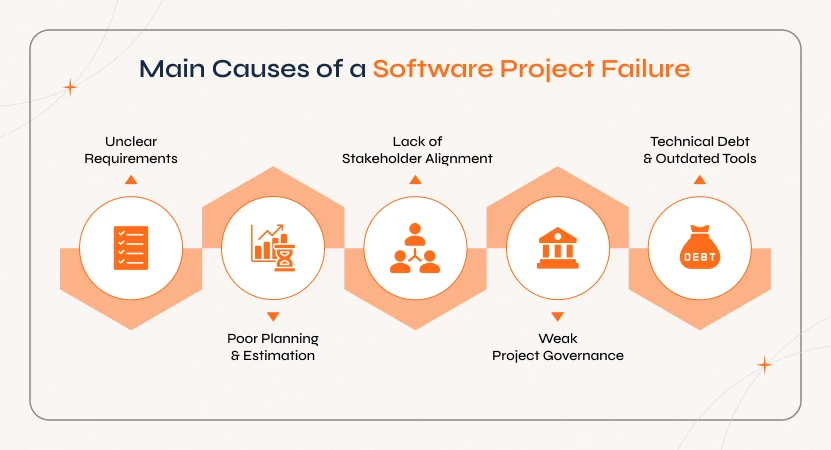
Unclear Requirements
If the technical teams, clients, and project manager aren’t in sync, things might get out of hand. The teams will end up with building the wrong ones. Misunderstanding between stakeholders and developers will often lead to constant changes, project delays, and wasted money. This is exactly why having transparent documentation and requirements early is necessary.
Poor Planning & Estimation
Tight deadlines and optimistic projections might sound great at first, but rarely work out in real time. When teams really underestimate the work or resources needed, they will absolutely end up rushing things. This will affect the quality and increase costs. A good project manager will create realistic plans with time adjustments for faster delivery.
Lack of Stakeholder Alignment
If the technical teams, clients, and project manager aren’t in sync, the project has a high chance of falling behind. Mixed priorities and unclear roles will cause confusion among teams and lead to wasted effort. Continuous check-ins and open communication help everyone stay aligned with business goals.
Weak Project Governance
In the absence of a structured oversight, even a skilled team will fail to keep pace. Weak governance includes unclear roles, inefficient decision-making, and no early warnings for potential risks. Business leaders and PMs must follow clear accountability, risk monitoring, and define escalation paths to keep things under control.
Technical Debt & Outdated Tools
Outdated systems, rushed development, and neglected maintenance will silently drain overall productivity. If the technical debt builds up, each and every change becomes risky and costly. On the contrary, it’s better to invest in modern tools and clean architecture.
Information Silos
With poor communication, critical information gets lost between departments, stakeholders, and developers. Decisions that are made in isolation create duplicated work, misaligned features, and constant rework. Regular updates and transparent communication channels are essential to keep things moving in the same direction.
Real Impacts of a Failed Software Project on Business
When the software project goes behind schedule or fails, it hits more than just timelines. A delayed recovery without a proper software project rescue plan may result in wasted investment, loss of credibility, and missed opportunities.
Before going for a rescue, here’s what the technology adaptation and other challenges business leaders really face before partnering with the rescue agency.
Wasted Investment Cycle
Being a business leader or project manager, there’s nothing more frustrating than witnessing funds vanishing right in front of your eyes with no usable outcome. Constant app development delays, reworks, and scope changes will consume the estimated budget, while stakeholders keep on demanding progress.
At some point, the process doesn't make any sense, and that’s when businesses start to realize third-party software project recovery help is needed to restore the direction.
Stakeholder Confidence Drops
If the delivery dates keep on slipping and the product demos disappoint, trust between the stakeholders will break into pieces. The teams will start questioning about the leadership, and the clients were forced to lose faith.
At the same time, it’s very difficult to rebuild that confidence internally. This is the situation that forces businesses to hold hands with the project rescue team, who can reach the expectation and rebuild credibility.
Harmony Turns Hostile
Regular misalignment between the business and technical teams will bring stress. Unclear ownership, long waiting hours, and shifting goals will create a toxic environment. At times, even the best-talented employee starts to think that the project is doomed.
In this situation, calling on a rescue team will bring clarity and a fresh idea. This is often what’s needed to reset and boost the team’s energy and purpose.
Opportunities Pass By
In the current fast-moving market, timing is everything. Each and every missed milestone indicates that competitors are moving ahead and reaching your target audience. Due to this, managing a remote development team will feel helpless watching weeks and months of planning goes in vain.
These urgencies are what push the firms to reach rescue experts who can bring the fallen project back from the dead. This will be a turning point before the opportunity shuts down completely.
Reputation at Stake
For an executive or project manager, a failed launch isn’t just a project loss to them. More likely, it’s personal credibility that took a hit. When things go wrong, the investors and clients often view it as a sign of weak planning. The pressure builds frustration and leads to loss of confidence.
This is where bringing a rescue team becomes essential. The rescue experts are the only ones who can quickly assess the damage and regain control over the project.
Should You Rescue, Rebuild, or Stop? A Quick Decision Guide
More importantly, not every struggling project needs rescue. Some needs rebuild, and the other needs to stop. Before committing resources, consider the points below:
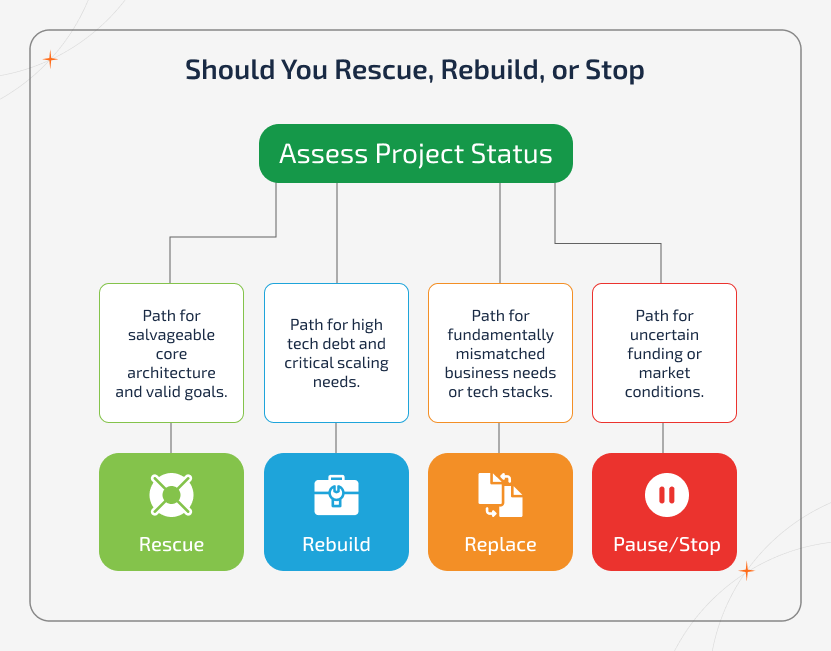
Rescue
Prefer rescue only when the project has clear requirements, core architecture is salvageable, and business goals are still valid. While considering these, the risks are manageable, and recovery can deliver ROI even faster than rebuild.
Rebuild
Opt to rebuild the entire project if the technical debt is too high, the architecture is outdated, and scaling needs are critical. Even though rebuilding costs more, your project will run smoothly and reliably for long term.
Replace
You can replace the platform or vendor when the current project fundamentally cannot meet the business needs of the tech stack is out of date. Sometimes, starting fresh is way smarter than rescuing.
Pause/Stop
Hit the “Pause” button when the market conditions, product-market fit, or funding are uncertain. Stopping the project for a temporary period prevents further waste and allows strategic reassessment.
Software Project Rescue Timeline
Here’s the typical recovery timeline that teams can expect during a software rescue. This shows what happens in the early followed by the upcoming weeks, so that everyone understands the pace, priorities, and progress checkpoints from the start.
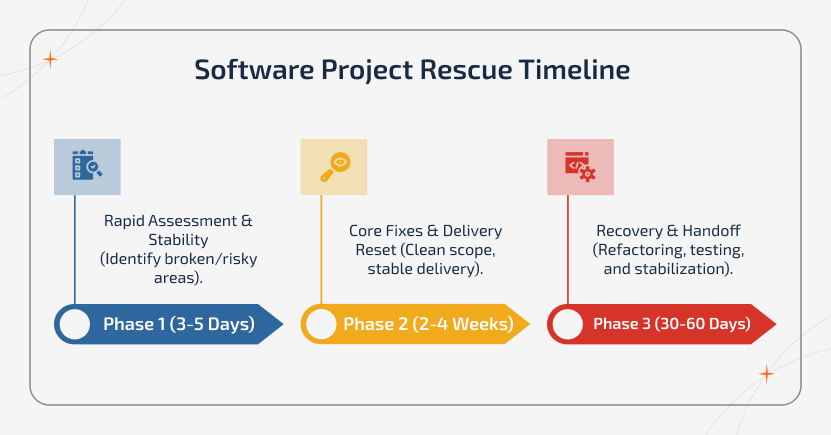
| Phase | Timeframe | Focus | What Happens |
|---|---|---|---|
| Rapid Assessment & Stability | Starting 3-5 days | Stop the damage | Identify what actually needs to be fixed, what’s risky, and what’s broken. Create a transparent stabilization and rescue plan |
| Core Fixes & Delivery Reset | 2-4 weeks | Fix what matters | Resolve critical issues, clean up the scope, and rebuild the delivery flow so that the work becomes stable and predictable |
| Recovery & Handoff | 30-60 days | Long-term health | Refactor weak areas, add testing and quality checks, and stabilize the system so it can confidently hand it back to the internal teams |
When to Consider a Software Project Rescue Consultant
Sometimes, if a project slows down under some conditions, it explicitly shows some signs. These signs show when to bring in the software rescue consultant or a software project rescue services provider before things get hard and go beyond recovery.
Product Vision Losing Clarity
Without proper communication, teams seem to build different versions of the software project. Due to these, the features don’t match, the UX feels inconsistent, and no one’s sure about what the result is going to be. This is a clear sign of alignment collapse. In this situation, a trusted rescue consultant service like Sparkout helps businesses to realign everyone who is working on the project.
Direction Stuck in Limbo
Whenever there’s a big decision to make among teams, like what features to build or when to launch, it keeps on revolving around a loop. Because no one wants to take full responsibility. It’s actually not a tech issue, but a leadership roadblock. On the contrary, rescue experts fill those gaps and help break the cycle. They set clear decision rules and give leaders the confidence to take leadership.
Vendors Lose Project Control
There’s a chance that your software development outsourcing team keeps overpromising results, changing developers often, or missing deadlines without proper updates. In this situation, you will start losing track of what’s actually happening behind the scenes. Here’s where the rescue consultant becomes essential. They audit the vendor’s work, and lead to a successful software project restoration. Meanwhile, if the current partner fails to show the work, switch to a dedicated software development partner for better results.
Post-Launch Expenses Explode
Even after a successful launch, you can face issues like constant crashes, support issues, or compliance problems. You’ll observe that these issues are eating your operation’s budget. This is a clear warning that the struggle isn’t over yet. A rescue team can step in to bring stability and build a clear plan for long-term maintenance and growth.
Effort Without Alignment
There are times when developers will work non-stop, the project manager putting out fires, and teams are growing impatient. Even though no one can see real progress. This is a clear sign of team misalignment. A software rescue consultant helps businesses to bring order back by setting transparent priorities and re-establishing collaboration.
Real-World Project Rescue Example (Apple Maps)
The following scenario shows how exactly the failing project turned around through structured diagnosis and focused execution.
The Actual Issue
When Apple launches their Apple Maps back in 2012, it actually brought chaos to the software development company. Users reported misdirection, wrong locations, and unreliable navigation. This damages the trust, triggers public backlash, and becomes a major business risk.
Where Software Rescue Made an Impact
Apple restructured the project leadership, replaced core teams, rebuilt data pipelines, partnered with better data providers, and redesigned the quality, testing, and release process. The project was stabilized through phased fixes instead of a full shutdown.
Outcome
As days passed, Apple Maps became more stable, accurate, and reliable, with global usage growth and improved trust. What actually started as a failing project turned into a dependable platform through a structured rescue and recovery process.
Warning Signs Your Software Project is Heading Towards Failure
A project failure doesn't happen overnight. It shows possible signs that executives and delivery owners can find out early. When you happen to see any of the following warning signs, then it's time to consider software project rescue services:
- The delivery milestone is getting delayed repeatedly without a factual reason.
- The scope of the project grows more than expected, while the progress remains unclear.
- Increased dependency on rework rather than delivering new features.
- Vendors bring in vague updates or switch team members frequently.
- Rising defect counts after every builder deployment.
- Exceeding budget while the product value remains stagnant.
All of the above are the red flags that show declining control. An early engagement with a software rescue consultant helps minimize the damage and cost escalation.
How Much Does Software Project Rescue Cost?
Software project rescue costs vary based on the complexity of the project and the depth of damage already done. In most cases, the investment is far more affordable than a complete rebuild. The factors that contribute to the pricing include:
- Project size and current architectural condition.
- Governance gaps and delivery process maturity.
- Team structure and vendor dependencies.
- Level of technical debt and refactoring needed.
- Recovery timeline urgency.
At Sparkout, our role as a software project rescue company is to provide faster auditing and define a clear path that ensures ROI.
Software Project Rescue Vs Project Re-Engineering - Key Differences Explained
While the project rescue and re-engineering aims to fix delivery time, they often address different needs and are as tabulated below.
| Criteria | Software Project Rescue | Project Re-Engineering |
|---|---|---|
| Purpose | Stabilize & recover ongoing delivery | Revamp the core system for future needs |
| Focus | Governance, clarity, team alignment | Architecture, performance, scalability |
| Urgency | Immediate — emergency action | Planned — long-term transformation |
| ROI | Short-term recovery | Long-term modernization |
Most often, businesses first initiate a software development project rescue to avoid the ongoing issue. After reaching a stable point, modernization and re-engineering starts as a strategic next step.
Tools & Technologies Used in Software Project Recovery
A structured recovery needs strong engineering and DevOps tools to get early insights and reliable delivery. At Sparkout, our rescue practices include:
- Auditing tools for code, performance, and cybersecurity assessment.
- Agile governance and sprint restructuring tools.
- Observability solutions for uptime & behaviour monitoring.
- CI/CD pipelines for safe and frequent deployments.
- Architecture refactoring frameworks that ensure long-term stability.
- Collaboration and communication enablement platforms.
All of the above tools ensure that your software project rescue is handled by data and not mere assumptions. This helps speed up recovery with visible progress.
Step-by-Step Software Project Rescue Plan
With a standard plan, get your struggling project back on track. From diagnosing failures to stabilizing delivery and preventing potential risks, the following plan ensures measurable progress and long-term success.
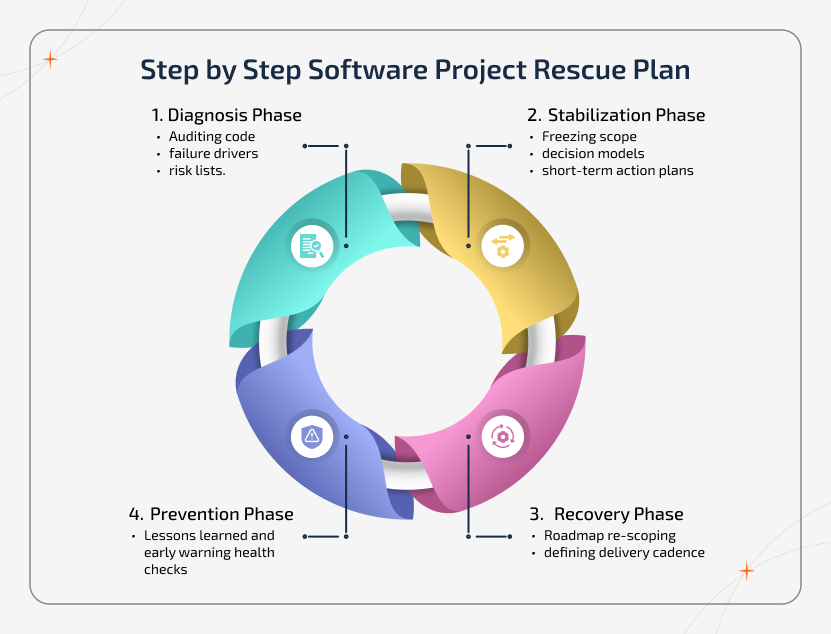
Step 1: Diagnosis Phase
- Audit code, process, and architecture
- Identify the top failure drivers
- Create a risk list with assigned owners
- Outline the recovery options
Step 2: Stabilization Phase
- Freeze scope to prevent uncontrolled changes
- List and give priority to critical defects
- Establishing a decision-making model for teams and leadership
- Generate a short-term action plan to stabilize delivery
Step 3: Recovery Phase
- Re-scope the roadmap with transparent milestones
- Update requirements and acceptance criteria
- Define the delivery cadence, which is aligned with the business goals
Step 4: Prevention Phase
- Document the lessons learned
- Set up ongoing project health checks
- Create an early warning checklist to detect risks at early stages
Practical Methods & Artifacts Used in Software Project Rescue
The actual issue starts with understanding what actually exists and not only with assumptions. The rescue team begins the process by collecting the core project artifacts, including requirements documents, product backlog, sprint history, architecture diagrams, test reports, incident logs, and deployment history. These materials explicit how exactly the project evolved, where it broke, and what’s blocking the delivery.
To point out the real issue fast, simple root-cause methods are used instead of some complex theories. To be precise, the “Fishbone method” helps businesses to break down issues into areas like people, process, technology, and management. In this way, the root causes are much easier to understand.
On the other hand, the “Pareto method” (80/20 rule) helps your internal team to focus on a small number of issues that cause most of the damage. When the decisions are unclear, weighted decision tables are used to distinguish options based on impact, software development cost, risk, and effort. This keeps the software project rescue process practical, structured, and solely based on evidence, not opinions.
Why Choose Sparkout for Your Project Rescue Needs
When the current project loses direction, adding more developers isn’t enough. You need a software project rescue company that understands business outcomes and can predict risks early.
At Sparkout, we provide the best software project rescue services with a blend of technical expertise and sharp business strategies to resurrect dead projects back to life.
Proven Expertise
Our rescue team has revived projects across different domains, including logistics, SaaS, fintech, and e-commerce. Each has an understanding of the unique failure points. We don’t actually rely on assumptions, instead we use data, proven frameworks, and years of delivery experience to make the recovery quick.
Business-First Approach
We proceed with the rescue operation beyond just fixing code. Each and every action we undertake, whether it’s refining workflows or restructuring the system, the plan is to meet up with your business goals.
Transparent Process
We believe that trust from a business starts with clarity. So, we allow your internal team to monitor our work through dashboards, structured reports, and continuous communication. As a result, there are no hidden costs, no fake promises, only visible progress.
Cross-Functional Rescue Squad
Our immediate project rescue team doesn’t just include developers. They consist of architects, project strategists, UI/UX experts, and DevOps specialists, who work altogether for fixing both the product and the process. Overall, it’s a full-spectrum approach, not a patchwork.
Long-Term Partnership
According to us, the rescue process doesn’t just end at the delivery. We assist with you throughout the post-launch and help with further stabilization, monitoring, and process handover to make sure the rescue team can manage scalability without setbacks.
Software Project Rescue Strategies Followed By Sparkout
Whenever a business approaches with struggling projects, Sparkout’s goal isn’t just to fix a broken software project. Moreover, it’s to restore control, clarity, and confidence. Here’s how we approach every software project rescue and recovery.
Uncover Truth Behind Progress
Our rescue process begins with assessing the project’s current health, like budget, team structure, and scope. This kind of unbiased auditing helps businesses to reveal the root cause of the delay and gives a solid starting point.
Spot Risks Early
Our next move is to stop the overflow. We use our advanced team and frameworks to identify high-impact blockers. Whether they are technical issues or management gaps, we pinpoint the precise flaw and fix it ASAP. These quick and visible actions help stabilize the project and do build trust.
Unify Team Direction
We do collaborate with leadership to clearly define what success actually looks like. Right after that, we align every team and task towards the business goals. This removes unnecessary work and helps teams to focus on delivering measurable value.
Strengthen Governance & Collaboration
For us, clear communication and accountability are the heart of complete recovery. We will set up a simple and structured governance model that actually makes the ownership clear, minimizes confusion, and keeps leadership under control. This aids both tech teams and the business in marching to the same goal.
Future-Ready Solution
Once the stability returns, our team helps in shifting the gears towards long-term sustainability. We aid in refactoring fragile components, documenting things up, and upskilling in-house teams. This results in robust, clean, and scalable solutions.
Similarly, if your business faces a sudden software failure, you can initiate the same rescue steps that we follow to make things right.
Independent Rescue Team: Roles & Responsibilities
An independent rescue team brings a decent structure, clarity, and accountability to the failing projects. Also, each role has a defined responsibility that eliminates confusion and boosts the recovery. This ensures faster recovery and better project quality.
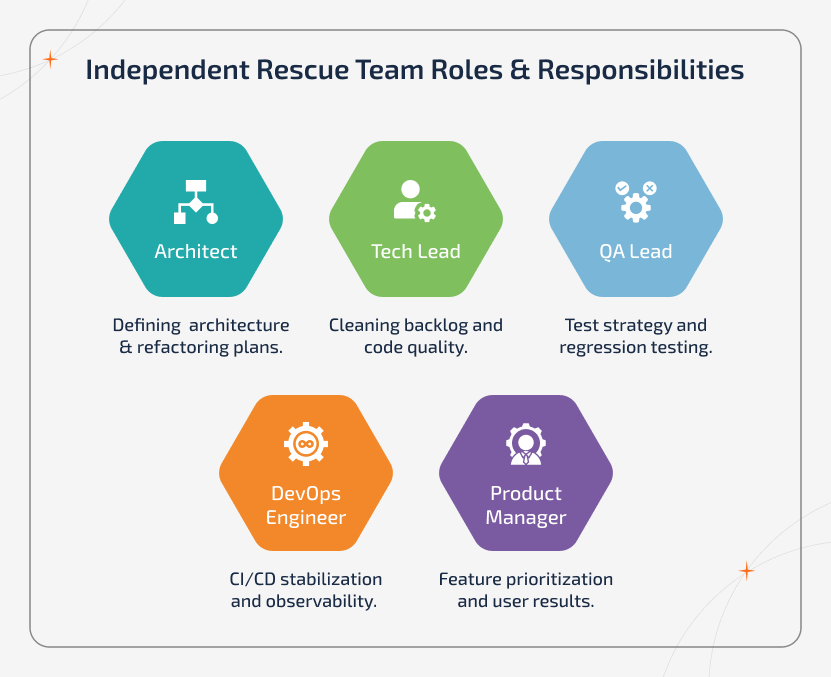
- Architect: Hiring an architect can help identify system risks, define a target architecture, and develop plans for refactoring.
- Tech Lead: A skilled tech lead will clean up the backlog, improve code quality, and help in creating a delivery plan.
- QA Lead: They can build a test strategy, manage regression testing, and set release gates.
- DevOps Engineer: stabilizes CI/CD pipelines, ensures environment parity, and sets up observability and monitoring.
- Product Owner/Manager: They excel in removing unnecessary features, focus on what the user needs, and ensure to give positive results.
Complementary Solutions to Support Your Project Recovery
For every rescued project. A right support system is mandatory to sustain progress and to scale confidently.
At Sparkout Tech, we offer complementary solutions that ensure software development project rescue success, addressing modernization, performance, user adoption, and post-launch support.
Product Re-Engineering & Modernization
We see many rescued projects suffering from old architecture and outdated technology. Our technical team helps in modernizing the core system, optimizing performance, updating stacks, and gradually increasing scalability. This ensures your product can handle future growth without flaws.
DevOps & Delivery Acceleration
Our Sparkout team will streamline your delivery pipeline with services like DevOps automation, environment standardization, and CI/CD setup. This actually reduces deployment risks and accelerates app development and launches. This results in giving your team a clear path to track the performance.
UX/UI Revamping
Technical recovery alone isn’t enough to sustain a project for long-term growth. A flawed user experience and user interface will sink the adoption. Our dedicated design team enhances the usability and aligns the product with your customers’ expectations.
Post-Launch Support
Beyond providing successful custom software solutions, we do continue to support your project with proactive maintenance, observability tools, and performance audits. Our main motto is to keep uptime, enhance security, and attain user satisfaction.
How to Keep the Project Healthy After Rescue
After the rescue, the project only sticks if the quality systems are built around the project. Ensure to start with a minimum test setup that actually protects delivery. The setup includes unit tests for core logic, integration tests for key flows, and smoke tests before every release. This actually creates a shield, so changes don’t break the production.
Followed by setting up clear rules for how exactly the work gets done. Everyone follows the same standards, code is checked before it goes live, and nothing is denoted as “done” unless it actually works. Before rollingout any updates, make sure to keep a checklist and a backup plan if something goes wrong.
Finally, keep the efficiency of the project long-term. Use basic monitoringto pin point problems too early and keep simple docs. Due to this, teams will know how the system works and the necessary steps to fix issues fast. This stops the actual project from falling back into chaos and makes the operations run smoothly.
End Note
Even if the project is carried out with maximum precision, it does hit turbulence at some point. What actually defies success is how fast a business responds to the occurring failure. With solid visibility, alignment, and leadership, even a failing software project can be transformed into a success story.
At Sparkout, we step in to restore the momentum. By utilizing modern recovery frameworks, transparent execution, and future-ready practices, as a trusted software project rescue and software development agency, we help businesses turn failure into growth and regain trust in their tech investments.
Reclaim Control of Your Software Delivery
Get your project back in control with the software project rescue team to deliver results faster.