


In recent times, most of the evolving businesses hit the same invisible wall, which is due to outdated systems and software. Legacy systems slow down decision-making, block scalability, increase security risk, and drain the overall revenue. In early 2026, tech modernization is’t just an upgrade, it’s more like a business survival.
This informative guide breaks down the best companies to opt for legacy system modernization, the criteria to choose the best company, and other valuable insights. If you’re a startup founder, CIO, CTO, or business leader planning for a serious digital transformation, this blog will be a decision playbook for you.
What Is Legacy System Modernization?
Legacy system modernization is all about rebuilding the existing software or foundation of your business and making it viable for the current trend. Instead of just patching the old software, it includes transforming rigid, outdated systems into flexible and cloud-ready platforms. So that it can scale and evolve alongside your business.
By applying this unique methodology, businesses can rethink how systems are designed, how exactly the data moves, and how the internal teams actually work with day-to-day technology. This replaces complexity with transparency, data silos with connectivity, and the dragging process with smart automation.
The primary goal of legacy system modernization service isn’t just the latest looks and additional inclusions. It’s faster decision-making, better customer experiences, minimal operational risk, and technology that fuels growth. By leveraging modernization, businesses can stay competitive and evolve gradually.
Why Legacy System Modernization Matters in 2026?
Today’s businesses face a rapid shift in market demands, regulations, and customer expectations. But integrating legacy systems makes it too difficult to respond quickly, increasing manual workload and limiting experimentation with the latest business models. This is the core reason why modernization matters in the current landscape. Modernization enables agility, allowing companies to adapt faster and stay competitive without revamping their entire operations.
Data is another important factor that we have to keep in mind. An outdated system often traps valuable insights, keeping things out of your hands, making analytics, forecasting, and AI-driven decision-making unreliable. A modernized system unlocks the data and helps in boosting visibility across various departments, helping leadership act proactively.
Strategies for Modernizing Legacy Applications
Companies take different paths depending on the system complexity, business goals, and resources. Here are the five core strategies commonly used today.
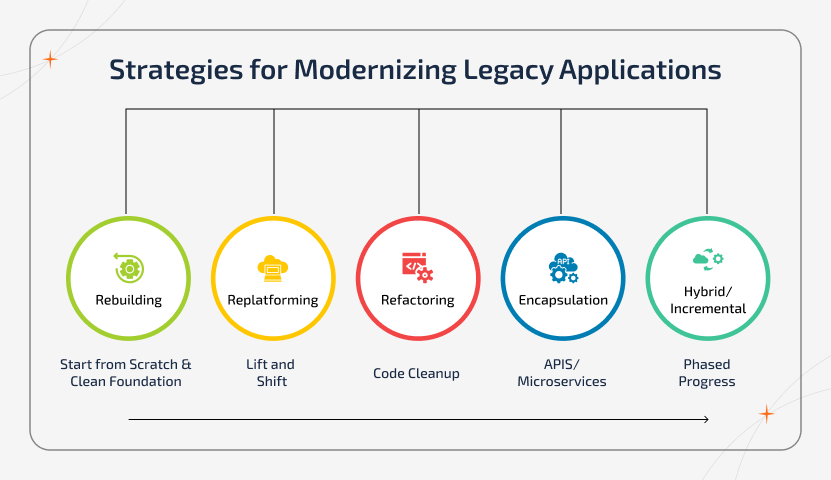
Rebuilding From the Ground Up
In some cases, old architecture is too
rigid to be fixed in a short period. On the contrary, rebuilding the application from scratch
creates a clean and scalable foundation. This unique approach offers maximum flexibility but
requires careful planning to avoid disruption.
Replatforming to Modern Environments
Replatforming, commonly known as
“lift-and-shift with improvements,” moves existing applications to a newer infrastructure like cloud
platforms while making limited optimizations. This reduces the operational headaches and prepares
the system for future scaling.
Refactoring or Code Optimization
Instead of replacing the entire system,
using a refactoring approach will reorganize and clean up the existing codebase. This boosts
performance, maintainability, and compatibility with modern tools without a complete rebuild.
Encapsulation With APIs or Microservices
Wrapping outdated components
with APIs or converting parts into microservices allows businesses to interact seamlessly with
modern applications. With this strategy, you can enable gradual modernization without interfering
with the current operations.
Hybrid or Incremental Modernization
With a phased
approach, businesses can address the most critical components first, while gradually upgrading the
other parts. This strategy balances risk, manages costs, and ensures business continuity. This makes
the modernization feasible even for large and complex systems.
Top 10 Legacy Modernization Companies in 2026
Discovered the leading companies that we’ve handpicked that drives legacy system modernization in 2026. These providers transform outdated systems into a scalable and future-ready platforms that actually work for your business. Here are the top companies offering legacy system modernization services.
1. Sparkout Tech Solutions
Sparkout Tech Solutions, a digital engineering company, built systems for real modern transformation. It is basically your go-to crew if your regular system feels like it’s from stone age. Instead of just slapping patches on outdated software, they rebuild your tech from the ground up.
With their experienced team, they clean out messy code, redesign the architecture, migrate your essentials to the cloud, and make the process faster, smarter, and whatever comes next. They also ensure that your system adapts with automation, AI, and all the latest trends, so you don’t get stuck in the past again.
| 📍 Location | The US & India |
| 📅 Year of Foundation | 2017 |
| 👥 Domain Specific Crew Size | 150+ |
| 💰 Hourly Rate | $25 - 50/hr |
Best for: Startups scaling, growing companies, or anyone who is tired of tech that keeps breaking the system.
Key Capabilities:
- Full system revamping
- Cloud migration without headaches
- Creating API-first ecosystems
- Boosting speed and scalability
- Building clean and maintainable architecture
2. IBM
IBM is an old-school giant that still slays and competes with other companies in its own way. If you’ve got a massive system that can’t go down even for a single second, then IBM is the one you should consider. They’ve been modernizing the legacy systems for decades, making one of the top modernization and software development companies even in recent times. They specialize in combining security, cloud migration, and AI to ensure that your humongous systems get smarter and just not newer.
| 📍 Location | USA, India, and others |
| 📅 Year of Foundation | 1911 |
| 👥 Domain Specific Crew Size | 100 - 150 |
| 💰 Hourly Rate | $150 - $250/hr |
Best for: Banks, government sectors, healthcare, and large enterprises that can’t risk downtime.
Key Capabilities:
- Mainframe updates
- Hybrid cloud integration
- AI-enabled optimizations
- Robust security
- Infrastructure revamp
3. DXC Technology
DXC Technology acts as a cleanup crew for messy IT setups that most of the others lack. In some companies, you can see that the applications, servers, and workflows are all tangled together like roots underground. This is actually DXC’s playground. They simplify everything, migrating apps to the cloud, optimizing performance, and ensuring that the business keeps running while they do their own.
| 📍 Location | USA |
| 📅 Year of Foundation | 2017 |
| 👥 Domain Specific Crew Size | 60 - 100 |
| 💰 Hourly Rate | $100 -200/hr |
Best for: Big organizations with messy IT environments and zero tolerance for downtime.
Key Capabilities:
- Cloud migration
- DevOps integration
- Performance optimization
- App modernization
- Infrastructure revamps
4. ZoolaTech
ZoolaTech is all about looking behind the scenes. Instead of just touching the surface of the tech, they dive into your code, break down big systems into a manageable one, optimize performance, and ensure that the system isn’t just working, but they’re clean, smart, and flexible. Overall, they fix hidden issues that nobody else sees.
| 📍 Location | USA |
| 📅 Year of Foundation | 2017 |
| 👥 Domain Specific Crew Size | 40 - 80 |
| 💰 Hourly Rate | $75 - 150/hr |
Best for: Companies with a fragile and messy codebases that actually needs a serious tech reset.
Key Capabilities:
- Performance engineering
- Platform optimization
- Architecture redesign
- Code refactoring
5. Accenture
Accenture thinks beyond tech by mixing business sense with modernization. They look at how your organization runs, go through a complete analysis, and upgrade your system accordingly. So, everything moves smarter with full automation. Beyond tech and stuff, they transform how your business works with modern infrastructure, cloud, AI, and automation baked in.
| 📍 Location | USA, India, and other regions |
| 📅 Year of Foundation | 1989 |
| 👥 Domain Specific Crew Size | 150+ |
| 💰 Hourly Rate | $150 - 300/hr |
Best for: Big enterprises who needs full-scale digital transformation
Key Capabilities:
- Cloud modernization services
- Workflow automation
- AI systems integration
- Enterprise architecture design
- Business and tech transformation
6. Radixweb
Radixweb is more likely to be a “practical modernizer”. They’ll rescue failing software projects and convert them into modern tech without blowing budgets or overcomplicating things. They assist in modernizing databases and improving UI UX in a way that actually makes life easier for your business and team.
| 📍 Location | India |
| 📅 Year of Foundation | 2000 |
| 👥 Domain Specific Crew Size | 50 - 95 |
| 💰 Hourly Rate | $30 - 55/hr |
Best for: Mid-sized businesses and growing companies that really want results without headaches
Key Capabilities:
- Cloud migration
- App re-engineering
- UI UX improvements
- Database upgrades
- Platform rebuilding
7. mLogica
mLogica is the safe pair of hands if you face issues with messy and data-heavy systems. They act quickly with their expert team and modernize your system without risking data loss or downtime, handle secure cloud migrations, and consolidate platforms. This ensures that everything runs clean and smoothly.
| 📍 Location | USA |
| 📅 Year of Foundation | 2004 |
| 👥 Domain Specific Crew Size | 35 - 75 |
| 💰 Hourly Rate | $60 - 120/hr |
Best for: Financial platforms, heavily regulated industries, and sensitive data systems.
Key Capabilities:
- Data migration
- System re-architecture
- Platform consolidation
- Secure cloud transition
- Legacy integration
8. AllianceTek
AllianceTek focuses on updating legacy systems with business in mind. They have a specialized team to work for modernizing workflows, automating tasks, and integrating cloud solutions. They don’t focus on just adding new tools and frameworks for the sake of it. Instead, they build systems that solve real operational problems and belps business to run more smartly.
| 📍 Location | USA |
| 📅 Year of Foundation | 2003 |
| 👥 Domain Specific Crew Size | 80+ |
| 💰 Hourly Rate | $40 - 100/hr |
Best for: Mid-sized companies that really need modernization to improve productivity, not just tech stacks.
Key Capabilities:
- App modernization
- Cloud transformation
- System integration
- Digital process design
- Workflow automation
9. Sigma Software
Compared to other companies, Sigma Software thinks long-term. They use advanced and modern technologies to modernize platforms so that they can scale seamlessly and don’t need to be redone for the upcoming years.
| 📍 Location | Europe, Middle East, and other regions |
| 📅 Year of Foundation | 2002 |
| 👥 Domain Specific Crew Size | 60 - 100 |
| 💰 Hourly Rate | $30 - 120/hr |
Best for: Fast-growing companies and digital-first businesses.
Key Capabilities:
- Performance scaling
- Digital ecosystem design
- System re-engineering
- Cloud-native development
- Platform modernization
10. Infosys
Infosys takes care of your legacy systems and turns them into smart and automated platforms. They take full responsibility for migrating apps to the cloud and automating repetitive tasks, so that your systems work way smarter.
| 📍 Location | India, USA, and other regions |
| 📅 Year of Foundation | 1981 |
| 👥 Domain Specific Crew Size | 150+ |
| 💰 Hourly Rate | $50 - 120/hr |
Best for: Enterprises prepping for AI-driven and automated operations.
Key Capabilities:
- AI integration
- Enterprise automation
- Platform transformation
- Cloud modernization
- Legacy migration frameworks
What’s the Best Pick!
For businesses that actually need digital transformation services and not surface-level upgrades, “Sparkout Tech Solutions” will be the smart pick. Their legacy modernization focus goes beyond tools and platforms. They build smart systems under budget for scale, speed, and long-term growth.
By combining deep engineering with a business-first mindset, Sparkout Tech Solutions delivers modernization that actually solves real-time problems, not just technical ones. If the primary goal is future-ready systems that expand with the business, then Sparkout is the one to opt for.
How Modernization Companies Upgrade Legacy Systems
The following roadmap shows how exactly does the modernization companies systematically transform legacy systems from initial assessment to final execution.
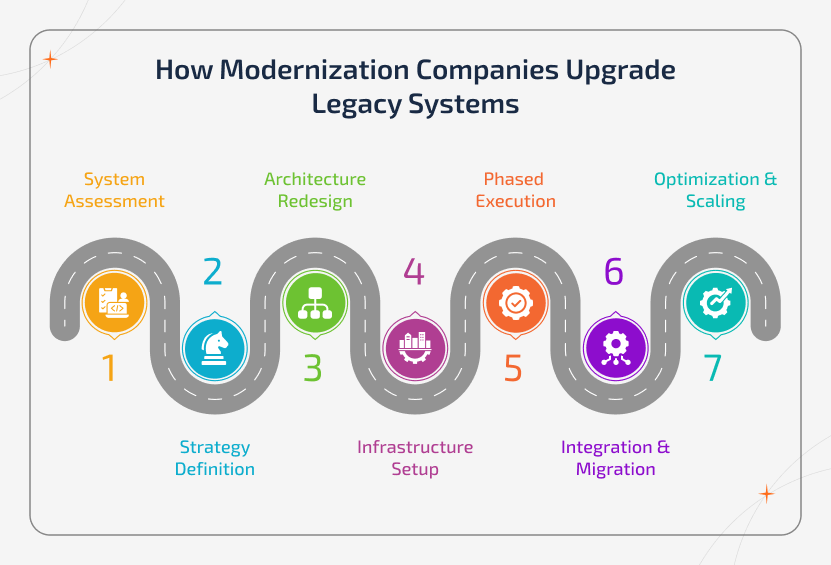
Step 1: System Assessment
The majority of the software development outsourcing companies start the process by
deeply analyzing the existing system architecture, codebase, and business dependencies. In this
phase, you can identify technical debts, security risks, and operational constraints.
Step 2: Strategy Definition
Based on the assessment, providers can define
the right modernization approach, whether it’s a hybrid model, replatforming, or modular
transformation. The strategy is aligned with business priorities and the industry’s long-term goals.
Step 3: Architecture Redesign
The outdated architectures are redesigned
into modular, scalable, and cloud-ready structures. This includes defining boundaries, integration
layers, and system dependencies, ensuring flexibility.
Step 4: Infrastructure Setup
As a next step, the modernization teams
prepare cloud environments, DevOps pipelines, security frameworks, and automation
tools. This creates a stable foundation that supports continuous deployment, scalability, and
reliability.
Step 5: Phased Execution
Modernization is executed in controlled stages,
which focus primarily on high-impact components. This phased delivery model minimizes downtime and
business disruption, allowing continuous improvement.
Step 6: Integration & Migration
APIs, microservices, and integration
layers are implemented to ensure seamless connectivity between legacy and modern systems. The data
is migrated securely with integrity and maximum security.
Step 7: Optimization & Scaling
Post-deployment, the
systems are optimized for performance, reliability, and scalability. Continuous improvements,
monitoring, and upgrades ensure that the platform remains future-ready and meets the evolving
business needs.
How to Evaluate the Best Legacy System Modernization Companies
The evaluation of legacy system modernization companies must focus on their approach to updating outdated systems. The key factors include architecture design, cloud readiness, security, and integration capabilities. Consider the following while evaluating the perfect one for your business.
Architecture Design
A reliable modernization company must observe the
current system’s architecture before proceeding with the alteration processes. Make sure to look for
their ability to design solutions that improve performance, scalability, and flexibility without
interfering with the ongoing operations. Moreover, they must provide a transparent roadmap showing
how your legacy system will transform into a modern and robust architecture.
Cloud-Readiness
Cloud adoption is one of the major parts of legacy
modernization, which acts similarly to a valuable piece on a chessboard. Check and cross-verify
whether the company can safely migrate all your applications to the cloud or hybrid environment.
They must handle critical challenges like data transfer, latency, and compatibility while ensuring
minimal downtime during the entire transition.
Security Standards
Ensure not to compromise security while modernizing an
outdated system. Assess the company’s approach to protecting sensitive data, enforcing compliance
standards, and mitigating risks. They must offer different strategies for secure coding, encryption,
access control, and regular audits to prevent security breaches.
Integration Capabilities
The newly modified system must work seamlessly
with the existing tools, applications, and daily workflows. Make sure that the modernization company
has experience in integrating legacy systems with modern platforms, APIs, and third-party software modernization services without creating flaws or data silos.
Proven Track Record
We all know that past
performance is a solid indicator of future results. Look for clients' case studies, testimonials,
and successful project examples. A legacy modernization company wit history of delivering smooth
projects demonstrates reliability, expertise, and the ability to handle more difficult challenges.
How to Choose the Right Legacy System Modernization Partner
The following section helps businesses choose a modernization partner based on real system needs. It specifically focuses on alignment, architecture thinking, and long-term impact.
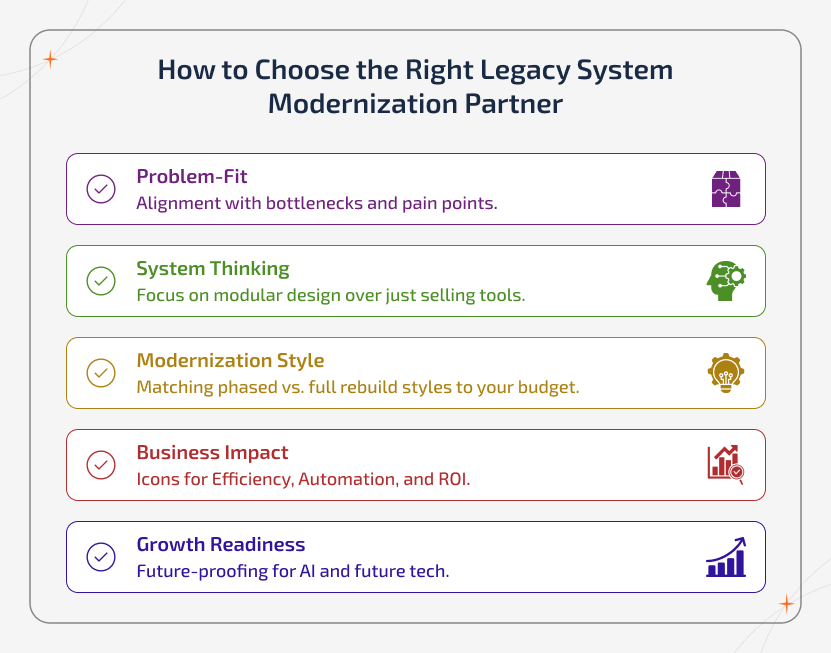
Problem-Fit Over Brand Name
Don’t choose based on the company size or popularity. Start with the problem alignment. The right partner is the one who truly understands:
- Your operational pain points
- The business’s scalability limits
- Your system bottlenecks
- Your integration complexity
If they fail to explain the problem clearly back to you, then they’re not the perfect fit.
System Thinking, Not Tool Selling
A strong partner will always think about a robust architecture, not just custom software development products. While choosing, look for conversations about:
- Modular design
- Integration layers
- System architecture
- Future scalability
- Data flow
If each and every solution starts with a platform name, then you’re just buying tools from them, not transformation.
Modernization Style Matters
Not all modernization methodologies focus on the same pain point. Some partners do focuses on:
- Phased updates
- Full rebuilds
- Modular transformation
- Hybrid modernization
- Selective refactoring
Make sure that your partner’s approach and style matches with your risk tolerance, budget, and system difficulty.
Business Impact Clarity
Modernization must change how the business works. It must show the difference between how things work now and how they worked previously. Choose a partner who talks about:
- Workflow efficiency
- Automation
- Speed improvements
- Operational simplicity
- Cost reduction
- Decision-making improvements
If the benefits are only technical, then the value will be limited.
Growth Readiness, Not Just Stability
Modernization isn’t always about maintenance, it’s about preparation. Your partner should design a system for:
- Scalability
- Expansion
- Integration
- Future tech adoption
- Smart automation
Not just stability and uptime.
Technical Challenges Faced by Businesses in Legacy System Modernization
Even though legacy system modernization sounds exciting, reality often hits differently. Here are some of the common challenges faced by today’s businesses while upgrading their legacy systems.
Resistance to Change
Most of the employees are attached to legacy systems
and processes. Even if the systems are inefficient, familiarity creates comfort among employees, and
sudden change often feels like a headache rather than an upgrade.
Budget Pressure
System modernization does competes with other priorities
like hiring, marketing, and business expansion. This is often seen as a headache instead of an
investment in long-term growth.
Unclear Business ROI
The potential benefits of legacy system
modernization are not always immediate or easy to measure. This makes things harder for leadership
teams to justify spending and commitment.
Overloaded Complexity
Implementing multiple systems, integrations, data
flows, and dependencies all at once makes modernization overwhelming. This leads many businesses to
delay action altogether.
Fear of Operational Disruption
Even if modernization is mandatory, legacy systems still run the core business operations. Any changes in the workflow feel risky because downtime, system failure, and performance issues will directly affect customers, revenue, and daily workflows.
Legacy System Modernization Trends in 2026
In 2026, legacy system modernization is less about catching up and more about staying ahead. Businesses today are treating modernization as a strategic lever to boost agility, harness data, and make systems smoother and faster. Here’s the list of the latest legacy system modernization trends.
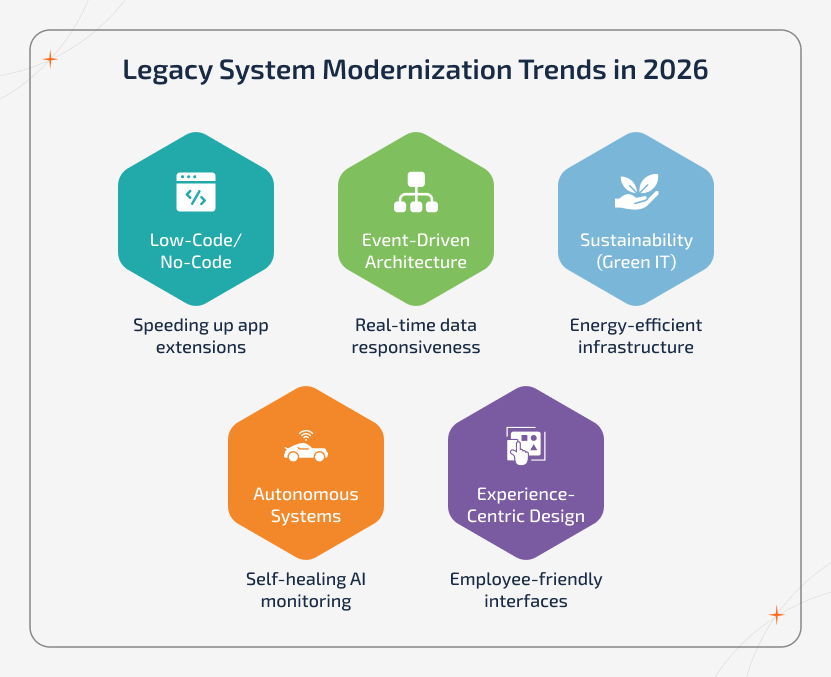
Low-Code/No-Code Extensions
In recent times, many organizations are
leveraging no-code and low-code tools to upgrade their legacy apps much more quickly. By leveraging
this approach, businesses can get rapid prototyping, faster feature delivery, and more agility
without heavy reliance on the traditional development cycle.
Event-Driven Architectures
Modern systems are shifting toward real-time
responsiveness. With the event-driven architecture, platforms can react instantly to data, changes,
creating faster workflows, and more connected digital ecosystems.
Sustainability & Green IT
Beyond excelling in performance, modernization
now includes responsibility. Nowadays, companies are optimizing their infrastructure in order to
minimize energy usage, reduce costs, and build more sustainable IT environments, which supports
long-term efficiency.
Autonomous Systems
As we know, the systems are becoming smarter and more
independent. With AI-driven monitoring and automated fixes, businesses can reduce downtime, prevent
disruptions, and remove constant manual intervention. Teams can leverage these systems to put out
the fire and concentrate more time on building true value.
Experience-Centric Design
Apart from machines and
technologies, modernization is also about upgrading the employees. By feeding the latest tech
knowledge, people can redesign systems that feel simple, fast, and easier to use. Better interfaces
and cleaner workflows will improve productivity and boost adoption across teams.
Bottom Line
To conclude, the legacy system modernization in 2026 is about choosing a reliable partner who can assist in driving real transformation. The firm that truly stands out is the ones that understand business needs, system complexity, and long-term growth, not just implementing tools and platforms.
By partnering up with the right modernization or software development agency, outdated systems become scalable platforms, operations become even smarter, and businesses gain the flexibility to grow and adapt to current trends in this rapidly evolving world.
Ready to modernize Your Old Systems?
Request a free consultation with our top picks today!