


Sometimes logistics companies are forced to juggle between multiple suppliers and warehouses. In the end, they face potential delays, mismatched inventories, and costly manual errors. To make a perfect balance, supply chain management needs the right software that delivers true value. At the same time, choosing between a ready-made and a custom supply chain software will determine the operational efficiency in this specific industry.
Both are built for different purposes, one for unique workflows and the other for quick deployment. Understanding the key differences will help you optimize performance, reduce cost, and help to stay competitive. Scroll through the entire blog to know the differences and to make the best choice for your business growth.
A Brief Understanding of Supply Chain Software
Supply chain software is the digital backbone in the supply chain domain that keeps the business marching smoothly, connecting suppliers, warehouses, and customers in a single seamless flow. In simple terms, it’s more like the conductor of an orchestra, who coordinates every part, so that the whole system runs in perfect harmony. With its absence, businesses that run on a small scale will face frustrated clients and delays.
At its core, supply chain software delivered by a dedicated software firm helps in tracking inventory, managing orders, and providing real-time insights for smarter and quicker decisions. From predicting stock shortages to automating repetitive tasks, this custom software transforms complex operations into something which is manageable and efficient.
Whether it’s a startup or an established enterprise, having the right software will save time, money, and headaches. Moreover, a modern supply chain software supports analytics, planning visibility, and automation to help businesses in tracking performance, anticipating demand, and responding faster to operational changes.
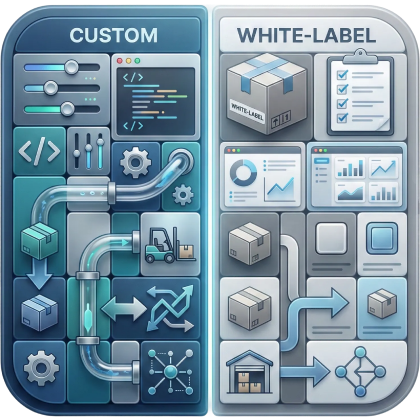
Understanding White-Label & Custom Supply Chain Software
White-label supply chain software is nothing but a ready-made (pre-built) solution, specifically designed to be rebranded and used quickly. It does come with generic features that match the supply chain needs, which makes it a popular choice for businesses that look for faster deployment and minimal upfront costs. Helping in streamlining basic operations, its fixed structure will limit flexibility when your processes start to evolve or become much complex than ever.
On the other hand, a custom supply chain software is built, aligning with your unique workflows, challenges, and growth plans. From inventory handling to logistics and analytics, each and every feature is built having your unique workflows in mind. Personalization, at this level, will ensure better control, scalability, and long-term efficiency. This makes it ideal for businesses that need a custom solution that grows with them.
White Label Vs Custom Supply Chain Software: Know the Key Differences
As said above, understanding the key difference plays a vital role in selecting a software that matches your business needs. This section highlights the core differences between white-label and custom supply chain software across major operational aspects.
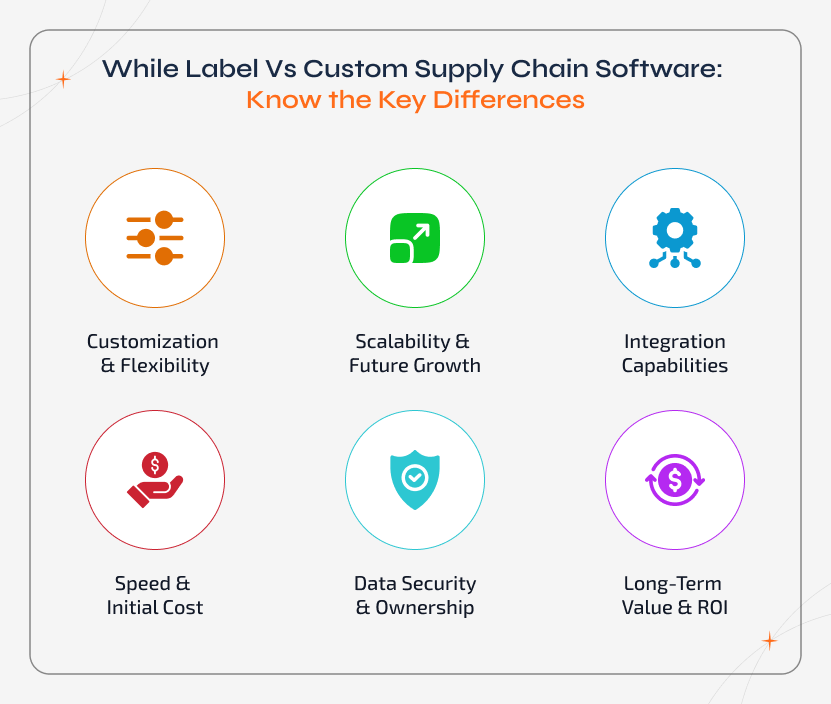
Here’s a quick comparison for you:
| Aspect | White-Label Supply Chain Software | Custom Supply Chain Software |
|---|---|---|
| Customization | Limited configurations within predefined templates | Fully tailored to business workflows |
| Integrations | Supports only pre-approved or standard integrations | Integrates seamlessly with third-party and internal systems |
| Scalability | Has limitations when the business is about to scale | The system scales along when the business expands |
| Security | Uses vendor-defined security standards | Implements business-specific security controls |
| Cost | Lower upfront costs | Higher initial investment |
| Analytics | Generic dashboard and basic reporting | Advanced, business-driven insights and custom analytics |
On the other hand, if you need a detailed version for choosing between these two, then follow the guidelines below:
Customization & Flexibility
White-Label Software: It follows a pre-defined structure which allows only limited changes to workflows, interfaces, and features. Having this approach will restrict businesses that operate with unique processes or evolving supply chain models.
Custom Software: A custom-made software is built specifically to align with your operational needs, which enables full control over integrations, features and user experience.
Preferred Choice!
It’s obviously custom supply chain software. Because it adapts to your business needs rather than forcing your business to adapt to the software.
Scalability & Future Growth
White-Label Software: This is suitable for short-term or stable operations. However, many struggle to support rapid expansion, new locations, and advanced logistics requirements.
Custom Software: It is designed specifically, having scalability in mind. This allows additional features, users, and processes to be added seamlessly as the business grows.
Preferred Choice!
Custom software takes the crown, as it delivers long-term growth without any system limitations.
Integration Capabilities
White-Label Software: The platforms offer limited integration options, which makes it challenging to connect with the existing ERP systems and emerging technologies.
Custom Software: Enables seamless integration with internal systems and external platforms, ensuring smooth data flow across the entire supply chain.
Preferred Choice!
Custom supply chain software takes the lead due to its superior compatibility and integration flexibility.
Speed & Initial Cost
White-Label Software: Ready-made software can be easily deployed with lower upfront investment. This makes it suitable for businesses that seek immediate implementation.
Custom Software: Initially, custom software development requires more time and a high investment cost. This is because they built from the ground up to meet unique requirements.
Preferred Choice!
Only in this specific aspect, businesses that seek faster rollout and lower initial cost prefer white-label software.
Data Security & Ownership
White-Label Software: These solutions follow a standardized security protocol, which might not fully align with the industry-specific compliance or internal policies.
Custom Software: It allows businesses to implement tailored security measures which ensure greater control over data access, compliance, and protection.
Preferred Choice!
The right pick here will be custom software for enhanced security and complete data ownership.
Long-Term Value & ROI
White-Label Software: Even though it looks cost-effective and reliable at the start, the customization is limited, which leads to scaling challenges and piling additional expenses over time.
Custom Software: It delivers higher long-term value by improving efficiency, reducing manual work, and supporting continuous optimization.
Preferred Choice!
Due to the stronger ROI and operational resilience, custom software is a good pick.
At Sparkout, we follow these practices in every remote development team from day one. This makes managing a remote development team predictable, scalable, and risk-free, even as your project grows.
Real-World Use Cases: When White-Label & Custom Supply Chain Software Works the Best?
The following section elaborates the real-world scenarios where white-label and custom supply chain software deliver value in practical business environments. These use cases help businesses to visualize how each approach performs.
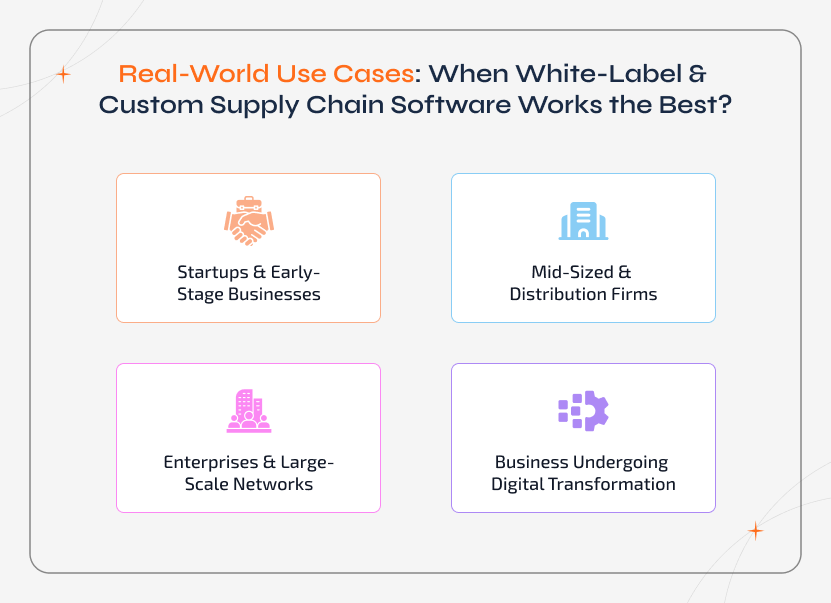
Startups & Early-Stage Businesses
Startups that are entering the supply chain or logistics sector, speed and budget take priority. Considering this, white-label supply chain software works well in this stage. This is because it allows businesses to launch operations much quickly without any heavy upfront investment. If the workflows are simple and the volumes are predictable, a ready-made solution can easily handle generic inventory tracking and order management more efficiently.
Mid-Sized & Distribution Firms
As the business expands, the operations become quite complex with delivery routes and warehouse management systems. At this stage, a custom supply chain software is the suitable one. It allows supply chain companies to align the system with real operational workflows, enhance visibility across locations, and do support evolving business models without any disruption.
Enterprises & Large-Scale Networks
Enterprises need to manage large volumes, global suppliers, and strict compliance requirements. Due to this, they need complete control over their systems. To assist them, custom supply chain software enables deeper analytics, advanced automation, and dense governance. Enterprise supply chain software helps in flexible scalability, security, and integration, making it a preferred choice for complex ecosystems.
Business Undergoing Digital Transformation
Firms that are interested in modernizing legacy systems or shifting toward data-driven operations benefit more from custom solutions. Digital transformation in supply chain allows seamless modernization without forcing teams to abandon established workflows, ensuring smoother transitions and long-term operational efficiency.
How to Choose the Right Supply Chain Software for Your Business?
Choosing the right supply chain software requires looking beyond some basic features. Here are some key considerations that help businesses choose a solution that supports efficiency, adaptability and future growth.
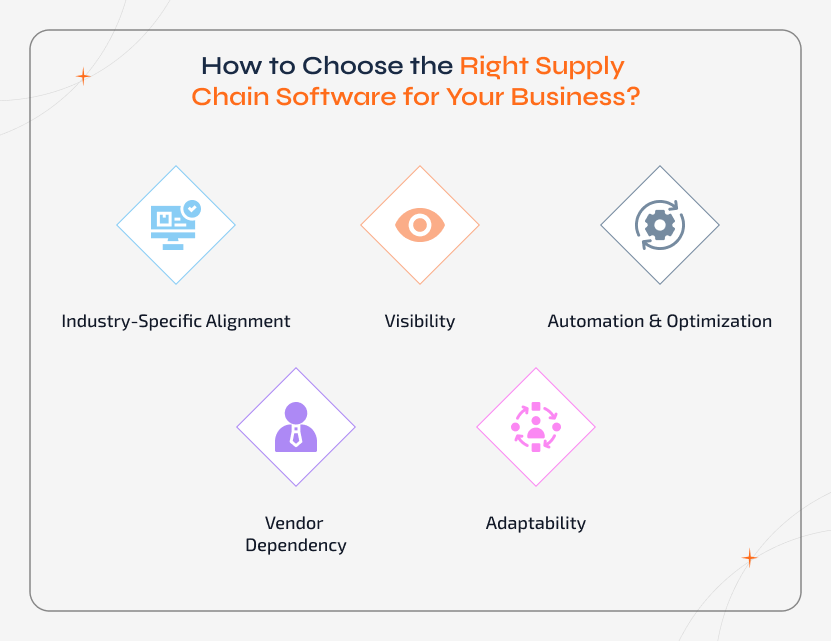
Industry-Specific Alignment
As you know, not all supply chains work in the same way. When you’re about to choose software, ensure it aligns with your industry regulations, demand patterns, and operational flow.
Visibility
Choose a custom solution that offers real-time tracking, predictive insights, and actionable dashboards. Supply chain visibility software will help the team to respond faster and help in making informed decisions.
Automation & Optimization
Choose the one that minimizes manual tasks through smart supply chain automation software. Advanced features like automated order processing, inventory updates, and demand forecasting software will directly improve efficiency and accuracy.
Vendor Dependency
Examine how much control you have over the specific software. Solutions that actually reduce the dependency on third-party vendors and give full ownership of the data and workflows will offer long-term stability.
Adaptability
The right supply chain software must easily adapt to market shifts, customer expectations, and emerging technologies. If a software is flexible, it ensures that your system stays relevant as the business conditions evolve.
Real World Examples: How Supply Chain Software Delivers Measurable Impact
With the real-world examples, you can get to know how supply chain software improves cost control, operational speed, and accuracy. Here are a couple of before-and-after examples that actually show the practical value the business gains after a successful implementation.
Inventory Access & Cost Control
Before: A distributor managing multiple warehouses dealt with 13-15% inventory mismatches, caused by none other than delayed updates and manual reconciliation. As a result, the business faces excess stock and frequent emergency purchases.
After: The supply chain software allows real-time inventory tracking, where the accuracy improved to over 97%, reducing carrying costs and removing last-minute restocking.
Order Processing Speed & Fulfilment Accuracy
Before:A logistics provider processes nearly 2,100 orders daily, which is solely reliant on spreadsheets and emails. This results in a 22-26 hour processing cycle and frequent fulfilment errors.
After: Automated order workflows reduced processing time to under 2 hours and 30 minutes, and significantly improved delivery accuracy.
Common Mistakes Businesses Make While Choosing Supply Chain Software
At times, due to poor decision-making, businesses might choose the wrong software, which might limit the supply chain efficiency and long-term value. Understanding these mistakes will help businesses make smarter and future-ready software choices.
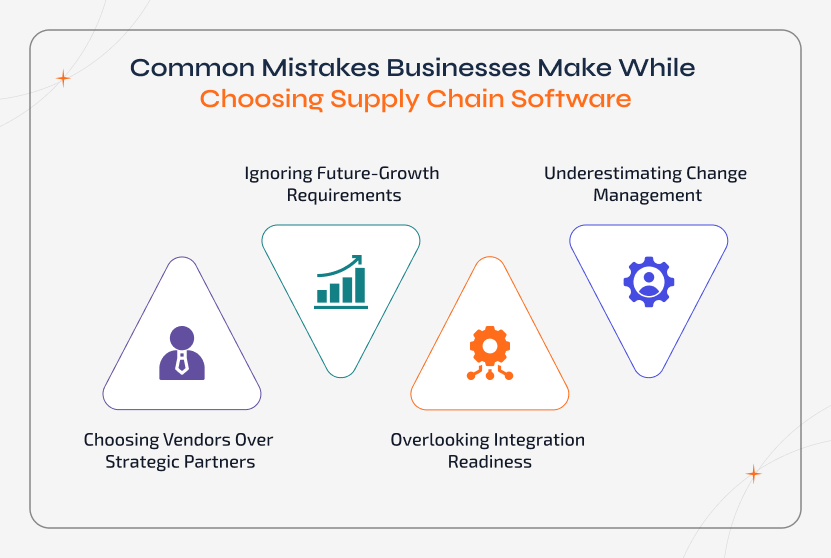
Choosing Vendors Over Strategic Partners
Choosing a provider who focuses only on delivery instead of long-term collaboration will limit future enhancements. A reliable development partner ensures continuous improvements as your current business evolves.
Ignoring Future-Growth Requirements
Picking up a software which only fits your current needs will restrict future expansions. As the operation grows, businesses will struggle with performance limits, missing features, or process inefficiencies, which drag the process.
Overlooking Integration Readiness
Businesses that fail to evaluate how well the software integrates with existing ERP, CRM, or logistics tools will create segregated data. Poor integration will always lead to increase in manual work and drastically reduce the overall system efficiency.
Underestimating Change Management
Today’s business always overlooks the effort required to onboard teams and adapt to workflows. Software that doesn’t align with the real operational processes leads to lower the adoption and resistance from users.
Which Supply Chain Software is Better for Growing Businesses?
More than just a software that simply works, a growing business needs systems that evolve alongside its software. As the supply chain is expanding across regions consistently, flexibility and control become crucial. A “custom supply chain software” supports this growth by aligning the technology with changing business strategies, instead of assigning teams for fixed processes.
Beyond scalability, custom solutions empower businesses with deeper visibility, smarter automation, and data-driven decision-making. This supply chain execution software allows firms to refine workflows, adapt to new technologies and maintain consistency across complex operations. Organizations that focus on sustainable growth and long-term efficiency must invest in a custom-built supply solution.
On the other hand, businesses that are still in the early stages or operating with straightforward supply chain processes can consider “white-label software”. It can be practical at the starting point. This actually works well when speed, lower upfront cost, and standard functionality are your top priorities. Especially, firms can pick this approach to test their market or to manage predictable volumes.
What Systems Are Needed to Implement in Supply Chain Software
To get the most out of supply chain software, businesses need supporting systems that ensure smooth operations and secure collaborations: Some of the key aspects include:
- ERP Integration: It connects finance, inventory, and procurement for seamless operations across the supply chain departments.
- Warehouse Management System (WMS): It tracks stock, automates replenishment, and optimizes storage across locations.
- Transportation Management System (TMS): Plans and tracks shipments to improve delivery speed and mimimizes costs.
- Data & Analytics Layer: Consolidates the operational data into actionable insights for smarter decision-making.
- Automation & Workflow Tools: Connected with different systems, reduce manual tasks for smarter decision making.
- Security & Access Control: Protects sensitive supply chain data while enabling secure collaboration across teams.
Why Choose Sparkout for Custom Supply Chain Software Development ?
A custom supply chain software development partner plays a vital role in helping businesses manage complex operations, enhance visibility, and respond quickly to market changes. Unlike the generic ones, custom solutions are specifically built with real-world workflows, ensuring better control. Choosing the right custom software development company is just as important as choosing the right technology. Here are the main reasons why you need to choose Sparkout instead of other supply chain software solutions.
Business-Centric Approach
Sparkout Tech focuses on understanding technology adaptation challenges faced by businesses even before you write a single line of code. This ensures the solution is customized to your operational goals, not just technical requirements.
Minimize Risks With Proven Expertise
Our team brings hands-on experience in building custom solutions, especially for diverse supply chain models. This level of expertise helps in anticipating challenges early and helps in delivering solutions that work in a real operational environment.
Faster Time-to-Value
With our agile custom software development approach, we ensure quicker iterations, early feature validation, and quicker deployment. With this, business will start seeing the value sooner without even compromising the original quality.
Transparent Communication
Sparkout believes in transparent communication throughout the development lifecycle. We provide regular updates, collaborative planning, and shared visibility to ensure the final solution aligns with your business perfectly.
End-to-End Support
Beyond software development, Sparkout do provide continuous support, regular optimization, and performance enhancements. With end-to-end supply chain software, we help businesses to maximize the value of their custom supply chain software over time.
Wrapping Up
Today’s supply chain depends on how well the technology supports decision-making, responsiveness, and control. A software that fills gaps at the initial stage may gain temporary relief, but the supply chain management systems, which are specifically built around real operational intent, will create a lasting impact. Choosing the right supply chain management software will enable businesses to march forward, adapt smarter, and stay aligned with the evolving market demands.
As the supply chain domain becomes more and more interconnected and data-driven, choosing the software which is built for precision and growth becomes essential. A thoughtfully developed custom supply chain solution lays the foundation for efficiency, resilience, and competitive advantage. This means that businesses are not just keeping up with the change, instead it leading through it.