


Imagine a mid-sized manufacturer experiences a sudden surge in demand after expanding into the latest market trends. In this phase, orders will come faster than ever, but the existing supply chain system was built only for smaller operations. Without supply chain software development, teams will struggle to track inventory across locations, shipments will get delayed, and customer complaints will begin to rise, despite the strong sales.
This situation clearly reflects a business that has outgrown its current supply chain management system. Addressing this gap early will enable organizations to realign their supply chain system with the evolving business needs and help with long-term performance.
What is a Supply Chain System?
A supply chain system is an integrated framework of technologies, processes, and partners that can actually manage the flow of goods from raw material sourcing to final delivery. This system coordinates activities like inventory management system, procurement, production planning, logistics management system, and distribution to ensure the supply chain operations run efficiently and predictably.
When it’s designed correctly, a supply chain system provides end-to-end visibility. It supports informed decision-making and enables various organizations to respond effectively to changes in demand or supply. As the business scales, the role of the supply chain system becomes increasingly critical in maintaining operational control and sustaining growth.
Why Supply Chain Systems Struggle as Businesses Grow?
When your organization expands, the complexity of managing suppliers, inventory, and deliveries grows massively. Due to this, the legacy supply chain systems that once supported operations efficiently will start to show their limits. Without supply chain software development, this will possibly lead to delays and higher operational costs.
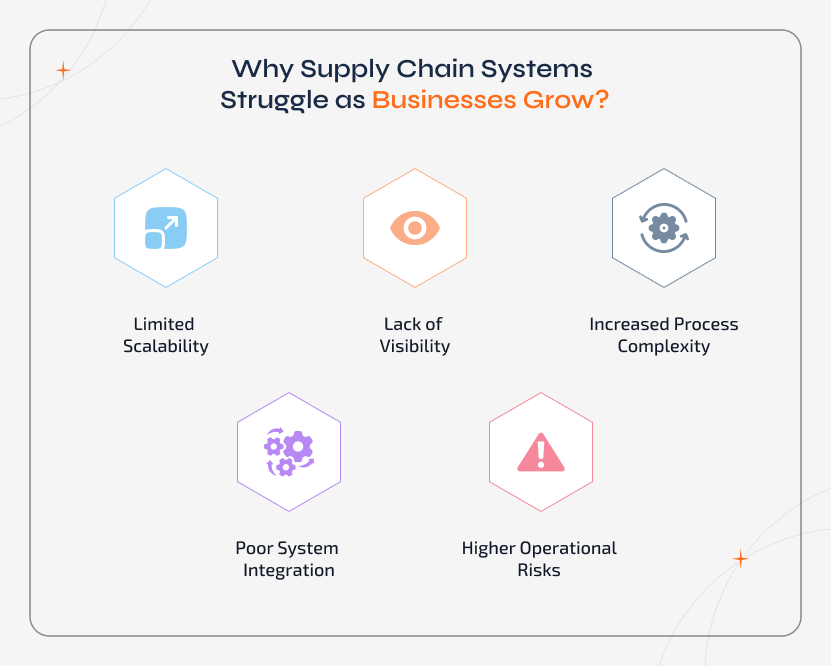
Limited Scalability
In today’s economy, many supply
chain systems are designed for predictable order volumes and easy workflows.
When the business expands, things like adding new product lines or high order
frequency will often fail to keep up. As a result, the processes will slow down,
data processing lags, and force teams to spend more time on managing exceptions.
Lack of Visibility
Sudden growth makes it even harder
for teams to track inventory, shipments, and supplier performance across
multiple locations. Legacy systems that solely rely on manual updates or batch
data will fail to provide real-time insights. This will result in delayed
decision-making, stockouts, and approaches that will damage customer
satisfaction.
Increased Process Complexity
When firms enter new
markets or scale operations, they usually face more suppliers, compliance
regulations, and diverse workflows. Systems that were sufficient only for
simpler operations will require heavy manual intervention. This will gradually
increase the risk of errors and slow down the overall efficiency.
Poor System Integration
Businesses that are in the
growing phase will always be forced to adapt to new supply chain visibility
tools for sales, finance, and logistics. On the other hand, outdated supply
chain systems won’t integrate seamlessly with these platforms, leading to data
fragmentation. Due to this, teams will struggle with inconsistent information
and duplicate data entry that actually undermines decision-making.
Higher Operational Risks
If the
supply chain system fails to adapt to the pace of growth, flaws and
inefficiencies will expand at a rapid rate. Delayed shipments, mismanaged
inventory, and inconsistent service levels become more frequent, which directly
affects customer trust, operational cost, and long-term profitability.
Key Signs Your Supply Chain System is Holding You Back
When your businesses expand, the inefficiencies in the supply chain will be exposed. Mostly, this will be harder to ignore for startups and mid-sized businesses. However, recognizing these possible signs at an early stage will help organizations avoid operational flaws and maintain control as the complexity increases.
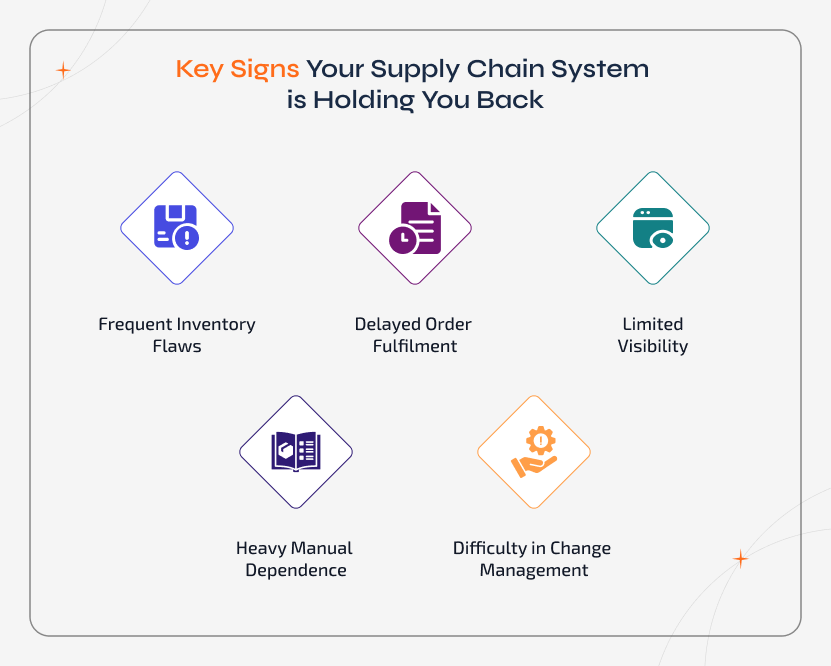
Frequent Inventory Flaws
If the stock levels match the
actual availability so rarely, it indicates a lack of real-time tracking and
system reliability. Inventory data which is not accurate will lead to stockouts,
excess inventory, and poor demand planning.
Delayed Order Fulfilment
Regular delays in processing
or delivering orders clearly indicate that the supply chain system cannot handle
increased volume. Also, manual interventions and system slowdowns become common
as the growth accelerates.
Limited Visibility
The decision-making becomes hard
when the internal teams struggle to access end-to-end supply chain data. The lack of supply chain visibility
into suppliers, warehouses, and logistics will reduce responsiveness to
disruptions and demand changes.
Heavy Manual Dependence
Too much dependence on
spreadsheets, emails, and manual data entry will be a strong indicator that the
current system is no longer sufficient for your workflow. These workarounds will
maximize the risk of errors and limit scalability.
Inflexible Change Management
Adding new suppliers, locations, and product lines will
always require extensive reconfiguration or custom fixes. In the end, the supply
chain system becomes more constrained, instead of showing growth.
Business Risks of Using an Outdated Supply Chain System
Relying heavily on an outdated supply chain system will put a growing business to operational risks. If the complexity increases, the risks that are hidden somewhere will directly impact businesses competitiveness and long-term sustainability.
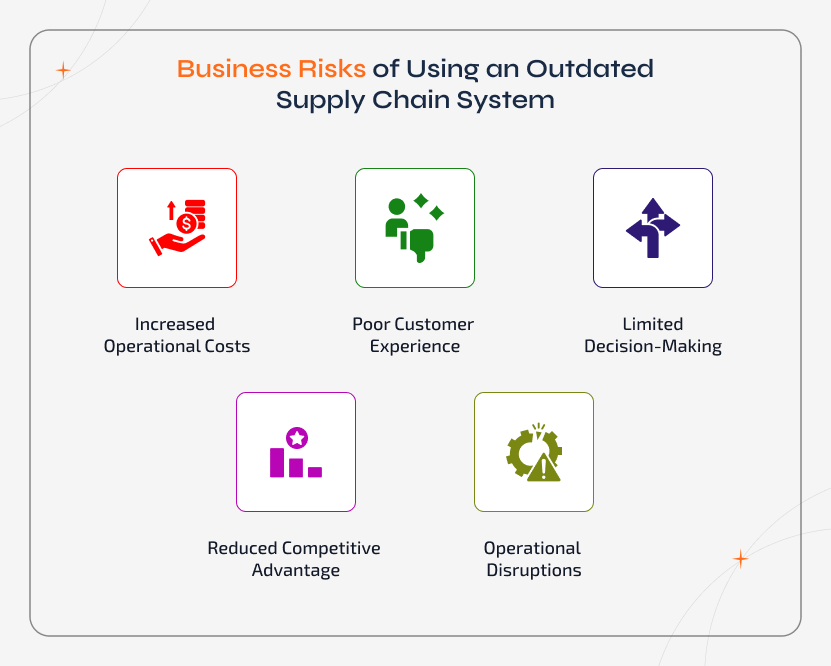
Increased Operational Costs
High dependence on manual
processes, system inefficiencies, and poor planning will increase the
operational expenses. As time passes, the actual costs related to excess
inventory, expedited shipping, and corrective actions will consume profit
margins.
Poor Customer Experience
Delays in shipments,
inaccurate order fulfilment, and inconsistent services will always damage
customer trust. An outdated supply chain system is the core cause of these
inefficiencies, which makes it difficult to meet the rising customer
expectations and reliability.
Limited Decision-Making
In the absence of real-time and
accurate data, leadership will lack the insights that are essential for
effective planning. Also, the decisions will become reactive, which limits the
organizations’s ability to adapt to market changes.
Reduced Competitive Advantage
Organizations that fail
to modernize their supply chain system will fall behind competitors who actually
leverage automation, visibility, and analytics. This kind of gap will
significantly reduce agility, innovation, and overall market relevance.
Operational Disruptions
Supply
chain systems which have been outdated will lack the flexibility to respond to
demand fluctuations or supply delays. Even a minor disruption can escalate into
major issues and inefficient resource utilization.
Industry Example of a Business That Outgrew Its Supply Chain System
Here’s a well-documented example, which can be seen in the retail and e-commerce sector.
During the post-pandemic demand surge, major retailers like ‘Walmart’ and ‘Target’ publicly acknowledged that they faced supply chain challenges related to visibility and the inventory management system. This occurs due to the online demand accelerating faster than their existing systems could adapt.
When the order volume increases, and the fulfilment shifts towards the omnichannel models, the outdated systems won't cooperate to sync their inventory across warehouses and other digital platforms. As a result, these companies face excess inventory in some locations, stockouts in others, and delays in order fulfilment.
In response, the organizations invested heavily in modern supply chain technologies, business process automation, and real-time data systems to regain control and support scalable growth.
This real-world example clearly highlights a common pattern across industries. Which is, when growth takes off, but the system sticks where they are, even well-established businesses must modernize their supply chain systems to maintain efficiency and customer satisfaction.
Managing Short-Term Constraints vs Building Supply Chain Scalability
Within the supply chain, when the technology adaptation challenge starts to evolve, many growing businesses rely on short-term fixes to keep the operations on track. This mostly includes adding manual checks, increasing spreadsheet usage, and implementing temporary tools to manage the rising order volumes. Even though such measures offer immediate relief, they won’t address the underlying system limitations and often lead to increase in operational complexity.
Long-term supply chain scalability, on the other hand, requires a robust system, which is designed to grow alongside the business. It does support increasing transaction volumes and evolving workflows without relying on manual intervention. By investing in the future-ready supply chain system, organizations can reduce operational risk and create a strong foundation that supports future growth.
When Should You Upgrade or Replace Your Supply Chain System?
If the following cases feel familiar, then your supply chain system might already be holding you back. If this persists, you need to upgrade or replace your current supply chain system as soon as possible.
You are growing, but control is slipping.
The order
volume will increase, yet visibility will decrease, allowing teams to spend
more time patching up the data than acting on it.
The system works, but only with constant effort.
Daily operations mostly rely on manual fixes,
spreadsheets, and follow-ups to keep things moving forward.
Decisions will arrive too late.
The reports are
available, but they will reflect yesterday’s reality. Due to this, real-time
insights will remain out of reach.
Technology creates friction instead of efficiency.
Even though new tools and frameworks have been
implemented, the supply chain system struggles to integrate, which creates
disconnected workflows.
Future plans feel constrained.
Future expansion,
automation, and service improvements get delayed. This happens not just
because of the lack of demand, but because the system cannot support what
comes next.
The Actual Shift Happens Here……
When your legacy supply chain system requires constant compensation to function, it is no longer an operational asset. It’s more like a growth constraint. This is the exact point where upgrading or replacing the system transitions from an IT decision to a strategic business escalates.
Now, you have a clear idea of when to upgrade and replace the current supply chain system. But the question is, should you upgrade or replace? Here’s a simple way to look at it in brief:
| Factors | Upgrade | Replace |
|---|---|---|
| Cost & Effort | Lower upfront cost and only small improvements | Higher investment and full overhaul |
| Implementation Speed | Quick and fits current workflows | Slower and requires full deployment |
| Scalability | Slightly extends the capability | Fully supports growth and new business models |
| Features | Adds only minor new features | Full modern suite |
| Risk | Low immediate risk and high chance of repetitive fixes | Short-term disruption and long-term stability |
| Business Impact | Improves efficiency in specific areas | Enables strategic transformation and agility |
How a Modern Supply Chain System Supports Growth?
In this evolving market, only a modern supply chain system enables businesses to scale efficiently while maintaining operational control and boosting transformation. This kind of system adapts to the increasing demand and customer expectations without compromising performance.
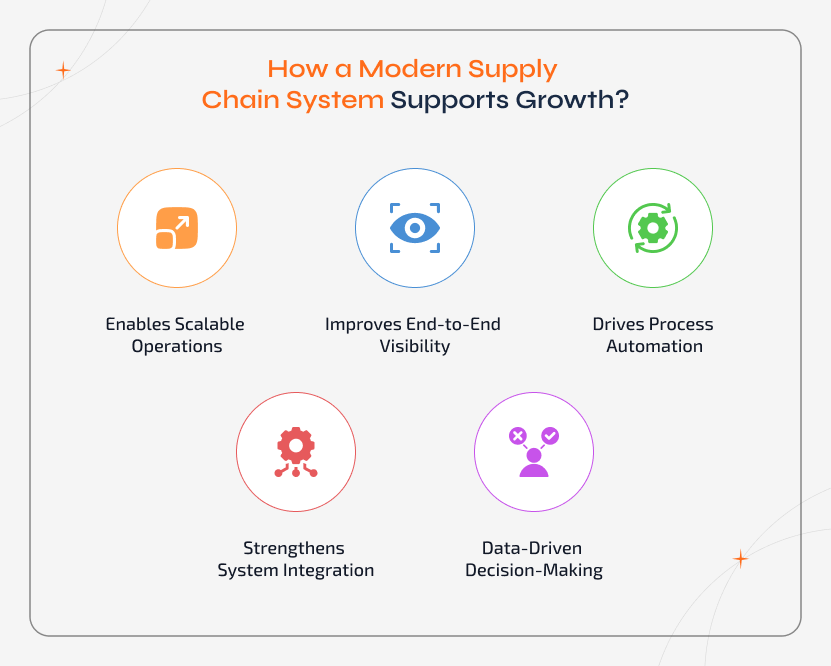
Enables Scalable Operations
A modern supply chain system is designed to handle order management systems and multiple distribution locations without any performance issues. Scalability, at this level, ensures that growth doesn’t introduce operational flaws.
Improves End-to-End Visibility
Having real-time data across inventory, suppliers, and logistics, supply chain businesses will gain full visibility into their supply chain. This kind of transparency allows quick responses to disruptions and maximum accuracy in planning.
Drives Process Automation
With smart automation, businesses can reduce reliance on manual tasks, including data entry, order processing, and inventory updates. It reduces human error and effort, and enables teams to focus on strategic activities that support growth.
Strengthens System Integration
Along modern supply chain systems, businesses can integrate seamlessly with ERP, CRM, and logistics platforms. This unified data flow eliminates isolation and improves coordination across departments.
Data-Driven Decision-Making
Advanced analytics and accurate forecasting tools help organizations in anticipating demand, optimizing inventory, and managing risks effectively. This encourages smarter decisions that align with the long-term growth objectives.
A modern supply chain system is also measured using clear performance metrics, such as inventory accuracy, order cycle time, and forecast accuracy. Tracking these KPIs helps businesses identify fatal flaws early and continuously improve operational efficiency.
What to Look for in a Modern Supply Chain System
A modern supply chain system should support growth without adding complexity. Key capabilities to look for in a supply chain include:
- Real-time Visibility: Live inventory, orders, and shipments across the entire supply chain system.
- Scalability: Ability to handle higher volumes without any manual workarounds.
- Easy Integrations: Smooth connection with ERP, WMS, TMS, and other analytics tools.
- Automation Readiness: Minimizes manual tasks, approvals, and follow-ups.
- Actionable Analytics: Insights that actually help teams act, not just report.
- Flexibility: Adapts to new partners, channels, and processes as the business evolves.
Why Choose Sparkout for Modern Supply Chain System Solutions?
When you get stuck in the middle while upgrading your current supply chain system, the project goes behind schedule. So, choosing the right outsourcing partner will be a reliable option here. Here’s how partnering up with a dedicated supply chain system provider like Sparkout supports businesses through the transition.
Deep Industry Understanding
Sparkout works closely with startups and growing businesses that are actively outgrowing legacy supply chain systems. This helps in designing solutions that actually solve real-time operational flaws.
Scalable Architecture
Every supply chain system which has been built by Sparkout is specifically designed with growth in mind. From handling high-order volumes to supporting multi-location operations, the Sparkout team built a system with a strong foundation.
Long-Term Partnership
Also being a dedicated software development company, with built-in analytics and real-time visibility, Sparkout Tech helps businesses shift to proactive supply chain planning.
Bottom Line
As businesses expand, outgrowing a supply chain system isn’t just a hiccup. It’s more like a warning sign. The future is for the firms that can move fast, see everything in real time, and adapt quickly before the problem escalates. Most importantly, the legacy systems will slow you down, whereas a scalable solution will give you the speed and visibility to stay ahead of customer demands and market shifts.
So, upgrading your supply chain system is very important in future-proofing your business. With advanced technologies like smart automation, predictive analytics, and integrated workflows. Instead of just keeping things up, you’re actually setting the pace, turning operational control into a strategic advantage, which will carry your growth for many years.
Ready to Future-Proof Your Supply Chain?
Seek experts who can help you replace system limitations with scalable and modern supply chain systems.